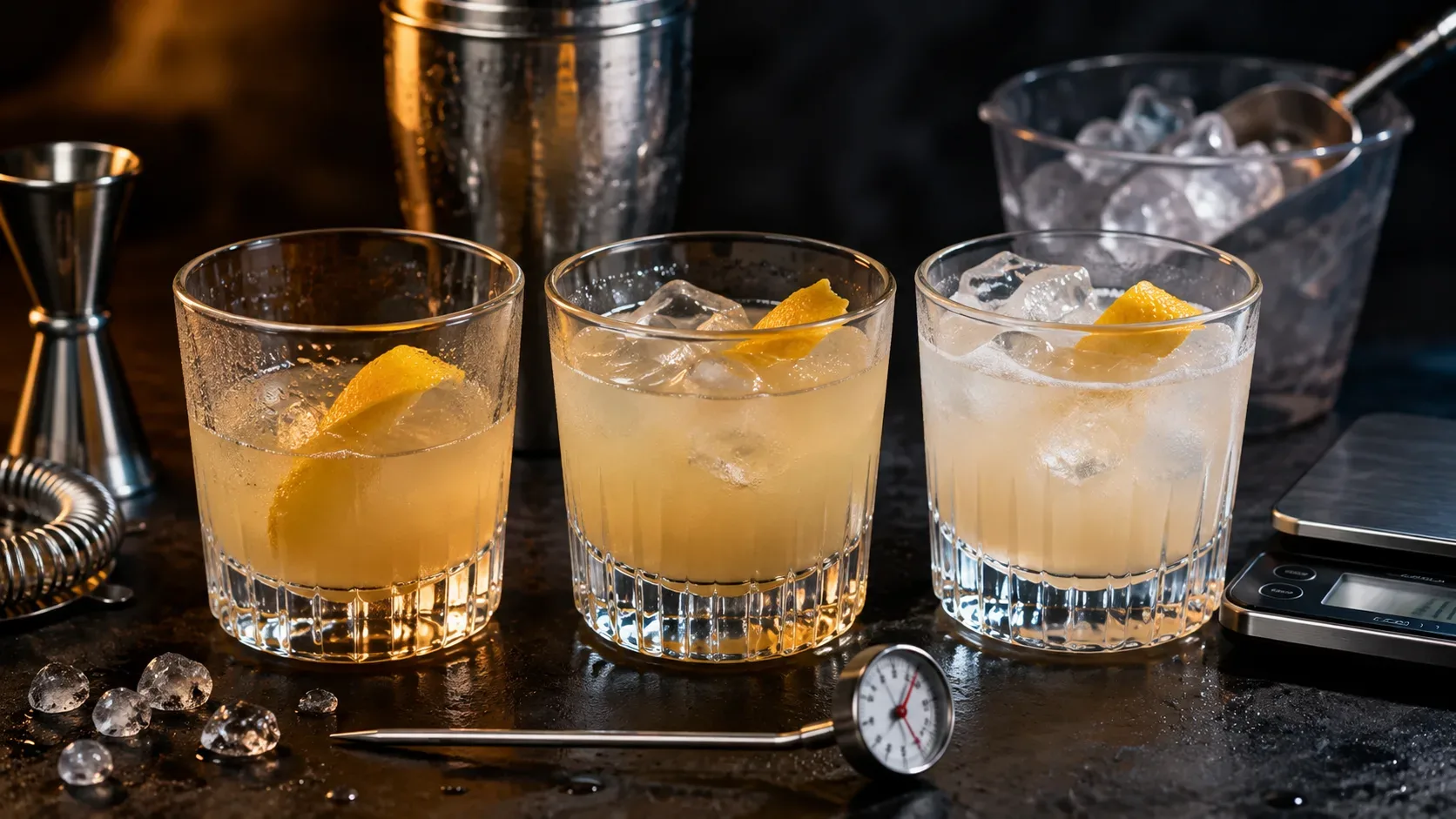
A cocktail is not balanced just because its ingredients were measured correctly. Between the bottle and the glass, the ice adds water, reduces the temperature and, depending on the technique, incorporates air. These changes are part of the drink's formulation — they are not side effects that should be avoided at all costs.
This is why the same recipe can seem alcoholic and aggressive in one preparation, light and expressive in another, or watery when the execution loses control. The difference may be in the stirring time, the initial temperature of the ingredients, the quantity and condition of the ice, the container or the interval between preparation and serving.
The dilution of drinks, therefore, should not be judged solely by the question “did there be too much water?”. The more useful question is: how much water entered, what temperature was reached, and how did this affect the sensory outcome?
Water is a cocktail ingredient
When preparing a drink with ice, part of the thermal energy of the ingredients and the container is transferred to the ice. When the ice melts, the resulting water becomes part of the drink. Under common bar conditions, cooling and dilution happen together.
Experiments published by Dave Arnold in the Cooking Issues project demonstrated this relationship and observed that drinks shaken with ice can reach temperatures below 0 °C because a solution of water and ethanol has a different freezing behavior than pure water. The same experiments also showed that, upon vigorous shaking, the temperature drop approaches a plateau after the first few seconds, although the exact value depends on the test conditions.
This does not mean that every cocktail must have the same amount of water. A short drink based on spirits, a sour with citrus and a long drink served over ice have different structures, textures and serving temperatures. The appropriate dilution is that which is part of the validated recipe, not a universal percentage applied to any mixture.
What changes when the ice melts
Alcoholic concentration
The added water reduces the ethanol concentration in the final liquid. This change can reduce the burning sensation and alter the way aromas, flavors, sweetness, bitterness and texture are perceived.
A sensory study published in 2018 evaluated dilution series of two rums and found significant differences in several attributes of aroma, flavor, mouthfeel and aftertaste. The study does not establish an ideal dilution for cocktails, but it confirms that changing the ethanol concentration changes the sensory profile of the drink — not just its “strength.”
Temperature
The cold influences the experience because it alters the volatilization of aromatic compounds, the perceived texture and the intensity with which certain elements appear. A cocktail that's too hot can highlight the alcohol and seem disjointed. An excessively cold cocktail may have less evident aromas upon first sip.
Temperature and dilution need to be evaluated together. Tasting a diluted mixture at room temperature and concluding that it has too much water can produce a misleading interpretation: the same composition, served cold, can be perceived differently. This is one reason why recipe testing must reproduce the actual serving temperature.
Texture and aeration
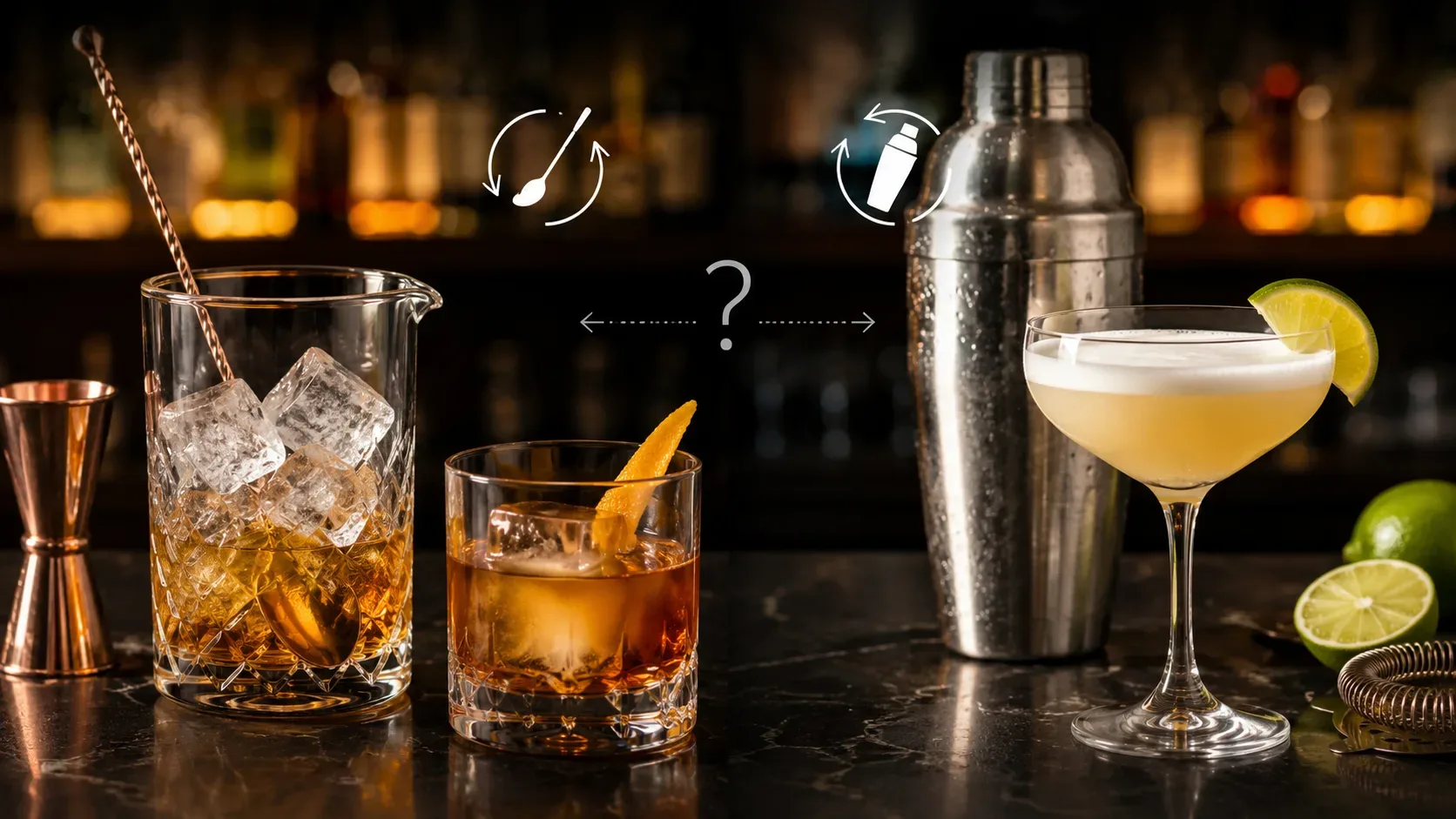
Shaking and stirring are not interchangeable techniques, just different speeds. Shaking in the shaker promotes intense contact with the ice and incorporates air, creating a texture that may be desirable in recipes with citrus, eggs, dairy or other ingredients that benefit from emulsification or foaming.
Stirring with a spoon tends to produce less aeration and preserve the clear appearance of cocktails composed mainly of alcoholic beverages. The technique chosen, therefore, must match the intended texture, not just the cooling goal.
Large ice always dilutes less?
Not necessarily.
During sufficiently intense shaking, experiments conducted by Arnold found similar final temperatures and dilutions with different types of ice, as long as there was enough ice and it was not excessively wet or fragmented. Smaller pieces can speed up heat exchange, but they also carry more surface water when they are wet.
The situation changes when the drink is stirred for a short time or remains served over ice. In these cases, size, surface area, initial temperature, cracks and amount of water adhered can alter the rate of cooling and dilution.
The practical conclusion is not that the shape of the ice is irrelevant. This is because comparing only the size of the cubes, without controlling temperature, humidity, mass and time, does not allow the result to be attributed to ice.
An experiment to measure the dilution of drinks
The protocol below is an editorial proposal. It still needs to be run, photographed, repeated and revised before the article is published as a completed test.
The objective is to compare the same cocktail prepared with three stirring times, keeping the other variables as constant as possible.
Working hypothesis
Longer stirring should, in principle, increase cooling and water incorporation until the system approaches a thermal plateau. After that, the differences may decrease and become more sensitive to the environment, technique, liquid retention in the ice, and instrument precision.
This is a hypothesis based on technical literature. The results of the essay should not be anticipated.
Necessary materials
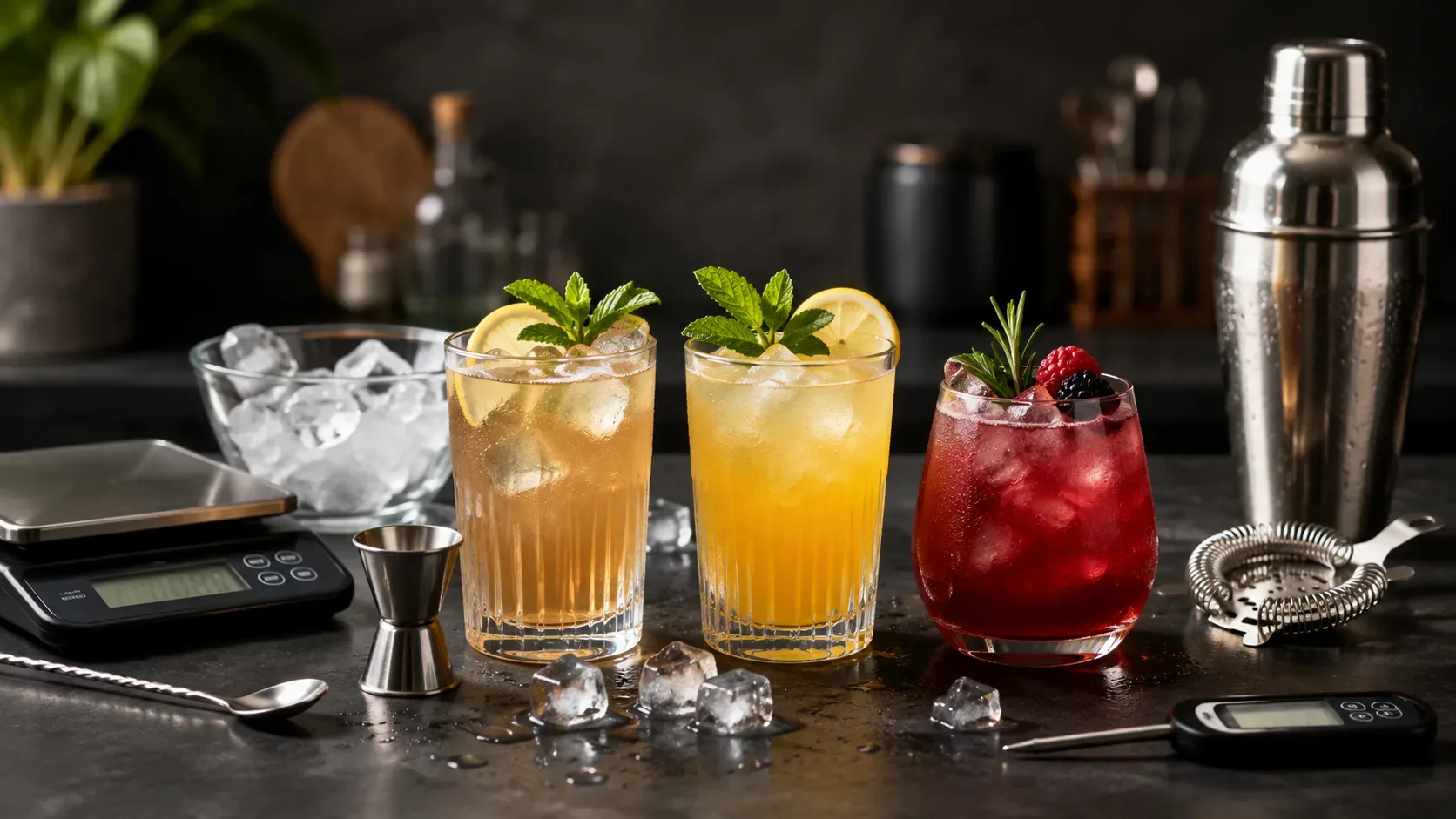
- digital scale with a minimum resolution of 1 gram; preferably 0.1 gram;
- quick response culinary thermometer;
- timer;
- same shaker and strainer in all repetitions;
- three identical weighing containers;
- ice from the same batch;
- previously homogenized ingredients;
- equal serving glasses;
- registration form;
- labels or codes for blind evaluation.
Recipes are normally formulated by volume, but the incorporation of water can be accompanied by mass. The ingredients must continue to be dosed according to the approved recipe; the balance is used as a control instrument for the experiment.
Choosing the base mix
The editorial team must define and test a single formula before publication. To make the differences more noticeable, a simple sour without egg whites tends to be easier to standardize than a recipe with foam, pieces of fruit or viscous ingredients.
The formula should not be presented to the public as a validated recipe until they are confirmed:
- exact volumes;
- alcoholic content of ingredients;
- syrup concentration;
- type and acidity of the citrus;
- initial temperature;
- mass of ice;
- time chosen as default;
- yield after straining;
- sensory result.
Variables that need to remain constant
Time can only be identified as a probable cause of the differences if the other factors are controlled:
- same mass and same batch of mixture;
- same initial temperature as the ingredients;
- same mass of ice;
- cubes of similar dimensions;
- same surface condition as the ice;
- same shaker;
- same operator;
- agitation intensity as constant as possible;
- same straining technique and duration;
- same interval between the end of stirring and measurement;
- same room temperature;
- previously weighed containers.
Preparing just three glasses—one for each time—produces an interesting visual comparison but a weak basis for conclusions. For editorial data, it is recommended to perform at least three repetitions of each condition, totaling nine preparations. The three photographed cups can be chosen from representative repetitions, without selecting only the most favorable results.
Suggested times for comparison
A possible starting array is:
- 5 seconds: short shake;
- 12 seconds: point close to the interval in which Arnold's experiments observed a slowdown in the drop in temperature;
- 20 seconds: prolonged shaking for comparison.
These times do not constitute a service rule. They were chosen to distribute the samples before, near, and after the stabilization interval observed in that experiment. Equipment, recipe, ice, and writing technique may produce different results.
How to weigh without confusing loss with dilution
The simplest method is to weigh the mixture before freezing and then weigh the strained liquid. The positive mass difference provides an estimate of the incorporated water:
Estimated water = final mass recovered − initial mass of the mixture
There is, however, an important limitation. Part of the original cocktail and melted water remains adhered to the ice, shaker and strainer. Splashes, small leaks and differences in drainage time may also occur. Dave Arnold called this retention holdback and showed that it can produce relevant error in weighing dilution calculations.
Therefore, the article must publish two distinct indicators:
- Recovered mass: how much liquid actually reached the glass.
- Estimated incorporated water: difference between the masses, accompanied by the reservation about retention and losses.
For greater accuracy, the team must also weigh the ice and residual liquid package and apply a standardized recovery procedure. Even so, the result must be presented as an operational measurement for a kitchen or bar, not as a laboratory analysis of alcohol content.
Two ways to express dilution
The percentages vary depending on the denominator. To avoid seemingly contradictory numbers, please state which formula was used.
Water added in relation to the initial mixture
Estimated embedded water ÷ initial mass × 100
Share of water added in the final liquid
Estimated incorporated water ÷ final mass × 100
Purely mathematical example: if a 100-gram mixture ends up with 125 grams recovered, the estimated water will be 25 grams. This corresponds to 25% of the initial mass, but 20% of the final mass. None of these numbers should be published as test results prior to actual execution.
Editorial test table
| Sample | Time | Repetition | Initial mass | Final recovered mass | Estimated water | Dilution over the initial mass | Initial temperature | Final temperature | Observations |
|---|---|---|---|---|---|---|---|---|---|
| A | 5 s | 1 | Pending | Pending | Pending | Pending | Pending | Pending | Pending |
| A | 5 s | 2 | Pending | Pending | Pending | Pending | Pending | Pending | Pending |
| A | 5 s | 3 | Pending | Pending | Pending | Pending | Pending | Pending | Pending |
| B | 12 s | 1 | Pending | Pending | Pending | Pending | Pending | Pending | Pending |
| B | 12 s | 2 | Pending | Pending | Pending | Pending | Pending | Pending | Pending |
| B | 12 s | 3 | Pending | Pending | Pending | Pending | Pending | Pending | Pending |
| C | 20 s | 1 | Pending | Pending | Pending | Pending | Pending | Pending | Pending |
| C | 20 s | 2 | Pending | Pending | Pending | Pending | Pending | Pending | Pending |
| C | 20 s | 3 | Pending | Pending | Pending | Pending | Pending | Pending | Pending |
Calculate the average of each group only after checking for runtime errors, leaks, or clearly invalid measurements. An unexpected result should not be discarded just because it contradicts the hypothesis; First you need to investigate what happened.
How to carry out sensory evaluation
The test must be separated from the instrumental measurement. Randomly numbered cups help reduce the influence of expectations such as “the fussiest one will certainly be watery.”
Evaluators can register:
- alcoholic sensation;
- perception of sweetness;
- perception of acidity;
- aromatic intensity;
- body;
- texture;
- perceived temperature;
- integration between components;
- preference, without confusing it with objective measurement.
Personal preference alone does not determine which sample is technically correct. One person may like the drink more concentrated; another, the more diluted version. The editorial output should show the measurements and explain how they relate to the panel's impressions.
To limit alcohol exposure, do not serve each evaluator nine full cocktails. Samples can be divided into small portions among participating adults, with transportation planning and no driving after consumption.
Alcohol-free testing needs to be separated
It is possible to repeat the protocol with a non-alcoholic cocktail, but it should not be treated as a perfectly equivalent control. Removing ethanol changes density, viscosity, freezing temperature and sensory perception.
An editorial alternative is to create a second matrix with a non-alcoholic recipe formulated and validated on its own merits. It must use the same times, instruments and evaluation criteria, but the results must be presented in an independent table.
This also avoids the misconception that replacing spirits with water automatically produces the same drink. The non-alcoholic alternative needs to be balanced as a complete recipe, with its own body, aroma, acidity, sweetness and dilution.
What the test can demonstrate
After execution, the article may respond with its own evidence:
- how much the recovered mass changed between times;
- what temperature was reached in each condition;
- at what point did the drop in temperature slow down;
- if the difference between 12 and 20 seconds was relevant in the equipment used;
- how the texture changed;
- which sample showed better sensory integration;
- how much liquid was retained in the ice and in the equipment;
- if the repetitions were consistent.
The test cannot prove that one time is ideal for all cocktails, all types of ice, or all bartenders. It will show the behavior of a specific recipe, under documented conditions.
Controlled dilution is repeatability
A good cocktail is not one that contains as little water as possible. It is one in which ingredients, water, temperature and texture reach the glass in an intentional and reproducible way.
The timer helps, but it doesn't solve it alone. Initial temperature, ice mass, technique, container and straining also need to be standardized. The scale shows how much liquid has been recovered; the thermometer shows how much the system has cooled; The sensory test shows how these measurements arrived at the palate.
Save the test table to compare your preparations and follow the series of techniques. Before turning the protocol into a recommendation, however, perform the repetitions and record the complete results.
Responsible consumption
This content is intended exclusively for people over 18 years of age. Law No. 13,106, of March 17, 2015, made it a crime to sell, supply, serve, administer or deliver alcoholic beverages to children or adolescents.
The Ministry of Health states that there is no amount of alcohol without risk to health and recommends avoiding consumption, especially for minors, pregnant women, breastfeeding women and people with conditions that could be aggravated by alcohol.
Anyone who consumes alcohol should not drive. Plan in advance for transport by a non-drinking driver, public transport, taxi or app.