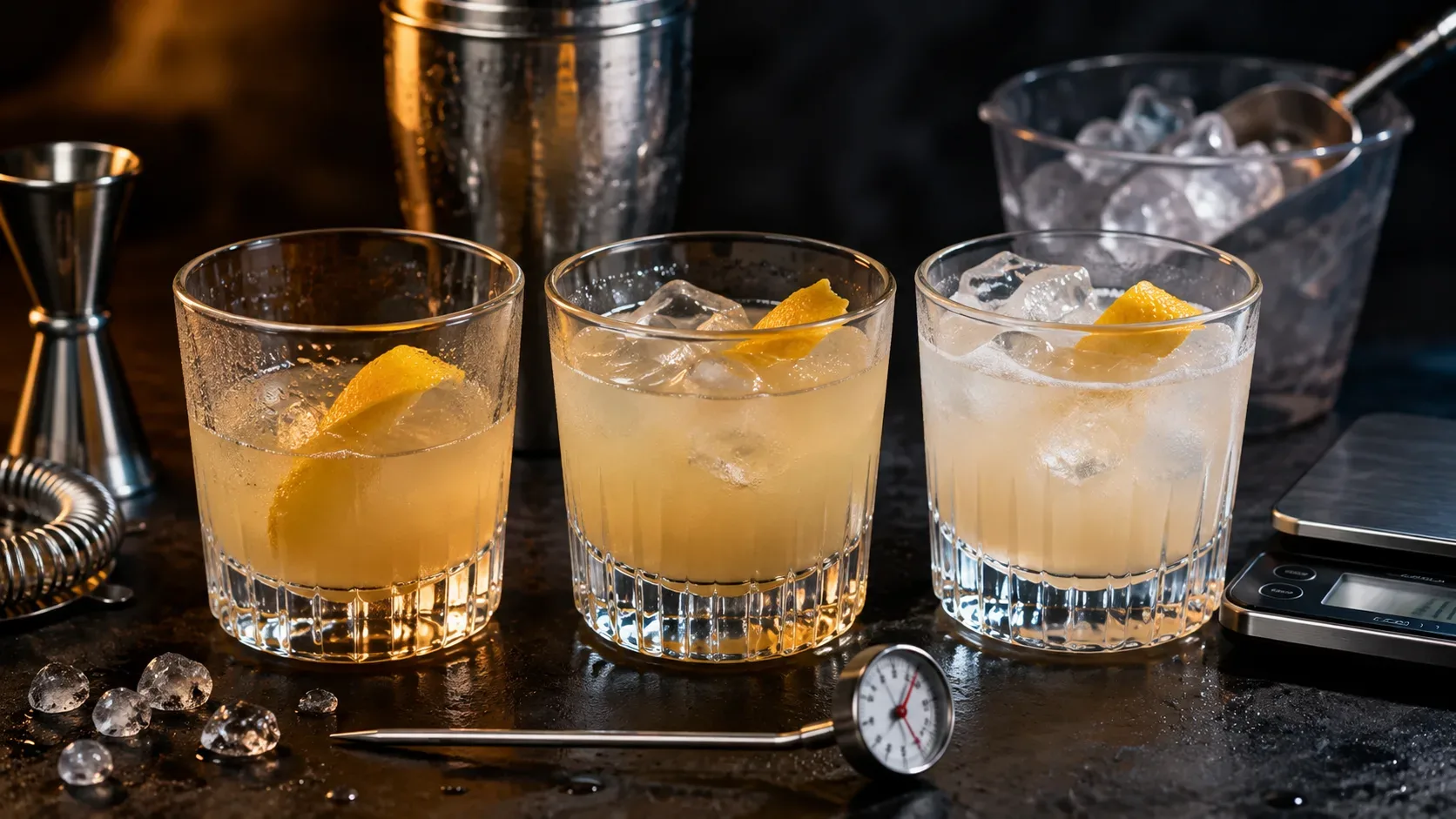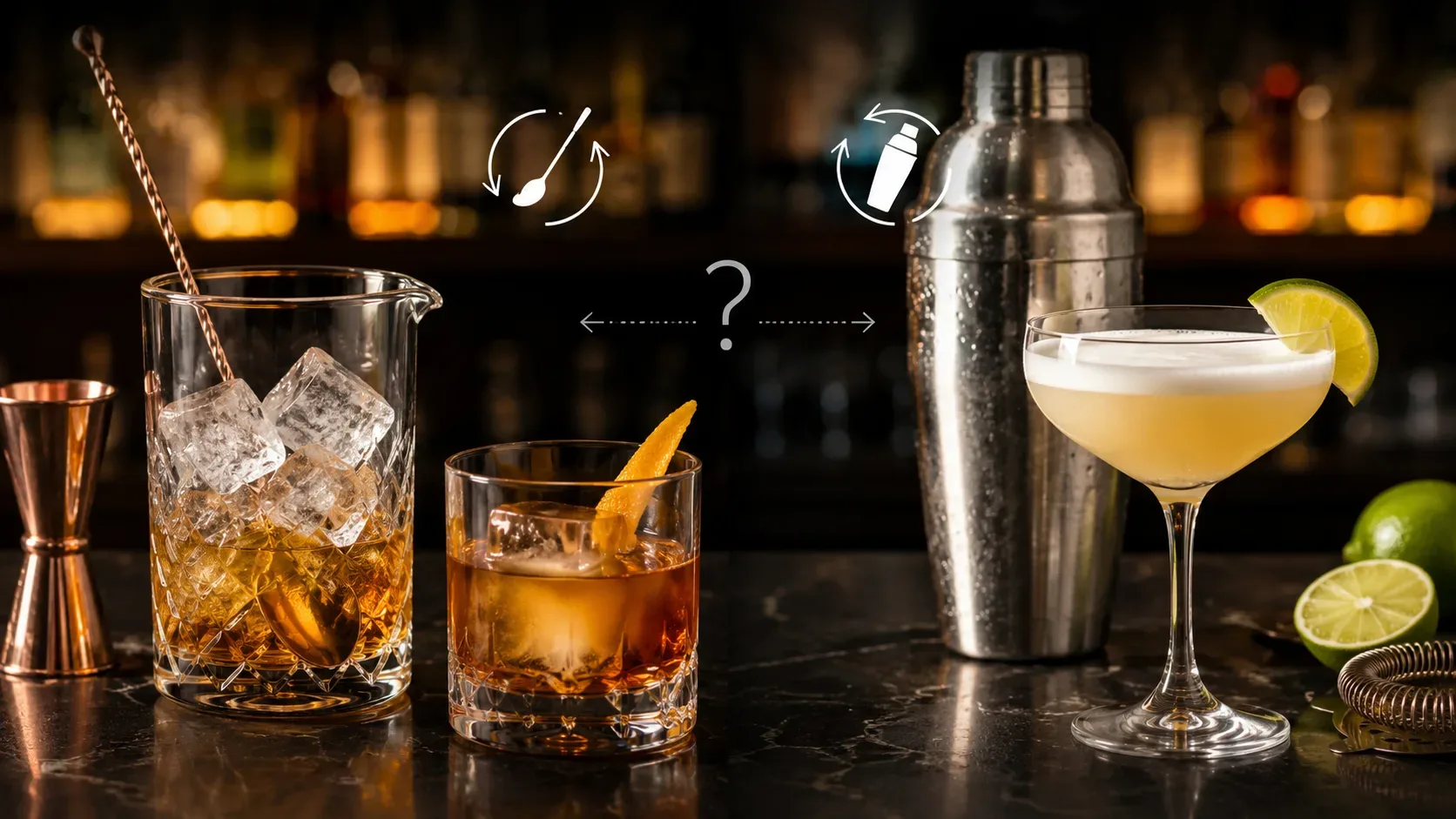
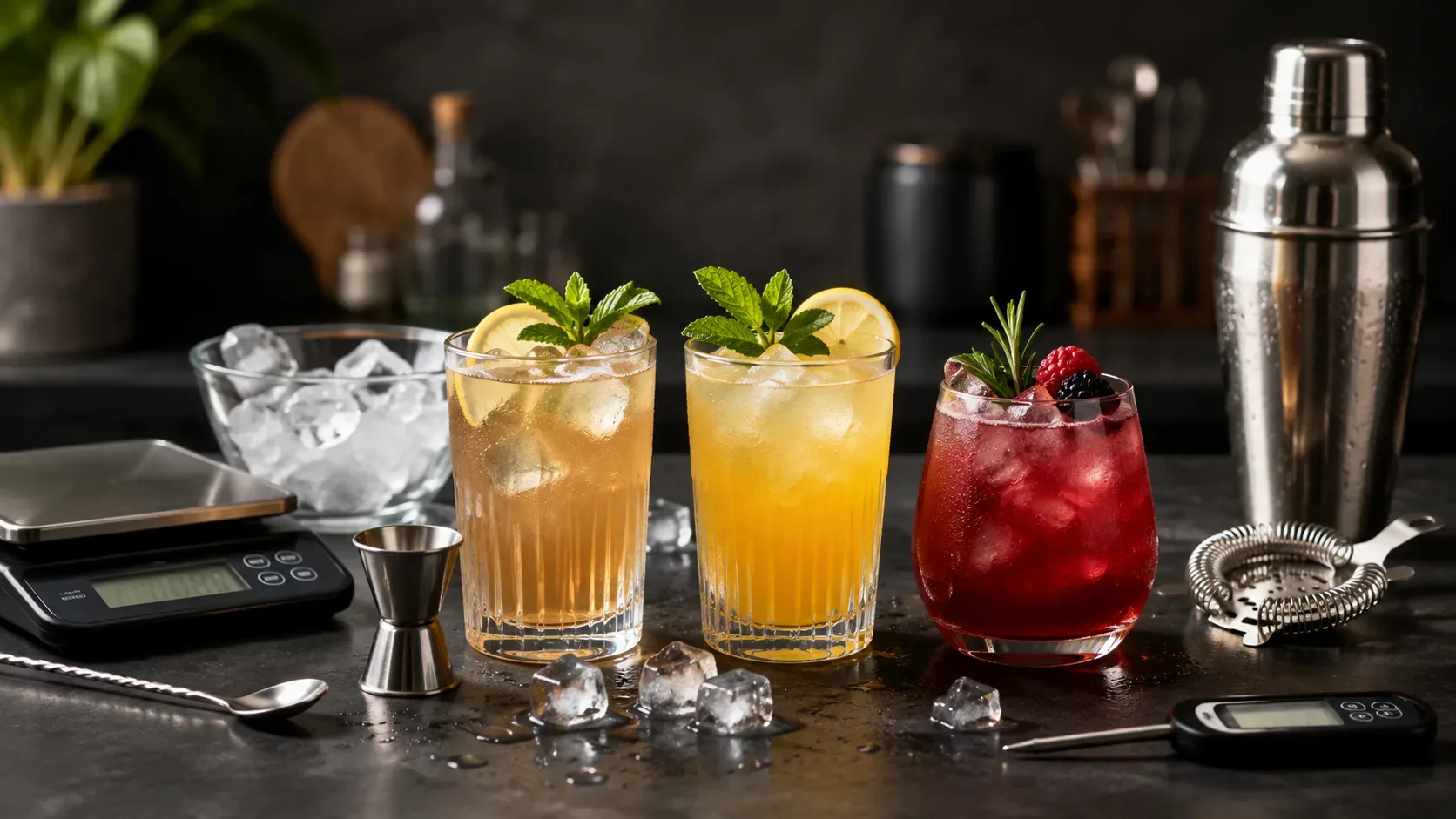
The method of weighing the drink before and after contact with ice works for both alcoholic and non-alcoholic cocktails. What should not be transferred automatically is the stirring time, the expected final temperature or the percentage considered ideal.
The reason is simple: the scale measures the mass gain caused mainly by melting water from the ice. It does not depend on the presence of ethanol. The behavior of the drink during cooling depends on its composition, including water content, sugar, acidity, pulp, viscosity, initial temperature and eventual carbonation.
Editorial note: the physical bench with the three formulations described below was not carried out in this investigation. Therefore, this text validates the method, defines the variables and delivers a reproducible protocol, but does not present comparative numbers as if they were real results. The publication must remain in reserve until the test is carried out in triplicate.
What exactly can be repeated without alcohol?
The most transferable procedure is the gravimetric test:
- weigh the drink before adding ice;
- shake or stir it under standardized conditions;
- strain and weigh all recovered liquid;
- calculate how much the mass has increased.
Batch cocktail making guides use this same practical logic: prepare a shot, weigh the ingredients before icing, and weigh the finished drink to estimate incorporated water.
The principle is also consistent with cocktail science experiments in which temperature, mass, and alcohol content were measured directly. These studies show that ice cooling and melting are linked, although losses during service can introduce measurement error.
Therefore:
| Test element | Can it be maintained? | Note |
|---|---|---|
| Weighing before and after | Yes | It is the simplest and most comparable method |
| Same container | Yes | Should be maintained to reduce variations |
| Same ice and same ice mass | Yes | Necessary condition to compare formulas |
| Same shaking time | Yes, as a controlled variable | It does not mean that this time is ideal for everyone |
| Same dilution target as the alcoholic cocktail | No | Needs to be sensorially validated |
| Same expected result | No | Sugar, water, temperature and texture change the system |
| Refractometer calibrated for alcohol | Not necessarily | Ethanol and dissolved solids require different interpretations |
Why does the absence of alcohol change behavior?
Alcohol is not just for flavor
Mixtures of water and ethanol have their own thermodynamic properties, such as thermal capacity and density depending on the proportion between the components. Experimental measurements of these properties confirm that an alcoholic beverage does not behave thermally like the same volume of pure water.
In bar tests, ice initially close to 0°C managed to bring vodka to a temperature below 0°C. This is because the presence of ethanol reduces the temperature at which the liquid phase can remain without freezing.
When removing the alcohol, the drink usually becomes proportionally richer in water. Bartenders consulted by Food & Wine report that non-alcoholic tea, juice or water-based drinks can become excessively diluted when given the same shake used in certain alcoholic recipes. The professional recommendation, in some cases, is to work with previously chilled ingredients and glasses and reduce or eliminate shaking with ice.
This is sensory guidance from professionals, not a universal rule: a citrusy, thick or emulsifier cocktail may still need to be shaken to gain texture. The point is that the technique must serve the formula, not be automatically copied from its alcoholic version.
Sugar also alters the system
Sugar doesn't just act on sweetness. Studies with aqueous sucrose solutions show that concentration and temperature are related to the viscosity of the solution. In practical terms, a more sugary drink may present greater resistance to movement and a different body sensation.
Sucrose also reduces the melting temperature of ice in solution. Experiments published in the Journal of Crystal Growth found a relationship between the concentration of saccharides and the reduction of the melting point in dilute aqueous solutions.
This does not allow us to predict, without a bench, that the sweetest sample will necessarily receive more or less water. The net result also depends on:
- initial temperature of the drink;
- internal temperature and surface humidity of the ice;
- shaking speed;
- contact area;
- total mass of the recipe;
- thermal capacity of the mixture;
- time needed to strain;
- liquid retained in the ice, in the sieve and in the container.
Evidence supports that sugar and alcohol alter relevant properties. It does not replace specific formula measurement.
How to calculate dilution correctly
There are two common ways to present the same result. They should not be confused.
Dilution in relation to initial revenue
Dilution over initial load = incorporated water ÷ initial mass × 100
Embodied water is estimated by:
final mass − initial mass
Purely mathematical example, not bench results:
- initial mass: 100 g;
- final mass: 118 g;
- estimated incorporated water: 18 g;
- dilution over the initial load: 18%.
Participation of water in the final product
Water incorporated in the final product = water incorporated ÷ final mass × 100
In the same example:
- 18 ÷ 118 × 100 = approximately 15.3%.
So saying “18% dilution” and saying “15.3% of the final drink came from ice” are different descriptions. The article or technical sheet must inform which convention was used.
Protocol for a real comparative test
To find out whether non-alcoholic drinks with different sugar contents respond in the same way, it is necessary to change only the sugar and keep other conditions as constant as possible.
Alcohol-free formulations
The three samples below are 100 g before freezing. Use the same batch of tea and lemon juice for all.
| Sample | Sugar-free black tea | Strained lemon juice | Water | Refined sugar | Added sugar |
| Low sugar | 80 g | 10 g | 10 g | 0 g | 0% of mass |
| Intermediate sugar | 80 g | 10 g | 5 g | 5 g | 5% of the mass |
| High sugar | 80 g | 10 g | 0 g | 10 g | 10% of the mass |
The sugar must be completely dissolved before measuring the initial temperature. Lemon juice already contains solids and natural sugars, but remains the same in all three samples; the experimental factor is added sucrose.
These formulas are test solutions, not ready-to-service recipes. The final sensory evaluation may require adjustments in acidity, bitterness or aroma.
Separation between alcoholic and non-alcoholic options
This protocol is exclusively without added alcohol. To avoid contamination of the comparison:
- do not use spirits;
- do not use liqueurs;
- do not use alcoholic bitters;
- check the label of aperitifs, de-alcoholized wines and fermented bases;
- if total absence is essential, select ingredients declared as 0.0%.
According to Brazilian regulations currently in force, a non-alcoholic beverage is one with a strength of less than 0.5% by volume at 20 °C, except for the exception provided for grape must. Therefore, “non-alcoholic” in the legal classification is not necessarily synonymous with 0.0%.
Equipment
- balance with a resolution of at least 0.1 g;
- digital culinary thermometer;
- timer;
- single cocktail shaker;
- single strainer;
- light and dry container to receive the drink;
- ice produced in the same batch;
- registration form.
Experiments published by Cooking Issues used scales accurate to 0.1 g and fast-response thermocouples to track weight and temperature. In a domestic kitchen, the thermometer will be less sophisticated, but standardization remains essential.
Recommended conditions
- Take all samples to the same initial temperature, preferably 20.0 °C, with a previously defined tolerance.
- Use the same mass of ice each round.
- Standardize the size of cubes and their origin.
- Always use the same shaker.
- Shake all samples with the same movement for 15 seconds.
- Strain for the same number of seconds.
- Immediately weigh the recovered liquid.
- Measure the final temperature.
- Repeat each sample at least three times.
- Switch the order of formulas between rounds to reduce the effects of equipment heating or ice change.
Previous experiments have found an approximation of temperature and dilution equilibrium after about 12 to 15 seconds of vigorous shaking in studied cocktails. This interval is a good methodological starting point, but should not be presented as a proven ideal time for these three non-alcoholic drinks.
Recording sheet
| Round | Sample | Initial mass | Initial temperature | Final dough | Final temperature | Embedded water | Dilution over load |
| 1 | Low sugar | 100.0 g | To be measured | To be measured | To be measured | To be calculated | To be calculated |
| 1 | Intermediate | 100.0 g | To be measured | To be measured | To be measured | To be calculated | To be calculated |
| 1 | High | 100.0 g | To be measured | To be measured | To be measured | To be calculated | To be calculated |
| 2 and 3 | Repeat the three samples |
The average alone is not enough. Also record the lowest and highest results. Large variation between runs may indicate inconsistency in ice, agitation, liquid recovery, or initial temperature.
How to interpret the test without drawing too many conclusions
The test must answer three different questions.
1. Does the same agitation incorporate the same amount of water?
Compare the dilution means of the three samples. A small difference in the variation between repetitions may just be procedural noise.
2. Do the drinks reach the same temperature?
Two samples may end up with similar dilutions and different temperatures. Therefore, weight and temperature need to be recorded together.
3. Does the same dilution produce the same sensory balance?
Not necessarily. The sweeter specimen may tolerate or even require more water before it appears watery. Samples with little sugar can quickly lose acidity, aroma and body.
The sensory test must be carried out separately from the physical measurement, ideally blindly and with the order of samples alternating. Participants can evaluate:
- aroma intensity;
- sweetness;
- acidity;
- bitterness;
- body;
- watery sensation;
- general balance.
The correct editorial conclusion is not “more sugar always creates more dilution” or “non-alcoholic cocktails should be shaken less.” The conclusion must relate composition, measured dilution, temperature and sensory acceptance.
Cases in which the test needs to be adapted
Certified drinks
Do not shake the already carbonated formulation in a closed shaker. In addition to the risk of pressure, the loss of gas and the formation of foam impair the recovery of the dough.
Test the still part first. Then add a heavy amount of sparkling water or other previously cooled carbonated component.
Juices with pulp, purees and foams
Pulp and foam may remain in the strainer or shaker. In this case, the difference in weight no longer represents just added water. Record losses and always use the same drain time.
Very concentrated syrups
The more viscous the mixture, the greater the retention on the walls of the container and on the ice. The influence of concentration and temperature on the viscosity of sucrose solutions is documented, which reinforces the need for replication.
Previously chilled ingredients
Refrigerated ingredients require less heat removal to reach serving temperature. This can reduce the melting that occurs during mixing. For this reason, a sample at 5 °C should not be compared with one at 20 °C.
After all, does the same test work?
Yes, as long as “same test” means measuring dilution by mass under controlled conditions.
It works because the scale can estimate the incorporated water regardless of whether there is ethanol. However, the same stirring time and the same percentage considered satisfactory in an alcoholic cocktail are not automatically suitable for a non-alcoholic drink.
The correct method is:
- measure, don't assume;
- compare formulas with equal masses and initial temperatures;
- repeat each condition;
- separate the physical result from sensory preference;
- do not treat the non-alcoholic version as an alcoholic recipe from which the distillate has simply been removed.
Until the three samples are actually prepared and measured, the publishable answer must remain limited: the method is transferable; the result and the ideal target still need benching.