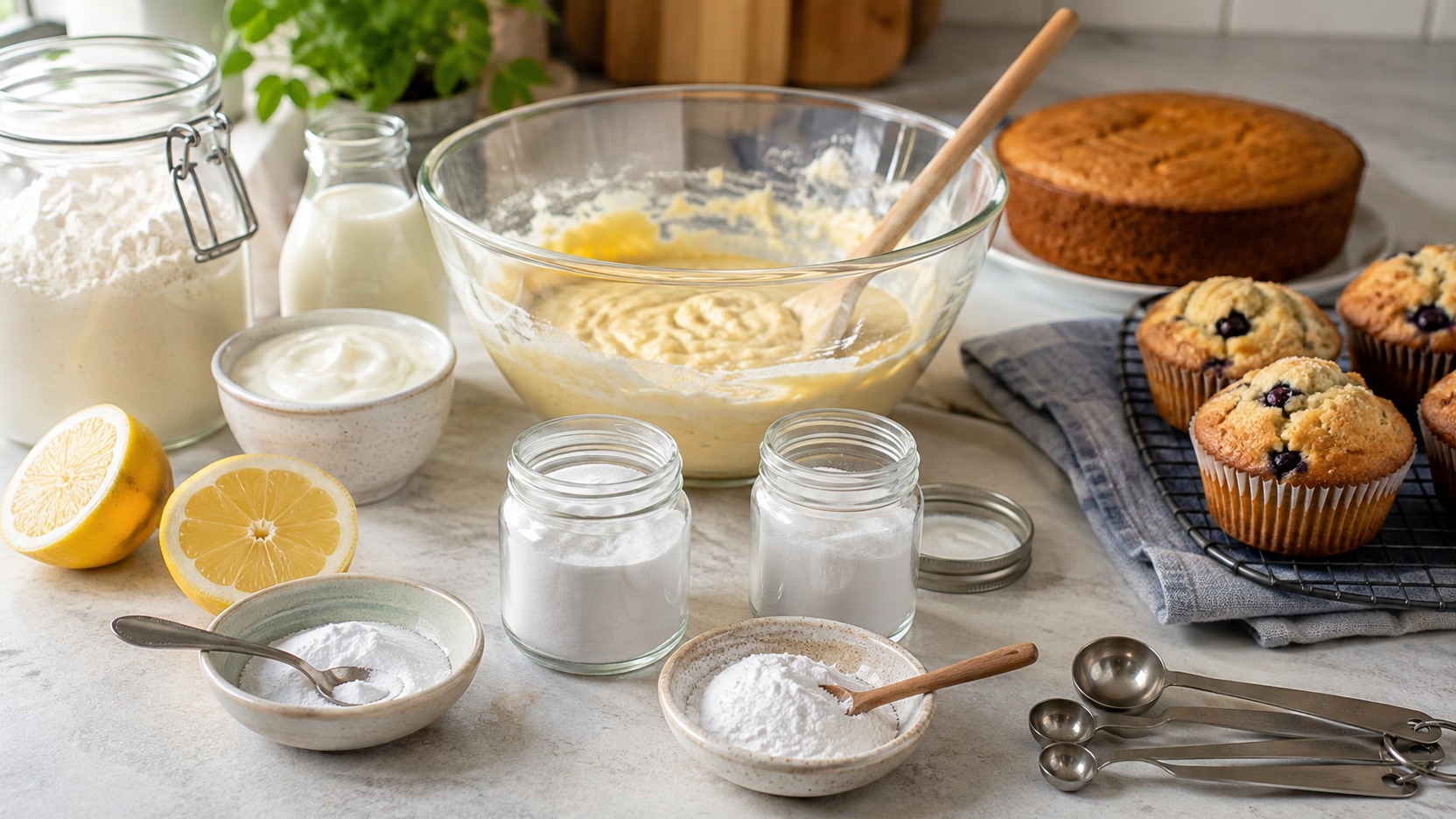
You've run out of chemical yeast and there's only bicarbonate in the cupboard? The short answer is: sometimes you can substitute it, but not to the same extent and not in every recipe. The two ingredients release carbon dioxide, the gas that helps the dough to rise, but they achieve this result through different paths. Baking soda is a base and needs to find enough acid in the dough. Chemical yeast already contains bicarbonate and acidic components in the mixture itself.
For this reason, exchanging a spoonful of yeast for a spoonful of bicarbonate usually creates a new problem instead of solving the old one. Bicarbonate may remain unreacted, the pH of the dough rises, the flavor changes and the roast may brown and spread differently. Adaptation works best when you think about the chemical function of the ingredient, not just the volume measured by the spoon.
The difference that decides whether the exchange works
Sodium bicarbonate is practically pure sodium bicarbonate. When it encounters an acid and moisture, an acid-base reaction occurs that releases carbon dioxide. These bubbles can become trapped in the structure of the dough and contribute to growth during preparation.
Chemical baking powder is a ready-made formulation to make this reaction happen more predictably. It combines bicarbonate with acidic salts and, generally, a starch that helps keep the components dry and separated during storage. Some formulations release gas in more than one step, including upon heating.
This difference explains the most important rule of this article: bicarbonate alone is not a complete substitute for chemical yeast. To fulfill the same function, it needs a source of acidity in a compatible quantity.
Why the exchange is not 1:1
A spoonful of chemical yeast is not a spoonful of diluted bicarbonate. It contains a balanced combination of base, acid and other components. If you use the same volume of baking soda, you add a much larger amount of base to the recipe than the original formula called for.
More bicarbonate also does not necessarily mean more growth. Without enough acid, some of it doesn't react as expected. Excess can leave an unpleasant taste and alter the flavor balance. At the same time, a more alkaline dough tends to brown more easily, because the higher pH favors browning reactions during the oven.
The texture may also change. In cookies, for example, small changes in the amount of baking soda can affect spread, crunchiness and color. In cakes and muffins, the amount and timing at which the gas is produced needs to match the dough's ability to retain these bubbles until its structure sets.
First diagnosis: what the original recipe calls for
Before substituting anything, look at the entire recipe. If it only asks for chemical yeast, this usually indicates that the yeast formula itself provides the acidity necessary for growth. If the dough doesn't contain a clearly acidic ingredient in significant quantities, baking soda alone is a poor tradeoff.
If the recipe calls for baking soda and an acidic ingredient, such as yogurt, buttermilk, sour cream, lemon juice or vinegar, the logic is different: the acidity of the recipe itself participates in the reaction. Still, the amount of acid matters. The mere presence of lemon or yogurt does not prove that there is enough acidity to replace all the expected chemical leavening.
If the recipe calls for chemical yeast and bicarbonate at the same time, don't treat one of them as redundant. Many formulas use baking soda to neutralize some of the acids in the dough and chemical leavening to provide additional rising. Removing the yeast and compensating with more bicarbonate can make the dough alkaline before even solving the volume issue.
When bicarbonate can replace chemical yeast
Substitution becomes much more predictable when you can reconstruct what the yeast would do. The most controlled way is to combine a small amount of baking soda with a measured dry acid, such as cream of tartar.
University extension references show precisely why there is no 1:1 equivalence. The University of Illinois Extension presents, as an attempt to replace a teaspoon of chemical yeast, about a quarter teaspoon of baking soda accompanied by cream of tartar. Colorado State University Extension publishes similar alternatives and includes versions with cream of tartar and starch.
In practice, this means that bicarbonate represents only a fraction of the volume of the chemical yeast that it helps to replace. The remainder of the formula needs to provide enough acid to consume this base. When the acid comes from a liquid, such as fermented milk, yogurt, lemon or vinegar, the adaptation also changes the amount of liquid in the recipe. This adjustment should not be made by free addition, as it can change the consistency of the dough.
What if the recipe already contains acidic ingredients?
A recipe with yogurt, buttermilk, sour cream, molasses, natural cocoa, lemon or vinegar may have useful acidity for baking soda. This does not mean that any of these ingredients are a free pass to replace chemical yeast.
The decisive point is the balance of the formula. Different acids have different concentrations; industrialized products also vary. A spoonful of yogurt in a large dough may not have the same effect as a relevant amount of fermented milk. Therefore, when a recipe is written for chemical yeast, the presence of an acidic ingredient should be treated as a clue, not as a ready-made equivalence.
If adaptation is necessary and you have no way to calculate or test this balance, a recipe originally formulated for baking soda and that acidic ingredient is usually a safer choice than converting a delicate recipe on the fly.
What changes in flavor, color and texture
Bicarbonate isn't just for creating bubbles. As it changes the pH, it can change the sensorial result of the dough. With too much base left, the flavor can become bitter, metallic, or just plain weird. The solution is not to add even more bicarbonate to try to gain volume.
In terms of color, the effect tends to become more intense gold when the dough becomes more alkaline. This may be desirable in some cookies, but it becomes a defect if the recipe is supposed to bake light or if the surface darkens before the center is finished cooking.
In texture, the behavior depends on the recipe. Biscuits can spread more and become crispier; Delicate doughs may rise unevenly or lose some volume if gas production does not match the structure. This is why the same adaptation should not automatically be applied to cake, muffin, pancake and cookie.
You've run out of yeast and there's no cream of tartar: what to do
If the recipe relies solely on chemical yeast and does not have a clear acid source, the most reliable option is not to switch to pure baking soda. Instead of trying to fix it later, look for a similar formulation that has already been created to use baking soda with an acidic ingredient available in your kitchen.
This change of strategy is especially useful in flexible preparations, such as pancakes, muffins and some quick breads, because many recipes exist in different versions: some use chemical yeast; others use baking soda combined with fermented milk, yogurt or another acid. You maintain the type of preparation, but start working with a formula whose chemical balance has already been thought out for the ingredients it contains.
In tall cakes, very airy doughs or recipes in which the final texture depends on precise rising, improvised conversion is more expensive. In these cases, postponing the preparation or choosing another recipe may be the most efficient decision.
I used bicarbonate in the same amount as the yeast: can it be saved?
If the 1:1 exchange has happened and the ingredients are still dry, the best time to correct is before adding liquids. If you know exactly how much you put in, you can redo the dry mix with the correct proportions or start this part over again.
Once the dough is wet, the correction becomes less predictable. Adding lemon or vinegar by eye doesn't just solve the chemistry of the baking soda: it also adds liquid, flavor and acid, and the reaction begins as soon as the components meet. In a delicate dough, time lost during this attempt could mean gas escaping before the oven can set the structure.
When the error was large, such as using a spoonful of baking soda instead of a spoonful of yeast, restarting the dough is usually safer than trying to neutralize the excess without calculating the entire formula. If the product has already been baked, there is no way to reverse the pH or redistribute the rising agent; What remains is to observe the result and adjust the next batch.
And in the opposite direction: chemical yeast instead of bicarbonate?
It's not a perfect swap either, but it can be less aggressive in some recipes because the yeast already brings acid and base together. The University of Illinois Extension suggests tentatively using about three times the amount of baking powder in place of baking soda.
Still, the recipe may change. If there was an acidic ingredient thought to react with the bicarbonate, it may be less neutralized and the final flavor may become more acidic. The color and texture may also vary because the pH of the dough and the way in which gas is produced are no longer the same.
Therefore, this conversion should be seen as an emergency solution, not as universal equivalence.
A better decision method than memorizing equivalences
Start by identifying which rising agent the recipe uses and what source of acidity is in the dough. Then, ask if this acidity was already part of the growth system or if the chemical yeast was responsible for carrying its own acid. Only then think about proportion.
If you have cream of tartar, you can reconstruct an alternative close to chemical yeast with bicarbonate in an amount much less than 1:1. If you depend on the acid of another ingredient, also adjust the amount of liquid and accept that flavor, color and texture may change. If the recipe calls for both agents, preserve the function of each rather than simply adding or multiplying measurements.
The central idea is simple: replace with function, not appearance. Bicarbonate and baking powder are white powders that help dough rise, but they are not the same ingredient. When one of them is missing, understanding where the base, acid and gas come from is what separates a reasonable adaptation from a dough that just received more powder.