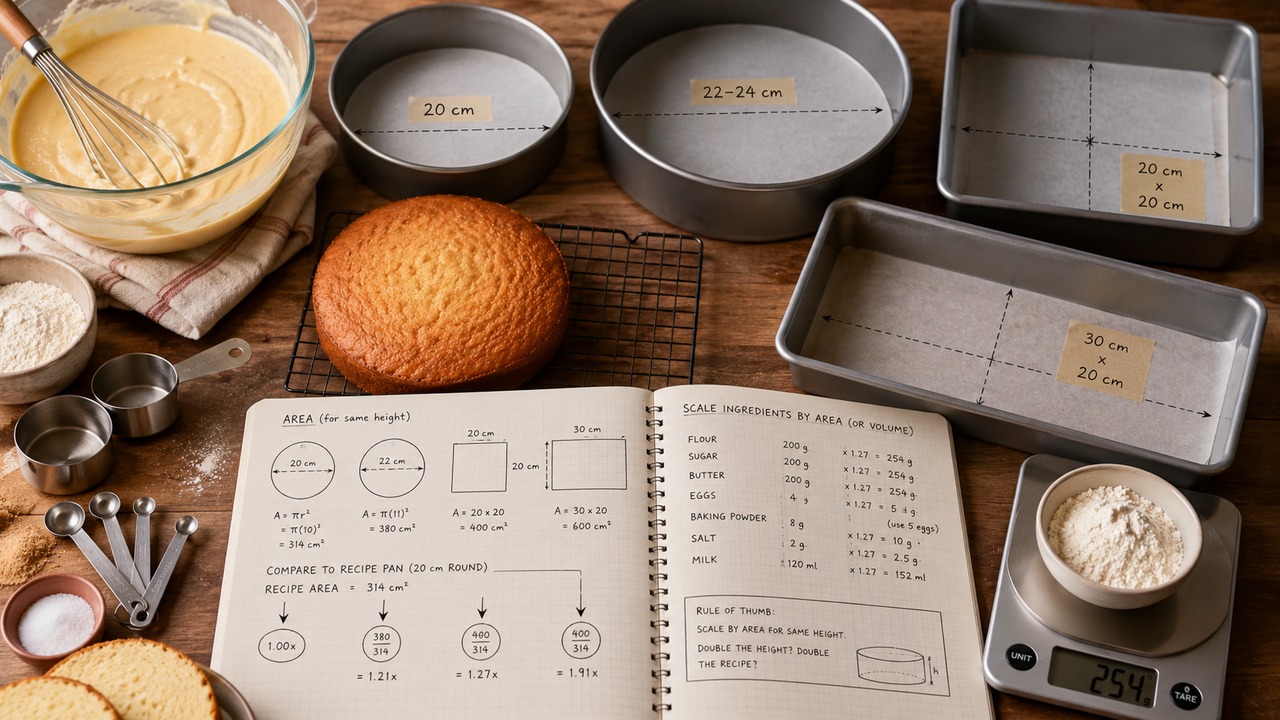
Exchanging a 20 cm pan for a 22 cm pan does not mean increasing the recipe by 10%. The diameter grew by 10%, but the base area grew by 21%. It is this difference that usually separates a cake with a similar height to the original recipe from one that is too low, overflows or requires a very different baking time.
The most useful method is to think about the thickness of the dough layer. If the new pan has a similar depth and you want to maintain the same cake height, compare the base areas. If the desired depth or height changes, start comparing volumes. From there, the multiplier found is used for flour, sugar, butter, liquids, yeast and eggs, preferably measured by weight.
The central rule: same cake height, proportion by area
When the only relevant change is the size or shape of the base, and the intention is to maintain approximately the same mass height, use this calculation:
multiplier = area of the new shape ÷ area of the original shape
Then, multiply each ingredient by the result.
For a round shape, the area is π × radius². The radius is half the diameter. For a square shape, the area is side × side. For a rectangular shape, it is length × width.
This logic works because, maintaining the same mass height, the necessary volume grows in the same proportion as the base area. It's a safer way to convert a recipe than just looking at the diameter or deciding that a pan "looks a little bigger."
Example 1: round shape from 20 cm to 22 cm
A 20 cm round shape has a radius of 10 cm. The area is approximately 314 cm². A 22 cm shape has a radius of 11 cm and an area of approximately 380 cm².
The multiplier is 380 ÷ 314 = 1.21.
This means increasing revenue by around 21%. If the original recipe uses 300 g of flour, the new amount is around 363 g. If you use 200 g of sugar, this comes to approximately 242 g. A 100 g ingredient becomes 121 g.
Understand why simply increasing 10%, following the diameter, does not preserve the height of the cake: what grows is a surface, not a line.
Example 2: round shape from 20 cm to 24 cm
The 24 cm shape has a radius of 12 cm and an area of approximately 452 cm². Compared to the 20 cm shape, the multiplier is 452 ÷ 314 = 1.44.
Here the recipe needs to rise by around 44% to maintain the same dough thickness. A recipe with 300 g of flour would come to 432 g. A quantity of 250 ml of milk would turn into 360 ml.
This example shows another common mistake: doubling the recipe because the pan looks much larger. From 20 cm to 24 cm, doubling it would produce too much mass for the same height. The calculation indicates 1.44 times, not 2 times.
Example 3: 20 cm round shape to 20 × 30 cm rectangular shape
The 20 cm round shape is approximately 314 cm². A rectangular shape measuring 20 × 30 cm is 600 cm².
The multiplier is 600 ÷ 314 = 1.91.
In practice, to obtain a layer of similar thickness, you would need almost double the recipe. If the original recipe has 300 g of flour, the mathematical conversion indicates around 573 g. Before preparing everything in a single batch, check that the bowl and mixer can handle the additional volume without damaging the mixture.
A quick map between round, square and rectangular shapes
Some equivalences help to see the logic without memorizing an entire table. A 20 cm round pan is about 314 cm². An 18 × 18 cm square is 324 cm², a difference of only about 3%. For many conventional doughs, with similar depth, they are close in dough capacity for the same height.
A 22 cm round pan is approximately 380 cm². A 20 × 20 cm square is 400 cm². The square one requires about 5% more mass to maintain the same height.
A 24 cm round pan is approximately 452 cm². A rectangular 18 × 25 cm is 450 cm². In this case, the areas are practically equivalent, as long as the useful depth and filling level are comparable.
The point is not to decorate pairs of shapes. It's knowing how to reconstruct any equivalence: calculate the area of the original shape, calculate the area of the new one and divide the second by the first.
When area is not enough: depth and volume change the bill
Comparing by area assumes that you want to maintain the same mass height. If the new shape is much deeper, much shallower, or has an irregular design, the base area alone no longer answers the question.
For simple, straight shapes, think of the desired dough volume as base area × layer height. If you want, for example, to also increase the height of the mass by 20%, multiply the area factor by 1.20.
In shapes with a central tube, designs, curves or very sloping walls, such as many Bundt shapes, capacity becomes a more useful reference. A practical way to compare empty shapes is to measure how much liquid each holds. But don't confuse full capacity with a safe amount of dough: the cake needs space to rise. The important thing is to preserve a filling fraction similar to that of the original recipe, not filling the mold to the brim.
Depth also affects the oven. A thicker layer takes longer to heat in the center; a thinner layer tends to bake faster. Therefore, the math of ingredients does not automatically turn into math of minutes.
Convert ingredients by weight whenever possible
Once you find the multiplier, the process becomes more predictable when the ingredients are in grams. A recipe with 250 g of flour multiplied by 1.21 becomes 302.5 g; in practice you can work with 303 g. The same logic applies to sugar, butter, chocolate, milk and other liquids that can be heavy.
Measurements in cups and spoons make fractions less comfortable and increase the risk of rounding each ingredient one way. If the original recipe only provides volume, you can still apply the multiplier, but a scale improves the consistency of the conversion.
For yeast, baking soda, salt and ingredients used in small quantities, avoid aggressive rounding. A multiplier of 1.21 should also increase these components by the same amount, unless you are working with a recipe or technique that has specific scaling instructions.
How to split eggs without guessing
Eggs are the most annoying ingredient when the multiplier does not produce a whole number. If a recipe uses 4 eggs and the factor is 1.21, the mathematical result is 4.84 eggs.
Instead of automatically rounding up to 5 or back to 4, beat the eggs and use the scale. A practical way is to beat 5 eggs, weigh the total and use 96.8% of that weight, because 4.84 represents 96.8% of 5. Another option is to use 4 whole eggs, beat the fifth separately and add about 84% of its weight.
This care makes the most difference in small recipes, in which a fraction of egg represents a large portion of the structure and moisture. In very large recipes, a small rounding tends to have a proportionally smaller effect, but it is still better to decide consciously than to change the formula for convenience without realizing it.
Oven time does not follow the multiplier
If the recipe was multiplied by 1.44, this does not mean baking for 44% longer. The oven responds to the thickness of the dough, the distance to the center, the material and color of the pan, the air circulation and the behavior of the dough itself.
As a starting point, stick to the temperature indicated in the recipe when you are using a similar form of material and just converting size or shape. Use the original time as a reference, not as a promise.
If you put the same amount of dough in a larger pan without scaling the recipe, the layer will be thinner and tend to bake faster. If you put the same dough in a smaller pan, the layer will be higher, it may take longer and there is a greater risk of overflowing. When you scale the quantity to try to preserve the thickness, the time will usually be closer to the original, but it can still change.
Start observing the cake before the end of the recipe. Color, surface firmness, discreet edge shrinkage when appropriate, and the spot test indicated by the recipe itself are more useful than multiplying minutes by a fixed formula.
The shape also changes as the heat reaches the cake
Even two pans with similar area and depth can bake differently if the material changes. Metal, glass and ceramics do not transfer and retain heat in the same way. Color and thickness of the metal also change the behavior of the edges and surface.
Therefore, a perfect geometric conversion does not automatically correct a change from light aluminum to glass, ceramic or very dark metal. If the objective is to reproduce the recipe with a minimum of variables, keep the type of material as close as possible to what was originally indicated and change one thing at a time.
There are cakes that should not be treated as a simple rule of three
Conventional doughs for butter cake, oil cake, carrot cake and similar preparations tend to accept size conversions more freely. Recipes whose structure strongly depends on the format and method of cooling deserve caution.
Angel food, chiffon and some sponge cakes depend on walls, height and specific techniques to grow and maintain the structure. Cheesecakes can respond differently to depth, bain-marie, and center-to-edge ratio. Cakes made in center tube pans also have a different heat path than a simple round pan.
In these cases, the area or volume still helps to understand the amount of mass, but does not guarantee that the original method will continue to work without adjustments. When the recipe itself requires a special shape for structural reasons, treat the substitution as a new technique adaptation, not just a quantity conversion.
A reproducible procedure for any shape change
Measure the original shape
Use the useful internal dimensions, because that's where the dough will go. For round shapes, confirm the inner diameter. For squares and rectangles, measure the inside length and width.
Define what you want to preserve
If the intention is to maintain the same cake height, compare areas. If the layer height or useful depth also changes, compare the desired dough volume.
Calculate a single multiplier
Divide the new area or volume by the original area or volume. Write down the result before mixing the ingredients.
Recalculate the entire recipe
Apply the same factor to all ingredients. Choose grams and weigh egg fractions. Avoid increasing some components and leaving others in the old quantities.
Treat the oven like a new observation
Keep the recipe temperature as a reference when the mold material is similar, but do not multiply the time. Watch the dot and record how long the new setting actually took in your oven.
The shortcut worth keeping
If you remember just one idea, keep this one: to maintain the same cake height, what matters is the proportion between the areas of the molds, not the proportion between the diameters. The calculation from 20 cm to 22 cm is 1.21 times; from 20 cm to 24 cm, 1.44 times; and from a 20 cm round to a 20 × 30 cm rectangular, about 1.91 times.
When the depth, material or structure of the mass changes, the account needs a second layer of reasoning. Geometry solves quantity; behavior in the oven still needs to be observed. This is the point at which adapting a recipe stops being “doubled by eye” and becomes a method that you can repeat.