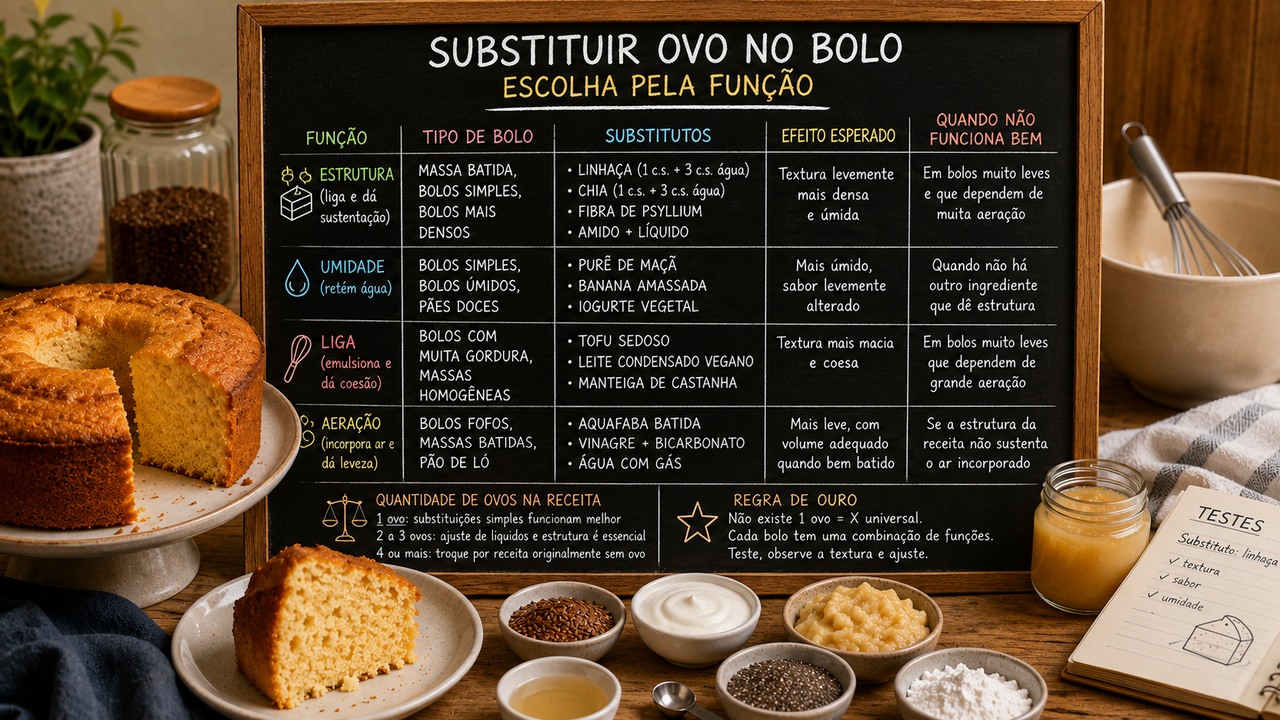
Replacing eggs in cake does not start with the question “how many spoons of banana are equivalent to one egg?”. The more useful question is: what is the egg doing in this dough? In a cake, it can help firm the structure, bind ingredients, emulsify water and fat, add moisture, promote aeration, contribute color and enrich flavor. That's why the same swap can work on a simple cake and leave another heavy, too moist, or unable to rise.
The rule of thumb is to treat any equivalence as a starting point, not as law. The simpler the dough and the less reliance on eggs to form structure and incorporate air, the greater the chance that a substitution will work. The more the recipe relies on beaten eggs, a high proportion of eggs, or little flour, the greater the chance that the switch will require a recipe originally formulated without eggs.
Why “1 egg = X” is not a universal rule
The egg is a multifunctional ingredient. When heated, its proteins coagulate and help the dough to firm up. The yolk contains emulsifiers that help keep fat and water distributed. Whites and whole eggs can also retain air when beaten, and the water present in the egg turns to steam during the oven. Furthermore, the egg contributes to the color, flavor and sensation of richness of the dough.
No home substitute reproduces all of this at the same time. Flaxseed and chia form useful gels for binding, but tend to leave more density and noticeable particles. Fruit purees provide water and body, but alter flavor and softness. Aquafaba can form foam, but it does not automatically replace the structure of a whole egg. Mixtures of liquid, fat and leavening may work well in simple doughs, but they do not create the same network of proteins.
Therefore, choosing well requires looking at the formula before looking in the pantry.
First diagnosis: what kind of cake is this?
Simple dough with chemical yeast
Snack cakes, muffins, and batters mixed using the direct method are often the most forgiving candidates. In them, flour and chemical yeast are already an important part of the structure and growth work. If the recipe only uses one or two eggs in a reasonable amount of flour, it is more plausible to compensate for part of the egg's functions with another ingredient.
Dough in which eggs are beaten to incorporate air
Sponge cake, genoise, angel food, chiffon and other doughs that use egg whites or beaten eggs as a central source of bulk are another category. In these cases, removing the egg does not just mean removing liquid: it means removing the system that creates and stabilizes much of the foam. Replacing them with bananas, apples or flaxseed “eggs” tends to attack the wrong function.
Dough with a lot of eggs in relation to flour
The number of eggs alone does not decide everything, but it acts as a warning sign. Four eggs in a recipe with a lot of flour, fat and baking powder represents a different situation than four eggs in a dough with little flour and a heavy reliance on beaten eggs. When eggs dominate the formula, the chance of a simple substitute preserving texture and volume drops significantly.
Choose by the predominant function of the egg
If the priority is alloy and some structure: linseed or chia
A recurring reference in baking tests is to mix 1 tablespoon of ground linseed or chia with 3 tablespoons of water to replace an egg, letting the mixture hydrate until it thickens. The gel helps hold the dough together, but doesn't imitate the egg protein after baking.
In published tests with muffins, pancakes and cookies, flaxseed and chia resulted in thicker batters and denser results than the egg control. Chia also makes the seeds more noticeable; flaxseed can add a slight graininess and cereal flavor. In a chocolate, banana, spice or other intensely flavored cake, these changes tend to be less disturbing than in a delicate white cake.
This type of substitution makes more sense when the cake already has chemical leavening, enough flour to support the structure and does not depend on egg foam. If the expected texture is very light, uniform and airy, seed gel is unlikely to be an invisible change.
If the priority is moisture and body: applesauce or banana
Fruit purees can provide water, solids and viscosity. In tests by King Arthur Baking with eggless banana bread, apple and banana were used as approximate weight alternatives to the egg in the formula. This shows a possible application, but also highlights the main limitation: puree is not egg protein.
Banana works best when its flavor matches the recipe. It tends to make the cake moister and can increase the feeling of density. Applesauce is usually more discreet, but still adds water and natural sugars. In either case, the switch is safer when another part of the formula already provides structure and growth.
If the recipe is a simple banana, chocolate, carrot or spice cake and includes an egg, fruit can be a plausible starting point. Whether it's a very light vanilla cake or a dough whose support depends on egg, the puree can release moisture and create another problem: lack of structure.
If the priority is aeration: aquafaba only makes sense in the right context
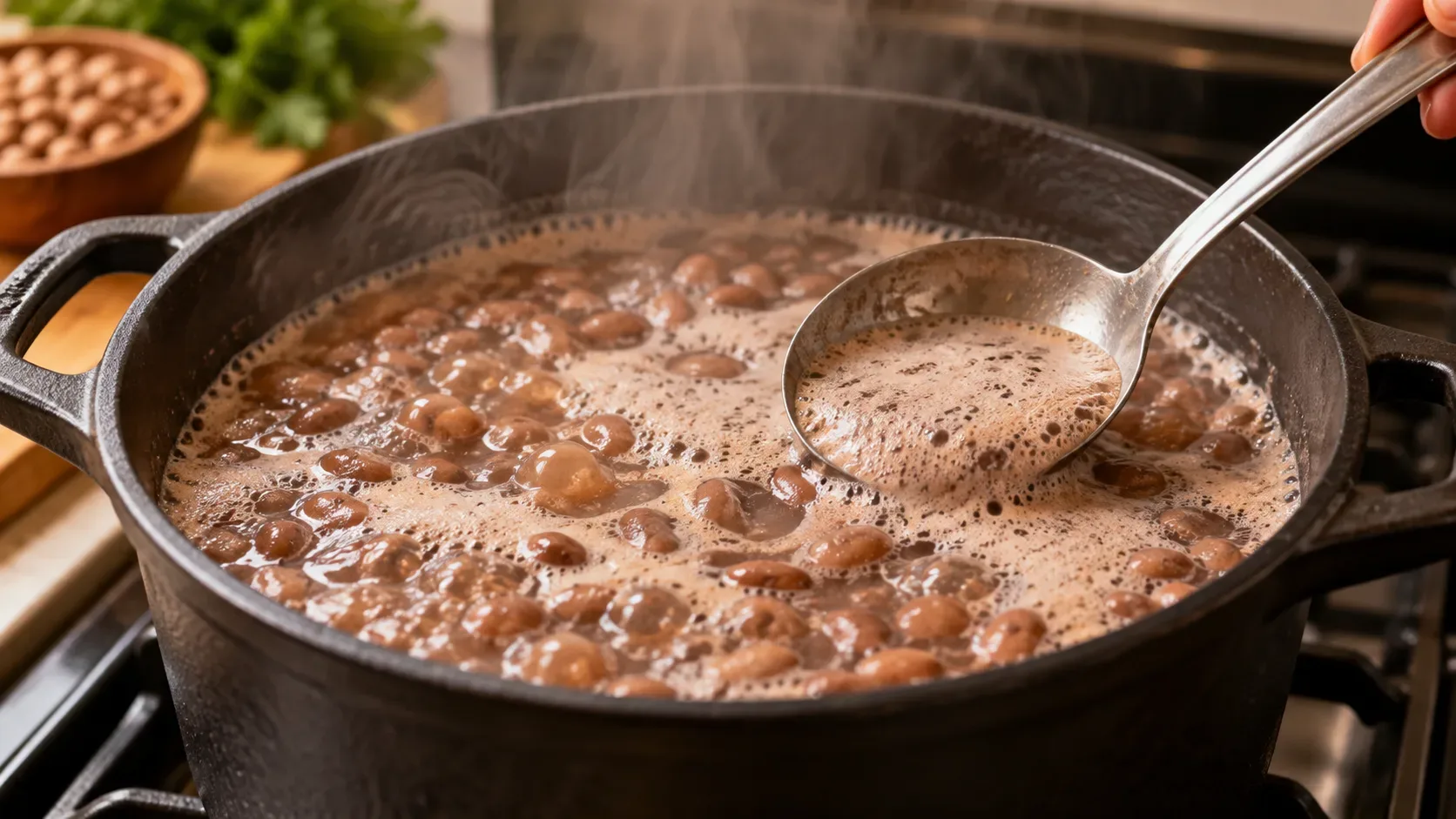
Aquafaba, the liquid from chickpea cooking, can form foam and is therefore valuable in preparations formulated to exploit this property. A common reference is about 3 tablespoons for the volume of an egg, but this equivalence does not transform aquafaba into a whole egg.
In recent Serious Eats tests, whipped aquafaba performed poorly as a whole egg replacement in pancakes, muffins, and cookies, producing crumbly or gummy results in several applications. The same ingredient, however, is known to work better in meringues and other preparations designed to stabilize foam.
For cake, this leads to a simple rule: if the recipe relies on whipped egg whites, look for a version already developed and tested with aquafaba. Just swapping each egg for a few tablespoons of the liquid without reformulating the rest of the batter is a gamble.
If the priority is neutrality in a simple dough: liquid, fat and chemical yeast
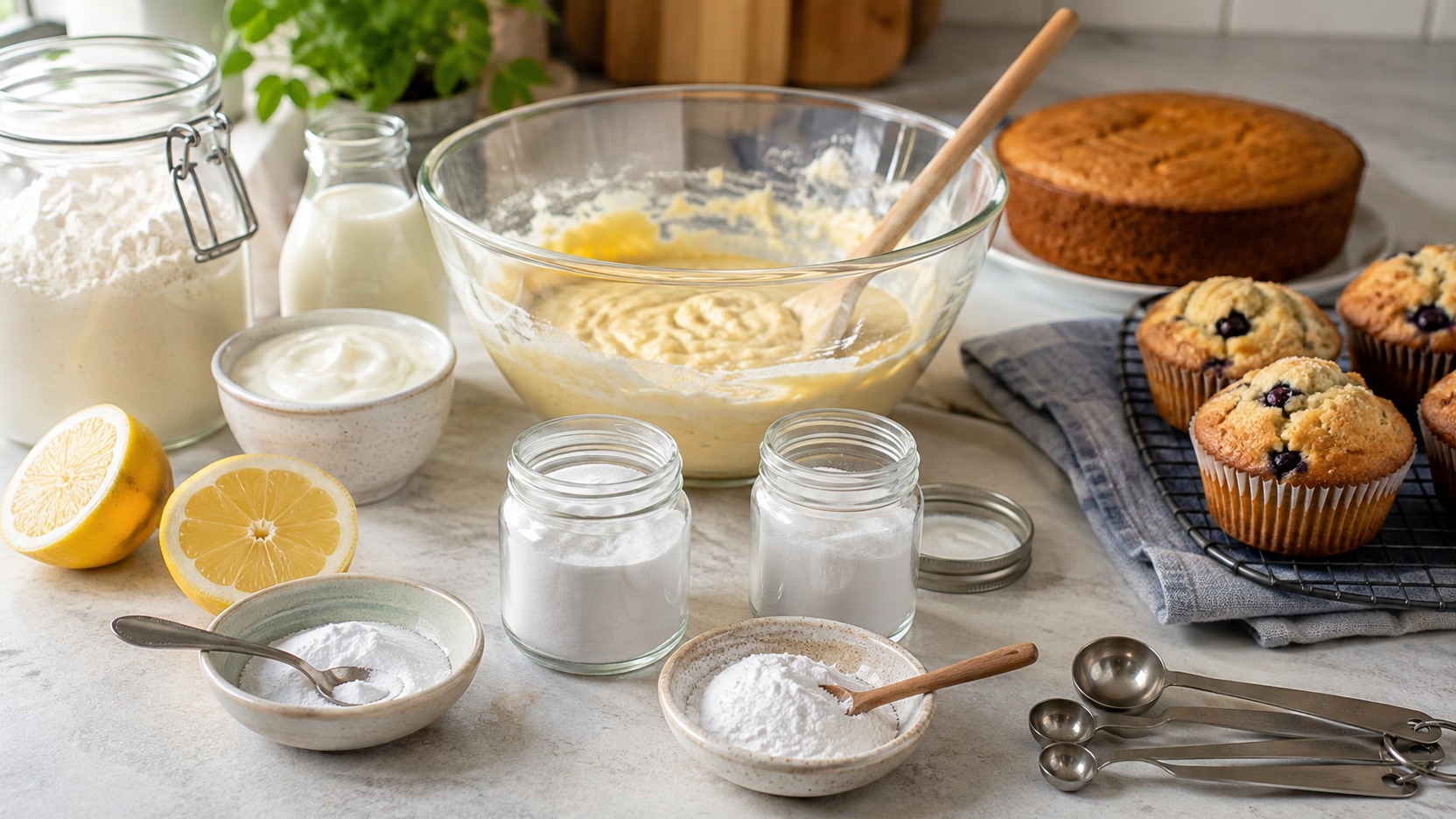
There are substitutions that try to replace functions separately instead of using a single ingredient. In a Kitchn test with vanilla muffin, the combination of 2 tablespoons of water, 2 teaspoons of yeast and 1 teaspoon of oil for each egg was among the best results, with a light and airy dough.. A later Serious Eats test used another ratio—1 tablespoon liquid, 1 teaspoon baking powder, and half a teaspoon oil per egg—and found it performed well especially in pancakes and muffins.
The difference between the two formulas is instructive: even a substitution based on the same logic changes depending on the recipe. This is not a universal equivalence for pouring on any cake. It is a strategy more suitable for simple doughs, already supported by flour and chemical yeast, when you want to avoid the banana flavor or the texture of seeds.
There is also a practical limit. Repeating the mixture several times to replace many eggs increases liquid, fat and yeast all at once and can unbalance the formula. For a recipe that relies heavily on eggs, it's safer to look for an egg-free version formulated from scratch.
If the priority is body and emulsion: creamy ingredients help, but do not create foam
Yogurt, silken tofu and other creamy ingredients appear in eggless tests and recipes because they can provide water, solids, viscosity and a more homogeneous dough. They are
more useful when the cake needs softness and cohesion than when it needs a large volume obtained by beaten eggs.
Be careful not to confuse “makes the dough cohesive” with “does the egg’s job completely”. In light cakes, switching to a creamy ingredient can reduce aeration and increase density. In moist, compact doughs, this change may be acceptable or even desirable.
The number of eggs changes the risk of replacement
A recipe with a single egg usually offers more margin because the other parts of the formula can take on much of the work. This doesn't make any swap safe, but it reduces the chance that you are removing the main structural element.
With two eggs, the difference tends to be more visible. Serious Eats deliberately chose recipes with two eggs in their tests precisely so that changes in structure, texture, color and flavor would be noticeable. The results varied greatly depending on the substitute and type of preparation.
With three, four or more eggs, do not apply an automatic rule. Ask what the ratio of eggs to flour is, whether the eggs are beaten, whether the recipe separates whites and yolks and whether there is another rising system. When the answer indicates that eggs are the skeleton of the dough, an originally egg-free recipe is the most predictable solution.
Situations in which it is better not to improvise
If the dough gains volume mainly from eggs or beaten whites, occasional replacement tends to fail. These include sponge cake, genoise, angel food and various chiffons. In these cakes, the technique of beating and stabilizing eggs is part of the recipe's architecture.
You also need to be careful with gluten-free cakes. In many formulas, the egg compensates for some of the structure that the gluten network would provide in a conventional recipe. King Arthur Baking shows that simple substitutions can work in some gluten-free preparations, but they become more risky when the egg is the main structure builder.
Another warning sign is a recipe with too much egg yolk or too much egg white for a specific reason. Yolks bring emulsification, fat and softness; Egg whites bring protein and the ability to form foam. A substitute chosen solely for volume does not respect this difference.
How to test an exchange without turning the recipe into a lottery
Start with the smallest change possible. If the recipe uses an egg and is a simple dough with chemical yeast, just change that egg and keep the rest the same. If the recipe uses multiple eggs, consider making half the recipe rather than blindly multiplying an equivalence.
Weigh the ingredients when you can. A large egg without the shell is close to 50 grams, but the objective is not just to copy the weight: it is to prevent the change from altering the hydration without you noticing. Purees, gels and liquids behave very differently despite occupying similar volumes.
Observe the dough before baking. A dough that has become much thicker, too fluid or unable to retain bubbles is already warning that the substitution has changed more than one
ingredient. After baking, compare height, firmness when cut, moisture, stickiness, crumbling, color and flavor.
To really test, change one variable at a time. Comparing a control version with egg and one with a single substitute teaches more than changing egg, milk, flour and yeast simultaneously. It is this type of comparison that allows you to transform an occasional change into a reproducible adaptation.
Decision examples on four different cakes
In a simple chocolate cake with chemical leavening and just one egg, hydrated flaxseed can be a reasonable choice when the priority is binding, accepting a slightly denser crumb. A mixture of liquid, oil and yeast can also be tried when wanting to preserve neutral flavor.
In a banana cake with an egg, additional mashed banana can work because the change in flavor is consistent with the recipe. The main risk is excess moisture and density, so the texture of the dough needs to be observed rather than just following a spoonful equivalence.
In a sponge cake that depends on four beaten eggs to rise, the safest choice is not to look for four “linseed eggs”. It is to use an eggless sponge cake recipe developed with another structure and aeration system.
In a gluten-free cake with little flour and lots of eggs, the substitute needs to compensate for much more than moisture. If there isn't a tested egg-free version of the recipe itself, swapping out all the eggs at once greatly increases the chance of collapse, gummy centers, or dough that doesn't hold together.
The best rule is to choose by function and accept that the texture can change
There is no one egg substitute that is best for all cakes. Flaxseed and chia are useful for binding, purees mainly resolve moisture and body, aquafaba is most valuable when its ability to form foam is exploited, and mixtures of liquid, fat and yeast can work in simple doughs that already have their own structure.
The decisive question is not “what is the equivalent of an egg?”, but “what function can I lose without dismantling this cake?”. When the answer is “almost none”, especially in very airy or egg-rich doughs, looking for an originally egg-free recipe is not giving up on the substitution. It's choosing a formula in which structure, moisture, binding and aeration have already been balanced to work without it.