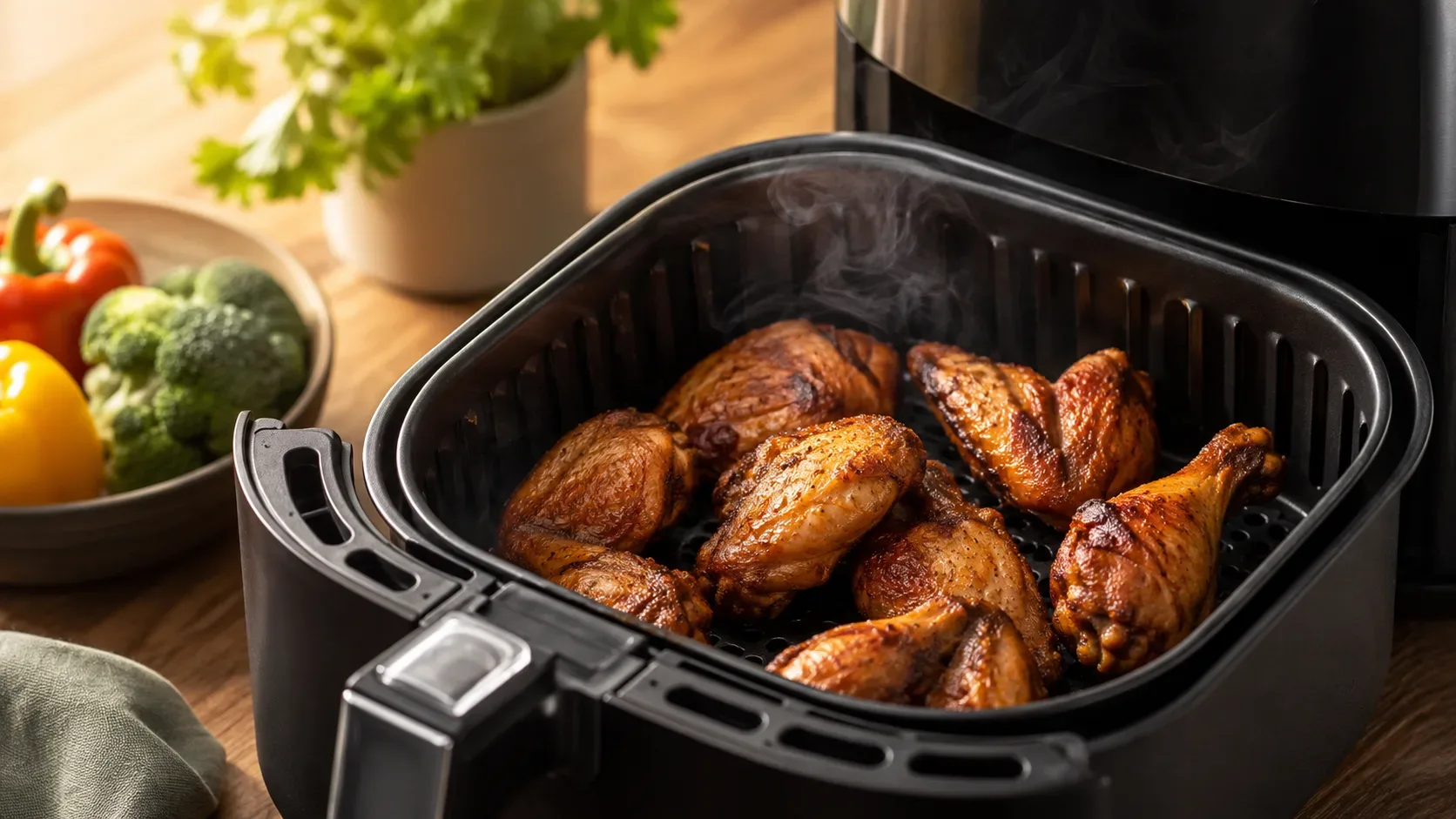
Saying that the air fryer is “just a small oven” gets part of the story right and hides precisely what most interferes with the result. It is, indeed, a close relative of the convection oven: there is a heat source and a fan moving hot air. The practical difference lies in how this air circulates in a compact cavity and how it can reach the surface of the food. Convection ovens and air fryers use ventilation, but chamber size, position of heating elements, basket design and fan configuration may differ.
This explains why two recipes at the same temperature can behave differently in the oven and in the air fryer — and also why an air fryer filled to the limit can lose precisely the advantage that makes it efficient for browning and leaving crispy surfaces.
What does airflow do besides “spread heat”
In a non-convection oven, the food receives energy mainly through radiation from the heating elements, contact with the baking tray and the natural movement of heated air. When a fan comes in, forced convection occurs: the device continuously passes hot air over the surface of the food. Convection ovens already use this principle, while countertop air fryers apply it inside a much smaller chamber.
This move has two important effects. The first is to increase heat exchange between the air and the surface. The second is to more efficiently remove part of the humid air that remains next to the food while the water evaporates. In other words, the fan is not just used to keep the temperature “uniform”: it also influences the speed at which the surface loses moisture.
A study published in 2025 in the journal Food Chemistry, carried out with potato strips in an air fryer, showed that changes in air flow speed altered the loss and distribution of water in the food. The work also found differences between regions of the chamber itself, showing that the air does not necessarily circulate at the same speed in all points. The specific values from that experiment should not be transferred directly to any domestic appliance, but the result confirms something important for the kitchen: air speed and distribution are part of the cooking process, they are not a secondary detail.
While there is plenty of water on the surface, evaporation consumes part of the energy received. As the surface dries, it heats up more and gilding becomes easier. This is why foods that are moist, piled up or touching each other tend to take longer to gain that crust that we associate with air frying. Potato research also noted that higher air velocity was linked to greater changes in water loss and surface structure.
So why does filling the basket change the result so much?
Because the fan only helps where the air can reach.
When pieces become very compacted, part of the surface is no longer directly exposed to the air current. At points of contact between one food and another, heat exchange and moisture exit occur differently. At the same time, a larger amount of food releases more vapor into the chamber.
The effect usually appears as a known combination: some pieces brown first, others remain pale, external parts are ready before hidden regions and the total time increases.
Manufacturers' own guidelines reflect this. Philips recommends distributing certain foods in a layer at the bottom of the basket and leaving passage for air circulation. For preparations placed in more than one layer, the guideline is to shake or turn the food during the process to expose other surfaces to the air current. The company also informs that the greater the quantity in the basket, the greater the need to move the contents.
This does not mean that all food must be in a perfect layer. Frozen fries, nuggets and bite-size pieces, for example, can be prepared with some overlap if there is enough space for circulation and if the contents are shaken during cooking. Fragile foods or pieces that you can't move without breaking benefit much more from a single layer.
The most useful idea is another: the capacity advertised in liters does not necessarily correspond to the ideal capacity to obtain maximum crunchiness. For foods that require a lot of exposed surface, the useful area of the basket may matter more than the total volume that fits inside it. This is a practical inference consistent with the recommendations to maintain air circulation and avoid excess food during preparation.
The perforated basket also makes a difference
The open shape of the basket is not just there to drain fat. It allows air to move around a larger area of the food, including underneath when the device's design creates this circulation.
This becomes more evident when you place a solid pan inside the air fryer. Philips recommends leaving space on the sides of molds and containers so that air can pass through. It also recommends that the container be placed inside the basket, and not in a way that eliminates the lower flow, because blocking this region changes the way the food receives heat.
So a pie in a pan and potatoes spread directly in the basket are using the same machine, but not exactly the same heat transfer pattern. The shape transforms part of the preparation into something more similar to baking in a small oven; the exposed potato receives the air current much more directly.
Air fryer and convection oven are the same, then?
No. They belong to the same operating family, but are not interchangeable in every detail.
A convection oven also moves hot air and can produce excellent browning. The difference is that your cavity is usually much larger. Countertop air fryers concentrate the process in a smaller space, generally with the food relatively close to the heat source and the main air path. Furnace manufacturers also recognize this technological proximity: Whirlpool describes the two systems as based on heating elements and fans, but points out differences in size, capacity and heating configuration.
This also explains why there are large ovens with “Air Fry” mode. GE, for example, describes its mode as a convection setting that combines heating and ventilation to produce a crispier exterior. In other words, “air fry” does not necessarily depend on a countertop appliance; depends on how heat, ventilation and food support are configured.
How to adapt an oven recipe to the air fryer without relying on a magic rule
There is no conversion that works equally for all devices. This is clear even in the manufacturers' recommendations. Whirlpool suggests, as a starting point for certain oven recipes adapted to the air fryer, reducing by 25°F — approximately 14°C — about 20% of the time. GE advises, in some large ovens with Air Fry mode, to start with the temperature and time indicated for baking the recipe. They are different equipment and modes, so there is no contradiction: the difference shows why a universal formula is risky.
A more reliable adaptation is done in four steps:
- Preserve the purpose of the recipe. If it needs a dry, golden surface, prioritize exposure to airflow. If it's cake, pie or other shaped dough, think of the air fryer primarily as a compact oven.
- Start with a smaller load. Do not adapt temperature, time and maximum quantity simultaneously. First find out how a layer or a moderate load behaves on your device.
- Use the temperature conversion only as a starting point. In a countertop air fryer, reducing something close to 10 to 15 °C in relation to a recipe made for a conventional oven may be a reasonable initial test, but it does not replace the manufacturer's instructions and observation of the food. The recommendation of approximately 14 °C appears, for example, in the Whirlpool conversion guide.
- Check before the original time is up. The air fryer can brown the surface quickly. On the first adaptation, check the point earlier and note the combination that worked. Next time, this note is worth more than a generic table found for another device.
For loose foods, stirring or turning mid-cooking helps transform previously hidden pieces into pieces directly exposed to the air. For delicate foods, it is best to reduce the load rather than relying on multiple shakes.
When making two batches can be faster than making a full batch
It seems contradictory: if everything fits in the basket, cooking at once should save time. But physical capacity and thermal performance are not the same thing.
A very large load may require more time, more interventions and even produce pieces with different browning points. Philips directly states that smaller portions tend to cook more evenly and recommends avoiding excess when the aim is to improve crispiness.
So for potatoes, vegetable chunks, nuggets, wings and other foods whose result depends heavily on browning, two airier loads can deliver a better result — and sometimes with little difference in total time — than one compacted load that needs to be extended repeatedly.
The most useful question, therefore, is not “how much can fit in my air fryer?”, but “how much can fit while maintaining the air circulation pattern that this recipe requires?”
It is this change in reasoning that makes it easier to adapt recipes. The air fryer does not have completely different cooking technology from a convection oven. What it does is use convection on another scale and geometry. And, when the result depends on crispiness, blocking this airflow is practically turning off an important part of the appliance's advantage.