When white sauce turns lumpy, the best approach is not to hide the texture with cheese, cream, or extra seasoning. First, identify the stage at which the lumps appeared. In most cases, the problem starts when liquid reaches the roux faster than the butter-and-flour mixture can disperse evenly. The good news is that, as long as the sauce does not taste burnt, there is usually a way to rescue it.
What to do as soon as lumps appear
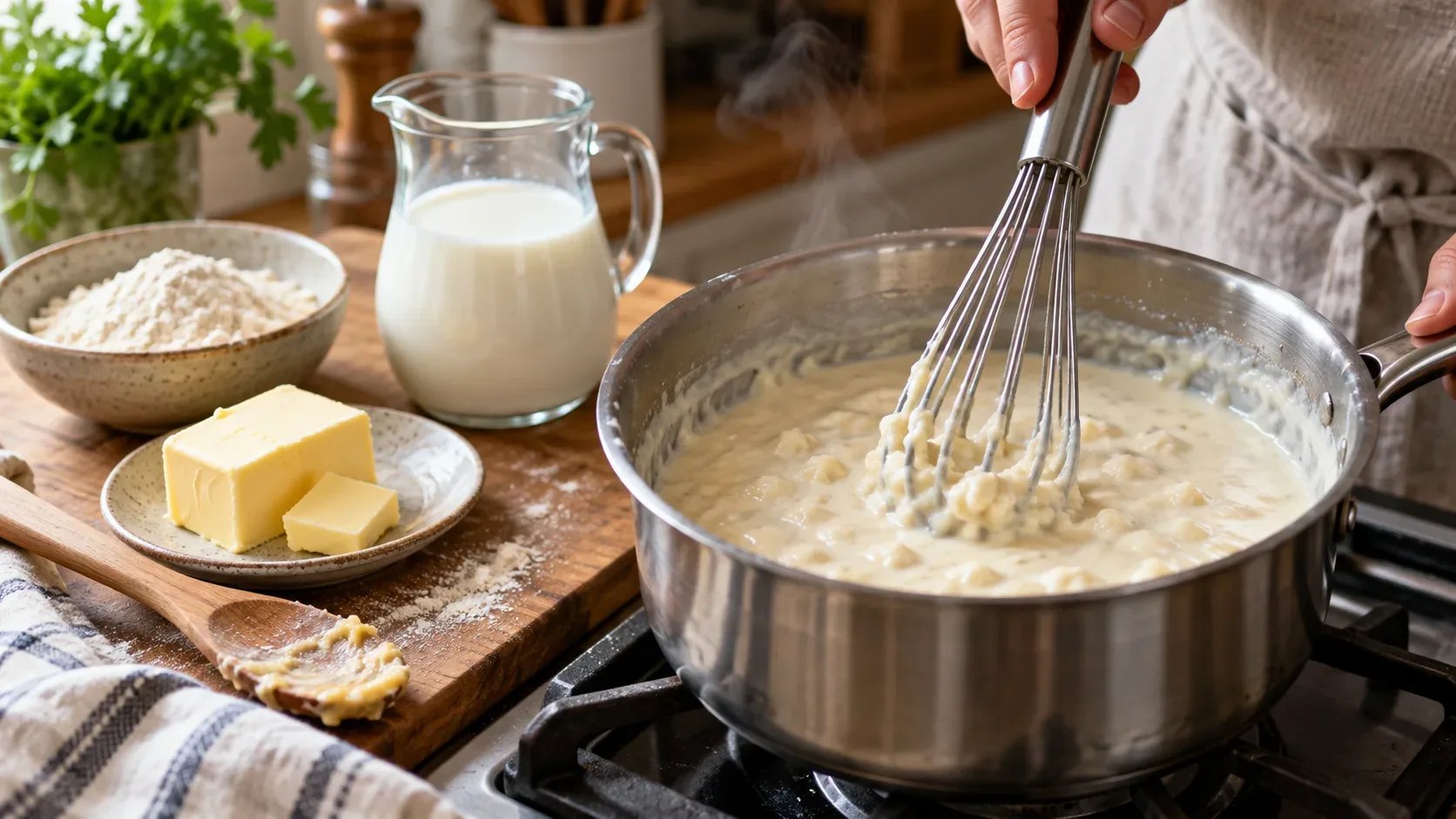
If the lumps showed up during the first additions of milk, take the pan off the heat for a moment and work the mixture with a whisk. Add only a small amount of milk and whisk until you have a smooth paste before adding more. This matters because a very thick roux takes liquid more reliably in stages: you reduce the chance of leaving dry flour pockets or pieces of roux that never disperse.
If all the milk is already in and the sauce is fluid but dotted with small lumps, keep whisking over moderate heat. Many lumps break down as the sauce heats and is stirred continuously. If only a few remain, pass the sauce through a fine-mesh sieve for an even texture. The Culinary Institute of America instructs cooks to add milk gradually, whisking or stirring to work out lumps, then bring the sauce to a boil before reducing it to a simmer.
Three rescue routes, depending on the stage
| Situation | Best first attempt | What to check afterward |
|---|---|---|
| The roux turned into an uneven mass as soon as the first milk went in | Take it off the heat, add a little milk, and whisk vigorously until smooth; then continue with small additions. | The base should be homogeneous before the next portion of liquid goes in. |
| The sauce is already formed but has a few lumps | Whisk over moderate heat and, if needed, pass it through a fine-mesh sieve. | After straining, return it to the pan to finish cooking the flour. |
| There are many persistent lumps | Use an immersion blender briefly, keeping the blade fully submerged to reduce splashing; strain afterward if you want a finer finish. | Return to low heat and cook gently until the raw-flour taste is gone. |
Why roux forms lumps when liquid is added
Roux is a cooked mixture of fat and flour made before the liquid is added. In a classic white sauce, the fat coats and disperses the flour particles. When milk is whisked in gradually, that dispersion is maintained and the starch thickens the mixture relatively evenly.
Trouble starts when a large amount of liquid hits roux that has not yet dispersed well. The outside of small clusters thickens before the inside can dissolve, creating pockets that are difficult to break apart. That is why the first liquid addition is usually the most critical: the goal is not to make the sauce thin quickly, but to turn the roux into a smooth base that gradually becomes more fluid.
There is no single universal temperature rule that prevents lumps on its own. Professional methods can work with hot or cold liquid, provided the incorporation and agitation are appropriate. Professional Cooking, for example, notes that hot liquid gelatinizes the starch quickly and therefore requires vigorous beating; cool liquid can be used to dissolve the roux before the rest is added. It is more useful to control pace, dispersion, and heat than to memorize “cold milk always causes lumps” or “hot milk always fixes them.”
The most common mistakes — and the clue each one leaves
- Flour and butter were not fully combined: the roux already contains dry spots or pieces that reappear once the milk is added.
- Milk was added too quickly: small balls of roux appear during the first or second addition.
- Not enough whisking: the mixture thickens unevenly around the pan and forms lumps before it becomes homogeneous.
- Heat is too high: the sauce nearest the bottom thickens too fast and may stick or scorch before the rest smooths out.
- Too much roux for the amount of milk: the sauce becomes overly thick or pasty. That is a ratio issue, not necessarily a lump issue.
- Too little cooking after thickening: the texture may look smooth, but the raw-flour taste remains.
After removing the lumps, the sauce still needs to cook
Straining or blending fixes texture, but it does not replace cooking. After rescuing the sauce, return it to the pan and bring it to a controlled boil or gentle simmer, stirring often. The aim is to finish hydrating the starch, stabilize the texture, and reduce the floury taste.
The exact time varies with quantity and recipe. Professional references commonly continue cooking the sauce gently for several minutes after it thickens. More important than following a rigid number is checking three signs: the texture is smooth, the sauce coats a spoon, and the raw-flour flavor has disappeared.
When masking the problem is not worth it
Cheese, cream, nutmeg, and other seasonings can improve the flavor of a properly made sauce, but they do not repair the structure of a lumpy one. Adding cheese before fixing the base can create a second problem: cheese exposed to excessive heat can make the mixture grainy or greasy, making it harder to tell whether the failure came from the roux or from the cheese emulsion.
Fix the béchamel first. Only then adjust salt, pepper, nutmeg, cheese, or the other ingredients in your recipe.
A simple method to prevent lumps next time
- Melt the butter over low to medium heat.
- Add the flour and mix until there are no dry pockets. Cook the roux without letting it darken too much when the goal is a white sauce.
- Add a small portion of milk and whisk until the mixture is completely smooth.
- Add the next portion only after the previous one is incorporated. As the mixture becomes more fluid, the additions can become larger.
- Keep the bottom of the pan moving with a whisk or spatula so the sauce does not thicken and scorch in isolated spots.
- Once all the milk is incorporated, bring the sauce to a controlled boil, then reduce the heat and cook until the texture stabilizes and the raw-flour flavor disappears.
Quick diagnosis: lumps, thickness, or raw flour?
| Sign | Most likely cause | Fix |
|---|---|---|
| Visible pale lumps in the sauce | Poorly dispersed roux or liquid added too quickly | Whisk, strain, or blend; then return to the heat. |
| Smooth sauce that is simply too thick | Too much roux, too much reduction, or too little milk | Whisk in milk gradually until you reach the desired consistency. |
| Smooth sauce with a floury taste | Not enough cooking after the starch thickened | Cook longer over low heat, stirring. |
| Burnt smell or flavor | The sauce scorched on the bottom | Transfer without scraping the burnt layer; if the burnt flavor has spread through the sauce, starting over is the better quality choice. |
Technical sources consulted
The guidance on gradual incorporation, whisking, and continued cooking is consistent with materials from the Culinary Institute of America and the Professional Cooking textbook. For rescuing already-lumpy sauces, the immersion-blender technique is also described in culinary testing by The Kitchn. A classic preparation using gradual milk addition and continued cooking is available from the Food Network.