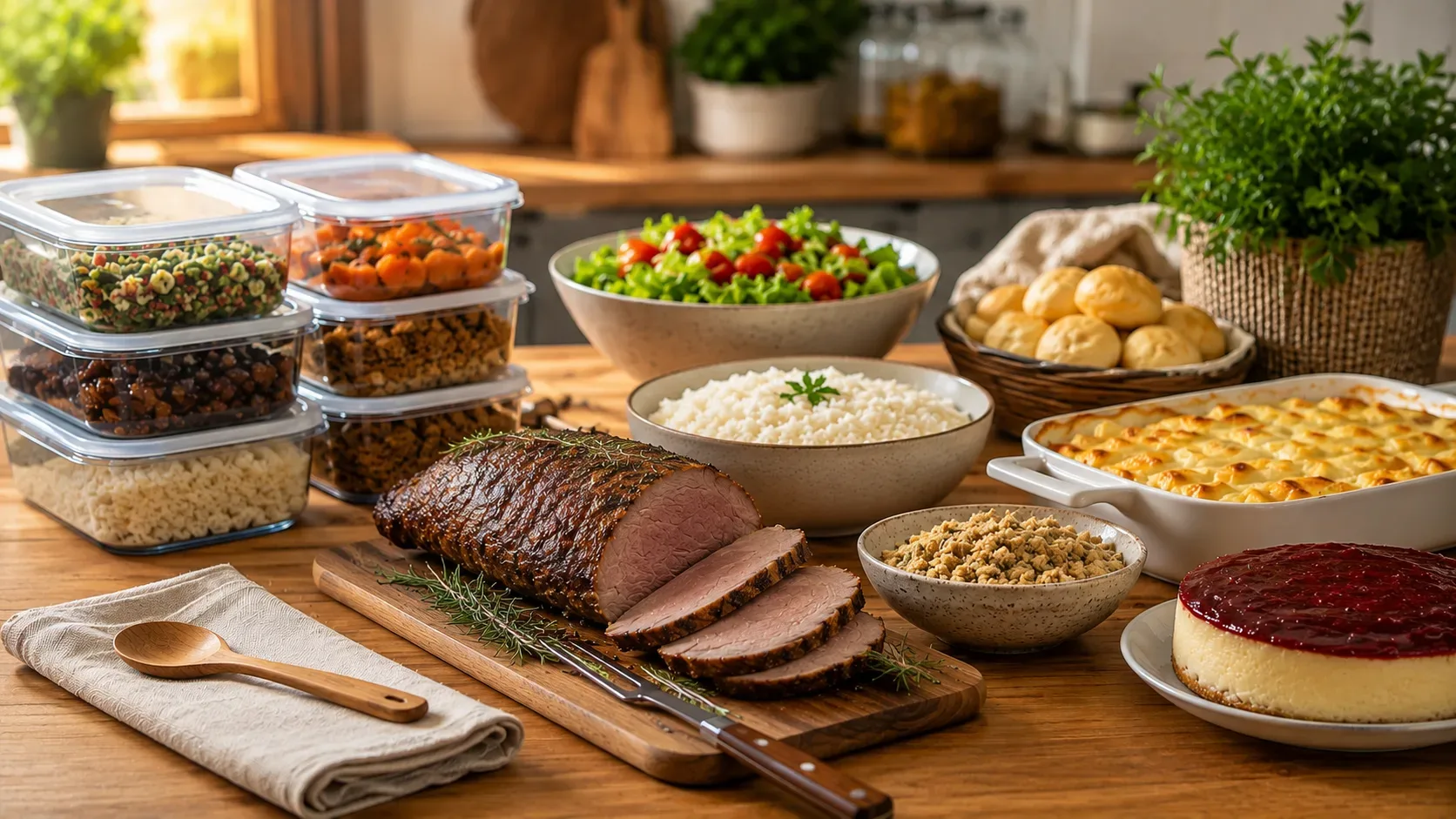
The menu fits in the kitchen. The risk lies in the order of tasks and the time that meat, side dishes and leftovers spend outside the refrigerator.
For lunch at 1 pm on Sunday, August 9, 2026, the safest way is to work backwards: first define what needs to arrive hot at the table, reserve the last oven time and only bring forward preparations that tolerate refrigeration or freezing.
The schedule below starts on Thursday, August 6th. He considers six adults, a domestic oven and a refrigerator capable of keeping food below 5°C. If lunch starts at a different time, shift Sunday's tasks by the same interval.
A flexible menu that doesn't fight for the entire oven
The framework works with different recipes. The important thing is to limit the number of preparations that rely on the oven in the 60 minutes before lunch.
A practical combination is:
- a main roast;
- rice cooked on the stove;
- a side dish that can be assembled in advance and finished in the oven;
- a sauce, beans or pan preparation;
- a salad kept refrigerated;
- a dessert prepared in advance.
This way, the roast occupies the oven first. When it comes out to rest, the accompaniment comes in to brown or heat up. Rice and sauce stay on the stove, while the salad stays in the fridge until it's close to service.
Reference quantities for six people
Amounts below are planning estimates, not nutritional prescriptions. Adjust according to your guests' appetite, the presence of children and the number of side dishes.
| Component | Per person basis | Approximate total for 6 |
|---|---|---|
| Boneless roast | 250 to 300 g raw | 1.5 to 1.8 kg |
| Roast with bone | 350 to 400 g raw | 2.1 to 2.4 kg |
| Rice | 60 to 70 g raw | 360 to 420 g |
| Vegetables, potatoes or gratin | 180 to 220 g | 1.1 to 1.3 kg |
| Salad | 100 to 120 g | 600 to 720 g |
| Farofa, sauce or other complement | 50 to 70 g | 300 to 420 g |
| Dessert | 1 portion | 6 servings and 1 reserve |
To recalculate, multiply the amount per person by the number of guests. A lunch for eight, for example, requires approximately 1.33 times the amounts indicated for six.
The temperatures that control the schedule
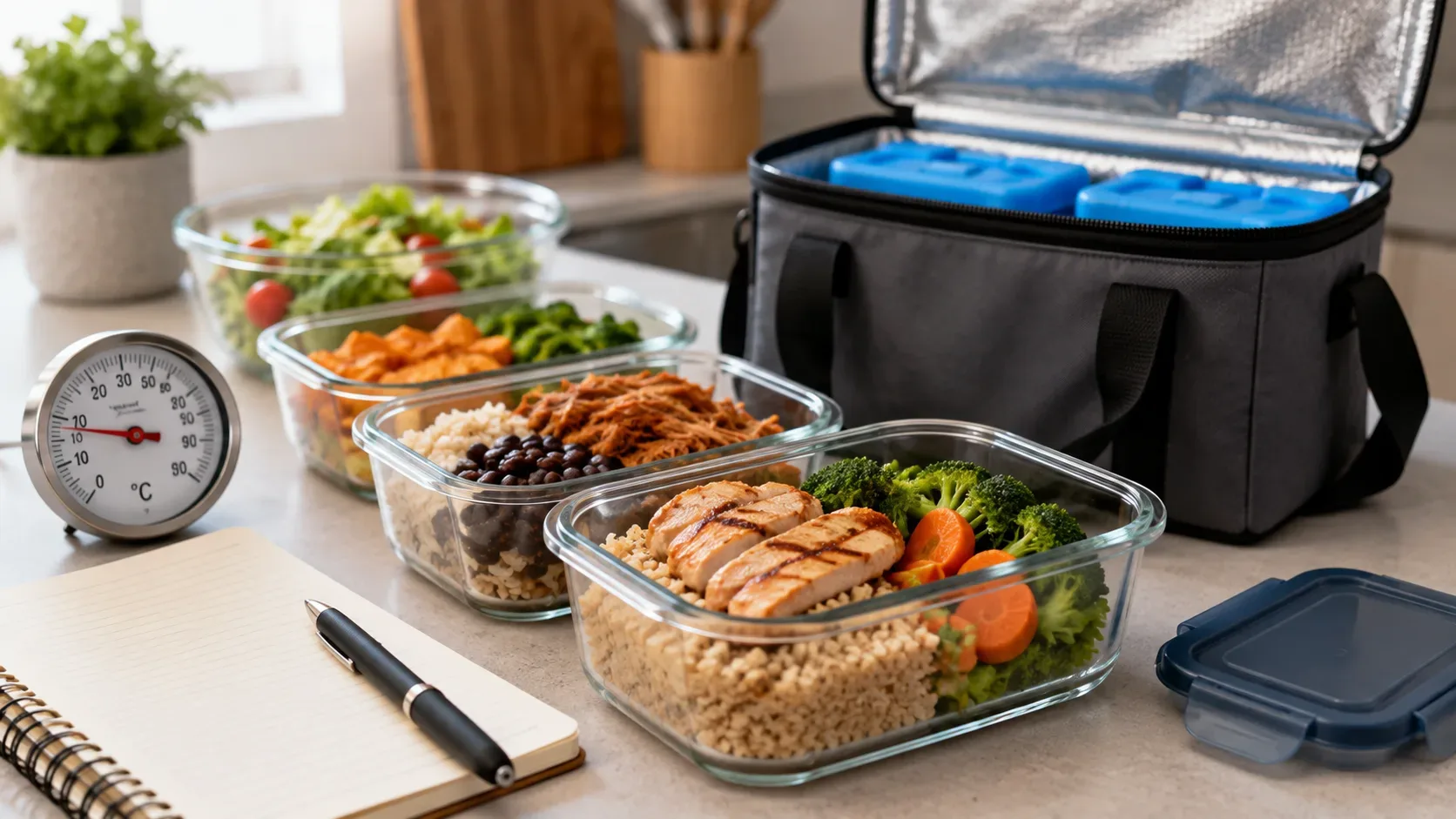
Before purchasing the ingredients, check that the refrigerator is operating below 5°C. A cooking thermometer also helps confirm the center of roasts, platters, and reheated foods.
As an operational reference:
- cold preparations must remain below 5°C;
- hot preparations on hold must remain above 60°C;
- the center of cooked or reheated food must reach at least 70°C;
- when cooling, the temperature must drop from 60°C to 10°C within two hours and then remain below 5°C or continue to freeze;
- meat and other frozen foods should thaw in the refrigerator, below 5°C, or in the microwave when cooked immediately.
These parameters come from RDC 216/2004, aimed at food services, and from domestic guidelines from Anvisa and the Ministry of Health. In this plan, they are used as a conservative reference for organizing a residential kitchen.
The regulatory limit of up to six hours above 60°C should not be treated as a domestic target. To preserve safety and quality, finish preparations as close to lunch as possible.
Schedule from Thursday to Sunday
The plan considers service at 1 pm. Roast oven times need to be adjusted to the cut, weight, recipe and equipment performance. Don't estimate the point just by the clock: confirm the temperature in the thickest part, without touching the thermometer to the bone.
| Date and time | Task | Critical point |
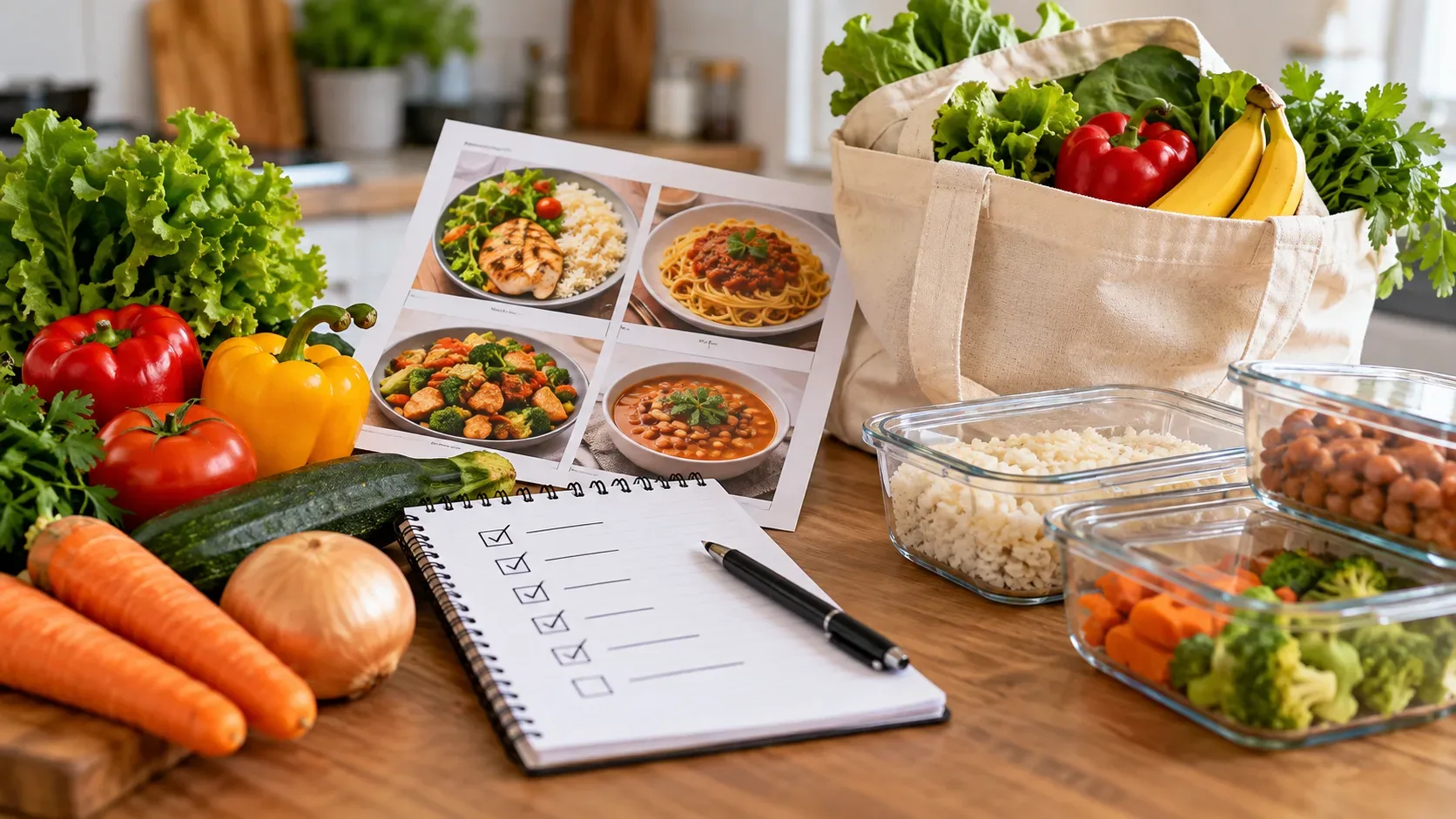
| Thursday, 6/8 — 10:30am | Confirm guests, dietary restrictions and menu. Calculate quantities. | Ask directly about allergies before shopping. |
| Thursday — 11am | Make room in the refrigerator and check the temperature. Separate jars and labels. | The refrigerator needs to keep perishables below 5°C. |
| Thursday — 3pm to 6pm | Do the shopping. Leave meat, dairy, cold and frozen foods until last. | Check the validity, conservation and integrity of the packaging. |
| Thursday — upon arrival | Place perishables immediately. Place raw meat in a closed container, below ready-made foods. | Prevent liquids from raw products from reaching other ingredients. |
| Friday, 7/8 — 6pm | Prepare cooked sauce, beans, broth or other item that accepts freezing. | Quickly cool, divide into portions, identify and freeze. |
| Friday — 7:30 pm | Prepare a cooked or baked dessert that can withstand refrigeration. | Avoid recipes with raw eggs. Keep refrigerated and covered. |
| Friday — 8pm | Move the roast from the freezer to the refrigerator, when applicable. | Large pieces may require more than 24 hours. Also follow the label. |
| Saturday, 8/8 — 9am | Check if the roast has defrosted and check ingredients. | Do not finish defrosting on the counter. |
| Saturday — 10am | Cleanse leaves, vegetables and fruits with a product suitable for food. Dry well. | Follow the label for the dilution and contact time of the sanitizer. |
| Saturday — 2pm | Cut salad ingredients and store separately from the dressing. | Keep everything covered and refrigerated. Season only on Sunday. |
| Saturday — 4pm | Assemble the oven accompaniment without finishing. Prepare seasonings and utensils. | Do not leave the dish or perishable ingredients on the counter. |
| Saturday — 6pm | Organize the oven queue, separate serving dishes and print the schedule. | The roast goes in first; monitoring occupies the last time. |
| Sunday, 9/8 — 8:30am | Check refrigerator, countertop, thermometer and utensils. | Only remove what will be handled at that moment. |
| Sunday — 9am | Preheat the oven and start roasting, according to the recipe time. | Do not wash the meat. Avoid contact between raw utensils and ready-made foods. |
| Sunday — 10:45am | Remove sauce, beans or broth from the freezer and begin reheating. | Heat completely, checking at least 70°C in the center. |
| Sunday — 11:15am | Start the rice and organize the stove burners. | Once ready, keep covered and warm, above 60°C. |
| Sunday — 11:30 am to 11:45 am | Check the roast. Remove when it reaches the safe point and let it rest covered. | Confirm the temperature in the thickest part. |
| Sunday — 11:45am | Place the gratin, potatoes or vegetables in the oven. | The refrigerated dish must heat up completely, including in the center. |
| Sunday — 12:20pm | Slice the roast, adjust the sauce and check the accompaniments. | If there is a wait, keep hot dishes above 60°C. |
| Sunday — 12:35 p.m. | Season the salad and transfer cold preparations to the table. | Remove cold dishes from the refrigerator as close to service as possible. |
| Sunday — 12:45 p.m. | Make the last temperature check and place the serving utensils. | Use a unique utensil for each preparation. |
| Sunday — 1pm | Serve lunch. | Avoid leaving dishes on the table for unnecessary time. |
| Sunday — 2pm | Start collecting, portioning and identifying leftovers. | Don't wait for large pans and dishes to cool by themselves on the counter. |
| Sunday — until 2:30 pm | Place the portions in the refrigerator or freezer. | Use smaller containers to speed up cooling. |
Anvisa recommends not washing meat, separating raw food from cooked food, using sanitizer recommended for food and keeping hot preparations above 60°C and cold below 5°C.
How to cool it without leaving the pan on the counter for hours
The common mistake is to keep a large pan at room temperature until it feels cold. This prolongs the passage through the range in which microorganisms can multiply.
To facilitate cooling:
- Divide the preparation into smaller, shallower containers.
- Remove bones from large pieces before storing leftovers.
- Leave space between the containers for cold air to circulate.
- Identify each pot with name, date of preparation and expiration date.
- Do not overcrowd the refrigerator with several large, hot pans at the same time.
It is not necessary to wait for the food to be completely cold before placing it in the refrigerator. The Ministry of Health advises storing preparations without waiting for complete cooling, preferably in smaller portions.
If the quantity is too large to cool within the allotted time, distribute it into more containers. A deep, full dish cools more slowly than smaller portions.
Reheating: hot in the center, not just around the edges
Sauces, beans, rice, meats and gratins must be reheated completely. Stir the pan preparations to distribute the heat and measure the center of the dishes.
Use 70°C throughout as the operating target. Once this temperature has been reached, serve immediately or keep the food above 60°C. Don't mix cold leftovers into an already hot pan just to “make up” the volume.
To reduce heating and cooling cycles, remove from the refrigerator only the portion that will be consumed. The rest remains refrigerated.
Allergies need to be included in the planning before shopping
Ask the six guests if they have food allergies and which ingredients should be avoided. Read the list of ingredients and allergen warnings on packaging, including broths, sauces, ready-made seasonings, farofas and desserts.
Anvisa defines cross-contamination by allergens as the accidental presence of a substance that was not added intentionally, but came into contact with the food during production or handling.
In a shared kitchen, the prudent course of action is:
- separate the ingredients intended for the allergic person;
- sanitise countertop, hands and utensils before preparation;
- prepare and cover the adapted option first;
- do not reuse oil, cutting boards, spoons or baking trays that have come into contact with the allergen;
- keep packaging and labels for reference;
- do not promise that a dish is “free from” a certain allergen when it is not possible to control cross-contact.
In case of severe allergies, the menu and preparation must be confirmed directly with the person or their guardian. Professional review is recommended when there is doubt about ingredients or risk of reaction.
How long to store leftovers
RDC 216 establishes, for food services, a maximum period of five days for prepared food kept at 4°C or less, with a reduction in the period when the temperature is between 4°C and 5°C. More recent domestic guidance from Anvisa recommends consuming leftovers from gatherings within three days when kept below 4°C. For this lunch, adopt the more conservative limit of three days.
Identify the jars on Sunday and plan to consume any refrigerated leftovers by Wednesday, August 12. Anything not included in this plan must be frozen as soon as it has been cooled properly.
The Ministry of Health informs that prepared foods kept below 60°C must be consumed within 60 minutes. So, start collecting the table as soon as everyone is finished, instead of leaving the dishes exposed throughout the afternoon.
If there is any doubt about how long a preparation has remained out of temperature control, the safest course is to discard it.
For other ideas for using and organizing the kitchen, see Cozinha que rende.
Print the schedule, write down the actual lunch time next to it and multiply the quantities by the number of guests. The gain is not in cooking everything in advance, but in anticipating what can be stored safely and reserving Sunday for what needs to arrive fresh and hot at the table.