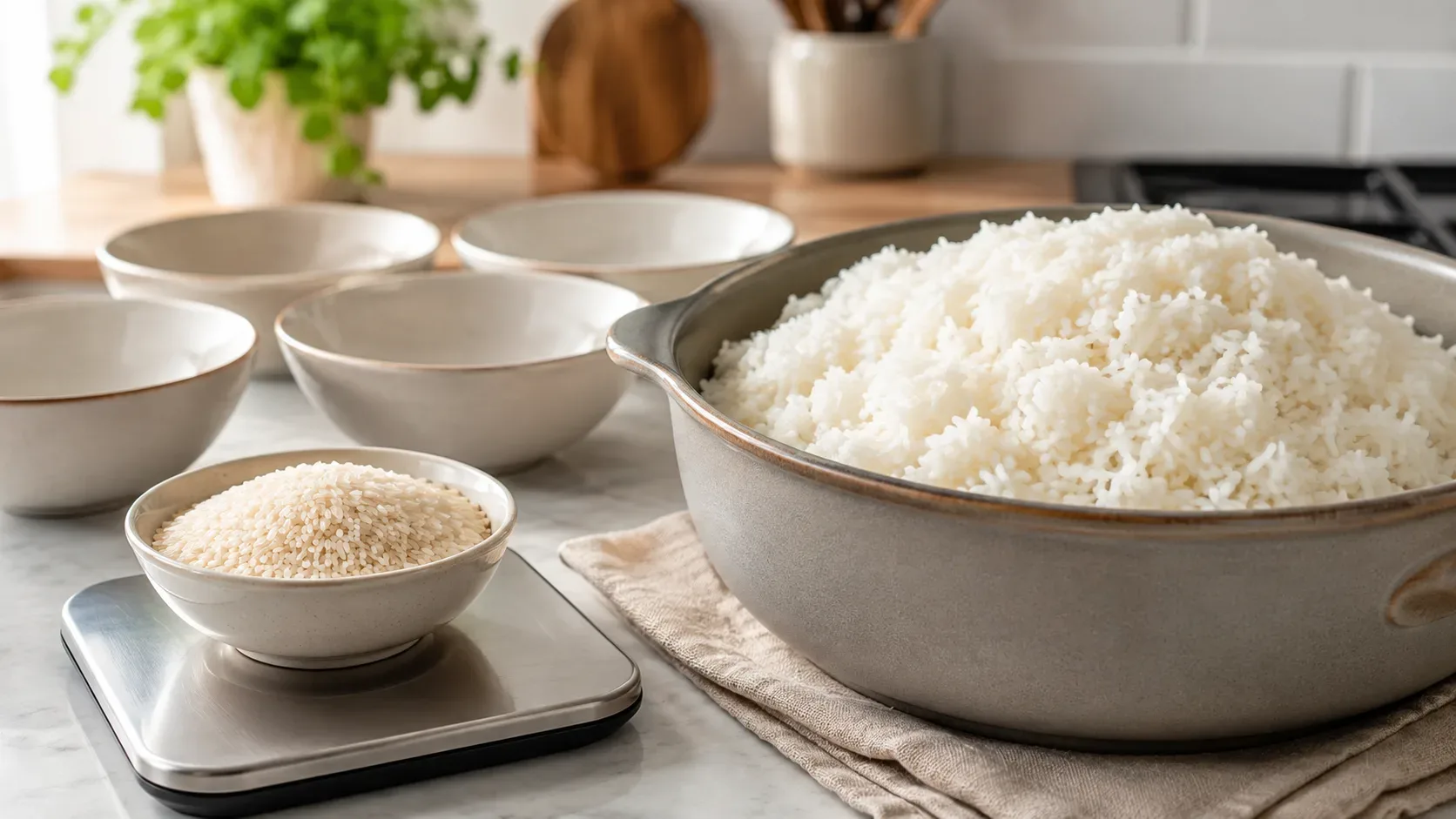
100 g of uncooked rice does not always turn into the same amount after cooking. Final weight depends on how much water is retained, the cooking method, time, evaporation, and the recipe itself. In three standardized preparations from the Brazilian Food Composition Table (TBCA), the data allow an estimate of roughly 200 to 250 g of finished rice preparation for every 100 g of uncooked rice. This range is a planning reference, not a universal rule.
Quick answer: how much does 100 g of uncooked rice yield?
For white rice cooked in a typical home setting, a practical starting point is to expect around 2 to 2.5 times the uncooked weight and then measure your own yield. That range appears when the rice amount in standardized TBCA recipes is scaled, but it is important to understand what the published yield factors actually mean.
TBCA records, for example, one preparation with a yield factor of 2.29 and another with a yield factor of 1.65. Those figures do not mean that 100 g of uncooked rice directly becomes 229 g or 165 g. The factor applies to the entire preparation, including seasonings and other ingredients. When the ingredient tables are scaled by the amount of uncooked rice, the two cited recipes correspond to about 246 g and 249 g of finished preparation per 100 g of uncooked rice. A third recipe without oil or salt, with a yield factor of 1.33, comes to about 200 g of finished preparation per 100 g of uncooked rice.
Why does rice weigh more after cooking?
The main reason is water absorbed during cooking. In TBCA, raw white rice contains about 12.9 g of moisture per 100 g, while cooked white rice without oil or salt contains about 66.9 g of moisture per 100 g. These records are not a before-and-after test of the same batch, so they cannot by themselves provide an exact conversion; they simply show why cooked rice weighs much more: much of the gain is water.
What actually changes the yield
- Amount of water: more retained water tends to increase final weight; discarded or evaporated water reduces yield.
- Pot, lid, and heat level: these change evaporation during cooking.
- Cooking and resting time: grains continue redistributing moisture after the heat is turned off.
- Rice type and method: white, brown, parboiled, pilaf-style, drained rice, and other methods should not automatically share the same factor.
- Added ingredients: oil, onion, garlic, salt, and seasonings also contribute to the weight of the finished preparation.
How to run a rice yield test at home
The best number for meal planning is the factor from your pot, using the rice brand and method you normally use.
- Weigh 100 g of uncooked rice.
- Cook it exactly as usual, noting the amount of water and other ingredients.
- After your normal resting time, weigh only the cooked rice or finished preparation, subtracting the pot weight.
- Calculate: yield factor = cooked weight ÷ uncooked weight.
Example: if 100 g uncooked becomes 235 g cooked, your factor is 2.35. If another batch ends at 220 g, the factor is 2.20. Repeating the test two or three times helps separate one-off variation from the normal pattern of your method.
How to calculate uncooked rice per person
Instead of starting with a fixed rule such as “x grams of uncooked rice per person,” it is more reliable to decide how much cooked rice you want to serve and work backward using your yield factor.
For cooked white rice without oil or salt, TBCA lists a full serving spoon as 55 g and a full tablespoon as 20 g. Household utensils vary, so weighing your own spoon once is useful if you want more precise planning.
The formula is:
uncooked rice needed = number of people × desired cooked portion ÷ yield factor
| Cooked rice target | Factor 2.0 | Factor 2.2 | Factor 2.5 |
|---|---|---|---|
| 110 g per person (about 2 TBCA serving spoonfuls) | 55 g uncooked | 50 g uncooked | 44 g uncooked |
| 165 g per person (about 3 TBCA serving spoonfuls) | 82.5 g uncooked | 75 g uncooked | 66 g uncooked |
| 4 people × 110 g = 440 g cooked | 220 g uncooked | 200 g uncooked | 176 g uncooked |
| 4 people × 165 g = 660 g cooked | 330 g uncooked | 300 g uncooked | 264 g uncooked |
These rows are not a nutrition prescription. They are planning examples: choose the cooked amount that fits the meal and apply the factor you measured at home.
If you have not measured your own factor yet
For a first estimate of white rice similar to the cited preparations, using a range of 2.0 to 2.5 is safer than treating the familiar “1 to 3” rule as automatic. If the meal cannot risk running short, use the conservative side of the calculation—a lower factor, which requires more uncooked rice—and record the leftovers. Adjust the next batch from the real result.
The most common mistake: using a recipe yield factor as a rice multiplier
This detail explains why apparently conflicting numbers can coexist in TBCA. In the preparation with a 2.29 factor, the ingredient list includes 40.77 g of uncooked rice, seasoning, and salt. In the preparation with a 1.65 factor, there are 40 g of uncooked rice, 20 g of a water-and-garlic seasoning, plus salt. Because the denominator is the mass of all recipe ingredients, two different yield factors cannot be compared as if they were “uncooked rice multipliers.”
To answer the practical question “how much does 100 g of rice yield?”, you must isolate the rice amount inside each recipe or, better still, run a direct test in your own kitchen.
Shortcut for any quantity
- Uncooked to cooked: uncooked weight × factor = estimated cooked weight.
- Cooked to uncooked: desired cooked weight ÷ factor = uncooked weight needed.
- For several people: people × cooked portion ÷ factor = total uncooked rice.
If your home factor is 2.35, for example, 300 g of uncooked rice yields about 705 g cooked. To obtain 1 kg of cooked rice, the reverse calculation is 1,000 ÷ 2.35, or about 426 g of uncooked rice.
Sources and method
The calculations above use TBCA records for raw white rice, cooked white rice, and three standardized recipes. Yield factors were treated as factors for the full recipe, not as direct conversions of the rice ingredient.
- Raw white rice — TBCA: https://www.tbca.net.br/base-dados/int_composicao_alimentos.php?n0REd3kv7e86D%2BViXWYUnQ%3D%3D=IuWNWJLGLyCVKxGOsgJTsg%3D%3D
- Cooked white rice and household measures — TBCA: https://www.tbca.net.br/base-dados/int_composicao_alimentos.php?n0REd3kv7e86D%2BViXWYUnQ%3D%3D=2AzHNNWifINK%2Bp7xdNbzVA%3D%3D
- Standardized recipe, factor 2.29 — TBCA: https://www.tbca.net.br/base-dados/int_composicao_estatistica.php?n0REd3kv7e86D%2BViXWYUnQ%3D%3D=BWTVBd4A8y%2BdhCvcILNxZw%3D%3D
- Standardized recipe, factor 1.65 — TBCA: https://www.tbca.net.br/base-dados/int_composicao_estatistica.php?n0REd3kv7e86D%2BViXWYUnQ%3D%3D=ZFRAupe0BC5DGGHmNWgb1g%3D%3D
- Standardized recipe, factor 1.33 — TBCA: https://www.tbca.net.br/base-dados/int_composicao_estatistica.php?n0REd3kv7e86D%2BViXWYUnQ%3D%3D=QJRnxlKBOG6UbsBcPsBuvQ%3D%3D