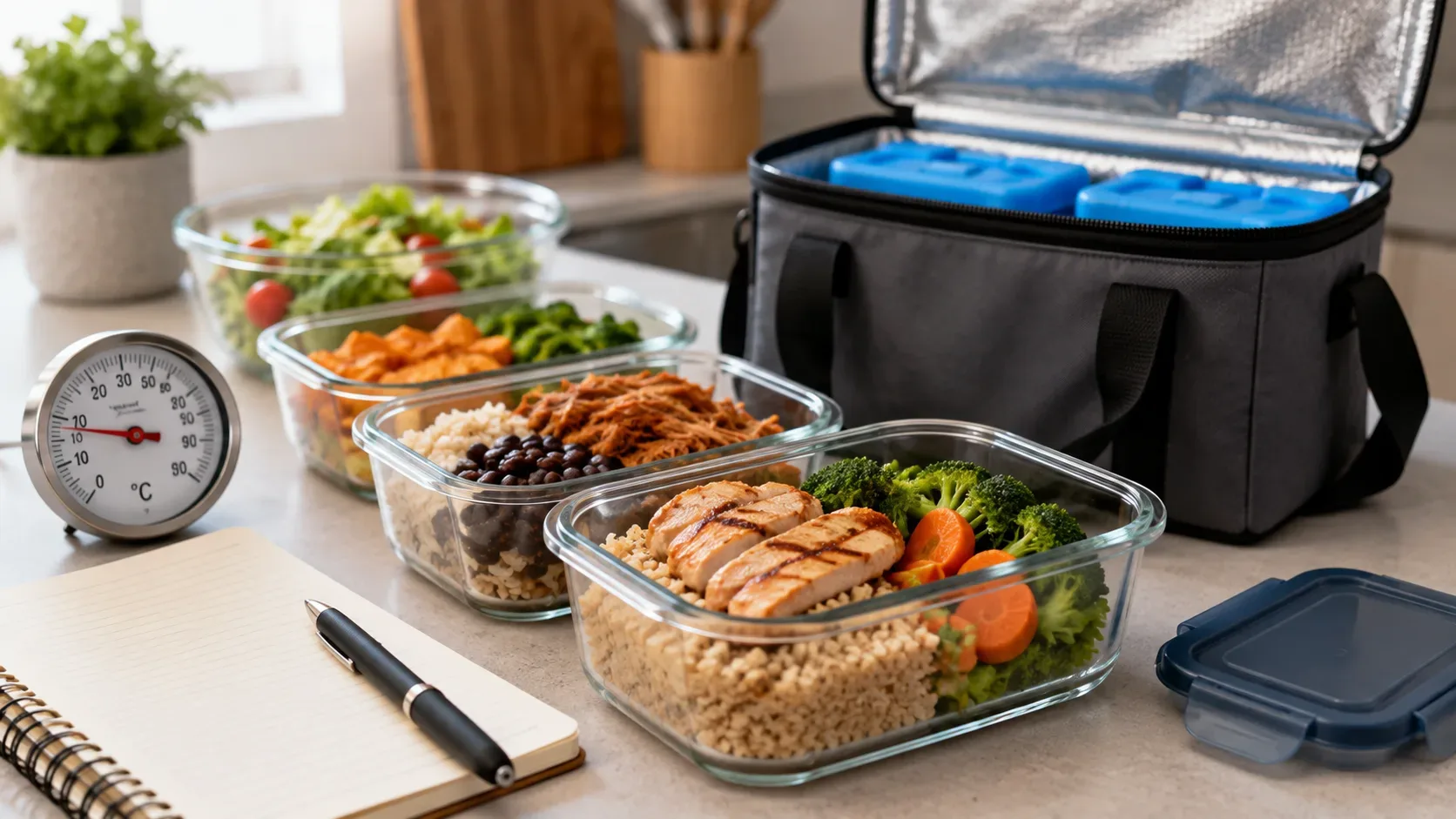
In weekly meal planning, the clock starts ticking whenever a perishable food comes out of refrigeration or is no longer kept piping hot. There is no different safe period for each recipe just because one contains rice, another chicken and another vegetables: what determines the conduct is the combination between temperature, time, handling and cooling speed.
For domestic use, the simplest reference is: perishable foods should not remain at room temperature for more than two hours. For freshly cooked foods that are already below 60 °C, the Ministry of Health adopts more restrictive guidance: consumption within 60 minutes. In environments above approximately 32°C, official international references reduce the general limit to one hour. These deadlines should not be added together; The first limit reached is always valid.
In practice, safe weekly planning should work with an operational target of up to 60 minutes between the end of cooking and the portions entering the cooling process. The two hours work as a maximum limit for domestic exposure situations, not as the recommended time for leaving pans cooling on the counter.
Quick answer: how long can you stay out?
| Situation | Limit or safety condition | Recommended conduct |
|---|---|---|
| Ingredients raw or refrigerated during preparation | Only for the minimum necessary time | Remove from the refrigerator in small batches and immediately return what is not used |
| Freshly cooked food, below 60°C and without refrigeration | Up to 60 minutes for consumption, according to the Ministry of Health | Serve immediately or start portioning and cooling immediately |
| Perishable leftovers or preparations at room temperature | Up to two hours as a general household limit | Refrigerate before the limit; discard when time is exceeded |
| Very hot environment, closed car or place above around 32°C | Up to one hour, as a complementary international reference | Use a thermal box or reduce the distance and exposure time |
| Food kept warm | Above 60 °C; food services can keep it that way for up to six hours | Only consider “kept warm” when the temperature is effectively controlled |
| Food kept cold | Below 5°C | Keep in the refrigerator or in a thermal container with a source of cold |
| Cooling hot food | From 60°C to 10°C in up to two hours | Divide into shallow containers and then bring to below 5°C or freeze |
| Transport without temperature control | One or two hour limits apply | Count the time since the food left the safe range |
RDC nº 216, of September 15, 2004, determines for food services that perishable ingredients are only exposed for the minimum time necessary. It also provides for hot holding above 60°C for up to six hours, cooling from 60°C to 10°C within two hours, and subsequent storage below 5°C or freezing at −18°C or below. Although the standard focuses on food services, these parameters are a useful technical reference for organizing the domestic process.
Weekly preparation flowchart
1. Before You Begin: Organize to Reduce Exposure
Separate clean containers, lids, labels, utensils and refrigerator space before removing perishable ingredients. Work in batches: use some of the pre-cut meat, dairy, eggs or vegetables while the rest remains refrigerated.
Official Brazilian guidance does not assign a universal number of minutes to this stage. It determines that perishable products remain at room temperature only for the minimum time necessary for preparation. Therefore, it is not safe to create an arbitrary rule like “meat can sit for 30 minutes” or “salad can sit for an hour” without considering the actual temperature and kitchen conditions.
Flow:
Ingredients in the refrigerator
→ only remove the batch that will be handled
→ prepare
→ cook or immediately return to refrigeration
→ never leave the rest waiting on the counter
It's also important to keep raw foods separate from cooked ones and use clean utensils before touching finished portions. Anvisa reinforces this separation in both handling and storage.
2. After cooking: serve or cool
Once the food has finished cooking, there are two safe ways to go:
Path A — immediate consumption
Keep the preparation above 60 °C until serving. The reference of up to six hours above this temperature is intended for temperature-controlled operations, such as food services. A pan that is turned off or an oven that is just warm does not guarantee this control.
If food is no longer being kept above 60°C, the Ministry of Health's foodborne illness prevention page advises that cooked food be consumed within 60 minutes.
Path B — storage for the week
Start cooling immediately. Do not leave the pan on the counter until all contents have reached room temperature.
The Brazilian technical goal is to reduce the temperature from 60 °C to 10 °C within two hours and then keep the food below 5 °C or freeze it at −18 °C or below.
Flow:
End of cooking
→ decide that the food will be stored
→ divide into small, shallow portions
→ start cooling without prolonged waiting
→ reach 10°C within two hours
→ keep below 5°C or freeze
How to cool it without leaving the pan on the counter for hours
Large, deep containers retain heat in the center for longer. Therefore, food safety agencies recommend dividing large quantities into smaller, shallow containers, which accelerates heat loss. The FDA also advises that perishable foods be refrigerated within two hours and that large volumes of leftovers be separated before refrigerating.
In the home kitchen, follow this sequence:
- Divide soups, beans, rice, meats, sauces and other preparations into smaller containers.
- Avoid immediately stacking hot containers.
- Leave space for cold air to circulate in the refrigerator.
- Use shallow containers whenever possible.
- Identify each portion with the preparation name, date and planned consumption period.
- Freeze the portions intended for the end of the week immediately.
Small warm portions can be placed in the refrigerator without waiting for them to cool completely. The biggest problem is inserting a bulky and very hot pan, which takes time to cool in the center and can raise the surrounding temperature. The CDC recommends spreading hot food into several clean, shallow containers so it cools more quickly.
Portioning is part of cooling
Portioning should not be an activity left for hours later. In weekly planning, this step needs to happen right after cooking, because every minute spent with food spread out on the counter is part of the exposure time.
An efficient sequence is:
remove from heat → divide into portions → identify → refrigerate or freeze.
RDC No. 216 requires that stored prepared foods be identified with the name, preparation date and expiration date, in addition to temperature monitoring. At home, etiquette also prevents an old serving from being confused with a newer preparation.
As a conservative operating rule, sum all periods outside the safe range. Ten minutes during portioning, an additional 30 minutes on the table, and an additional 40 minutes in an ice-free bag represent 80 minutes of exposure. Placing food in the refrigerator between one step and another should not be used to mentally “reset” the clock.
Is a whole week in the fridge a good idea?
No. Planning for seven days does not mean that all meals must remain refrigerated for seven days.
RDC nº 216 establishes a maximum period of five days for prepared food kept at 4 °C or less in food services. However, more recent domestic guidance from Anvisa, published on December 19, 2025, recommends consuming leftovers within three days when kept below 4°C.
For household planning, the most prudent strategy is:
- Refrigerator: portions for the day of preparation and the following three days.
- Freezer: portions intended for other days.
- Defrosting: in the refrigerator, below 5°C, or in the microwave when the food is heated or cooked immediately.
- Countertop: never use to defrost perishable foods.
The five-day limit is not a universal guarantee for any recipe or home refrigerator. Preparations with more sensitive ingredients, equipment without adequate control or hygiene failures may require a shorter period of time. The label of an industrialized ingredient may also establish more restrictive conditions after opening.
Transportation: the lunch box remains in the flow
Transportation is not a neutral step. Food needs to come out of the refrigerator at the last possible moment and remain cold during transportation.
Anvisa's booklet advises the use of well-closed and identified containers and, when transport takes a long time, appropriate thermal boxes. RDC nº 216 determines that time and temperature are controlled during storage and transport.
For cold lunchboxes:
- refrigerate completely before transporting;
- use a bag or thermal box;
- keep the preparation below 5°C;
- put it in the fridge as soon as you arrive at your destination;
- do not leave your bag in a parked car or in direct sunlight.
As a supplement, the United States Department of Agriculture's Food Inspection Service recommends at least two cold sources in perishable meal pouches, positioned above and below the food. The recommendation was updated on March 7, 2025.
For hot meals, use a thermal container capable of keeping the preparation at 60 °C or more. Without proper measurement or equipment, don't assume that food remains in the hot range just because the packaging is still warm.
If there is no temperature control, apply the clock:
out of refrigerator or loss of safe heat
→ transport
→ waiting
→ consumption
= total time outside safe range.
Under normal conditions, do not exceed two hours. In a hot car, beach, outdoor area or environment above approximately 32°C, use one hour as a limit.
When the preparation should be discarded
Discard food when:
- remained at room temperature for more than two hours;
- stayed for more than an hour in an environment above approximately 32 °C;
- was cooked, dropped below 60°C and remained uneaten or cooled for more than 60 minutes;
- did not reach 10 °C within the two hours scheduled for cooling;
- arrived at destination without refrigeration and it is not possible to confirm how long it remained outside the safe range;
- was transported without a source of cold and exceeded the exposure limit;
- there was contact between ready-made food and utensil, surface or liquid from raw food.
Freezing after the limit does not correct the previous exposure. The decision should be made by time and temperature history, not by the intention of consuming the food only several days later.
Final flowchart to save
PREPARATION
Is the perishable ingredient refrigerated?
→ Yes: only remove the necessary batch
→ handle with clean utensils
→ avoid contact between raw and ready
→ cook or return to the refrigerator
AFTER COOKING
Are you going to consume it now?
→ Yes: keep it above 60°C or consume it within 60 minutes after losing this condition
Will you store it?
→ Yes: start cooling immediately
→ divide into shallow containers
→ reduce from 60°C to 10°C within two hours
→ refrigerate below 5°C or freeze
PORTIONING
Are portions identified?
→ preparation name
→ date
→ planned deadline
→ refrigerator for the next three days
→ freezer for the rest of the week
TRANSPORTATION
Can you keep it below 5°C or above 60°C?
→ Yes: transport in a thermal container and refrigerate upon arrival
→ No: count the total time outside the safe range
→ general limit of two hours
→ limit of one hour in an environment above approximately 32°C
Frequently asked questions
Can I wait for the food to cool completely before putting it in the fridge?
No need to wait for small portions to reach room temperature. Divide the food into shallow containers and start cooling immediately. Leaving a large pan on the counter for hours defeats the purpose of quickly reducing the temperature.
Does the two-hour time limit start again after the food is returned to the refrigerator?
For home control, treat time as accumulated. This is a conservative decision based on the fact that the risk accompanies the total period at temperatures favorable to microbial multiplication, and not the number of times the container has been in and out of the refrigerator.
Can I prepare seven days of lunches at once?
You can prepare them, but it is not recommended to keep them all refrigerated for seven days. Use the refrigerator for the first portions and freeze those intended for the rest of the week. Anvisa recommends, for household leftovers below 4°C, consumption within three days.
Is an empty thermal bag enough?
No. The bag reduces heat exchange, but needs adequate cold sources to keep perishable foods below 5°C. As a complementary measure, use two reusable ice cubes or an equivalent combination and take the lunch box already refrigerated.
Save this flowchart with your weekly meal plan and record the time the first preparation comes off the heat. Watching the clock is as important as choosing the ingredients.