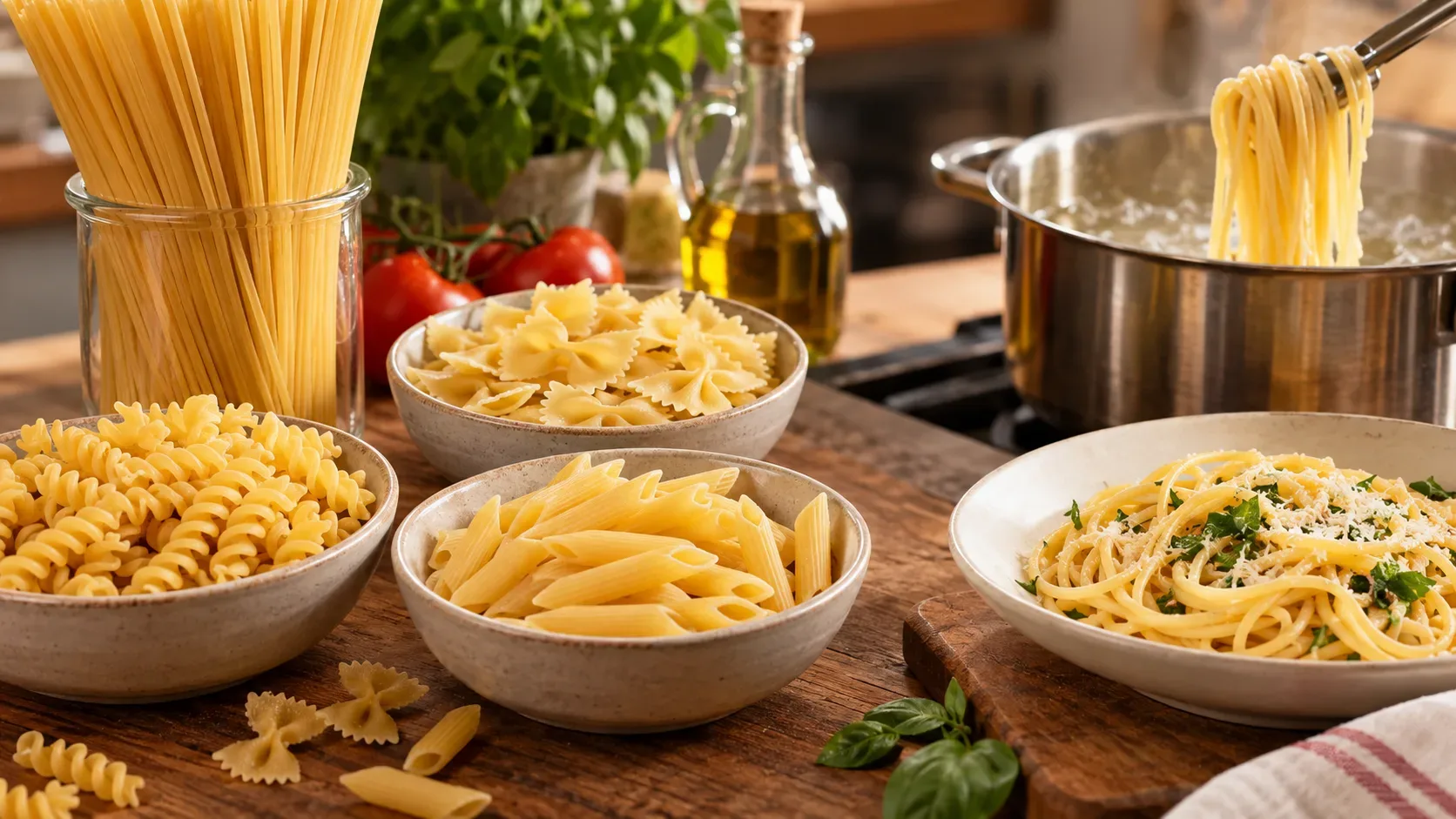
Short answer: to calculate dry pasta without running short or making too much, weigh it before cooking. Barilla uses 56 g, or 2 oz, of dry pasta per person as a general rule of thumb. For a main meal, the British Nutrition Foundation gives 75 g of dry pasta as an example adult portion. Because the right amount depends on the rest of the meal, this guide uses 45 g per person for a side dish as a planning point and 75 g per person when pasta is the main dish.
Shape mainly changes volume, not the basic calculation. In Barilla's chart, 56 g of spaghetti yields about 1 cup cooked, while 56 g of penne or farfalle yields about 1 1/4 cups. That is why two portions with the same dry weight can look quite different after cooking.
How much dry pasta to calculate per person
| Role in the meal | Dry amount per person | How to use it |
|---|---|---|
| Side dish | 45 g | A practical planning point for meals with protein, vegetables, bread, salad, or other sides. |
| Manufacturer reference | 56 g | Barilla's general rule of thumb for one dry pasta portion. |
| Main dish | 75 g | An example adult portion used by the British Nutrition Foundation for dry pasta. |
These are planning references, not universal serving rules. Appetite, age, activity level, sauce, protein, and the number of side dishes all affect how much a person actually eats.
Manual calculator for 2, 4, and 6 people
To estimate cooked volume, the table below uses two shortcuts: common long shapes such as spaghetti, linguine, and fettuccine are close to 1 cup cooked for every 56 g dry; common short shapes such as rotini, elbows, penne, and farfalle are roughly 1 to 1 1/4 cups cooked for every 56 g. There are exceptions, so the package information is the best reference when greater precision is needed.
| Use | People | Dry pasta | Long pasta, estimated cooked volume | Common short pasta, estimated cooked volume |
|---|---|---|---|---|
| Side dish | 2 | 90 g | 1.6 cups | 1.6 to 2.0 cups |
| Side dish | 4 | 180 g | 3.2 cups | 3.2 to 4.0 cups |
| Side dish | 6 | 270 g | 4.8 cups | 4.8 to 6.0 cups |
| Main dish | 2 | 150 g | 2.7 cups | 2.7 to 3.3 cups |
| Main dish | 4 | 300 g | 5.4 cups | 5.4 to 6.7 cups |
| Main dish | 6 | 450 g | 8.0 cups | 8.0 to 10.0 cups |
The cups above follow the U.S. measure used by the source, about 240 ml. Because short pieces fill a measuring cup differently, weighing the dry product remains more reliable than measuring by volume.
How shape changes yield
The comparison below shows why dry pasta cannot be converted to cups with a single rule. The values come from Barilla's yield chart for a 56 g dry serving.
| Shape | Approximate dry measure for 56 g | Cooked yield |
|---|---|---|
| Spaghetti | Best weighed; Barilla uses a bundle measured by circumference | 1 cup |
| Elbows | 1/2 cup | 1 1/8 cups |
| Farfalle | 3/4 cup | 1 1/4 cups |
| Penne | 2/3 cup | 1 1/4 cups |
| Rotini | 1/2 cup | 1 cup |
This explains a common situation: 300 g of penne and 300 g of spaghetti have the same dry weight, but the penne usually takes up more space in the serving bowl after cooking.
The simplest formula for any number of people
Dry pasta grams = number of people x grams per person.
Then, if you want to estimate the finished volume: cooked cups = dry grams ÷ 56 x the shape's yield per 56 g.
Example: for 4 people with pasta as the main dish, using 75 g per person, calculate 4 x 75 = 300 g of dry pasta. For spaghetti, the estimate is 300 ÷ 56 x 1, or about 5.4 cups cooked. For penne, 300 ÷ 56 x 1.25 gives about 6.7 cups cooked.
Why weighing dry pasta is better than judging the pot
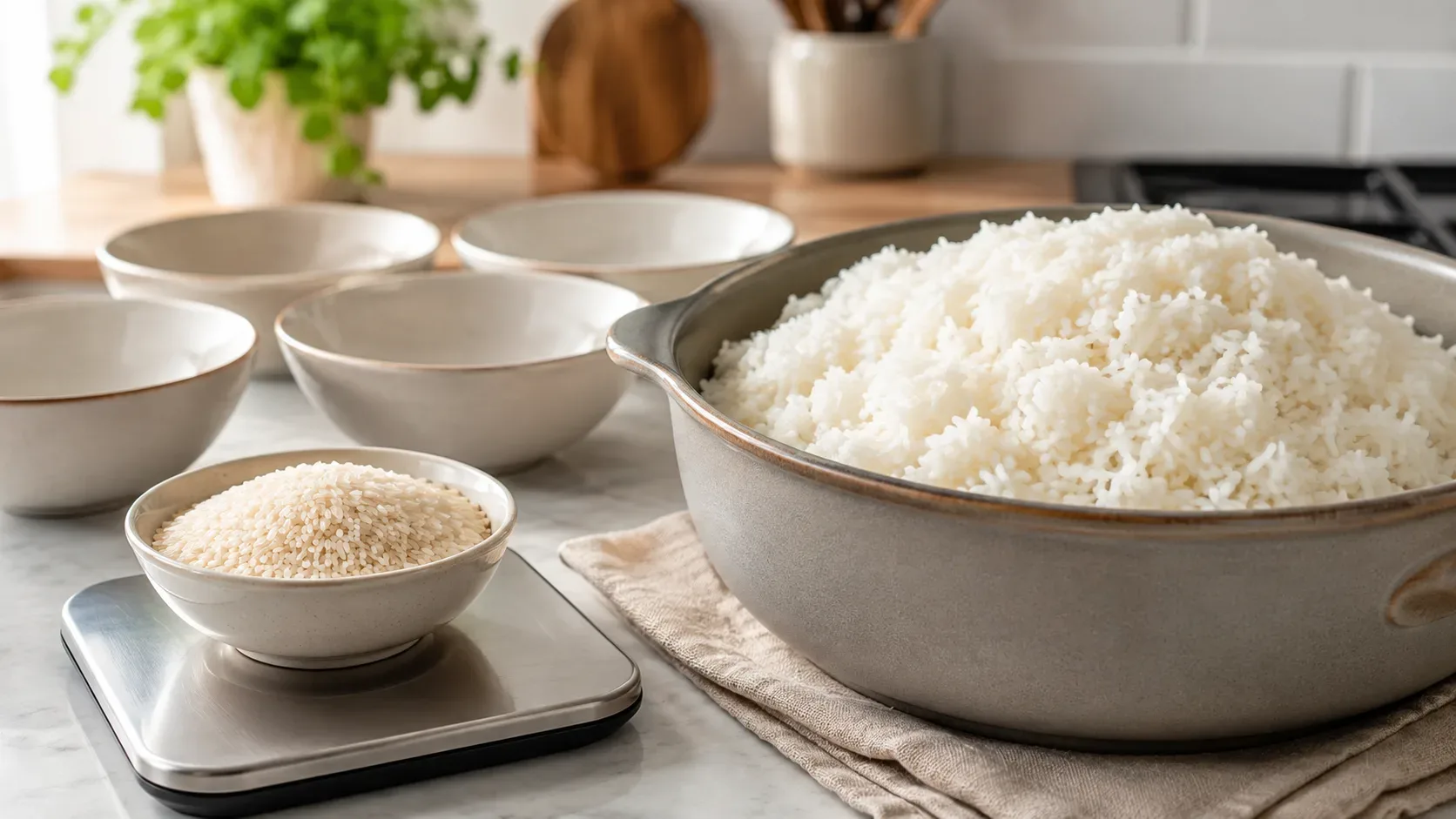
Pasta absorbs water during cooking. The British Nutrition Foundation, for example, presents 75 g dry pasta and 180 g cooked pasta as corresponding references. That does not mean every pasta always absorbs exactly the same amount of water. Cooking time, shape, thickness, composition, and draining all change the result.
The USDA Food Buying Guide also treats yields as planning averages and notes that cooking method, product, and service can change actual yield. In practice, dry weight is the most stable number for deciding how much to buy and cook; cooked volume is more useful for estimating how much space the finished pasta will occupy.
How to adjust the amount without running short or wasting food
- Meal with several side dishes: start around 40 to 50 g of dry pasta per person.
- Pasta as the main dish: 75 g per person is a useful adult starting point, then adjust for the group.
- Bulky sauce with protein and vegetables: the pasta amount can move closer to the side dish range.
- Big appetites or planned leftovers: increase the chosen base by about 10% to 15% instead of adding a full extra portion per person.
- Very large, stuffed, or unusual shapes: check the package because volume yield can fall well outside the ranges used in this calculator.
Which number should you use in practice
If you only need a quick rule, use 56 g per person as a neutral manufacturer reference. If pasta is the center of the meal, 75 g per person is a more suitable adult planning base. If it is only a side dish, 45 g per person helps reduce leftovers without making the portion token-sized.
For precise cooking, weigh the dry pasta. To plan serving dishes, storage containers, and visual yield, use the cooked-cup formula and adjust for the shape.
Sources for the numbers
Barilla, Pasta Serving Size, Dry & Cooked: 56 g reference and shape-specific yields.
British Nutrition Foundation, Portion sizes: 75 g dry pasta adult example and cooked pasta reference.
USDA Food Buying Guide: guidance on using average yields as a planning tool.