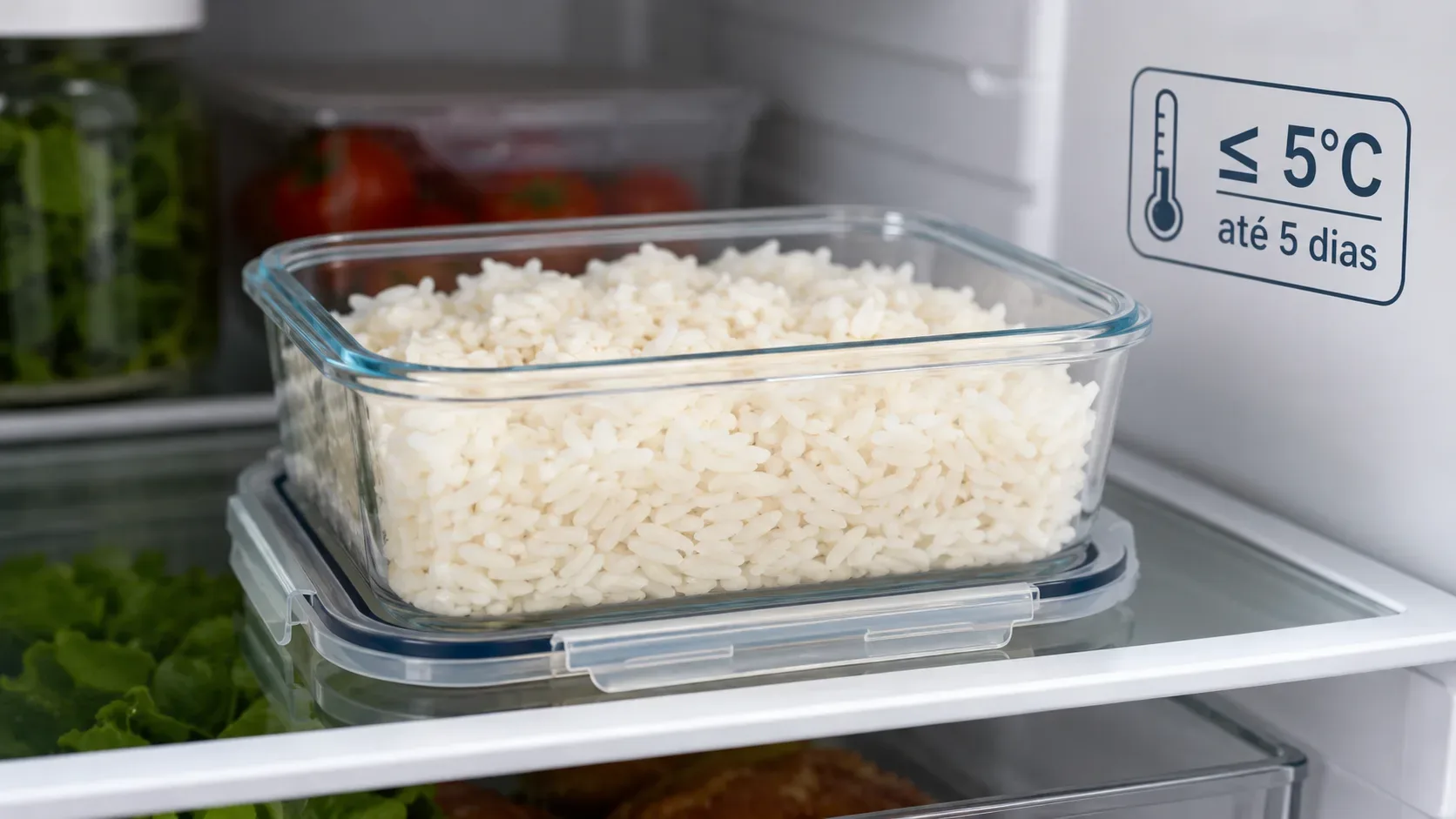
Cooked rice should not spend hours cooling on the counter. The safer approach is to divide leftovers into smaller, shallow containers, refrigerate them promptly, and keep the refrigerator cold. Brazil's Anvisa advises keeping cooked and perishable foods below 5 °C and gives a general maximum of five days for refrigerated prepared food. RDC 216/2004 adds an important condition: the five-day limit applies when storage is at 4 °C or below; between 4 °C and 5 °C, the storage period must be shortened.
Short answer: what to do with rice after cooking
- Do not wait for the whole pot to become cold. Separate the rice you plan to store as soon as cooking or the meal is finished.
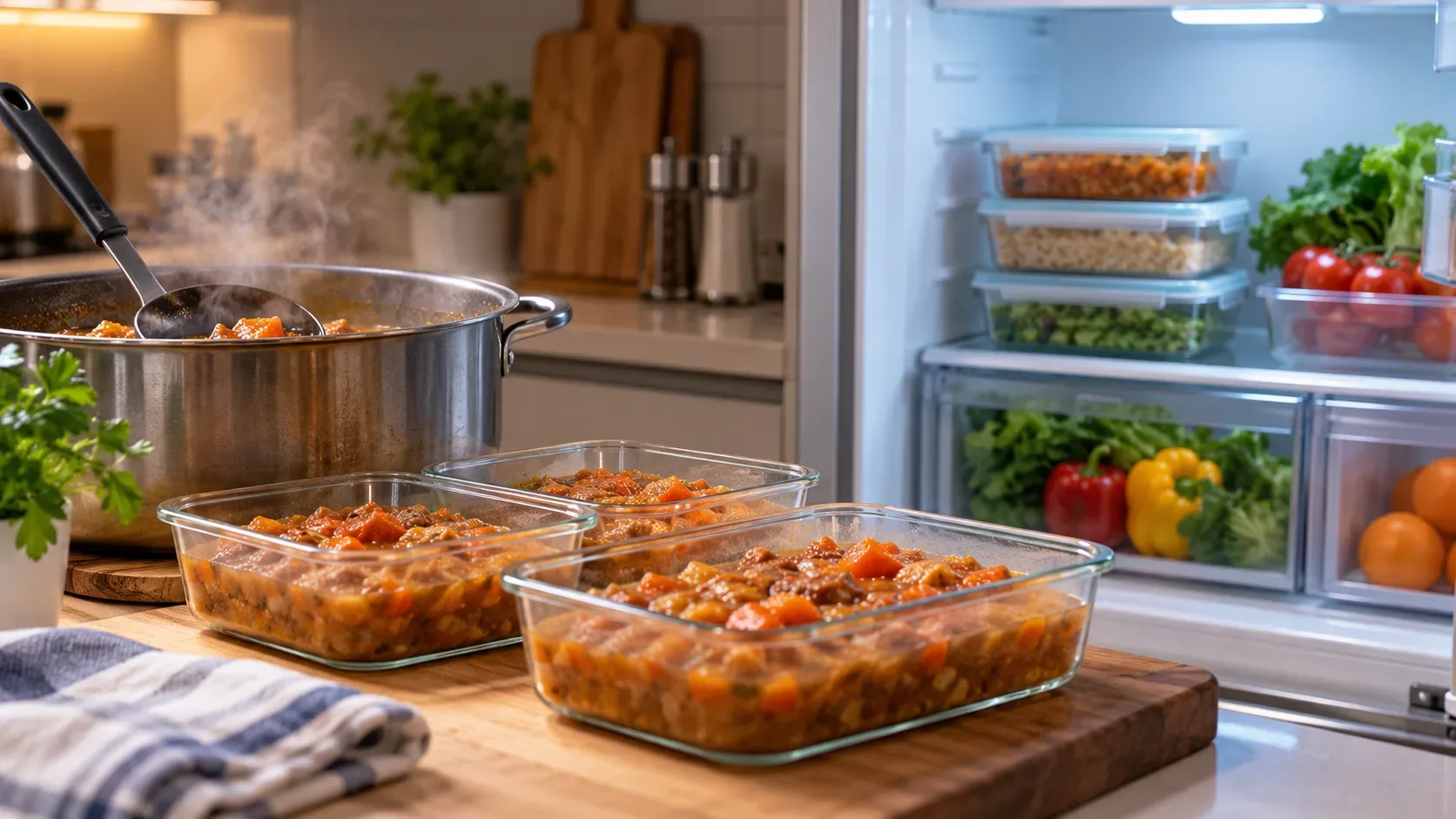
- Divide it into smaller portions and shallow containers. This speeds heat loss. The USDA recommends shallow containers to cool leftovers quickly.
- Refrigerate without delay. As a food-safety reference, perishable foods should not remain at room temperature for more than two hours; in very hot conditions, the window is even shorter.
- Keep the refrigerator below 5 °C, ideally at 4 °C or below. Mark the preparation date on the container.
- Use it early. Five days is a Brazilian regulatory ceiling for prepared food held at 4 °C or below, not a guarantee that any batch of rice will be safe through day five.
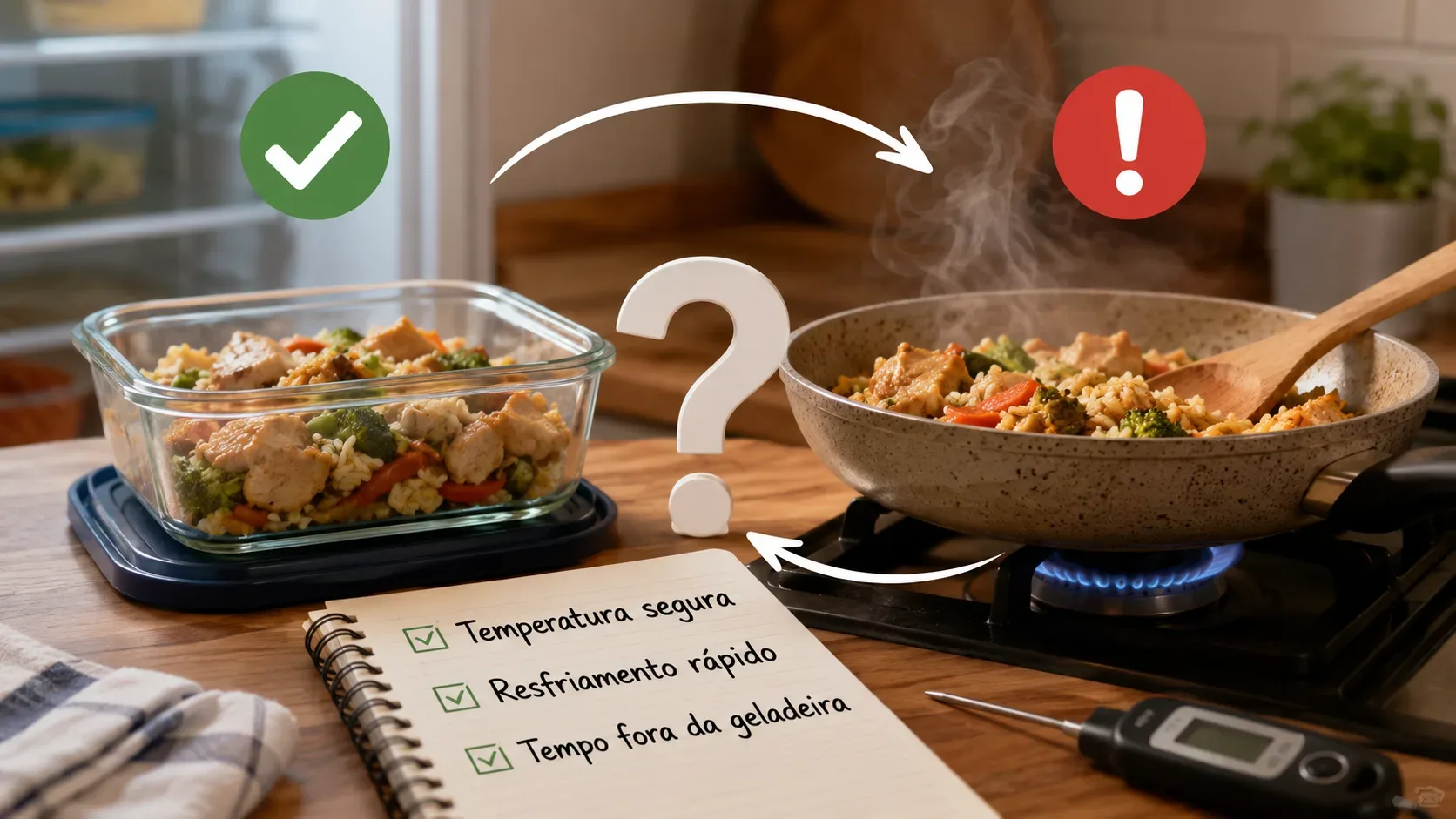
- If time or temperature is uncertain, discard it. Reheating does not fix improper storage.
Why cooked rice deserves special attention
The classic hazard associated with rice is Bacillus cereus, a spore-forming bacterium that can occur in grains and other foods. Cooking kills many bacterial cells, but some spores may survive. If cooked rice remains long enough at favorable temperatures, those spores can germinate, bacteria can multiply, and some strains can produce toxins.
The FDA notes that rice and pasta are among the foods in which B. cereus and its spores are found, and that the emetic toxin cereulide can resist heat. That is why the safety strategy is not “I will just heat it very well later.” The main controls happen before reheating: rapid cooling and proper refrigeration.
How to cool rice without leaving it on the counter for hours
A common mistake is leaving a large pot of rice at room temperature “until it cools.” A large mass loses heat slowly at its center. To shorten that time, transfer the rice to one or more shallow containers in portions that match how you will use it later. If you have a large batch, use more containers instead of creating a thick layer.
For food-service operations, RDC 216 uses a technical cooling benchmark: reduce prepared food from 60 °C to 10 °C within two hours, then keep it refrigerated below 5 °C or freeze it. At home, you are unlikely to measure that cooling curve precisely, but the principle is useful: do not prolong the food's time at temperatures that favor microbial growth.
You do not need to wait until rice reaches room temperature before refrigerating it. For normal household quantities, smaller containers help the refrigerator remove heat more efficiently. Avoid putting one very large, very hot pot on a shelf, however: portioning is what makes cooling faster and more predictable.
How to store rice in the refrigerator and count the days
Use clean, food-safe containers with lids. Label the preparation date, especially if you cook rice for several days at a time. The clock starts on the day the rice was cooked, not on the day you remembered to label it.
| Situation | Safer action |
|---|---|
| Refrigerator at 4 °C or below | Use five days as the maximum under the Anvisa reference for prepared food; eating it sooner is more prudent. |
| Refrigerator between 4 °C and 5 °C | Shorten the storage time. RDC 216 does not support automatically applying the full five days in this range. |
| Refrigerator temperature unknown or fluctuating | Do not rely on the nominal day count. Check the temperature with a thermometer and be conservative with leftovers. |
| Rice stayed unrefrigerated for more than two hours | Discard it, especially if time and temperature were not reliably controlled. |
| You do not know how many days ago the rice was cooked | Discard it. An unknown date removes the main way to control the risk at home. |
Authorities differ on storage windows. The USDA uses 3 to 4 days as its general guidance for refrigerated leftovers. That is more conservative than the five-day ceiling in the Brazilian reference. At home, there is little benefit in trying to “win” an extra day: if you will not eat the rice soon, freezing fresh portions is usually the simpler choice.
Smell, appearance and texture: discard signals, not a safety test
Mold, unusual sliminess, a strong color change, or an unpleasant odor are all sufficient reasons to throw rice away. The reverse is not true: rice that looks and smells normal is not necessarily safe.
The USDA explains that pathogenic bacteria generally do not change a food's taste, smell or appearance. Smelling the container therefore cannot reconstruct how long the rice spent outside the refrigerator or whether microbes multiplied. Never taste a spoonful “just to check” when the storage history is uncertain.
Thorough reheating matters, but it cannot erase an earlier mistake
When eating refrigerated rice, heat only the portion you need and make sure the heat reaches it evenly. In a microwave, spreading the rice out and stirring during heating helps reduce cold spots. The USDA uses 74 °C (165 °F) as a reference for reheating leftovers.
Do not use reheating as a rescue strategy for rice that was forgotten on the counter. Some toxins can resist heat, so food that has been mishandled may remain unsuitable even after it becomes very hot. The decision to discard should be based on the storage history, not only on the reheating temperature.
When to discard rice instead of trying to save it
- if the rice remained at room temperature for more than two hours or the unrefrigerated time is unknown;
- if it has exceeded the storage window you use for the refrigerator's actual temperature;
- if there was a power outage or refrigeration failure and you cannot confirm that the food stayed cold;
- if there is mold, an abnormal odor, slimy texture or other clear deterioration;
- if the container has no date and you cannot reconstruct when the rice was cooked.
When there is a reasonable doubt, discard it. The cost of a serving of rice is not worth accepting a risk that cannot be assessed by smell or taste.
A practical routine checklist
- when cooking or serving is over, separate what will be stored right away;
- use shallow containers and smaller portions to speed cooling;
- refrigerate promptly instead of letting the pot “cool on its own” for hours;
- check that the refrigerator is below 5 °C; to use RDC 216's five-day ceiling, keep it at 4 °C or below;
- label the preparation date;
- eat it early or freeze portions you will not use within a few days;
- reheat evenly and only the portion you plan to eat;
- do not treat smell, appearance, or a small taste as proof of safety.
Sources and limits of this guidance
The Brazilian references cited here are Anvisa's public guidance on prepared-food storage and RDC 216/2004, a regulation aimed at food-service operations. USDA and FDA guidance is used as complementary technical reference for household cooling, leftovers, and Bacillus cereus. People at higher risk of complications from foodborne illness should be even more conservative whenever storage conditions are uncertain.