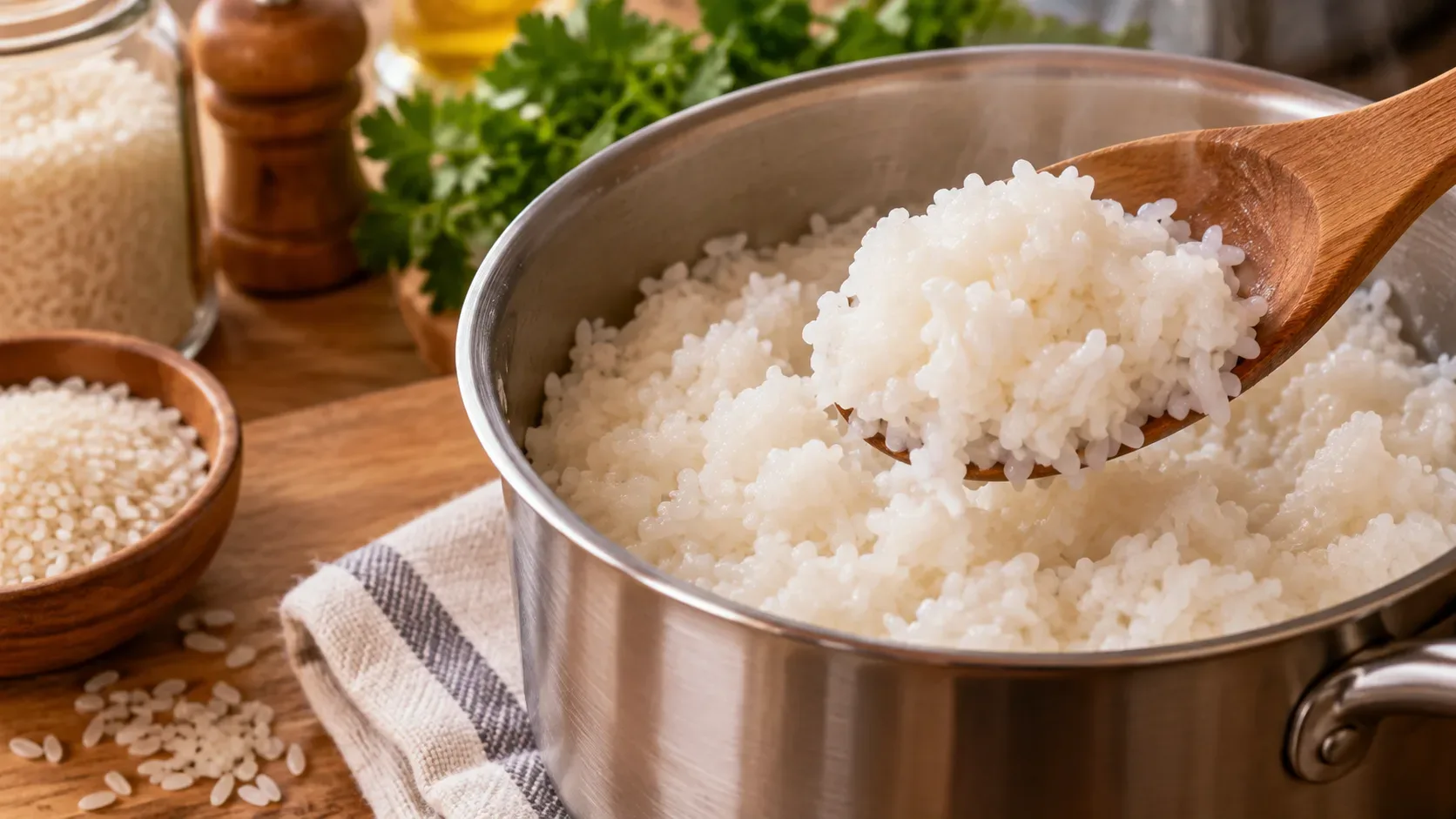
Mushy rice does not always mean the same thing. If there is still free water in the pot, the best move is to remove moisture; if the grains are intact but very sticky, the issue may be surface starch plus handling; if the grains are already split, deformed, or turning into a paste, the rice is overcooked and no technique can restore its original structure. At that point, the practical choice is to improve what can still be improved or repurpose the rice in another dish.
First, identify the problem
| Sign | Likely cause | Best response |
|---|---|---|
| Water is pooling at the bottom and the grain is already tender | Too much liquid or insufficient evaporation | Stop cooking, drain, and let moisture escape |
| There is no free water, but the grains are clumped and glossy | Surface starch, too much agitation, or trapped moisture | Stop stirring, spread out, and dry gently; rinse quickly only as a last resort |
| The grains are splitting, very swollen, or mash easily | Overcooking | Do not keep trying to “fluff” them; repurpose the rice in a dish that suits a soft texture |
This distinction matters because rice does not become sticky only because there is “too much water.” During cooking, starch absorbs water, swells, and gelatinizes; some of its components can migrate toward the surface and increase adhesion between grains. A review of rice starch chemistry describes this water uptake, swelling, and amylose leaching during gelatinization. See the scientific review.
If water is still in the pot, remove moisture before cooking longer
Once the grain is already tender, continuing to boil it just to “dry everything out” can turn excess water into true overcooking. In that situation, turn off the heat and avoid stirring.
- If there is a clear pool of water at the bottom, carefully drain the rice through a fine sieve.
- Let it drain thoroughly without pressing the grains.
- Return the rice to the still-warm pot and leave it uncovered off the heat, or spread it on a wide platter so steam can escape.
- If it remains wet, spreading it on a baking sheet and using low heat for a few minutes can help remove moisture. Receitas Globo also recommends draining and, when appropriate, drying mushy rice in a low oven. See the guidance.
If water remains but the center of the grain is still hard, the diagnosis is different: the rice may simply be undercooked. In that case, the priority is to finish cooking without agitating the pot rather than draining automatically.
If the rice is sticky but the grains are still intact
Here the goal is to reduce surface moisture without breaking more grains. Vigorous stirring tends to worsen the pasty feel because it increases friction, breaks grains, and spreads more starch over the surface. Educational material from the Federal University of Santa Catarina also connects agitation during cooking with grain breakage and amylose release. See the UFSC material.
- Stop stirring: use a fork or spatula only for minimal movement when transfer is necessary.
- Spread it in a thinner layer: a platter or baking sheet increases exposed surface area and helps steam escape.
- Use dry heat sparingly: a few minutes in a low oven can improve wet rice, but it cannot repair split grains.
- Rinse only in severe cases: quickly rinsing very sticky rice under cold water can remove surface starch, as Receitas Globo suggests, but it also cools the rice and may wash away salt and flavor. Drain very well before reheating.
Washing raw rice before cooking is not a universal rule either. The result depends on the rice variety, cooking method, and desired texture. For everyday fluffy white rice, follow a tested recipe or package instructions instead of assuming that one ratio or technique works for every grain.
If the grains are already breaking down, you cannot “uncook” them
When rice has gone past its ideal point, drying can reduce moisture, but it cannot rebuild lost structure. The clearest sign is a grain that mashes easily, loses its shape, or blends into neighboring grains like a paste.
At that stage, more stirring, aggressive frying, or extra time in the pot usually makes things worse. It is more efficient to change the dish. Useful options include:
- rice fritters or croquettes;
- baked rice with vegetables, cheese, or leftover proteins;
- fillings where a more cohesive texture is useful;
- creamy preparations where very soft grains are not a defect.
The Receitas Globo article on mushy rice likewise recommends transforming the preparation when the original texture cannot be recovered satisfactorily. See the suggestions.
What usually makes mushy rice worse
- Constant stirring: increases breakage and spreads starch.
- Keeping it boiling just to evaporate water after the grain is already tender: moisture may fall, but cooking continues.
- Using very high heat to “dry it fast”: the bottom can burn before the rest loses enough moisture.
- Adding raw rice to already cooked rice: the two batches need different cooking times and amounts of water, so they tend to finish unevenly.
- Leaving a large pot of cooked rice at room temperature for hours: that stops being only a texture issue and becomes a food-safety issue.
How to reduce the chance of mushy rice next time
A common Brazilian recipe uses two measures of water for one measure of white rice, and Receitas Globo presents that ratio in its fluffy-rice recipe. Treat it as a starting point, not a law: rice variety, pot, heat level, batch size, and method all change water needs. See the reference recipe.
- Use the ratio recommended for the type of rice you bought.
- After adding water and adjusting seasoning, minimize interference: stir as little as possible during cooking.
- Control the heat so cooking stays steady without scorching the bottom.
- Once the liquid is absorbed and the grain is done, turn off the heat and allow the brief resting period called for by your method.
- Fluff gently with a fork instead of compressing the grains with a spoon.
A quick decision for the next pot
Visible water + tender grain: stop cooking, drain, and spread out. No free water + intact but sticky grain: stop stirring, let steam escape, and dry gently; rinse quickly only if the texture is extremely sticky and you accept losing some seasoning. Split grains or rice turning into a paste: stop trying to restore firmness and repurpose it.
If you are storing it, treat rice as a perishable leftover
If the rice will not be served soon, cool it quickly in shallow containers and refrigerate it rather than leaving it at room temperature for long periods. The USDA advises refrigerating leftovers within two hours and using shallow containers to speed cooling; when reheating, heat leftovers thoroughly. See the food-safety guidance.
In short, rescuing mushy rice depends less on a universal “hack” and more on identifying the stage of the problem. Extra water can still be removed; surface stickiness can be reduced; grains that have already lost their structure cannot be restored to their previous state. Reading those signs keeps a simple correction from turning into more cooking, more breakage, and more starch.