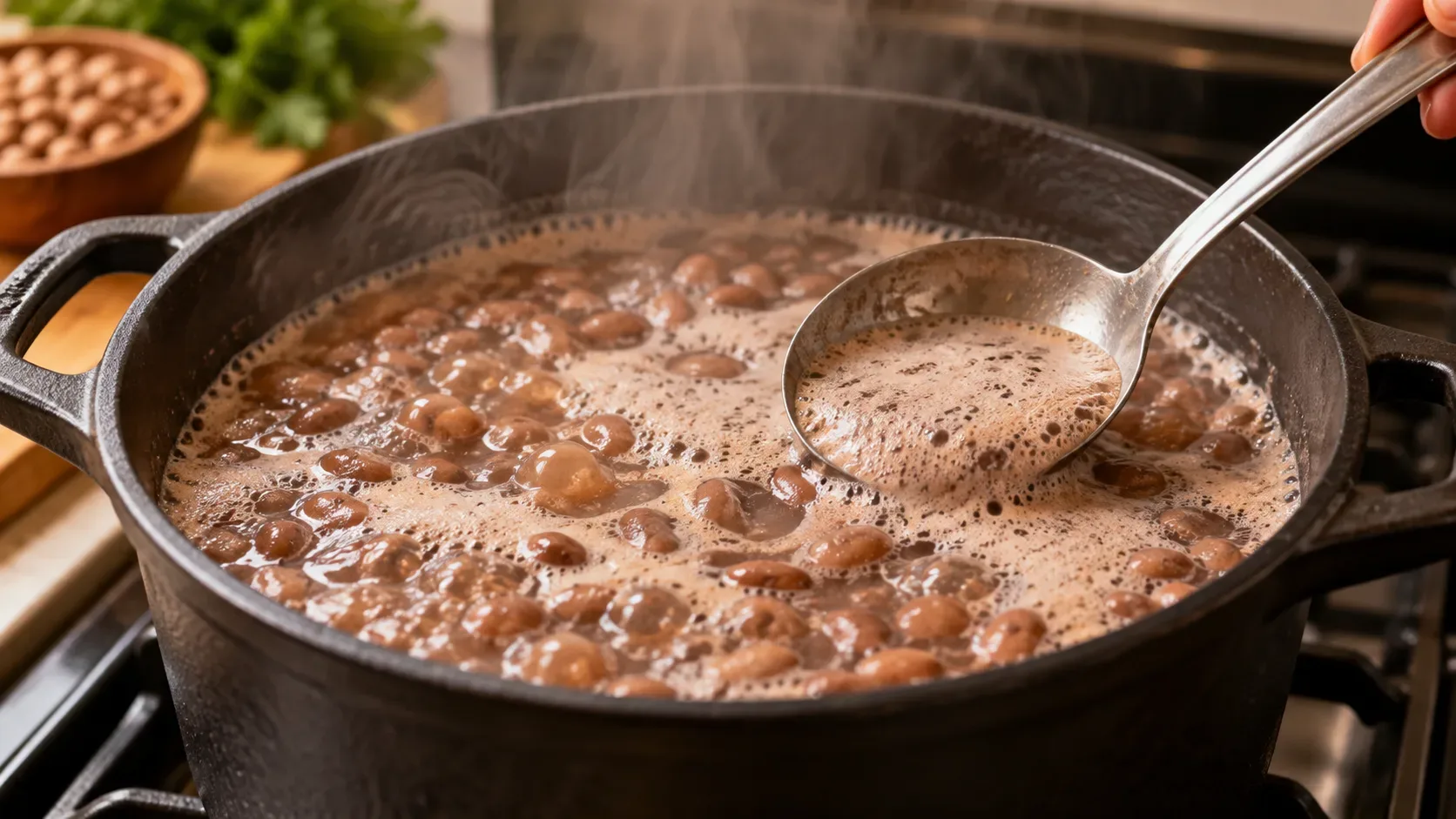
Short answer: no. The foam that appears during normal bean cooking does not have to be skimmed off as a rule. It forms because the cooking liquid picks up compounds from the beans that can help bubbles form and, especially, remain stable at the surface. Skimming can be useful to control boil-over or to produce a visually cleaner broth, but it is not a required bean “purification” step.
What the foam in the pot actually is
As beans heat, water and temperature change the structure of the seed and some of its components migrate into the liquid. Studies of legume cooking water — often called aquafaba — show that this liquid can contain proteins, soluble carbohydrates and polysaccharides, as well as low-molecular-weight compounds such as saponins. The composition varies with the legume species, the bean-to-water ratio, cooking time and other processing conditions.
The important point is that the foam is not made of one single substance. In work with chickpeas, faba beans, lentils and common beans, different fractions of the cooking liquid have contributed to foam formation and stability. A 2026 study of aquafaba from common beans and lentils, for example, found performance differences related to protein and carbohydrate composition; another 2026 study found correlations between certain polysaccharides, including gelatinized starch, and foam stability. See the study on common beans and lentils and see the study on aquafaba polysaccharides.
Why the bubbles do not burst immediately
Boiling creates and moves bubbles through the liquid. In nearly pure water, many of them break quickly when they reach the surface. In legume broth, however, dissolved or dispersed molecules and particles can form films around bubbles, reduce interfacial tension and increase the viscosity of the liquid phase. This slows film drainage and allows some bubbles to remain together as foam.
- Proteins: they can adsorb at the gas-water interface and form a film around bubbles. Aquafaba studies associate soluble proteins with the ability to incorporate air and stabilize foams.
- Saponins: these molecules occur naturally in many legumes and have surface-active properties. Aquafaba research shows that they can contribute to foam formation and stability, including through interactions with proteins. See the study on saponins, amino acids and foam.
- Starch and other polysaccharides: they can increase liquid viscosity and help stabilize the structure. In faba bean process water, reduced foaming after amylase or protease treatment indicated contributions from both carbohydrates and proteins. See the study on faba beans and foam-forming components.
That is why saying the foam is “just starch,” “just protein” or “just saponin” oversimplifies the process. The proportions change with the bean and the cooking method.
Do you need to skim the foam?
For most home cooking, no. The choice is mainly culinary and practical rather than a safety requirement.
| Situation | What to do | Why |
|---|---|---|
| Brothy beans, soup or stew | You can leave it | The foam usually decreases when the boil is controlled; some of the broth solids and compounds contribute body and texture. |
| A broth where a cleaner appearance matters | You can skim it | Skimming removes the surface layer of bubbles and some attached solids, which can make the surface look cleaner. |
| The pot is close to boiling over | Lower the heat first | Reducing boil intensity cuts bubble generation and foam buildup; skimming may help, but it does not fix excessive heat. |
| Foam keeps coming back | Do not chase every new layer | As long as the liquid boils and contains compounds that stabilize bubbles, more foam can form. |
Lowering the heat usually helps more than constant skimming
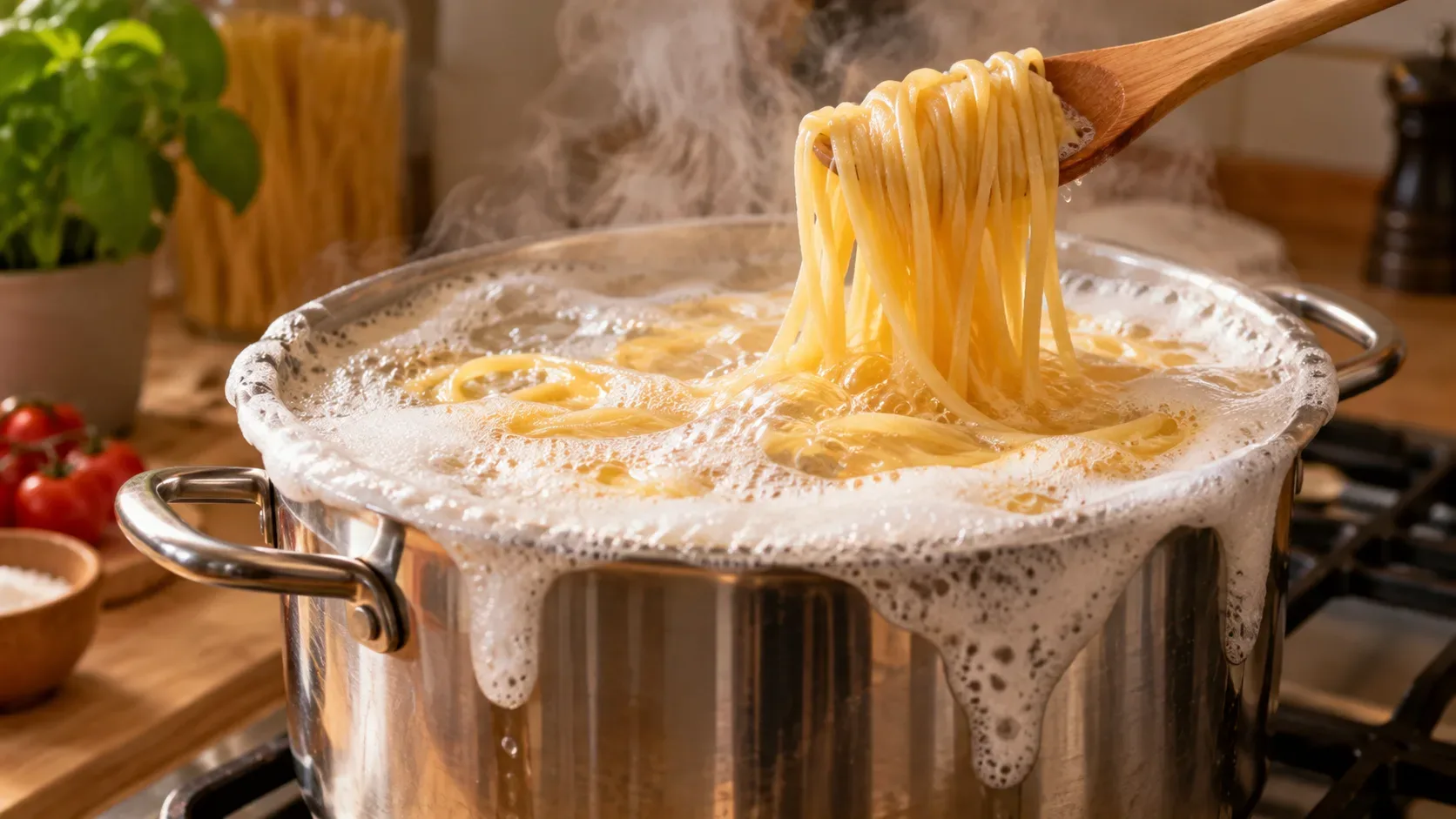
A violently boiling pot produces many bubbles in a short time and increases surface agitation. If the broth contains compounds that stabilize those bubbles, the foam volume can rise quickly and climb the sides of the pot. Once the necessary boil has been reached, reducing the heat to a more controlled cook usually lowers the risk of boil-over and can also promote more even cooking.
This explains why foam often “disappears” or becomes less bulky after the heat is reduced: fewer new bubbles reach the surface and existing films have time to drain and rupture. It does not mean the foam-forming compounds have vanished from the broth; the physical dynamics have changed.
Does skimming change flavor, texture or nutrition?
Texture and appearance: removing a small layer of foam usually makes only a minor difference. Repeated skimming that also removes liquid and fine solids can leave the broth slightly less cloudy or less full-bodied. In recipes where a rustic, thick broth is desired, this is rarely necessary; in more delicate preparations or when visual clarity matters, it can be a useful aesthetic choice.
Flavor: there is no good basis for a universal rule that the foam makes beans bitter, “dirty” or bad-tasting. Sensory effects depend on the bean, the broth, the seasonings and how much material is removed. If the foam carries seasoning particles or solids you wanted to keep, skimming can remove some of those as well.
Nutrients: the foam contains material that came from the beans and cooking liquid, so skimming removes some matter along with the bubbles. But in a home pot it does not make sense to treat skimming as a reliable way to reduce antinutrients or “toxins.” That is a separate issue tied to proper bean preparation.
Foam is not a safety test
The presence or absence of foam does not tell you whether beans are safe to eat. The most important example is red kidney beans: raw or undercooked beans can contain high levels of phytohaemagglutinin, a lectin that can cause nausea, vomiting and diarrhea. The FDA advises proper preparation of dried beans; for kidney beans, its published guidance includes soaking and boiling in fresh water. See the FDA guidance on natural toxins in food.
Skimming foam does not replace adequate heat treatment. Likewise, a lot of foam does not mean the pot is “more toxic,” and little foam does not prove that the beans have been cooked safely.
What to do in practice
- Cook the beans using a method appropriate for that type of bean.
- Once boiling is established, adjust the heat to avoid violent boiling and boil-over.
- If the foam takes up too much volume or you want a cleaner-looking surface, skim it with a spoon or skimmer.
- If you want a thick, home-style broth, you can simply let the foam subside and continue cooking.
- Judge safety by proper bean preparation, not by the appearance of the foam.
What the science supports
Bean foam is best understood as a consequence of the chemistry and physics of the broth itself. Proteins, saponins and carbohydrates or polysaccharides released during cooking can work together to keep bubbles at the surface. The relative importance of each component varies among legumes and cooking methods, so there is no single explanation that fits every pot.
In the kitchen, the practical rule is simple: skimming is optional. Do it for volume control, visual clarity or texture preference — not because the foam itself proves that the beans are dirty or toxic.