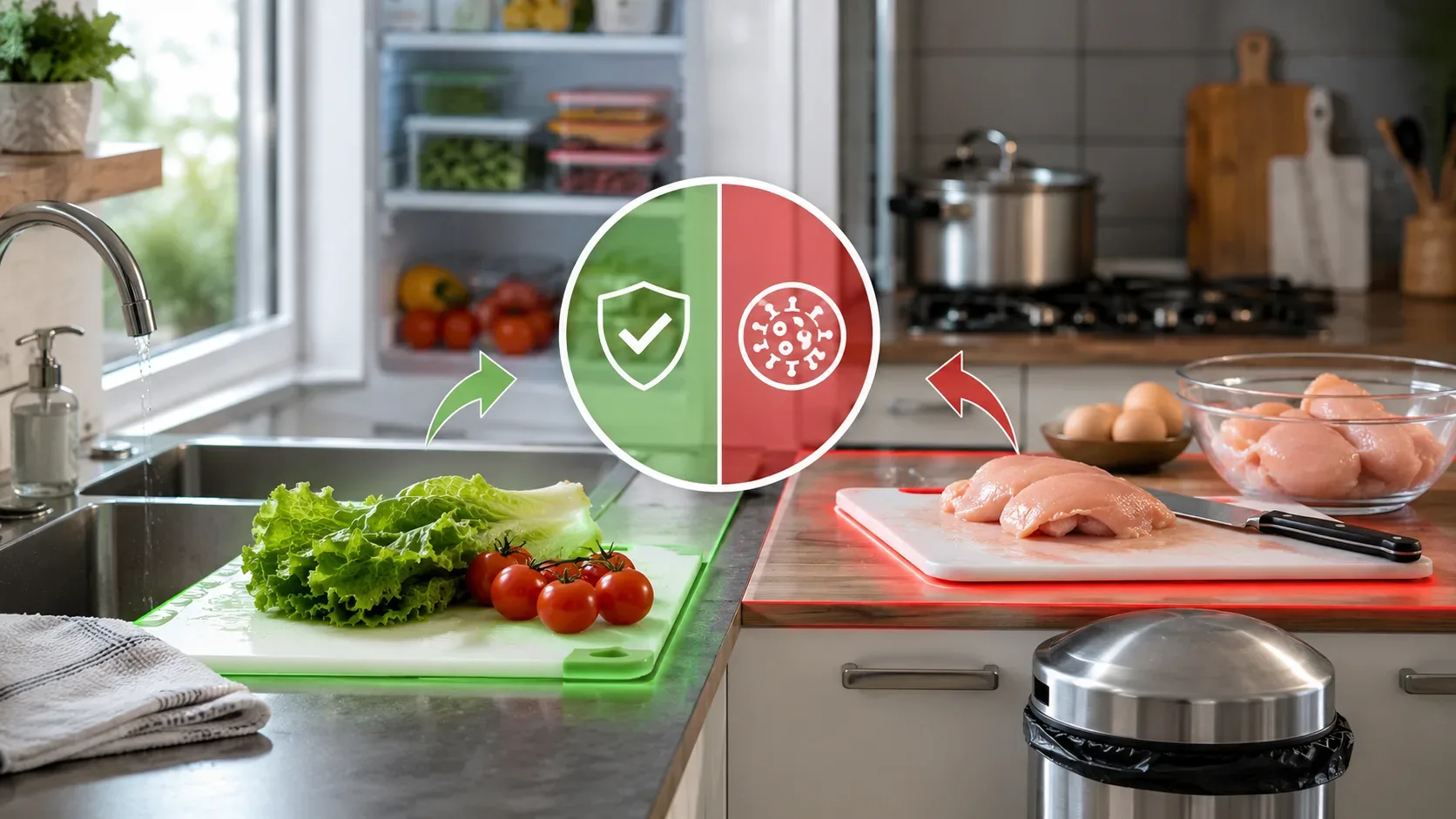
Health surveillance does not just start with inspection. It also appears in the small decisions made between the sink, the countertop, the stove and the refrigerator.
August 5th is officially National Health Surveillance Day since Law No. 13,098, of January 27, 2015. The legislation provides that the date is dedicated to raising awareness among the population on topics related to health protection.
In the home kitchen, this protection can be translated into a practical question: which risk does each habit help to stop? Washing your hands reduces a route of contamination. Separating raw foods from ready-made foods prevents microorganisms from crossing the counter. Controlling time and temperature makes it difficult to multiply.
These measures reduce risks, but do not make any food infallibly safe. Waterborne and foodborne diseases can be caused by bacteria, viruses, parasites, toxins or chemical substances. Nausea, vomiting, abdominal pain, diarrhea and fever are among the most common symptoms, and children, the elderly, pregnant women and immunocompromised people may require special attention.
The principle behind the checklist
The World Health Organization summarizes safe handling in five ideas: maintaining cleanliness, separating raw and cooked foods, cooking thoroughly, storing at safe temperatures, and using adequate water and raw materials.
The following checklist adapts this logic to your home routine and adds two frequently neglected points: thawing and handling leftovers.
| Habit | Main risk that helps reduce |
|---|---|
| Wash your hands during transitions | Transfer of microorganisms from hands to food |
| Organize a flow between clean and dirty areas | Cross contamination |
| Cleanse each food correctly | Contaminated splashes and inadequate sanitation |
| Maintain the cold chain | Multiplication of microorganisms in perishables |
| Thaw under refrigeration | Microbial growth on the surface of food |
| Cook completely | Survival of heat-sensitive microorganisms |
| Refrigerate and identify leftovers | Multiplication during cooling and late consumption |
1. Wash your hands when the task changes
Washing your hands just before starting is not enough. During preparation, they touch cell phones, taps, handles, packaging, trash, animals, raw food and other surfaces again.
Anvisa recommends repeating the wash whenever there is an interruption of this type. The Agency's best practices booklet recommends that careful washing lasts more than 20 seconds, reaching the palms, back, nails and spaces between the fingers.
Important moments to wash again:
- before starting preparation;
- after using the bathroom;
- after handling meat, fish, eggs or vegetables that have not yet been sanitized;
- after touching the trash;
- after using your cell phone or answering the door;
- before touching ready-made foods again.
Reduced risk: microorganisms present on hands can reach foods that will not be cooked again.
2. Create a flow between what is raw and what is ready
Cross contamination occurs when microorganisms are transferred from one food, utensil or surface to another. A classic example is cutting raw chicken and, without washing the knife and cutting board, using them in a cooked food or in a salad.
It is not mandatory to have two kitchens or complete sets of utensils. The essential thing is to control the sequence:
- organize and sanitize the food that will be consumed ready-to-eat first;
- leave meat, fish and other raw items for a separate stage;
- wash your hands, knife, cutting board, sink and countertop with water and detergent before changing tasks;
- use different dishes for raw food and cooked food;
- in the refrigerator, keep raw items in closed containers, without contact with ready-made preparations.
When there is a food allergy
Separation needs to be even more strict when someone in the house has allergies. Anvisa defines allergen cross-contamination as the accidental presence of an allergenic ingredient that was not intentionally added to the product or preparation.
As a prudent household rule, read the label with each purchase, first prepare the meal intended for the allergic person and use properly sanitized hands, surfaces and utensils. Depending on the severity and medical advice, unique utensils may be necessary.
Reduced risk: transfer of microorganisms or allergens to a preparation that appears safe.
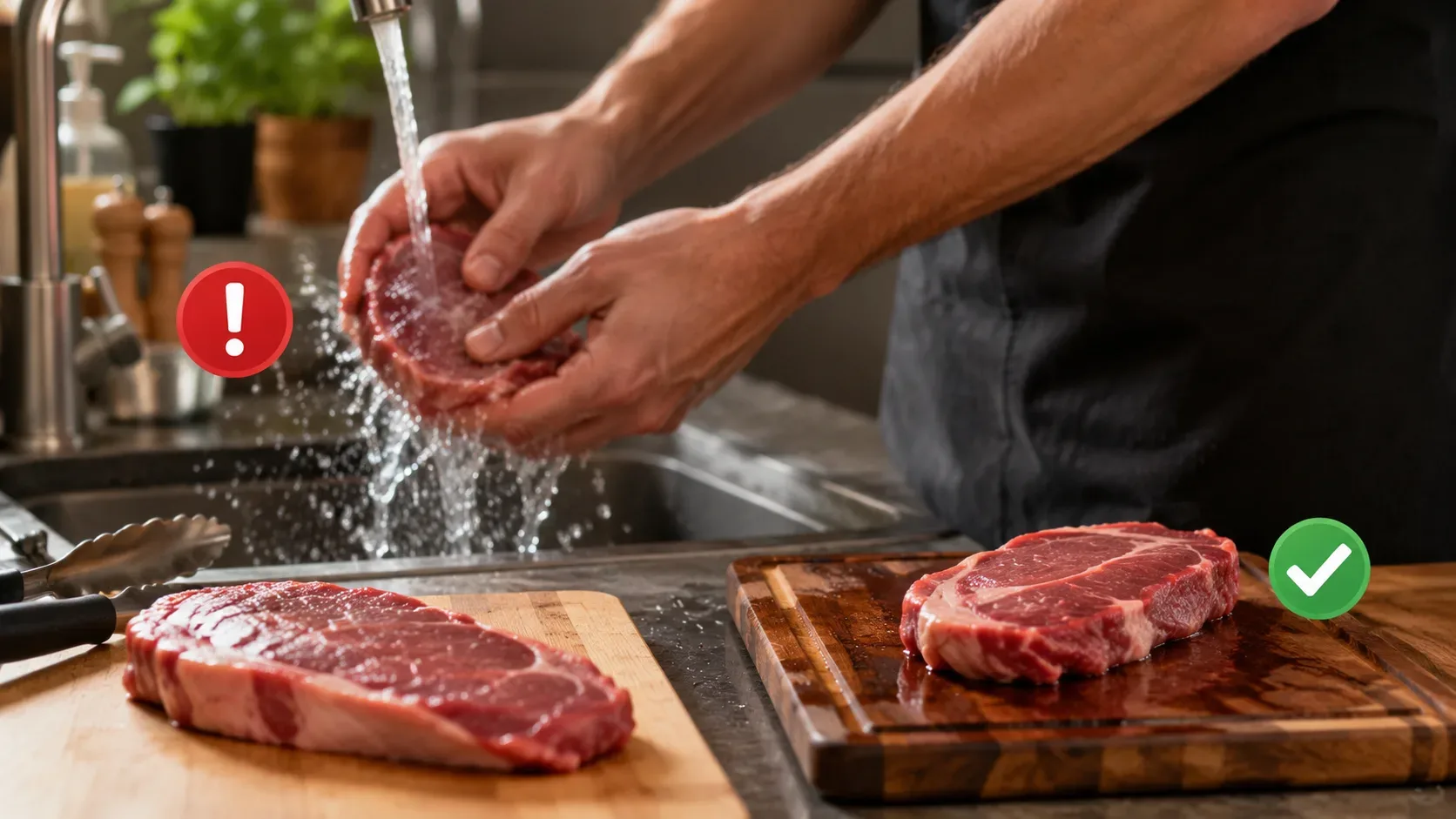
3. Don't wash meat and clean vegetables with the right product
Washing chicken, beef, fish or other meats under the tap does not adequately eliminate microorganisms. Splashes can spread across the sink, countertops, sponge, dishes and nearby food. Control must occur mainly by separation during preparation and complete cooking.
Fruits and vegetables follow a different logic. First, remove deteriorated parts and wash each unit or leaf under running water to remove soil and visible dirt. When sanitization is indicated, only use a regulated product expressly suitable for food, respecting the dilution and contact time stated on the label. Then, rinse according to the manufacturer's instructions.
Do not improvise concentrations. Different products may have different formulations. Anvisa also clarifies that culinary vinegar does not replace a sanitizer suitable for food.
Reduced risk: spread by splashes, survival of microorganisms on vegetables and chemical contamination due to incorrect use of sanitizers.
4. Check if the refrigerator is really cold
Putting something “in the refrigerator” only works as a safety measure if the equipment maintains the appropriate temperature and cold air can circulate.
Anvisa uses below 5 °C as a reference for refrigerated foods and above 60 °C for preparations kept hot. The range between these temperatures is treated as a danger zone because it favors the multiplication of many microorganisms.
A refrigerator thermometer helps check the actual temperature, especially in old, overcrowded or frequently opened appliances. Organize the interior to avoid leaks and contact between categories:
- ready preparations and foods that will be consumed without cooking, protected;
- closed containers with leftovers and opened ingredients, identified;
- raw meat and fish in intact packaging or container that contains liquids;
- enough space for cold air to circulate.
Store refrigerated and frozen products as soon as you arrive from shopping and follow the storage conditions indicated on the label.
Reduced risk: multiplication of microorganisms and dripping of raw liquids onto ready-made foods.
5. Thaw in the refrigerator — not over the sink.
When defrosting at room temperature, the outside of the food can heat up a lot before the center loses its ice. This creates favorable conditions for the multiplication of microorganisms precisely on the surface that will be manipulated.
Anvisa's guidance is to thaw under refrigeration, at a temperature below 5 °C. The microwave can also be used when the food goes immediately to cooking. Meat must remain in a container capable of retaining the released liquids.
Plan ahead: transfer the food from the freezer to the refrigerator the day before or at the interval necessary for the size of the item. Avoid leaving it on the counter overnight.
Reduced risk: multiplication on the outside of the food and contamination of other items by defrosting liquids.
6. Cook the center, not just the surface
Browning on the outside does not prove that the center has reached sufficient temperature. Anvisa's booklet recommends that all parts of the food reach at least 70 °C, a reference also adopted in the WHO's general materials on safe preparation.
When you have a culinary thermometer, insert the rod into the center of the thickest part, avoiding bones and large areas of fat. On large or irregular pieces, measure at more than one point.
Without a thermometer, cook completely and make sure there are no raw areas remaining, especially in poultry, ground meat, fish and egg preparations. Appearance is an indication, but is not a substitute for an objective measurement.
When reheating a leftover, the heat must also reach the center. Heating only the edges or serving a preparation that is still cold inside does not offer the same control.
Reduced risk: survival of microorganisms that can be destroyed by appropriate heat treatment.
7. Control the clock and quickly dispose of leftovers
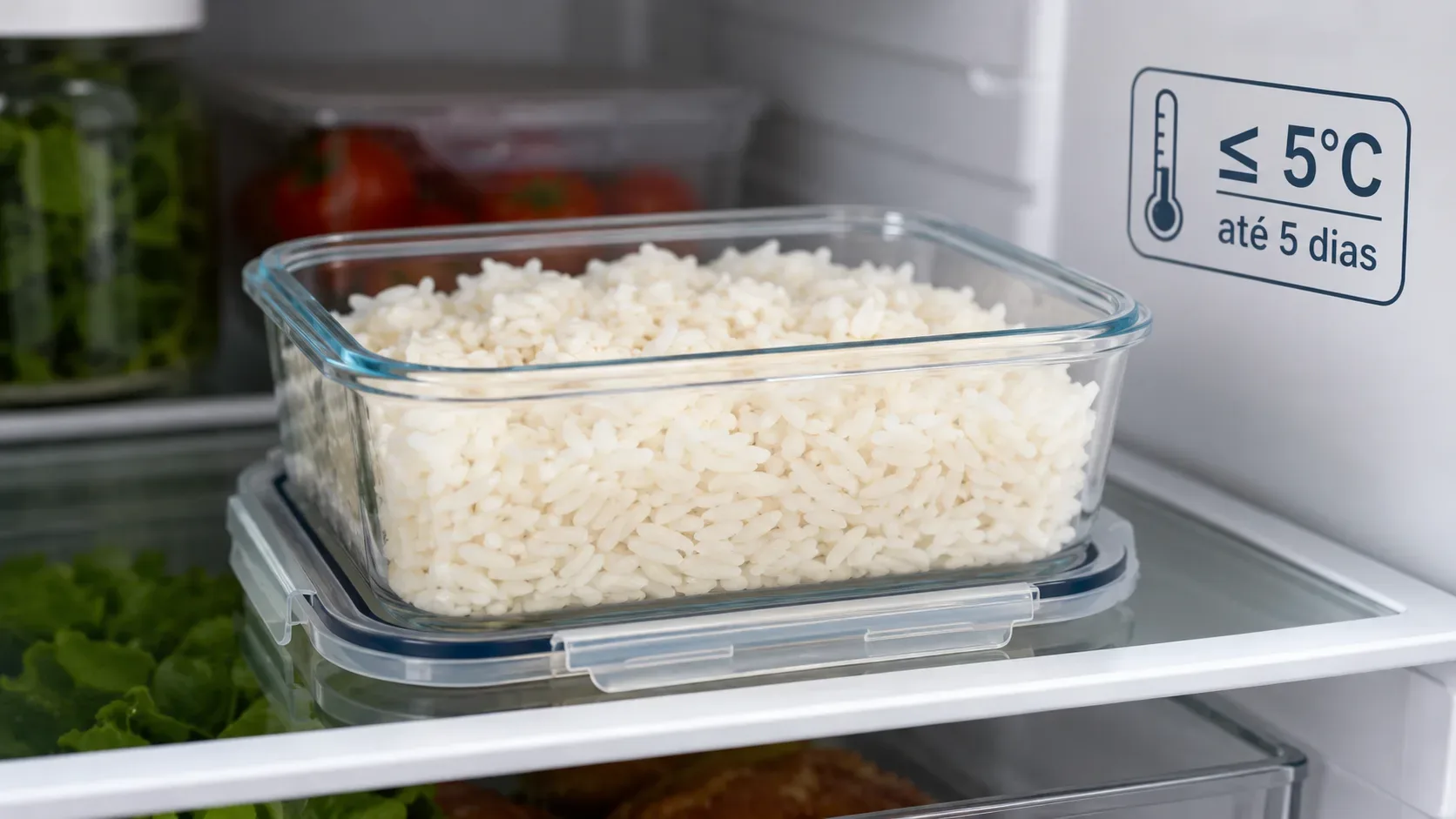
After preparation, the food should not spend hours waiting on the stove or table. Anvisa recommends keeping hot preparations above 60 °C and cold below 5 °C, reducing the interval between preparation and consumption as much as possible. For leftovers, the guidance published in December 2025 is not to exceed two hours at room temperature and refrigerate in well-closed containers.
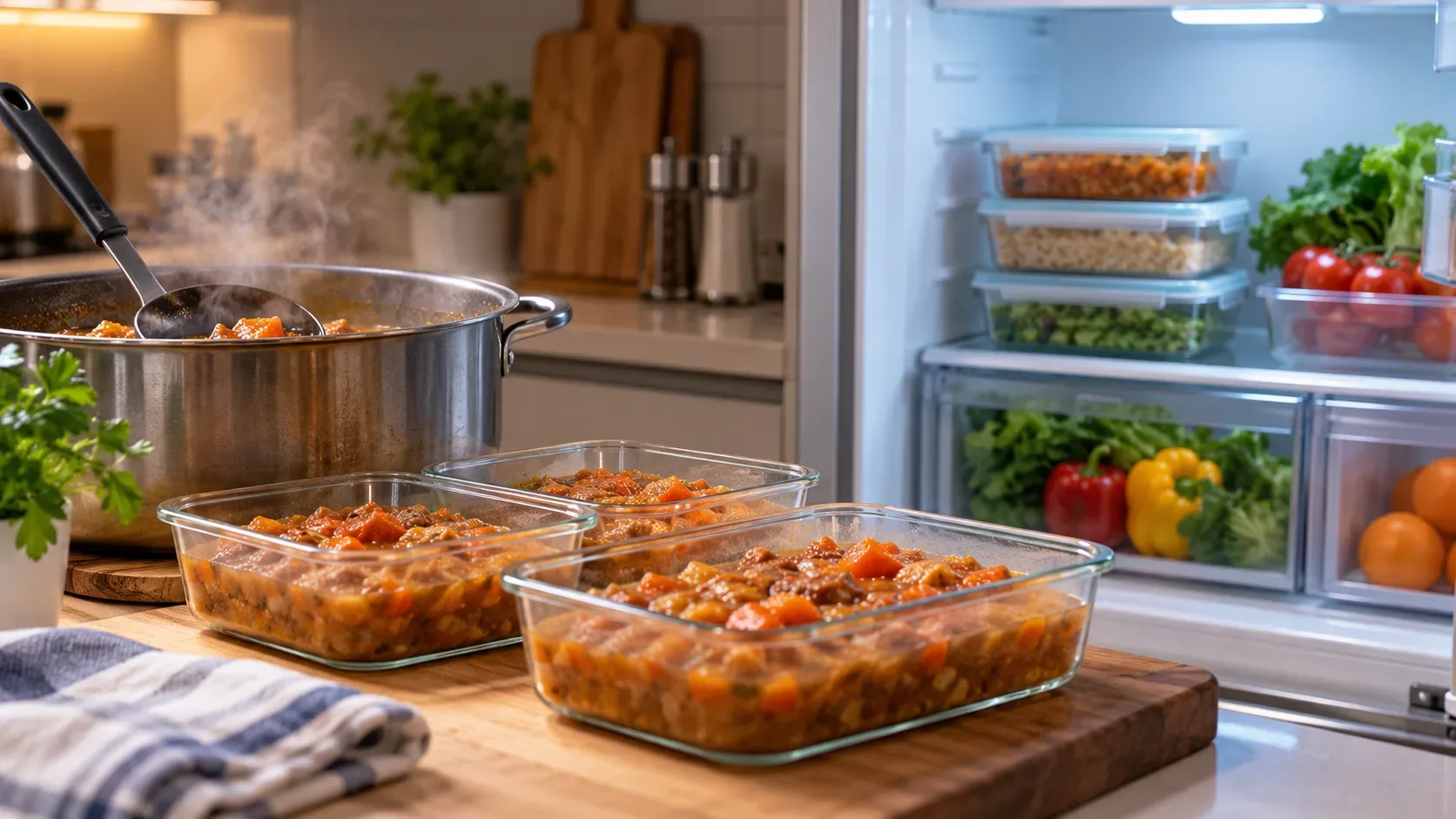
Divide large volumes into smaller containers, rather than keeping a pan too full. Label each pot with the preparation name and date.
There is a relevant difference between official materials: an older guide for food services mentions up to five days for food prepared below 5 °C, while the most recent domestic guidance from Anvisa generally mentions up to three days below 4 °C for supper leftovers. Because documents have different contexts and the actual time frame depends on preparation, temperature, and handling, the shorter limit is the most prudent domestic choice when no specific instruction exists.
Even within the deadline, odor and appearance do not guarantee safety: some microorganisms capable of causing illness may be present without noticeably altering the food.
Reduced risk: multiplication during cooling, loss of control over the date and consumption of a leftover kept for an excessive time.
Home food safety checklist
Save this list to use before, during and after cooking:
-
I washed my hands and will repeat the washing after each interruption.
-
I separated raw foods from ready-made preparations.
-
I changed or washed the knife, cutting board, plate and countertop between steps.
-
I didn't wash meat in the sink.
-
I sanitized vegetables with running water and, when indicated, food grade sanitizer.
-
I confirmed that the refrigerator is below 5°C.
-
Defrost in the refrigerator or use the microwave before immediate cooking.
-
I cooked it completely and checked the center of the preparation.
-
I will refrigerate leftovers no more than two hours at room temperature.
-
I identified the containers with name and date.
For people with allergies, I checked labels and avoided cross-contact.
The most important habit is thinking about routes
Food safety at home does not depend on a perfect kitchen. It depends on recognizing the paths through which a risk can advance.
The hand touches the cell phone and returns to the salad. The meat liquid drains onto a shelf. The same knife goes from raw food to ready food. The leftovers cool slowly for hours. Each habit in this guide exists to interrupt one of these routes.
Save the checklist and use it as a complement to the guide “How long can each preparation be kept out of the refrigerator”. To organize meals in advance, also read “Cook once, eat three” and apply the planning without losing control of temperature, separation and dates.
Seek a healthcare service if you experience significant or persistent symptoms, especially when there are signs of dehydration or when the affected person belongs to a higher risk group. Cases of food allergies must follow the prevention and emergency plan guided by the responsible healthcare professional.
Guide sources and references
- Presidency of the Republic — Law No. 13,098, of January 27, 2015.
- Anvisa — August 5th: National Health Surveillance Day.
- Anvisa — Health Surveillance Day: health protection.
- Anvisa — Booklet on Good Practices for Food Services.
- Anvisa — Are you going to prepare supper? Check out our tips and ensure health on your plate!.
- Ministry of Health — Waterborne and Foodborne Diseases.
- World Health Organization — Five Keys to Safer Food Manual.