Placing an egg in a glass of water may give a clue about its aging, but it does not answer the most important health question: whether it is microbiologically safe.
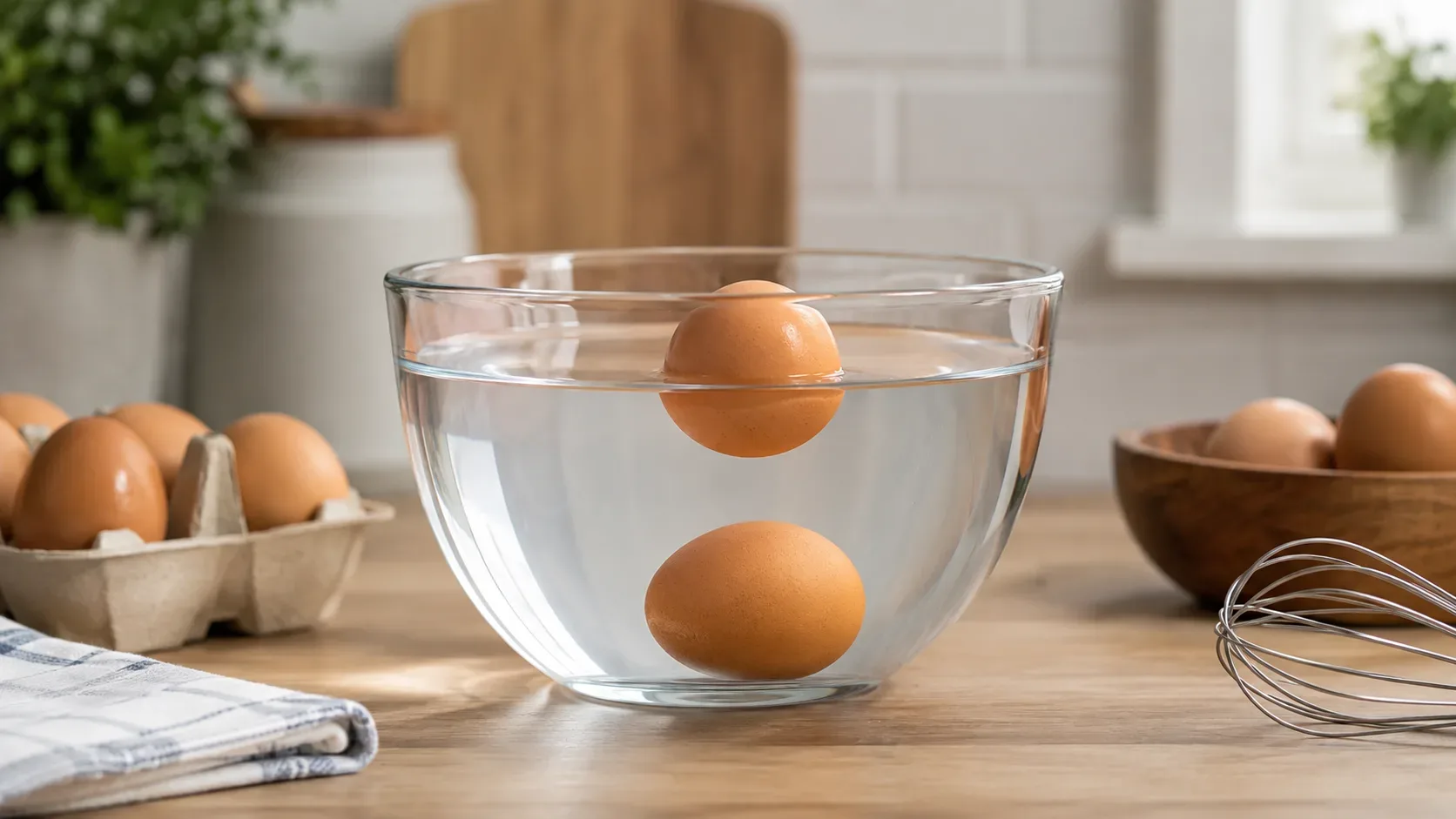
The so-called float test works because the physical characteristics of the egg change during storage. As the air chamber increases and the egg's density decreases, it tends to gain buoyancy. An egg that floats, therefore, is usually an older egg. This does not automatically mean that it is contaminated, just as sinking does not prove the absence of bacteria.
What the water test actually measures
In practice, the test observes buoyancy, a consequence of the density of the egg in relation to the water.
During storage, water loss and other changes in internal quality occur. Studies of stored eggs show enlargement of the air chamber and changes in specific gravity over time. Characteristics of the shell also interfere in this process, which helps explain why the test does not work like a clock capable of telling exactly how old an egg is.
The United States Department of Agriculture's Food Safety and Inspection Service, USDA-FSIS, explains that an egg can float when its air chamber has grown enough to make it more buoyant. The guidance characterizes this as a sign of poorer quality, but highlights that the egg may still be safe to use.
This detail changes the popular interpretation of the test. Floating is not synonymous with “spoiled”; It is, first and foremost, a physical sign of aging and loss of quality.
Can an egg that sinks be contaminated?
You can.
The FDA warns that even fresh eggs, with clean shells and no cracks, can contain Salmonella. Therefore, appearance of freshness, external integrity and result in the glass of water are not tests capable of excluding microbiological contamination.
This is precisely where the rule “it sank, you can eat it; it floated, throw it away” becomes misleading. It mixes two different concepts:
- freshness and quality, which physically change during storage and can influence fluctuation;
- microbiological safety, which depends on factors such as contamination, origin, conservation, handling and preparation.
The water does not detect Salmonella or other microorganisms. Therefore, an egg that remains at the bottom does not receive any type of “domestic certificate” of safety.
What if the egg floats: do you need to throw it away?
Flotation alone does not allow us to conclude that the egg is unsuitable. The USDA's own guidance recommends, when faced with an egg that floats, crack it into a separate container and observe abnormal signs, such as an unpleasant odor or unusual appearance, before deciding on use.
This assessment, however, remains a check for noticeable deterioration — not a microbiological examination. The absence of a bad smell or visible change does not prove that the food is free of Salmonella, because apparently normal eggs can also contain the bacteria.
Water testing therefore makes more sense as supplementary information about quality than as the main criterion for deciding whether an egg is safe.
How to evaluate eggs more safely
At home, the decision shouldn't depend on a single trick. It is more useful to consider together the origin, packaging information, storage conditions, shell integrity and how the egg will be prepared.
Anvisa recommends checking the expiration date, packaging and physical conditions when purchasing and, for products of animal origin, look for products regulated by inspection services. The Agency also advises washing eggs in drinking water, one at a time, only before use — and not before storing them — in addition to washing your hands after handling.
In preparation, the Ministry of Health includes hand hygiene and proper cooking of eggs among the prevention measures against Salmonella.
These precautions say more about risk reduction than observing whether the egg rises or falls in a glass.
To delve deeper into the purchase, storage and safe preparation part, the related content “Plastic eggs? What Anvisa really said...” should be linked here as additional reading.
So, what is the egg-in-water test for?
It serves as a rough household indicator of aging and quality, especially since the air chamber tends to enlarge during storage. It is not intended to determine an exact age and should not be used to confirm microbiological safety.
The most correct reading is simple: if the egg floats, there is a sign that it has undergone changes associated with storage. If it sinks, it probably retains the physical characteristics of a less aged egg. In neither case does the test report whether Salmonella is present.
So, when the question is “is this egg younger or older?”, fluctuation can offer a clue. When the question is “is this egg safe to eat?”, you need to look at origin, conservation, integrity, handling and preparation — not just the glass of water.