Freezer burn does not make food unsafe by itself. It is a quality problem: parts of the food become dry, tough, discolored or develop altered flavor because the surface has lost moisture and been exposed to air. The USDA Food Safety and Inspection Service (FSIS) states that affected areas can be cut away before or after cooking, while heavily freezer-burned foods may be discarded for quality reasons rather than because freezer burn itself causes illness.
There is an important caveat: freezer burn does not replace a food-safety assessment of the storage history. A food can be dried by freezer burn and still have remained safely frozen; conversely, food that thawed for too long can become risky even without typical freezer-burn patches. USDA guidance says food kept continuously at 0 °F (about -18 °C) remains safe, although quality declines over time.
What freezer burn is and why it happens
Freezer burn is essentially dehydration of the surface of frozen food. The National Center for Home Food Preservation describes it as surface drying caused by inadequate wrapping. USDA adds that it occurs when air reaches the surface of the food.
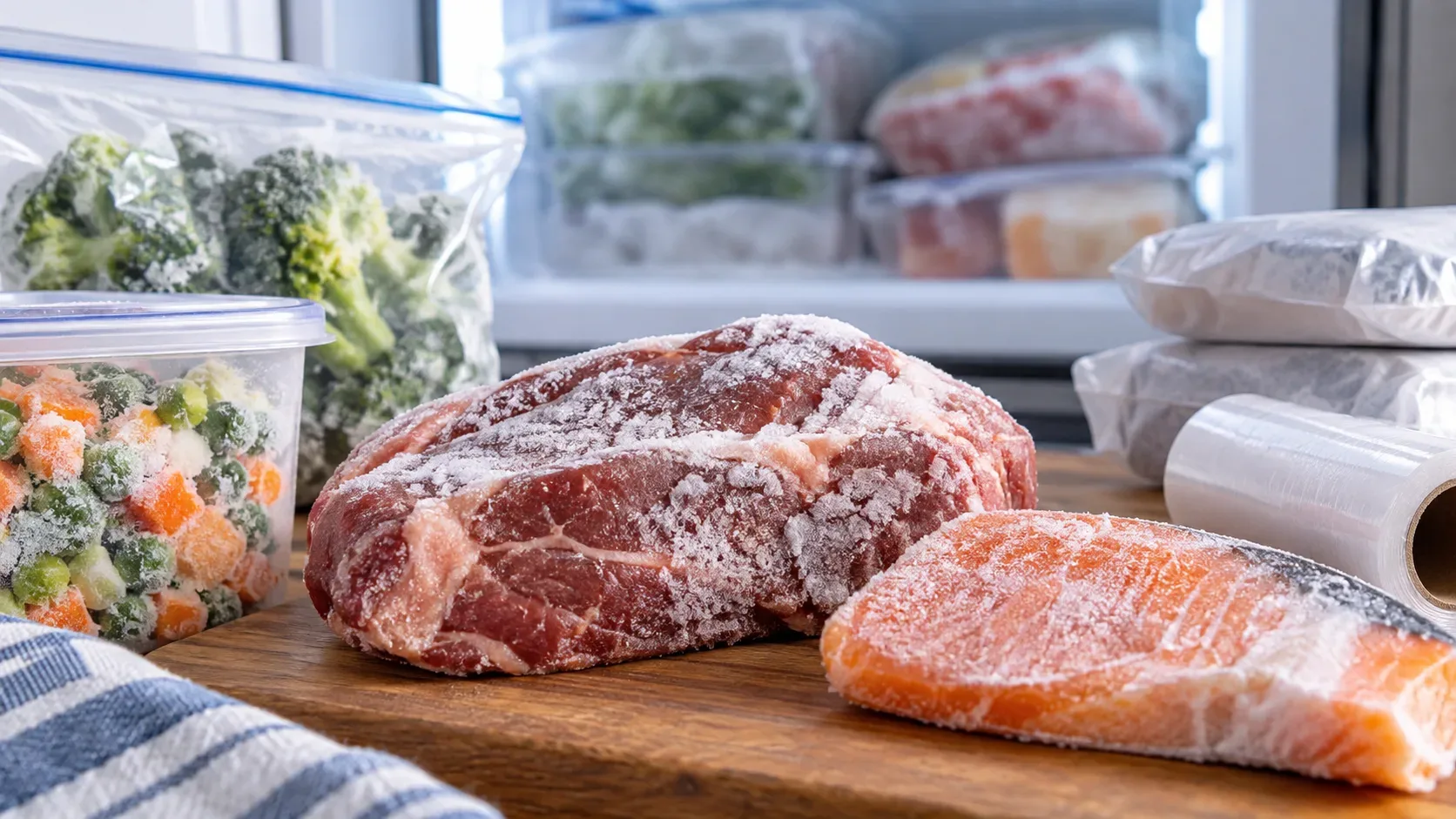
In practice, some of the water in the food is lost from the frozen surface. This creates dry, tough or leathery areas, often grayish or brownish on meat. In fruits, vegetables and frozen dishes, the effect can show up as dried areas, excessive ice crystals, and loss of texture, color or flavor. Penn State Extension links freezer burn to dehydration and oxygen exposure, which can reduce texture, color, aroma and flavor.
The more air that remains in the package, the more permeable or poorly sealed the packaging is, and the longer the food stays in storage, the greater the likely quality loss. Temperature fluctuations and partial thaw-refreeze cycles can also worsen texture damage.
Checklist: safety vs. quality
| Situation | What it means | Practical action |
|---|---|---|
| Dry, whitish, grayish or brownish patches; tough texture | Consistent with freezer burn | Assess how extensive it is. Trim affected areas and use the rest if the storage history was safe. |
| Food stayed continuously frozen at about -18 °C | Microbiological safety is maintained; quality can decline over time | Decide how to use it based on texture, aroma and flavor after safe thawing. |
| Package is torn, contains a lot of air or is poorly sealed, but food remained frozen | Higher risk of quality loss | Rewrap or overwrap to limit further damage and use it sooner. |
| There was prolonged thawing or unsafe temperature exposure | This is a safety issue, not merely freezer burn | Do not use freezer-burn appearance to judge safety. Consider time and temperature exposure. |
| Drying is severe and unpleasant flavor affects most of the portion | Quality is seriously compromised | Discard for quality if the cooking result would not be acceptable. |
Can freezer burn make you sick?
No, when the only change is freezer burn and the food was kept safely frozen. USDA says the condition makes food dry in spots but does not make it unsafe. That is different from deterioration caused by temperature abuse, contamination or improper thawing.
For that reason, do not rely only on color, smell or appearance to decide whether food that thawed without temperature control is safe. During events such as a power outage, USDA advises checking temperature and whether ice crystals remain; perishable foods that have been above 40 °F (about 4 °C) for more than two hours should be discarded. Those rules address food safety and are separate from freezer burn.
How to use food with freezer burn
The best use depends on how much of the portion has lost moisture. The dried area will not fully return to its original texture, so the practical approach is to trim very tough parts and choose dishes in which moisture, sauce or slow cooking reduces the sensory impact.
Mild: a few dry areas
- Meat, poultry and fish: trim the toughest spots if desired and cook normally. Sauces, marinades and moist cooking methods help offset lost juiciness.
- Vegetables: use in soups, sautés, purées or fillings, where small texture losses matter less.
- Fruit: choose compotes, syrups, preserves, sauces, baked dishes or other cooked preparations if texture has deteriorated.
Moderate: noticeable drying across several areas
When much of the surface is dry, dishes that break down the food's original structure usually work better. Meat can be chopped or shredded for stews, sauces, pies and fillings; vegetables can go into soups, creams and purées; fruit can become compotes or cooked toppings. The goal is not to fully “rehydrate” the food, but to avoid serving the driest part as the main feature.
Severe: flavor and texture are badly affected
USDA notes that heavily freezer-burned foods may need to be discarded for quality reasons. If drying is widespread, the texture is very tough or the flavor is unpleasant, trying to salvage it may simply carry the defect into the entire dish.
How to prevent freezer burn
Prevention mainly means limiting air contact and moisture loss. According to the USDA FSIS, proper packaging helps maintain quality and prevent freezer burn; the agency recommends pressing out as much air as possible and wrapping tightly.
- Use freezer-grade materials. Heavy freezer bags, rigid plastic containers with tight seals, freezer paper and heavy-duty foil are suitable options. USDA notes that plastic wrap alone does not provide enough protection for prolonged storage.
- Remove as much air as possible. Press air out of bags before sealing. With freezer-safe vacuum packaging, keep the seal intact.
- Overwrap when needed. Original meat and poultry packaging can allow air through; for longer storage, USDA recommends an additional protective layer.
- Freeze in realistic portions. Smaller packages are opened less often and leave less empty space when only part of the food is needed.
- Keep the freezer at 0 °F (-18 °C) or below. Stable temperature better preserves texture, color and flavor and reduces partial thawing cycles.
- Freeze quickly. USDA explains that faster freezing forms smaller ice crystals, which cause less cell damage.
- Label and date packages. Rotating stock and using older packages first reduces excessive storage time and quality loss.
Packaging: what works best
For home freezing, the simple rule is: an air-and-vapor barrier + a tight seal + little trapped air. Thin general-purpose bags, loose-fitting containers or plastic wrap used alone expose food more readily. Freezer bags, airtight rigid containers, freezer paper, heavy-duty foil and suitable vacuum systems provide more consistent protection.
If a package tears or opens in the freezer, USDA says that does not automatically make the food unsafe. If it remained frozen, rewrap or overwrap it and prioritize using it.
When it is better to discard it
Discard food when there is a real safety concern — such as an unsafe thawing or temperature history — or when quality is so poor that the food has no reasonable culinary use. Freezer burn by itself is a quality defect, but it is not a reason to ignore time, temperature, contamination or signs of spoilage.
In short: if the food stayed properly frozen, freezer-burned areas can be trimmed and the rest can often be used. To prevent the problem next time, reduce air inside the package, use freezer-appropriate materials, seal tightly, keep the temperature stable and avoid storing foods longer than needed for good quality.