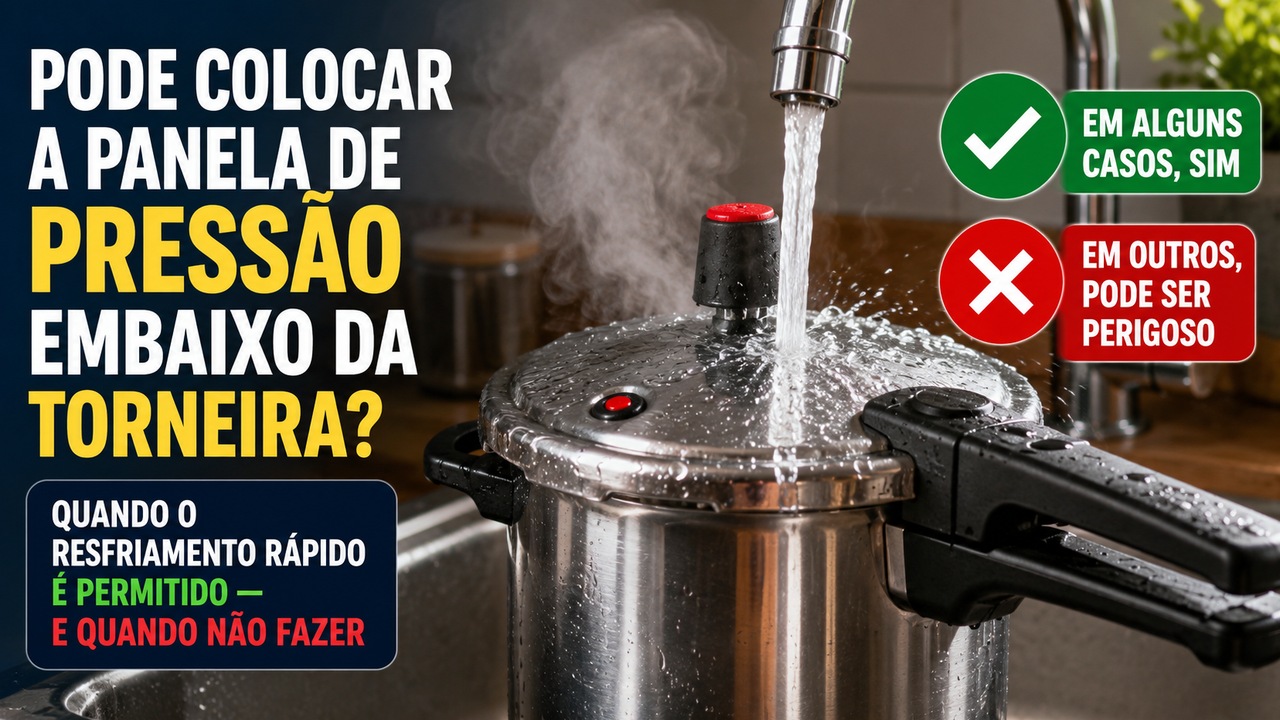
You can put a pressure cooker under the tap, but only when the manual for that model authorizes this method and exactly in the way described by the manufacturer. There is no single safe rule that applies to every pressure cooker. If the manual prohibits it, does not mention the procedure, or you have not yet identified the model, cold water should not be treated as a universal shortcut for releasing pressure.
The divergence is clear in the sources themselves. The official manual for the Tramontina Brava, for example, provides for rapid depressurization with the cooker in the sink basin and cold water over the lid, waiting for the pressure indicator pin to go down before opening. The Corpo de Bombeiros Militar do Paraná, on the other hand, advised the public not to put cold water on a hot pressure cooker to force pressure release. Rochedo, in official guidance for internally closing pressure cookers, also recommends avoiding thermal shock and not abruptly cooling a hot cooker with water.
The short answer: your model's manual comes first
The decisive point is not whether someone has already put a pressure cooker under the tap and nothing happened. It is also not enough to find a page online saying that the method is safe. What matters is whether the manufacturer provides for this type of depressurization for the specific cooker in your kitchen.
Pressure cookers vary in materials, closure design, valves, indicators, and safety devices. Therefore, an instruction that is valid for one model should not automatically be transferred to another. The existence of safety certification also does not make every depressurization procedure equivalent: the user still needs to operate the product in the way provided by the manufacturer.
In practice, the best rule is simple. Identify the brand and model, consult the official manual, and follow the depressurization method described there. If the manufacturer offers more than one option, choose among those options. If it prohibits abrupt cooling, do not improvise with cold water.
What the Tramontina Brava manual actually authorizes
In item 11 of the official manual for the Tramontina Brava Pressure Cooker, the manufacturer presents two forms of depressurization. In the slow method, the cooker remains at room temperature for a few minutes until the indicator pin goes down. In the rapid method, the instruction is to place the cooker in the sink basin and use cold water over the lid; opening should occur only after the pressure indicator pin has gone down.
This detail matters because the instruction is not equivalent to simply pouring water over any hot pressure cooker. It is a documented procedure for that product, with a defined position and a pressure indicator that must confirm that the cooker can be opened.
The current Brava product page itself states that the model has a depressurization system and safety devices. This reinforces why the specific manual is more useful than generic advice: it describes how the components of that product should be used together.
Why the Paraná firefighters say not to use cold water
In guidance published on September 15, 2025, the Corpo de Bombeiros Militar do Paraná recommended waiting for all pressure to be released before opening the lid and included among its safety precautions the instruction not to put cold water on a hot pressure cooker to force pressure release.
This recommendation has a different scope from the manual for a specific product. The firefighters are speaking to the general public, who use pressure cookers of different brands, ages, materials, and conditions. In that context, a conservative recommendation prevents a procedure permitted for certain models from becoming an automatic practice for every cooker.
The firefighters' guidance also emphasizes maintenance: the safety valve and gasket should be clean, dried-out or damaged parts need to be replaced, and the lid and lock must be properly aligned. This helps explain why the issue is not limited to water temperature. Safe depressurization depends on the entire assembly being in good condition and being operated according to its design.
Rochedo also warns against abrupt cooling
On its official page dedicated to internally closing pressure cookers, Rochedo recommends avoiding thermal shock and explains among its precautions that a hot pressure cooker should not be cooled abruptly with water. The same page instructs users to follow the manufacturer's directions.
This example shows why it is not safe to turn the Tramontina Brava authorization into a rule for all pressure cookers. Even among products currently sold, guidance differs. The difference may be related to the cookware's design and the procedure intended for it, but it
is not prudent to try to infer on your own, based only on appearance or closure type, whether the tap method is allowed.
And why do some cooking pages say that it is allowed?
A Receitas Nestlé page published on July 15, 2026 presents two alternatives for opening the pressure cooker safely: wait for natural depressurization or cool the cooker under cold running water, without wetting the valve, to speed up the process. The page itself says it brings together guidance based on manufacturer manuals.
This type of content helps explain why an online search can seem contradictory. A cooking page may summarize a procedure accepted by certain manufacturers, while a fire department provides a more conservative general rule and another manufacturer prohibits abrupt cooling for its product line. The error occurs when guidance with limited scope is read as if it applied to every pressure cooker.
For this reason, a generic page can serve as an initial reference, but it should not replace the product manual when the instructions differ.
How to decide what to do with your pressure cooker
If the manual authorizes running water
Use the method only under the terms described. If the manual says to place the cooker in the sink and direct water onto the lid, do that. If it says that a valve or selector must not get wet, respect that restriction. If it requires waiting for the pressure indicator to go down, do not try to open the cooker earlier simply because the hissing has stopped.
The end of the noise is not, by itself, authorization to open. The indicator, lock, and model-specific instructions are there to prevent the lid from being opened while there is internal pressure.
If the manual prohibits abrupt cooling
Do not put the pressure cooker under the tap just to save time. Use the depressurization method indicated by the manufacturer, which may involve natural waiting or activating a dedicated pressure-release system. The instruction for your model is more specific than advice found in a video, comment, or recipe.
If the manual says nothing about cold water
The absence of authorization should not be interpreted as implicit authorization. Look for the section on depressurization, opening, or pressure release and follow only the methods described. If there is any doubt, contact the brand's official support channel or obtain the manual that corresponds to the product code.
If you do not know the model
Look for identification engraved or printed on the body, bottom, lid, or packaging. Until you confirm the correct procedure, the more conservative option is to remove the cooker from the heat source, not force the lid or valves, and wait for the pressure to drop naturally, while observing the cookware's own indicators.
Cold water over the lid is not the same as immersing the cooker
The wording of the manual matters. In the Brava's case, the instruction is to place the cooker in the sink basin and use cold water over the lid. This does not authorize submerging the entire cooker, pointing the water jet at any component, or adapting the method to another model.
Likewise, the Nestlé guidance mentions running water without wetting the valve. This difference in detail already shows that the popular phrase "putting the pressure cooker under the tap" is too vague to serve as a technical instruction.
When a practice involves a pressurized container and very hot liquid, terms such as "on the lid," "without wetting the valve," "wait for the pin to go down," and "do not cool abruptly" are not expendable details. They define different procedures.
What should not be done in any scenario
Never force the lid while there is internal pressure. The Brava manual links the indicator pin to the presence of pressure, and the firefighters' guidance also says to wait until pressure has been fully released before opening.
Also, do not use a blockage, abnormal valve behavior, or a defective lock as a reason to improvise a depressurization method. The firefighters recommend regular maintenance and replacement of dried-out, damaged, or clogged components. A pressure cooker showing signs of failure needs the problem corrected, not a shortcut so it can continue to be used.
And do not copy a procedure just because someone else's pressure cooker looks similar. Two pieces of cookware with a similar shape may have different depressurization systems.
So, in the end: can you or can't you?
You can when the manufacturer of your model authorizes rapid cooling with water and you follow the manual's procedure exactly. The Tramontina Brava is a concrete example in which cold water over the lid is part of the official rapid depressurization instructions.
Do not do it when the manufacturer says to avoid thermal shock or abrupt cooling, as appears in Rochedo's current guidance for internally closing pressure cookers. And if you do not know the model or cannot find clear authorization, do not treat the tap as a universal method. The general guidance from the Corpo de Bombeiros Militar do Paraná is precisely not to use cold water to force pressure release.
The apparent contradiction disappears when you ask, "for which pressure cooker?" The safe rule is not to choose the source that confirms the habit you already have, but to apply the specific instruction for the product that is in your kitchen.