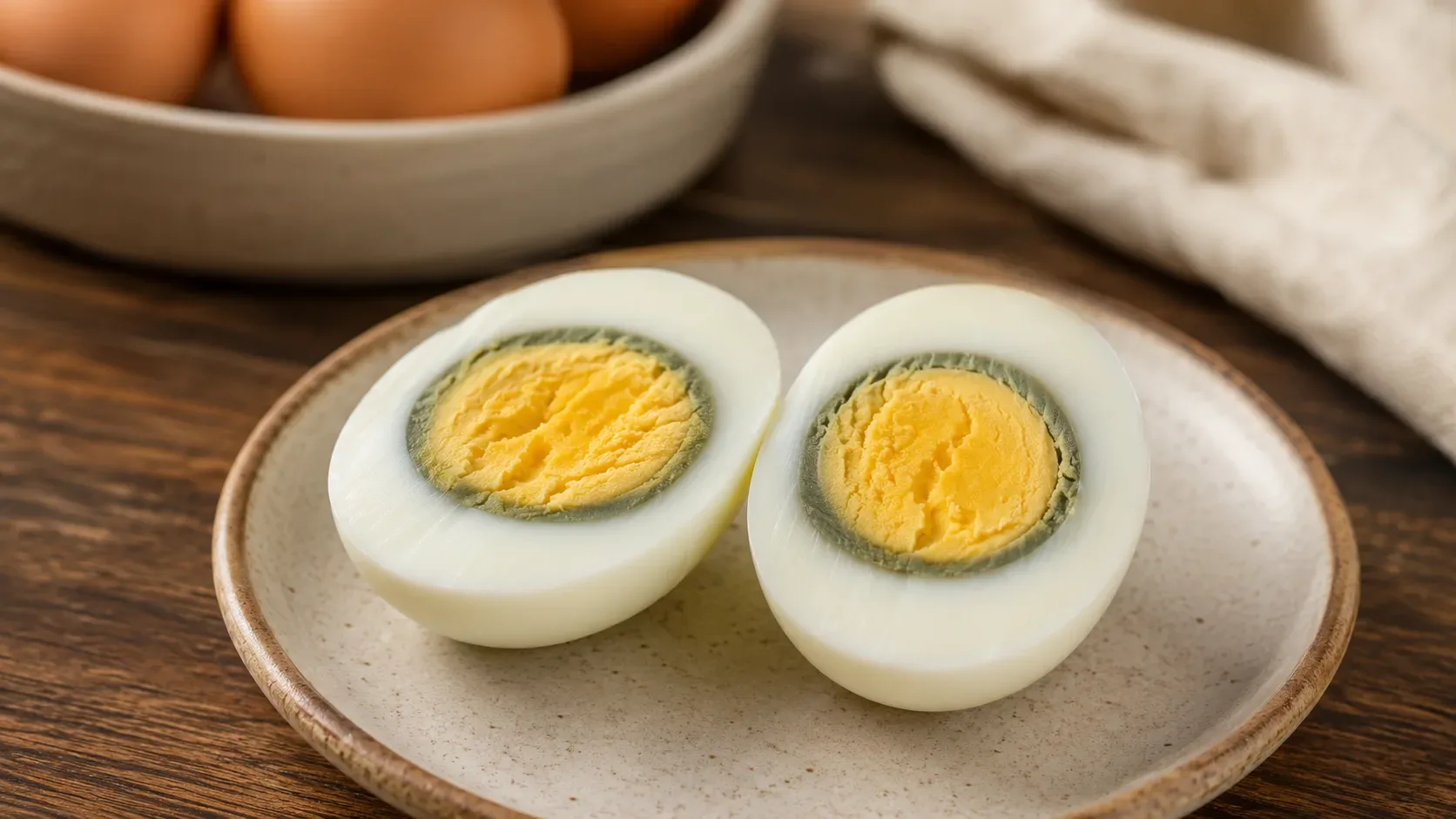
Cutting into a hard-boiled egg and finding a green or grayish ring around the yolk may give the impression that there is something wrong with the food. Most of the time, however, this change in color is a consequence of the cooking itself: sulfur compounds in the egg white react with the iron present in the yolk and form a greenish layer on the surface. This change, in itself, does not mean deterioration.
Why does a green ring appear around the gemstone?
When the egg remains under heat for too long or is subjected to a very high temperature, the reaction between components of the white and yolk is favored. The University of Nebraska–Lincoln explains that sulfur from the white and iron from the yolk can form ferrous sulfide on the surface of the yolk, responsible for the gray-green appearance.
This is why the change usually appears precisely in the external region of the yolk, where it is in contact with the white. The amount of iron present in the cooking water can also contribute to the appearance of color.
Therefore, the green ring usually says more about how the egg was cooked than about its conservation status.
Does a green yolk mean the egg has gone bad?
No. The typical green ring of a well-cooked or overcooked egg is considered a harmless change. Nebraska Extension and Iowa State University Extension treat this coloring as a cooking reaction, not a sign of spoilage.
There is, however, an important difference: saying that the color green is not dangerous is not equivalent to saying that any egg with that color is automatically safe for consumption.
Safety also depends on factors that appearance does not reveal, such as storage, contamination and time out of refrigeration. The FDA warns that even eggs that appear normal, with clean shells and no cracks, can contain Salmonella. In Brazil, the Ministry of Health also links raw or undercooked eggs to the transmission of this bacteria and recommends that eggs be well cooked.
Thus, an isolated greenish ring is not a reason to discard the egg, but it also does not work as a “safety test”.
Overcooking promotes color change
The more intense or prolonged the heating, the greater the possibility of the gray-green halo appearing. In addition to the visual change, excessive cooking can make the yolk drier and the white firmer than desired. The practical recommendation for reducing the ring is to avoid cooking longer than necessary and to cool the egg quickly once cooking is complete.
Placing hard-boiled eggs in cold or ice water helps stop residual heating. Nebraska Extension recommends this rapid cooling as one of the ways to minimize the formation of green color.
There is therefore no need to try to “correct” an egg that has already turned green. If it has been prepared and stored properly, the color change is mainly a matter of appearance and texture.
What really matters to know if a boiled egg is safe
The appearance of the gem must be interpreted together with the preparation and conservation conditions. In Brazil, the Ministry of Health recommends keeping eggs preferably refrigerated and cooking the food well; Its page on preventing foodborne illnesses also recommends limiting the time spent at room temperature for perishable foods to the minimum necessary.
As an additional reference for home storage, the FDA recommends consuming cooked eggs kept refrigerated within one week. The agency also advises not to leave boiled eggs out of the refrigerator for more than two hours, reducing this period to one hour when the ambient temperature exceeds approximately 32 °C.
Unpleasant odor or an unusual appearance other than the typical green ring merits another evaluation. Iowa State University Extension advises that when evaluating an older egg, abnormal odor and unusual changes be considered; the institution explicitly differentiates the green color of boiled eggs from changes associated with spoilage.
In other words, green around the yolk and bad egg are not synonymous.
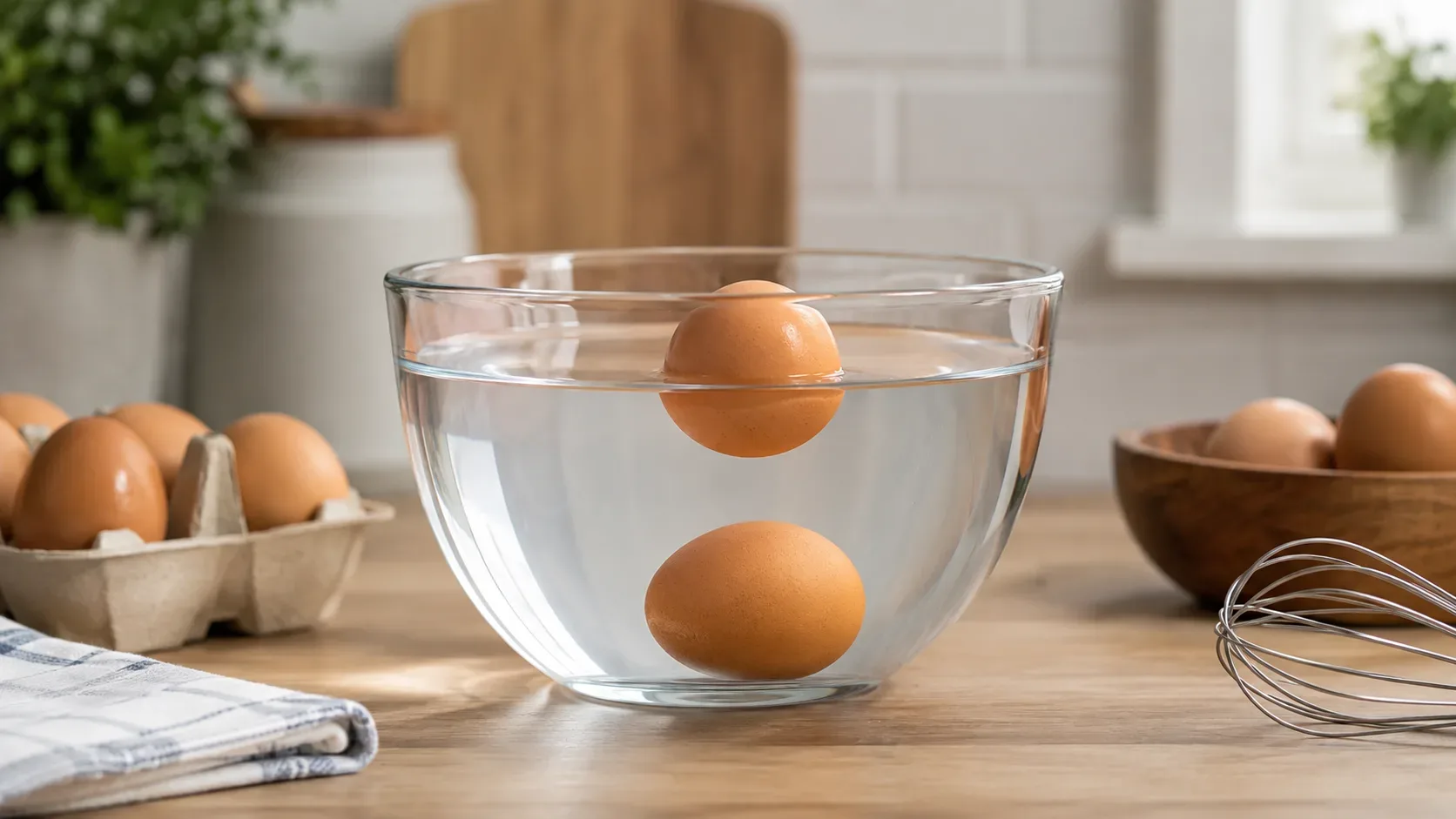
And when the egg floats before cooking?
That's a different question. An egg that floats in water tends to have a larger air chamber, a feature that increases as it ages. The test, therefore, helps more to interpret age and quality than to confirm microbiological safety. Iowa State University Extension notes that an older egg may float and still not necessarily be spoiled.
If the question arises before cooking, the content “Eggs float in water: does the test measure freshness or safety?” complements this explanation. The central idea is the same: a visual or physical characteristic can provide a clue about the egg, but it should not be turned into an absolute test of safety.
In the case of the green yolk, the clue is quite specific: you're most likely seeing the result of heat, sulfur, and iron — not proof that the egg has deteriorated.