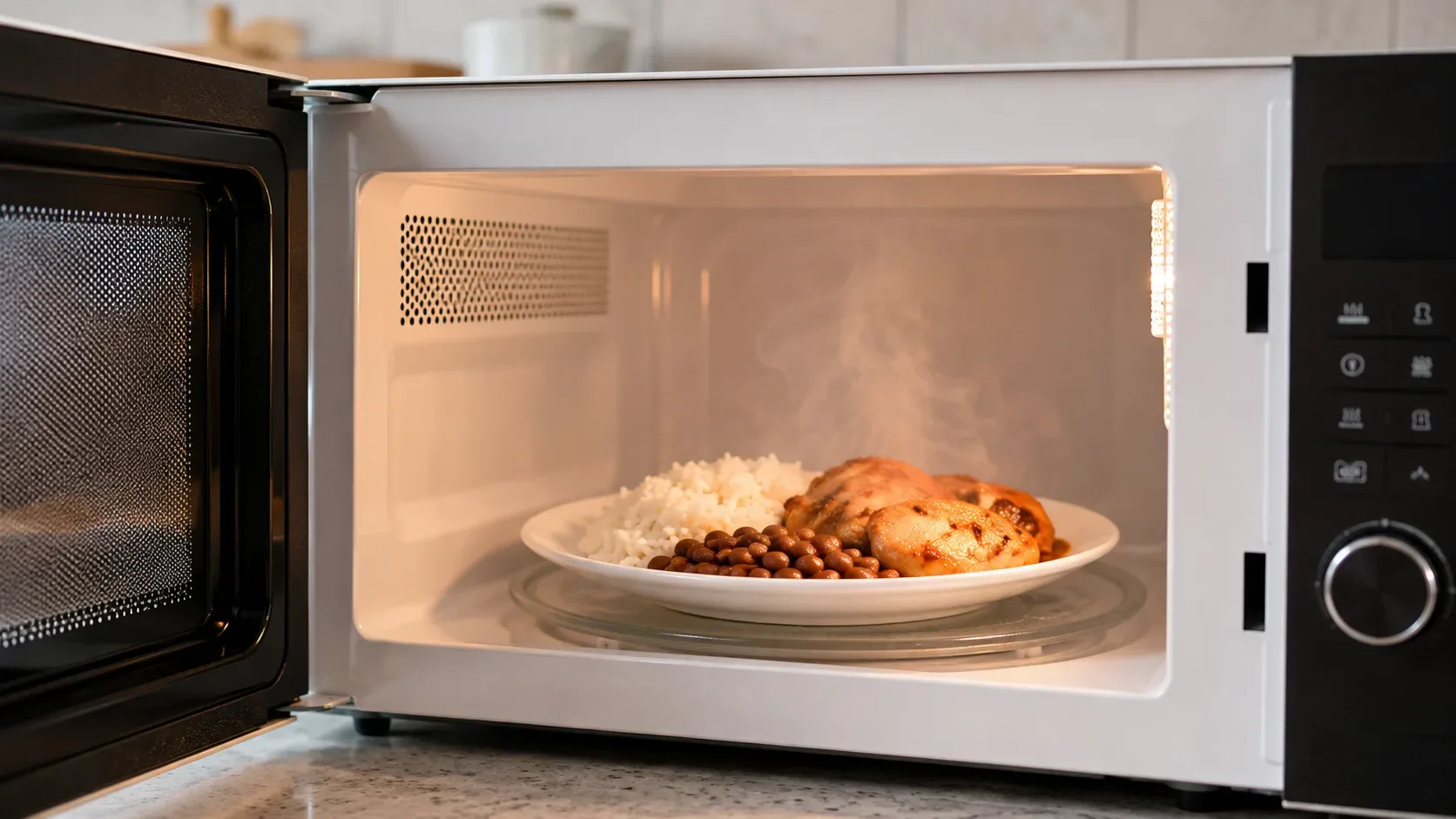
You heat up your lunch, take the plate out of the microwave and find a strange combination: sauce almost boiling on one side and food still cold on the other. In many cases, this does not mean that the device is defective. The very way in which microwaves are distributed within the cavity favors regions that receive more energy than others.
The turntable exists precisely to reduce this effect. But he doesn't solve everything alone. The shape and quantity of the food, the chosen power, the heating time, the possibility of stirring the food and even the minutes of rest after the appliance turns off influence the result.
Where do hot and cold spots come from
Inside the device, a component called a magnetron produces microwaves, which are reflected by the metal walls and absorbed by the food. This electromagnetic energy is converted into heat in the food. The FDA also emphasizes that the microwave does not simply cook “from the inside out”: in thick foods, the outer regions receive the energy more directly, while the center depends largely on heat conduction from the already heated parts.
The reflected waves inside the cavity interfere with each other. The result is a pattern with regions of greater and lesser electromagnetic field intensity. OpenStax describes this phenomenon as the formation of standing waves and points to the rotating plate, as well as systems that change the direction of the waves in some devices, as ways to better spread the heating points.
This helps to understand why two very close parts of the same meal can end the cycle at different temperatures. And there's another complicating factor: the food itself is not uniform. Thickness, amount of water, composition and shape change the way energy is absorbed and how heat spreads.
What the turntable actually does
The glass dish does not heat the food on its own. Its main function is to move the container during operation.
When rotating, different parts of the food successively pass through regions of greater and lesser microwave intensity. Instead of leaving an area of food stationary at a low energy point all the time, the movement better distributes the exposure to the field inside the oven.
This reduces unevenness, but does not guarantee identical temperature across the entire dish. A thick portion of rice, a large piece of meat, or a meal with components of different densities may still have cold regions.
Therefore, stirring the food during the cycle remains useful even in appliances with a rotating plate. Food safety guidelines also recommend stirring or rearranging food to reduce cold spots during heating.
Why decreasing power can improve results
Increasing power is not always synonymous with better heating. Often it just means delivering energy faster.
In many conventional microwaves, selecting a lower power does not cause the magnetron to continually produce a weaker version of the power. The device alternates on and off periods. In models documented by GE Appliances, for example, a 50% level roughly corresponds to the magnetron being active half the time.
Devices with inverter technology can control energy delivery in another way. Panasonic, for example, describes its inverter models as capable of delivering reduced levels of power more continuously, in contrast to the on-off cycle of conventional systems.
This difference is important because device power and selected power level are not the same thing, and the exact behavior depends on the model.
In practice, if the edges get very hot before the center heats up, reducing the power and increasing the time may help. The reason is not that low power eliminates cold spots, but that less aggressive heating offers more time for the heat already produced to travel from hot regions to colder regions.
This effect is especially relevant in thicker foods. The FDA explains that in these cases, the interior ends up being heated largely by heat conduction from the outer layers.
Rest is not wasted time
When the microwave beeps, microwave emission has ended, but the temperature of the food has not yet stabilized.
The hottest parts continue to transfer heat to colder regions. This is why microwaveable food packaging and recipes sometimes call for a few minutes of resting before serving. FoodSafety.gov advises following this time when it appears in the instructions, explaining that cooler regions continue to receive heat from warmer regions during the waiting period.
Rest, therefore, does not alone correct an extremely uneven dish. It functions as the last step in a sequence that may have already included proper food distribution, rotation and, when possible, a break to stir.
Larger, denser foods also tend to rely more on this thermal redistribution than smaller, thin portions.
How to reheat more evenly
When food permits, a simple sequence greatly reduces the chance of finding a cold center after the whistle:
- Distribute the food evenly. Avoid concentrating the entire portion in a high pile. Spreading the food out increases the exposed area and reduces the distance the heat needs to travel to the center.
- Cover loosely when appropriate. A microwave-safe lid with steam vent helps conserve moisture. Official food safety guidance recommends covering food during reheating and arranging it evenly.
- Adjust power and time to the type of food. If a small, homogeneous portion heats well at maximum power, there is no reason to complicate things. But if the edges overheat while the middle remains cold, try lower power for longer. Also consult the device manual and packaging instructions.
- Stop in the middle to stir or rearrange. In rice, pasta, beans, stews and other foods that can be mixed, moving the cold part to another position is one of the most efficient ways to reduce temperature differences. If the device does not have a turntable, the orientation is even more relevant.
- Let it rest before deciding if it is still cold. Respect the time indicated on the packaging or recipe. After the cycle, conduction continues to redistribute heat between regions of the food.
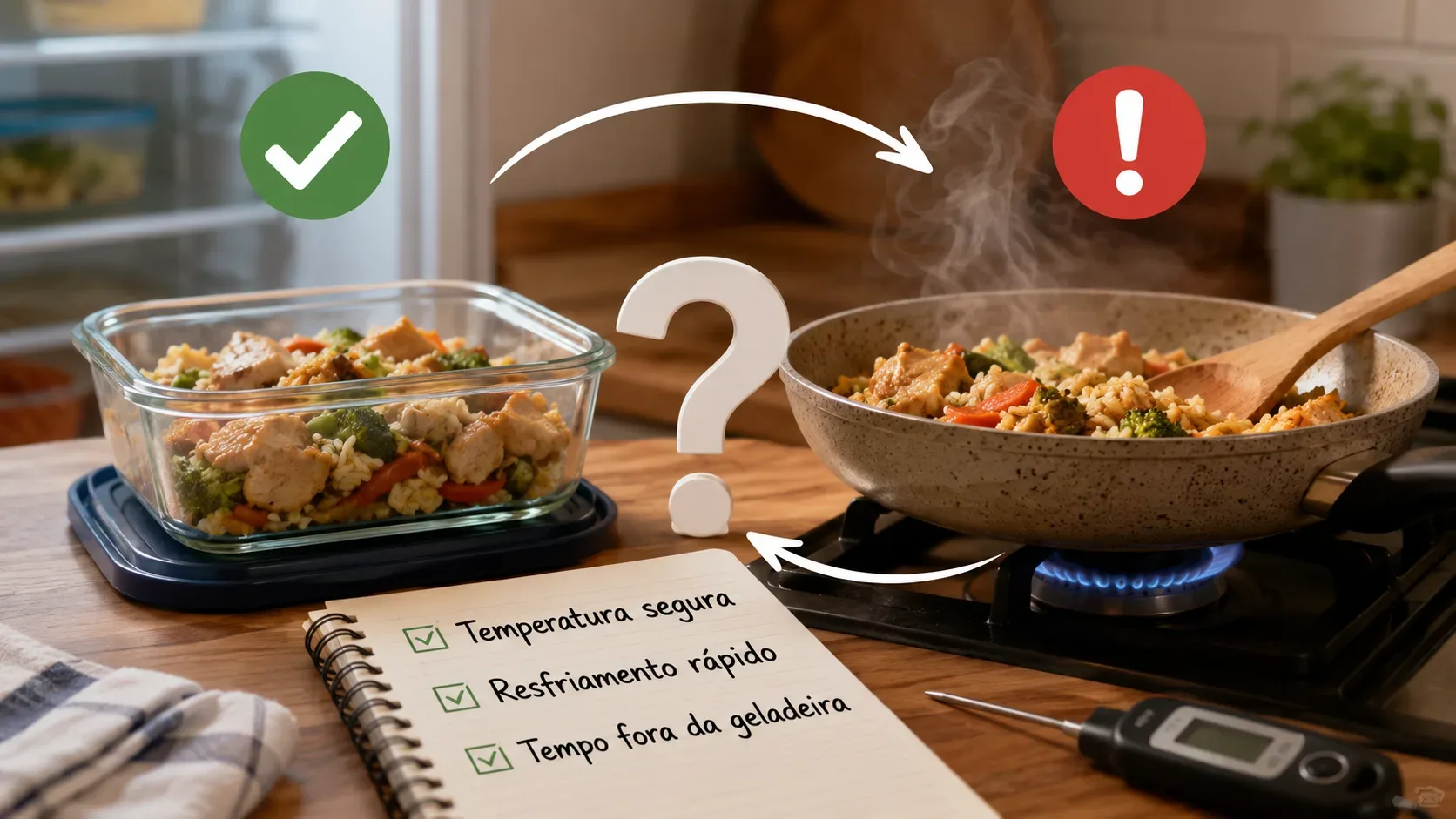
For leftover meals where microbiological safety is relevant, it is not enough to evaluate just by touching or tasting a part. FoodSafety.gov recommends that reheated leftovers reach 74°C and advises checking the temperature at different points when there is a risk of uneven heating.
So the problem is the device or the way you use it?
In most common situations, finding a colder area is a consequence of a combination of the energy pattern within the cavity and the difficulty for heat to distribute throughout the food.
The turntable reduces fixed exposure to hot and cold spots. Power controls the speed and, depending on the technology, the way energy is delivered. Stirring or rearranging the food physically redistributes the heated regions. And rest gives time for the heat to continue moving from the hottest to the coldest parts.
It is this combination, and not simply adding another 30 seconds at full power, that tends to produce more uniform reheating.