The panel lights up, you select the power, place the pan on the cooktop and nothing happens. In many cases, this does not mean that the device is defective. The induction cooktop needs to recognize a base with adequate magnetic properties and, depending on the model, it also requires that this area is of sufficient size and well positioned over the cooking zone.
So the magnet test is important, but it doesn't tell the whole story. A pan can attract the magnet and still fail in a certain area because only a small part of the bottom is ferromagnetic, because the base is too small, or because the pan is off-center. Manufacturer's manuals document precisely these situations.
Why is the pan part of the heating system
In a conventional electric cooktop, a resistance heats up and transfers heat to the pan. In induction, a coil beneath the surface produces an electromagnetic field that transfers energy directly to a compatible pan. The heating is generated in the container itself.
This explains why it is not enough to place any pan on the glass. The container needs to interact properly with the magnetic field. Ferromagnetic materials such as cast iron, enameled steel, and certain types of stainless steel are compatible. Glass, ceramics, copper, aluminum and non-magnetic stainless steel, when they do not have an appropriate base for induction, are not detected in the same way.
This is also why simply saying that “stainless steel pan works” can lead to error. There are stainless steel compositions that do not have the necessary magnetic properties. What matters about the cooktop is the construction of the base, not just the material advertised on the body of the pan.
The magnet test shows whether the bottom is magnetic
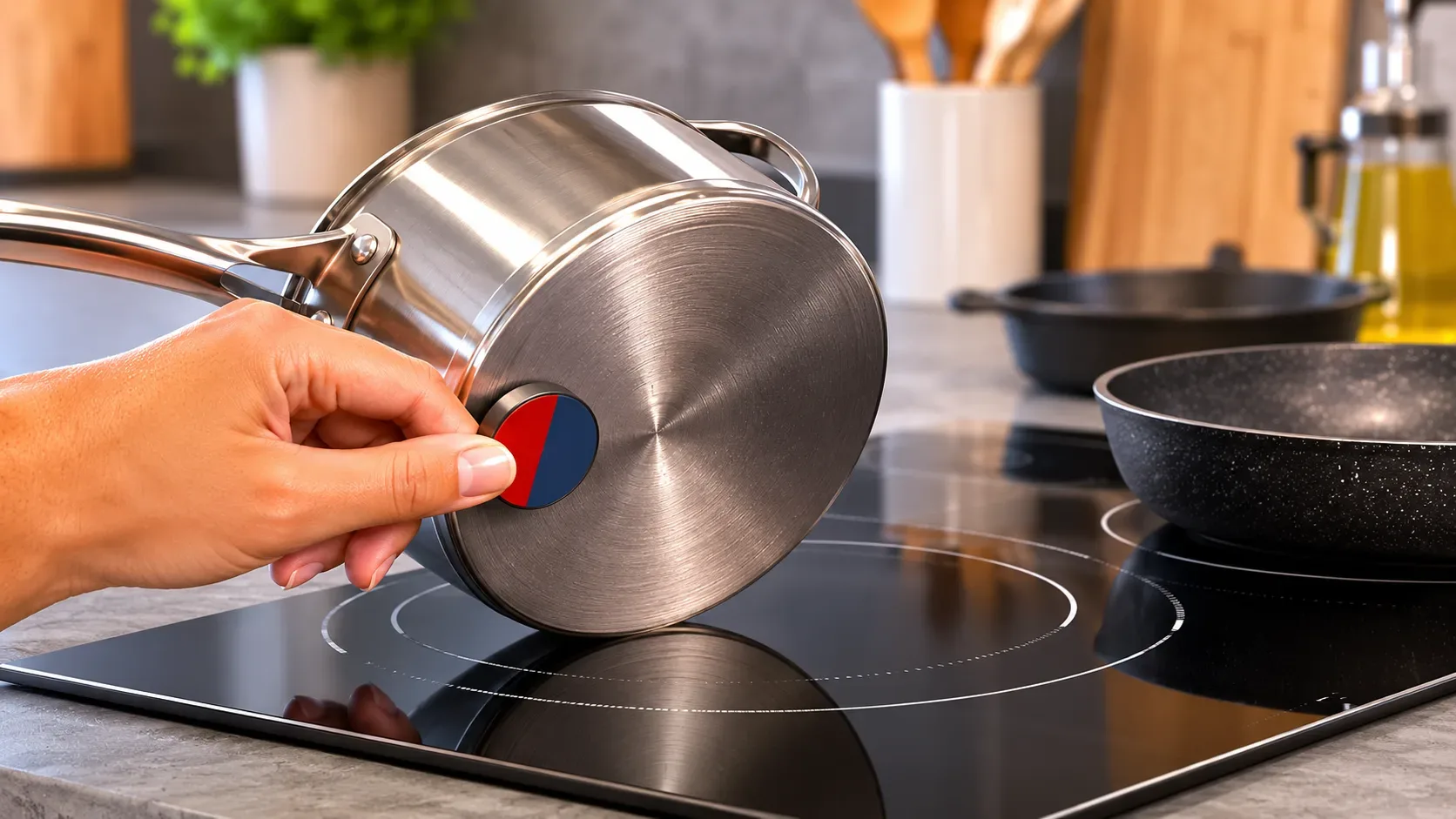
The simplest home test is to turn the pan over and touch a magnet to the bottom. If there is a firm attraction, there is ferromagnetic material in that region and the pan passes the first compatibility test. This guidance appears in manufacturers such as Bosch, Tramontina and Electrolux.
But there is a detail that helps explain the apparently contradictory cases: don't just test one point. Pass the magnet through the center and other parts of the base. This is a practical application of the Bosch documentation, which warns that some pans only have part of the ferromagnetic bottom. In these cases, only this region effectively participates in the heating and a reduced magnetic area can impair performance or even prevent detection.
Thus, a wide frying pan may have, for example, a much smaller magnetic disc embedded in the center. Looking from above, it looks like a large pot; for the induction system, however, the relevant area may just be that disc.
The diameter that matters may be smaller than it seems
Induction cooktops have detection limits that vary depending on the zone, material and design of the appliance. Bosch informs in the manual that this limit depends on the diameter of the ferromagnetic area on the bottom and the material used in the base. Electrolux also relates detection failure to a background that is too small for the selected zone.
This has two practical consequences. The first is that the diameter of the pan mouth, measured at the top edge, does not necessarily represent the useful diameter for induction. A pan can open quite a bit on the sides and have a relatively narrow base. Bosch's own documentation draws attention to the difference between the top diameter of the container and the diameter of its base.
The second is that there is no universal minimum number that fits all cooktops. As an example, the Brazilian page for Tramontina Square Basic 4EI 60 states, for that specific model, a minimum of 14 cm in the 20 cm zones and 12 cm in the 18 cm zones. These numbers show why your device's manual should prevail: they should not be generalized to other models.
A small pan that is not recognized in a large zone may therefore work in a smaller zone. Bosch recommends testing the container in a smaller diameter area when it is not detected.
Centering the pan also makes a difference
If material and size appear correct, note where the base is resting. Both Bosch and Brastemp recommend that the container be centered over the cooking zone. A pan that is too small or positioned inappropriately may not be recognized by the system.
This is a simple test before concluding that there is a defect: remove the pan, place it again in the center of the zone marking and select the power. If there is another area closer in size to the base, try it there too.
In cooktops with flexible zones, the behavior may be different because the appliance can combine inductors or adapt the active area. Still, size and positioning remain subject to model-specific rules, which reinforces the importance of consulting the manual.
Flat bottom helps, but doesn't replace magnetism
Manufacturers also recommend flat-bottomed pans. The United States Department of Energy cites the combination of a flat base and magnetic attraction as a compatibility criterion, while Tramontina, Electrolux and Bosch advise the use of flat bases for proper functioning.
It is important to separate two things. A flat bottom does not make a non-magnetic pan compatible. Magnetism remains the first requirement. A deformed or very irregular base can harm the cooking result and the correct positioning of the container, even when the material is suitable.
The same reasoning applies to multilayer pans. They can work perfectly if they have an appropriate ferromagnetic layer on the base. The problem appears when this layer is small, discontinuous or insufficient for the area used.. Bosch documents that a base that is only partially ferromagnetic may heat up only in this region, distribute heat unevenly, or even fail to be detected.
How to find out if the problem is the pan before buying another one
A short sequence of tests usually separates incompatibility from possible cooktop failure:
- Test the pan with a magnet. Make sure it sticks firmly to the bottom and pass it to different points on the base, not just the center.
- Note the size of the magnetic area. If the magnet only holds onto a small central disc, that area — and not necessarily the entire visible width of the pan — is the most useful reference for understanding detection.
- Center the container. Place the base in the center of the chosen zone.
- Try a smaller zone, if available. A small pan may not reach the detection limit of a larger zone.
- Compare with a pan that you know works. If the other is normally recognized in the same area, the utensil becomes the prime suspect. This is a diagnostic inference consistent with the compatibility tests recommended by the manufacturers.
- Consult the model manual. Look for the minimum and maximum dimensions allowed for each zone and the meaning of the symbol or code displayed on the panel. Limits vary between devices.
The combination of these tests is more reliable than just asking if “the pan is induction”. It checks material, magnetic area, dimension and position — precisely the factors that the cooktop uses or that manufacturers relate to detection.
What if the magnet sticks, the size is right and it still doesn't heat up?
At this point, it is worth expanding the diagnosis. Bosch recommends checking if the correct zone has been selected, if there is a defined power level, if lock or pause are active and if there is an error code on the panel. Brastemp also includes power supply and safety interlock between checks when the cooktop does not work as expected.
Code behavior varies by model. In Brastemp equipment covered by the support page consulted, for example, code C85 leads the user to check the magnetic material, size and centering of the pan, while other codes are directed to technical assistance. This does not mean that “C85” has the same meaning on devices from other brands.
If several proven compatible pans stop working in the same zone, or if no zone recognizes containers that previously worked, the hypothesis of a problem with the appliance gains strength. In this case, the safest path is to follow the manual and authorized support, instead of disassembling the cooktop or trying to intervene in its electrical components.
The main idea is simple: the magnet responds “is there magnetic material here?”, but the cooktop still needs to see a suitable magnetic area, of a compatible size and correctly positioned. Before changing an entire set of pans, these three checks usually reveal where the incompatibility lies.