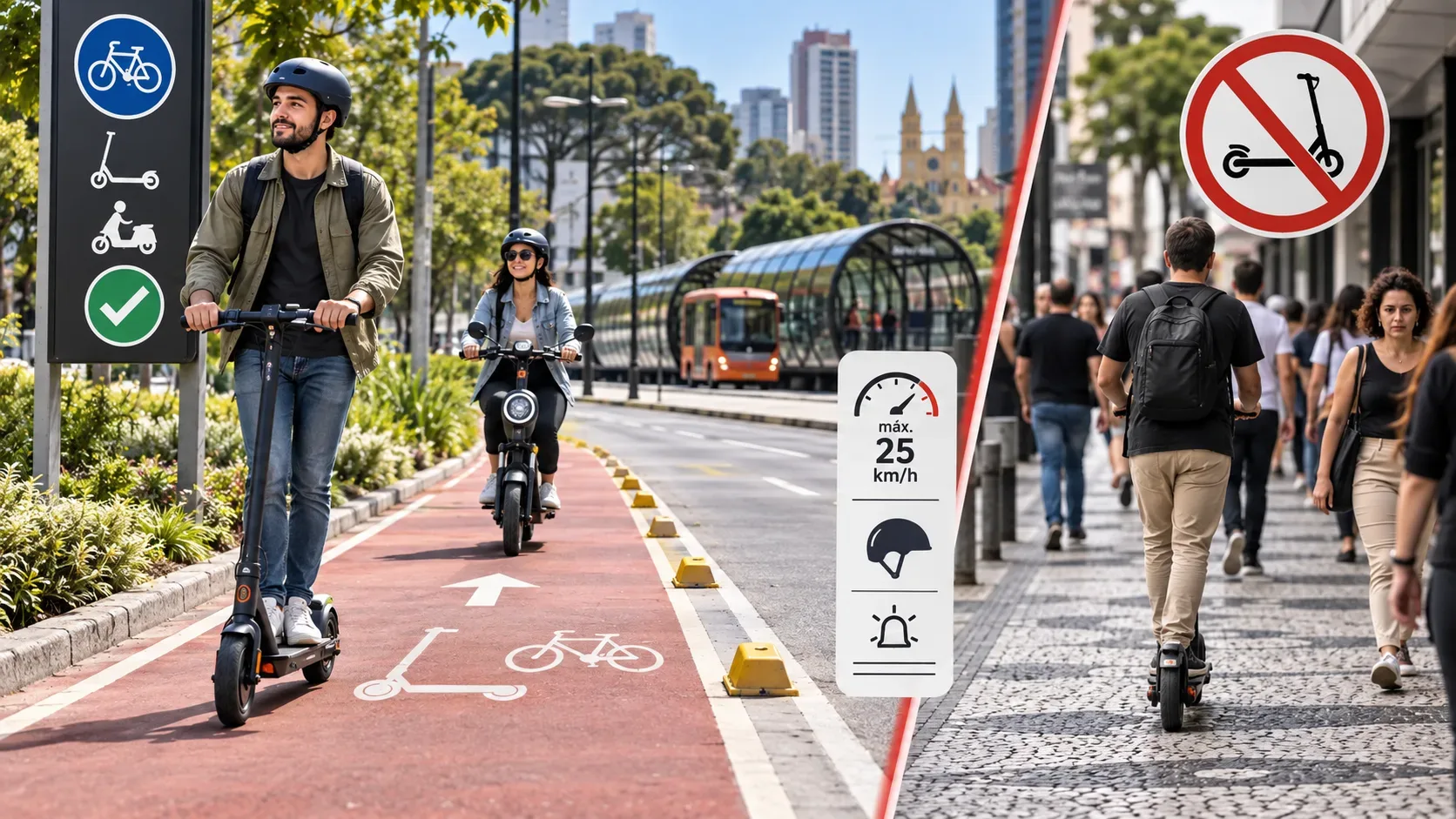
Curitiba announced new rules on September 17, 2026 for the circulation of individual self-propelled mobility devices. In its official notice about Decree 1520, the City lists electric kick scooters and skateboards, scooters, mini-scooters and unicycles, and says these devices may travel on streets with posted speed limits of 30 km/h or 40 km/h, as well as in bike lanes and on cycle paths. The same notice prohibits their use on sidewalks, express roads and dedicated public transport lanes.
The local rule should be read together with Contran Resolution 996/2023, which defines an individual self-propelled mobility device and gives local road authorities the power to regulate where it may circulate. The City of Curitiba also states that when a device fits this category and is not a moped, it does not require a driver's license or a license plate.
Which devices fall under the self-propelled category
Under Contran Resolution 996/2023, an individual self-propelled mobility device must have one or more wheels and, as a general rule, a propulsion motor with a maximum rated power of 1,000 W, a maximum factory speed of 32 km/h, a width of up to 70 cm and a wheelbase of up to 130 cm. The resolution provides an exception for one-wheel self-balancing unicycles, which may have a motor with a maximum rated power of up to 4,000 W.
This means the commercial name alone does not determine the legal category. A product sold as a scooter, mini-scooter or kick scooter may cease to be treated as a self-propelled mobility device if its original factory specifications exceed the legal limits. In that case, it may be classified as a moped, motorcycle, motor scooter or tricycle, depending on its characteristics, with different legal obligations.
Where these devices may circulate in Curitiba
| Place | Status announced by the City | What to check |
|---|---|---|
| Streets with a 30 km/h limit | Allowed | Follow signs and the general rules of the road. |
| Streets with a 40 km/h limit | Allowed | The device must still fit the self-propelled mobility category. |
| Bike lanes | Allowed | Follow the speed limit established for the cycling infrastructure. |
| Cycle paths | Allowed | Follow the speed limit established for the cycling infrastructure. |
| Sidewalks | Prohibited | Curitiba adopted a stricter rule than the general possibility in the federal regulation for pedestrian areas. |
| Express roads | Prohibited | The municipal notice excludes these roads from self-propelled device circulation. |
| Dedicated public transport lanes | Prohibited | Exclusive transit corridors may not be used by these devices. |
The Contran resolution allows the authority responsible for a road to authorize self-propelled devices in pedestrian areas at up to 6 km/h, on bike lanes, cycle paths and signed bicycle routes according to the local limit, and on roads with a maximum speed of up to 40 km/h. Curitiba, however, expressly stated that sidewalks are prohibited. The municipal notice reviewed does not mention signed bicycle routes, so it is not safe to assume they have the same authorization as bike lanes and cycle paths without checking signs and any supplementary rules.
32 km/h is a device classification limit, not permission to ride at that speed everywhere
The 32 km/h figure appears in the federal rule as the maximum factory speed for a device to qualify as self-propelled mobility equipment. It does not mean a rider may travel at 32 km/h in every location. On bike lanes and cycle paths, the speed limit set by the road authority must be followed. On streets, posted speed limits, signs and the other applicable circulation rules still apply.
In practical terms, riders should check both the road sign and the type of space before choosing a route. A street with a 50 km/h limit, for example, is not included in the authorization announced by the City for self-propelled devices, which refers to streets limited to 30 km/h or 40 km/h.
When a driver's license and license plate are not required
For devices that truly qualify as self-propelled mobility equipment, Contran Resolution 996/2023 exempts them from registration, licensing and license plates. Curitiba's notice also says these devices do not require a driver's license because they are not classified as mopeds.
The exemption changes if the vehicle does not fit the category. The federal resolution itself provides that equipment whose power, maximum factory speed or other characteristics exceed the limits for self-propelled devices must be placed in another vehicle category, as applicable. This is why the manufacturer's original technical specifications matter more than the vehicle's appearance or its marketing label.
Required equipment
Contran Resolution 996/2023 requires self-propelled mobility devices to have:
- a speed indicator and/or electronic speed-limiting device;
- a bell;
- front, rear and side night-time lighting or signaling incorporated into the device.
The rule allows an alternative to a conventional speedometer if speed is indicated through an audible alert or a smartphone app. These are federal requirements and they apply alongside the circulation restrictions set by the municipality.
How to check whether your kick scooter or scooter fits the rule
- Check the manual, technical label or manufacturer documentation for the maximum factory speed.
- Check the motor's rated power. Under the general self-propelled rule, the ceiling is 1,000 W.
- Check width and wheelbase if there is any doubt about the classification.
- Confirm that the device has the equipment required by Contran.
- Plan the route using bike lanes, cycle paths or streets limited to 30 km/h and 40 km/h, and avoid sidewalks, express roads and dedicated transit lanes.
What the municipal notice does not detail
The official September 17 notice sets out the main allowed and prohibited locations and the core technical limits, but it does not state fine amounts, any education-only period or a street-by-street list in the notice itself. Those points should not be assumed. For enforcement details, users should follow the full decree, any supplementary acts and the signs installed by the traffic authority.