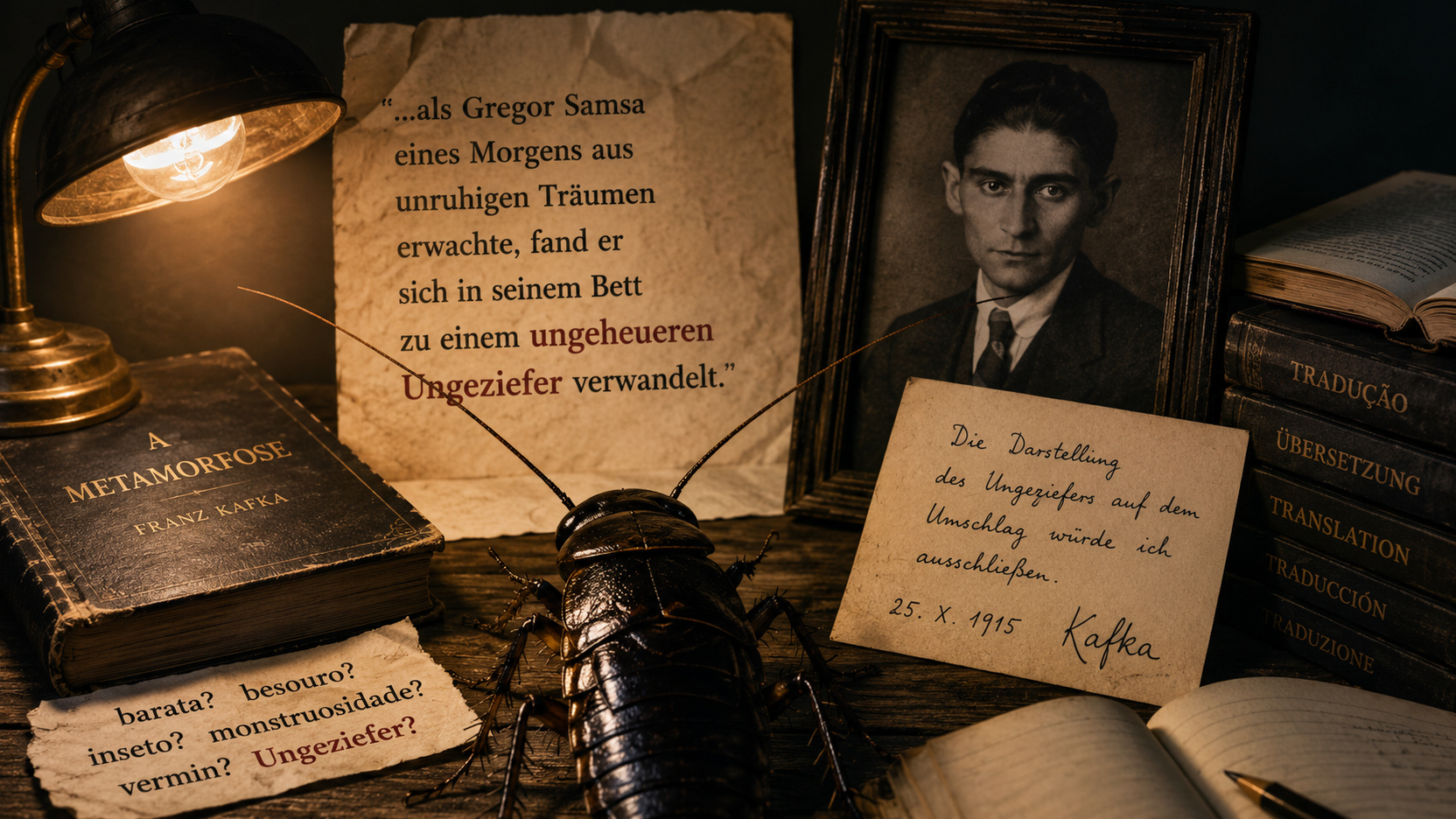
The safest answer is: no, Franz Kafka did not write that Gregor Samsa turned into a cockroach. In the sentence that opens The Metamorphosis, the narrator says that he woke up transformed "zu einem ungeheueren Ungeziefer." The difficulty lies precisely in Ungeziefer, a broad and unpleasant German word, without the degree of zoological precision that "cockroach" would have in English.
That does not mean every translation as "insect" is wrong. The body Kafka describes is clearly nonhuman and has features that suggest a large arthropod, and the author himself, in a 1915 letter, uses the word Insekt when referring to the creature. The problem begins when a translation choice or a cultural image is treated as though it were a textual identification of species.
The short answer: Kafka did not write "cockroach"
The original does not use Kakerlake, Schabe, or another German word that specifically names a cockroach. It uses Ungeziefer, preceded by ungeheueren. Depending on context, ungeheuer can carry ideas such as monstrous, enormous, excessive, or terrible. Ungeziefer, meanwhile, works as a generic term for animals regarded as unwanted, harmful, or repulsive.
Duden, one of the major dictionaries of German, defines Ungeziefer as animal pests and gives examples as different as lice, bedbugs, mites, rats, and mice. The breadth of those examples itself shows why the word does not point to a species. Its etymology is also telling: the term goes back to an idea of an animal unfit for sacrifice, and later narrowed to designate beings seen as harmful or unwanted.
There is no perfect English equivalent that preserves at once the generality, repulsion, and rhythm of the original. "Vermin" is close to the semantic field but is awkward as the name of a single creature. "Bug" is broad but can sound colloquial. "Insect" is clearer and matches several clues in the body, although it is more specific than Ungeziefer in its dictionary sense. It is in this space that translations begin to diverge.
Gregor's body gives clues, but does not settle the species
Kafka describes the new body gradually. At the beginning, Gregor notices a back hard like armor, a convex brown belly divided by curved ridges, and many thin legs in relation to the size of his body. Later he learns to use his Fühler, a term that can be translated as antennae or sensory feelers, realizes that he does not really have teeth but does have strong jaws, and manages to cling to surfaces and crawl along walls and the ceiling.
These details make it perfectly understandable that many readers imagine an insect. They also help explain why "monstrous insect" became such a stable solution in Portuguese. But the pieces do not form a taxonomic record. Kafka does not name a species, does not provide a complete anatomical description and, at several points, treats the body through partial sensations and discoveries as Gregor tries to move, eat, or cross the room.
For that reason, saying "it is a creature with an insect-like appearance" is more defensible than saying "it is a cockroach." The first formulation summarizes clues from the text. The second adds an identification that the narrator does not provide.
What about the "beetle" mentioned near the end of the novella?
There is a passage that often fuels another categorical answer. In the third chapter, the old cleaning woman, who does not show the same fear as the other characters, calls Gregor "alter Mistkäfer." Mistkäfer is a dung beetle, something close to "old dung beetle" or "old scarab."
That does not turn the line into a diagnosis by the narrator. It is a character giving Gregor a crude nickname, in a context in which she treats him with familiarity and contempt. The word reveals how she sees him, not a classification established by the narrative voice.
The distinction matters because The Metamorphosis constantly works with the contrast between what Gregor still thinks and feels as a person and what others come to see when they look at him. A designation tossed out by a character does not carry the same weight as an objective identification made by the narrator.
Why so many translations choose "insect"
The choice of "insect" did not come out of nowhere. It solves a real difficulty: it quickly gives the reader an image compatible with much of the bodily description and avoids words that, in Portuguese, could sound strange or out of place.
Modesto Carone, one of the major Brazilian references for translating Kafka directly from German, rendered the passage as "inseto monstruoso" ("monstrous insect"). In his comments on the sentence, he acknowledged that the solution was correct in a general sense but did not preserve all the effects of the German. One of them is the sequence of words with the prefix un- at the beginning of the novella, which contributes to the atmosphere of negation and estrangement in the sentence.
Translator Raquel Abi-Sâmara discussed the same problem in a 2021 article in Cadernos de Tradução, published by UFSC. When retranslating the work, she sought a less domesticated form and proposed "monstruoso bicho repugnante" (roughly, "monstrous repulsive creature"). According to her account, the published edition replaced bicho with "inseto," while keeping "repugnante." The case shows that the translation of a classic depends not only on the dictionary: editorial tradition, reader expectations, and revision choices also carry weight.
A study by Helmut Galle published in 2023, comparing 22 Brazilian translations of the novella, again found a strong concentration in formulas such as "inseto monstruoso" and "monstruoso inseto." The recurrence helps consolidate "insect" as a familiar answer, but familiarity does not turn a translation solution into a zoological species explicitly stated by the original.
Where the cockroach came from in the Brazilian imagination
The association with the cockroach is especially strong in Brazil, and Tito Lívio Cruz Romão's research helps separate translation from cultural reception. In an article published by Revista Graphos, from UFPB, the researcher compared 31 versions of Die Verwandlung in Portuguese, Spanish, Italian, French, and English, with special attention to Ungeziefer and the image of the cockroach.
The study shows that the cockroach became a recurring reference in Brazilian reception even when it does not appear as the translator's choice for the German word. One example is particularly illuminating. In the 1965 Brazilian edition translated by Brenno Silveira, the opening spoke of "uma espécie monstruosa de inseto" ("a monstrous kind of insect"), but the back cover described the character as having metamorphosed into a barata, a cockroach. In other words, the same editorial object could give the reader two different answers, one in the translated text and another in the paratext.
Covers, summaries, adaptations, comics, videos, classes, and popular references repeated over decades can fix an image faster than the original's ambiguous wording. When that happens, it is easy to remember "Gregor turns into a cockroach" as if the sentence were in the book.
The strength of that association does not make it absurd. A cockroach is one of the possible images evoked by a large, crawling, brown, repulsive creature. The unjustified leap is turning a visual possibility into definitive textual information.
The letter of October 25, 1915 is the decisive clue about the image
Shortly before publication in book form, Kafka learned that Ottomar Starke would make the cover illustration. In a letter dated October 25, 1915 to the publisher Kurt Wolff Verlag, he reacted to the risk that the artist might draw the creature. Kafka asked that the insect itself not be drawn and added that it should not be shown even from a distance.
The letter requires careful reading. First, Kafka uses Insekt, "insect," when referring to the creature outside the literary text. That gives support to translations that choose "insect" as a general term. Second, and perhaps more importantly, he rejects fixing the form visually. As alternatives for the cover, he suggests scenes in which the family members stand before the closed door, or are in a lit room while Gregor's dark room remains open.
The letter, therefore, does not serve to prove that Gregor "is not an insect." It shows something more precise: Kafka did not want the creature reduced to a determined visual figure. That resistance fits the narrative strategy of providing bodily features without naming a species.
That is precisely why a modern cover with a cockroach can be read in two ways. If presented as the answer, it simplifies the text. If presented as the popular image that the article is questioning, it can work as a starting point for doubt.
So what does Gregor Samsa turn into?
At the level most faithful to the original, Gregor turns into an ungeheueres Ungeziefer: a monstrous, harmful, repulsive, or unwanted creature whose species is not specified. "Monstrous insect" is a traditional and defensible
translation, especially because the body described is strongly insect-like and Kafka used Insekt in his correspondence. Even so, the word chosen in the narrative is more open than "insect" and much more open than "cockroach."
"Cockroach" should be treated as an interpretation or cultural image, not as a literal answer. "Beetle" does not settle the issue either, because Mistkäfer appears in the cleaning woman's speech, not as the narrator's classification. Translations diverge because each one has to decide how much of Ungeziefer's indeterminacy to preserve and how much to turn into an immediate image for the reader.
If the question is "Did Kafka write that Gregor turned into a cockroach?", the answer is no. If the question is "Is it possible to imagine a cockroach?", yes, as one among several visualizations. And if the question is "What is the most precise way to say what happens?", the best answer is that Gregor wakes transformed into a monstrous and repulsive creature with an insect-like appearance, which Kafka deliberately does not fix as a particular species.