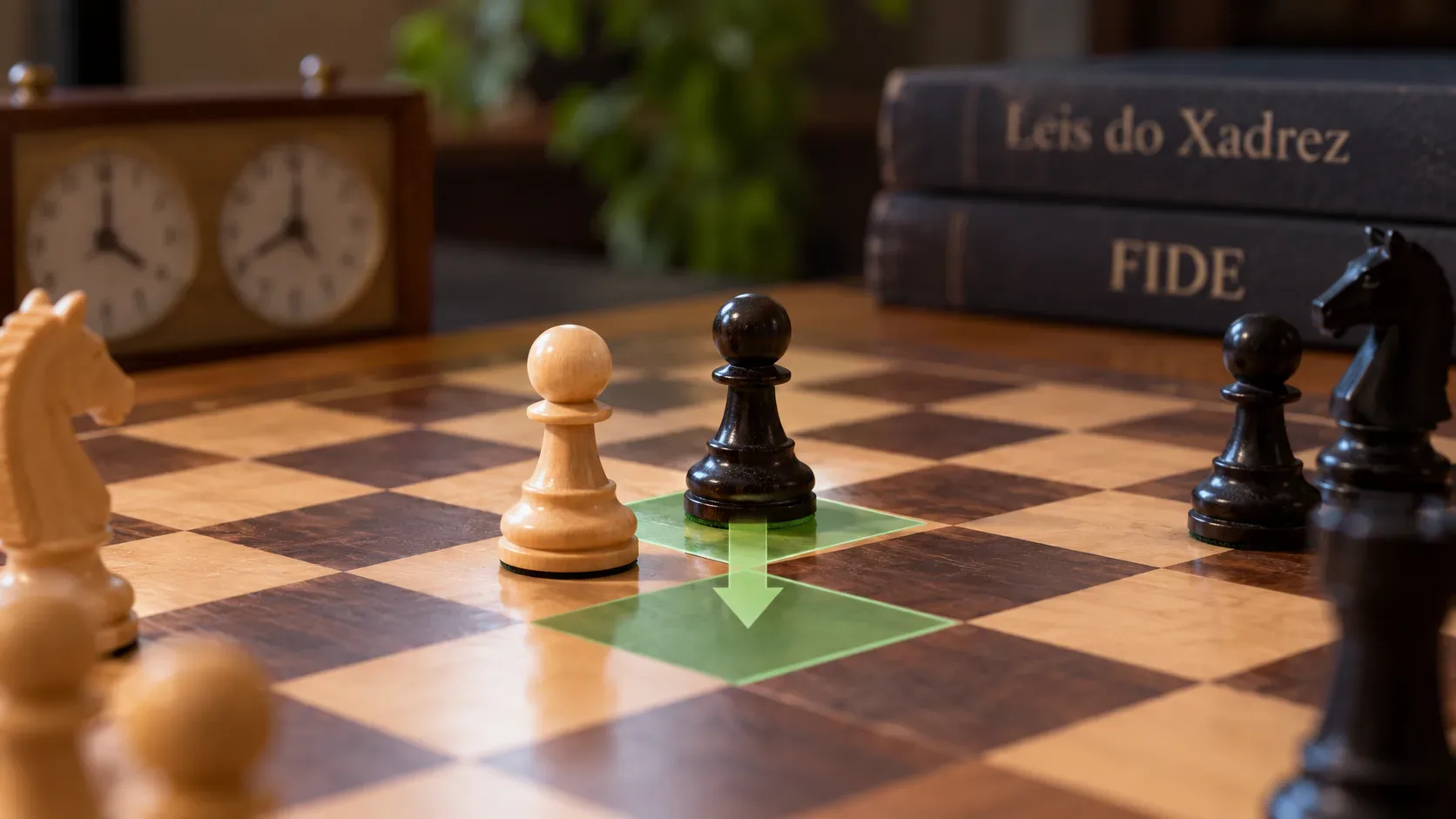
An en passant capture can occur only in a very specific situation. An opposing pawn must have just advanced two squares in a single move from its starting square and ended next to your pawn. On that immediate next move, your pawn may capture it diagonally as if the opposing pawn had advanced only one square. If you make any other move, the opportunity disappears.
The conditions for an en passant capture
To decide quickly whether the capture is allowed, check four points:
- The opposing pawn has just advanced two squares. That advance must have happened in a single move from the pawn's starting square.
- The two pawns ended side by side. After the two-square advance, the opposing pawn must be on the same rank as your pawn and on an adjacent file.
- The capture is made diagonally onto the square the opposing pawn crossed. The destination square is empty before the capture. The captured pawn is removed from the square where it finished its two-square advance.
- The capture must be made immediately. If the player who could capture makes another move, the right to that en passant capture ends.
In addition, as with every chess move, the capture must be legal with respect to the king. It cannot leave your own king in check or expose it to attack.
Which rank must the capturing pawn be on?
| Side | Capturing pawn | Opponent's advance | Capture square |
|---|---|---|---|
| White | On the 5th rank, for example e5 | A black pawn leaves the 7th rank and advances two squares, for example d7-d5 | On the 6th rank, for example e5xd6 en passant |
| Black | On the 4th rank, for example c4 | A white pawn leaves the 2nd rank and advances two squares, for example b2-b4 | On the 3rd rank, for example c4xb3 en passant |
The capturing pawn does not need to be making its first move. The requirement to start from the original square applies to the pawn that has just advanced two squares.
Legal example: white pawn on e5 and black pawn from d7 to d5
Imagine a white pawn on e5. Black plays d7-d5, moving the pawn two squares and placing it beside the white pawn. White may immediately respond with e5xd6 en passant.
- The white pawn leaves e5 and finishes on d6.
- The black pawn that finished on d5 is removed from the board.
- The d6 square was empty before the capture.
- If White chooses any other move, this specific capture is no longer available.
The logic of the rule is to treat the black pawn, for this capture, as if it had advanced only one square, from d7 to d6.
When the right is lost or the capture is illegal
| Situation | En passant? | Reason |
|---|---|---|
| White pawn on e5; Black plays d7-d5; White immediately plays e5xd6 | Yes | The pawn advanced two squares from its starting square, the pawns became adjacent, and the capture was immediate. |
| White pawn on e5; Black plays d6-d5 | No | The black pawn advanced only one square. |
| White pawn on e5; Black plays d7-d5; White plays another move | Not on a later turn | The right expires as soon as White declines the immediate reply. |
| White pawn on e5; Black plays g7-g5, with another file between the pawns | No | The opposing pawn must finish on an adjacent file. |
| White pawn on e5 shields the white king on e1 from a black rook on e8, with the e-file otherwise clear; Black plays d7-d5 | No | e5xd6 would remove the pawn from the e-file and leave the white king in check. |
| Black pawn on c4; White plays b2-b4; Black immediately plays c4xb3 | Yes | It is the same mechanism from Black's side. |
Why does the capture seem to land on an empty square?
This is the part that causes the most confusion. In a normal capture, the capturing piece moves onto the square occupied by the opposing piece. In en passant, the capturing pawn moves to the square the opposing pawn would have occupied if it had advanced only one square. The opposing pawn is already one square farther because it used the two-square advance, so it is removed from a different square than the capturing pawn's destination.
The rule depends on the immediately previous move
En passant is a temporary right. The board position by itself is not enough to determine whether the capture is possible. You must also know what the last move was. Two visually identical board positions can have different legal moves if, in one position, the pawn has just advanced two squares and, in the other, it has been on that square since an earlier move.
This feature also appears in the FIDE rules on position repetition: the availability of an en passant capture can make two visually identical positions count as different positions for repetition purposes.
Mini-test
- A white pawn is on a5 and Black has just played b7-b5. May White play a5xb6 en passant?
Yes, provided the move does not expose the white king to check. The black pawn has just advanced two squares and ended beside the white pawn. - In the same situation, White plays h2-h3. On White's next turn, can the pawn still capture b5 en passant?
No. The opportunity ended when White made another move. - A white pawn is on e5 and a black pawn moves from d6 to d5. Is en passant available?
No. The move from d6 to d5 was only one square. - The pawn on e5 is the only piece blocking a black rook on e8 from attacking the white king on e1. After d7-d5, may White play e5xd6 en passant?
No, if the e-file is clear between the rook and king. The capture would leave White's own king in check. - The capturing pawn moved earlier in the game. Does that prevent en passant?
No. What matters is that it is on the correct square and the opposing pawn has just made the two-square advance from its starting square.
What the FIDE Laws say
The FIDE Laws of Chess state in Article 3.7.3.1 that a pawn beside an opposing pawn that has just advanced two squares from its original square may capture it as though it had advanced only one square. Article 3.7.3.2 limits this capture to the immediately following move. Articles 3.9.2 and 3.10 also make clear that no move may expose or leave the player's own king in check.
In practice, the decisive question is simple: did the opposing pawn just advance two squares and finish beside my pawn? If so, check whether the diagonal capture can be made now and whether your king remains safe. If you make another move, the right disappears.