The short answer is this: in the FIDE Laws of Chess used in face-to-face competitions, the third repetition and the 50-move rule depend on a correct claim by the player taking the turn. The fifth repetition and the sequence of 75 moves by each player without pawn movement or capture ends the game in a draw without depending on a request. This division avoids two common confusions: thinking that every third repetition is automatic and counting 50 moves in total, when the rule says 50 moves on each side.
The matrix that resolves the doubt
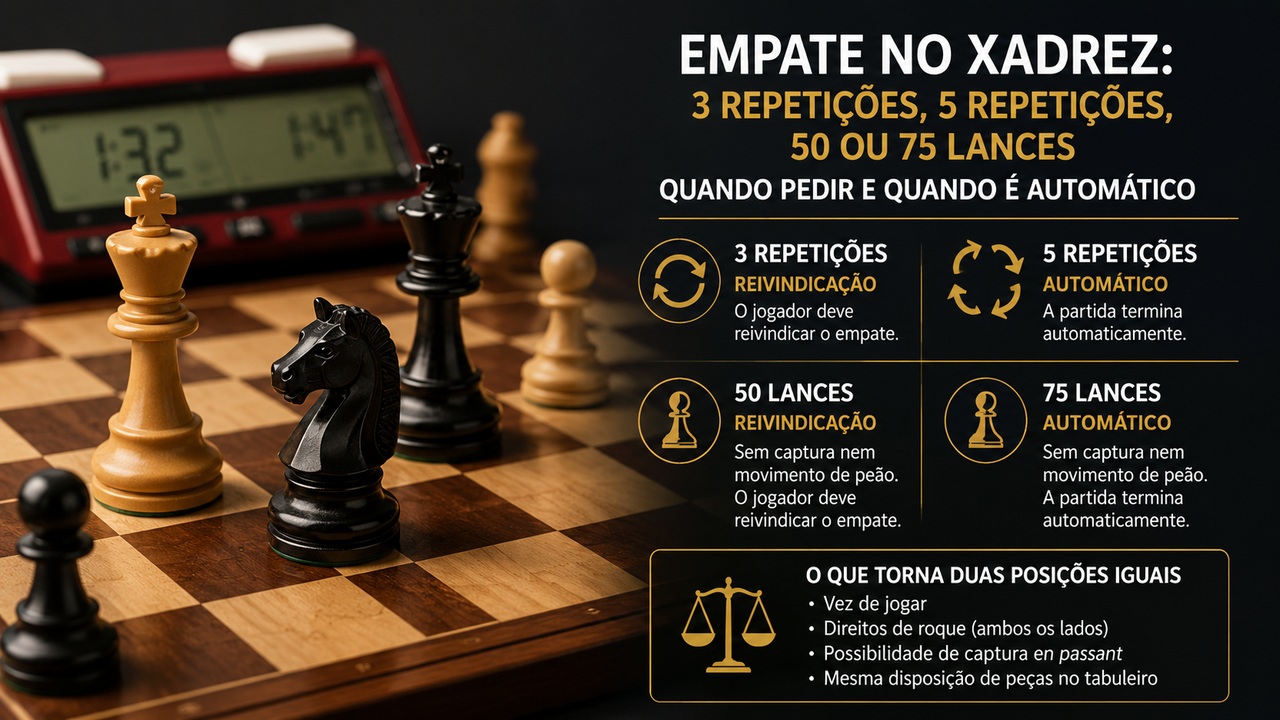
The logic can be stored in four numbers. Three instances of the same position entitle you to claim a draw. Five occurrences make the draw happen automatically. Fifty moves by each player with no pawn movement and no capture entitles him to claim. Seventy-five moves from each player under these same conditions make it an automatic draw.
In current FIDE in-person rules, therefore, 3 and 50 are claim triggers; 5 and 75 are automatic shutdown triggers. The difference is not just terminological. In the first two cases, the player needs to act at the correct time. In the last two, the rule does not depend on the will of the player.
Three repetitions: player needs to claim
Article 9.2 of the FIDE Laws of Chess establishes a draw when the same position appears for at least the third time, provided there is a correct claim by the player taking the turn. It is not necessary for the sequence of moves to be repeated identically, nor for the three occurrences to be consecutive. What needs to reappear is the position in the technical sense of the rule.
There are two main ways to make a claim. If the third occurrence has already appeared and it is your turn, you can request verification. If the position will appear for the third time with the move you intend to make, the rule allows you to indicate that move in the spreadsheet, without
play it on the board, and declare to the referee the intention to play it. This indicated bid cannot be changed later.
In an in-person match, this means that it is not safe to simply play the repeater and continue pressing the clock hoping someone stops the match. If the rule depends on a claim, the procedure is part of the right to a draw.
Repeated position is not just a board with the same pieces
FIDE considers two positions to be equal only when the same player has a turn, pieces of the same type and color occupy the same squares and the possible moves of all pieces are the same. This last part is the one that produces the most errors.
Imagine that a king and a rook return to their original squares after the king has moved. Visually, the board may appear the same as it did at a previous time, but the right to castling has been lost. As the legal possibilities have changed, the positions do not count as equal for repetition.
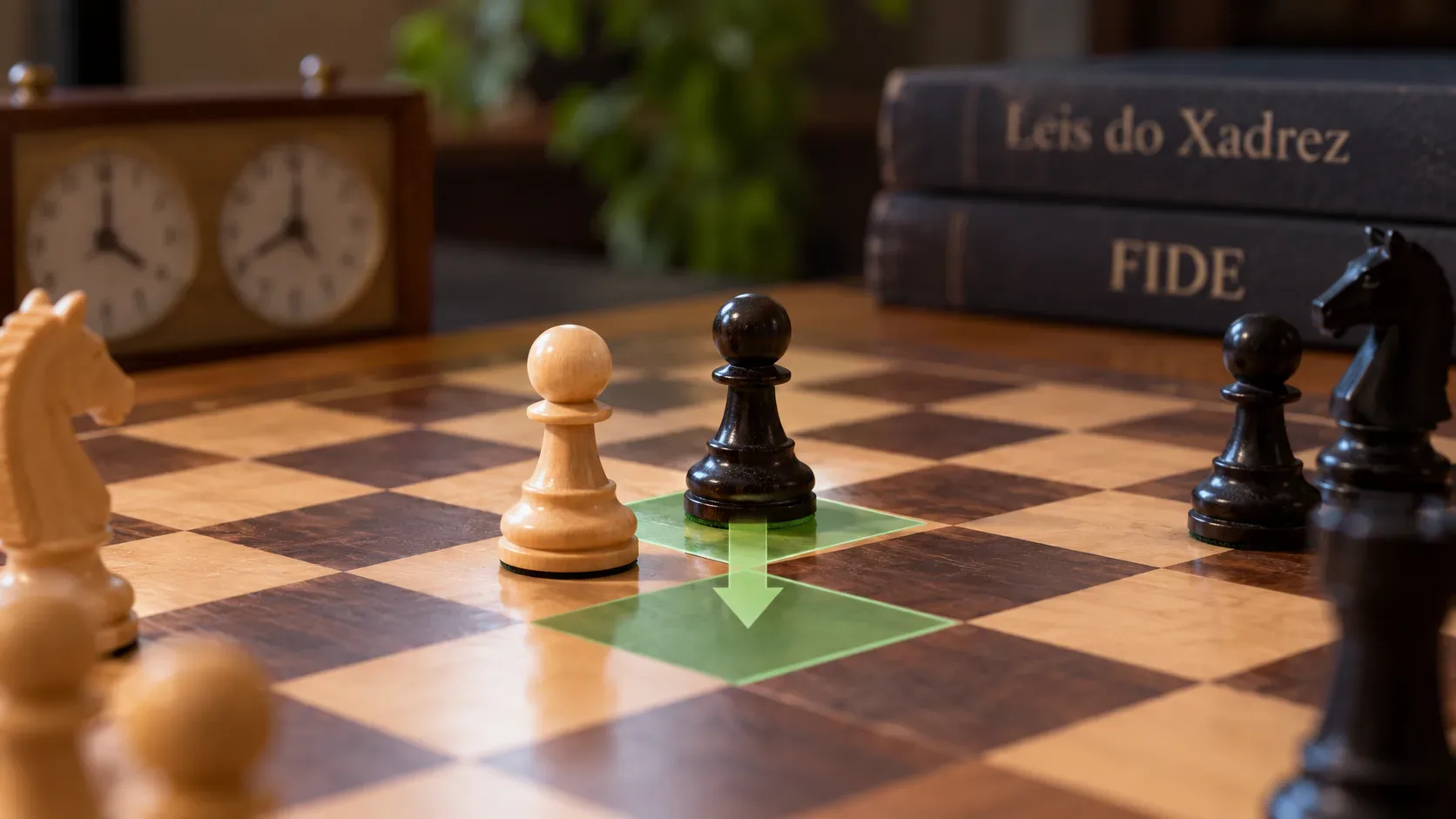
The en passant creates another important exception. The right to capture en passant only exists immediately after the opponent's pawn advances two squares. If this right existed in one occurrence and no longer exists in another, the availability of movements is different. The arrangement of the pieces can be the same and yet the position may not be the same for the rule.
It is also essential that it is the same side's turn. An identical arrangement of pieces with White to play in one occurrence and Black to play in another does not form a valid repetition.
Five repetitions: the draw no longer depends on the order
Article 9.6.1 creates the second level. If the same position appears at least five times, depending on the definition used for repetition, the match is a draw. Here there is no condition of a correct claim by the player.
This difference explains why the rules of three and five repetitions coexist. In the third occurrence, the player who has the turn can end the game if he makes the claim correctly. If no one does and the game keeps repeating, the fifth occurrence acts as an automatic limit.
In face-to-face practice, the referee must apply the rule when the fact is identified. The player does not need to turn the fifth repetition into a claim for a draw to exist.
50 moves rule: what exactly should be counted
Article 9.3 deals with another situation. A draw can be claimed when each player's last 50 moves have been made without any pawn movement and without any capture. In chess software language, this corresponds to 100 half-moves in total, because each side must have completed 50 moves.
The counter returns to the beginning whenever a pawn moves or any piece makes a capture. Check does not restart the count. Neither does Roque. A promotion restarts because the pawn necessarily moved to promote; an en passant capture also resets because it involves pawn movement and capture.
The rule does not ask if the position is won, tied or difficult to convert. It is an objective criterion based on the history of moves since the last pawn movement or capture.
How to claim 50 bids
The procedure is similar to the third repetition. If each player's last 50 moves have already been completed under these conditions and you have a turn, you can claim a draw. If your next move produces exactly this condition, you can indicate the intended move on the scoresheet and declare to the referee your intention to play it, without making it first.
FIDE also provides consequences for an incorrect claim: the referee adds two minutes to the opponent's remaining time and the match continues. If the claim was based on an intended move, that move must be played according to the rules.
There is also a procedural detail worth remembering: if the player touches a piece as predicted by the touched piece rule, he loses the right to claim a draw for repetition or for the 50 moves in that move. Therefore, when the claim depends on the move you intend to make, the moment to call the referee matters.
75 moves: the second limit is automatic
Article 9.6.2 establishes that the game is drawn when a sequence of at least 75 moves by each player occurs without pawn movement and without capture. Unlike 50 bids, this level does not require a claim.
There is an express exception: if the last move of the sequence of 75 results in checkmate, checkmate takes precedence. Therefore, a mate executed precisely on that last move does not turn into a tie for the count.
The relationship between 50 and 75 is similar to the relationship between three and five repetitions. The lower limit gives the player the right to stop the match by claiming; the higher limit prevents the match from continuing indefinitely if no one exercises this right.
Why are there two limits for each type of draw
The FIDE Laws do not need to say that 50 is an incomplete version of 75 or that three is an incomplete version of five. They fulfill different functions in the procedure. The first level is an option available to the player. The second is a closure imposed by the rule itself.
This also helps you understand why continuing to play after reaching the right to claim does not necessarily mean there was an error. A player may not realize the situation, may prefer to continue, or may simply not make a valid claim. The automatic rule exists precisely so that the match does not depend forever on this initiative.
A simple example of repetition that deceives
Suppose a king still has the right to castle, leaves the original square and then returns. Later, the tower and other pieces also return to the squares they occupied before. A photograph of the board may look identical, but the legal position of the game has changed: the king has already moved, so castling is no longer possible. For article 9.2, these two positions are not the same.
Now think of a pawn that has just moved two squares forward and can be captured en passant. If the pieces return to the same arrangement a few moves later, this temporary right has already disappeared. Once again, the board design is the same, but the
possible moves are not.
For this reason, applications and referees do not count repetition just by comparing where the pieces are. Position status includes rights that are not visible in a static photo.
What changes when the match is online
Online chess should not be treated as an automatic copy of the in-person procedure. FIDE itself has Online Chess Regulations for official competitions on a virtual board. In them, the game zone must automatically end the game on the third occurrence of the same position and also when the last 50 moves of each player have been completed without pawn movement or capture. In other words: in this specific regulation, the software automates precisely two cases that, in person, depend on claims.
FIDE also makes it clear that unsupervised online competitions may have rules defined by the platform itself. Therefore, interface behavior is part of the player's practical experience and may vary.
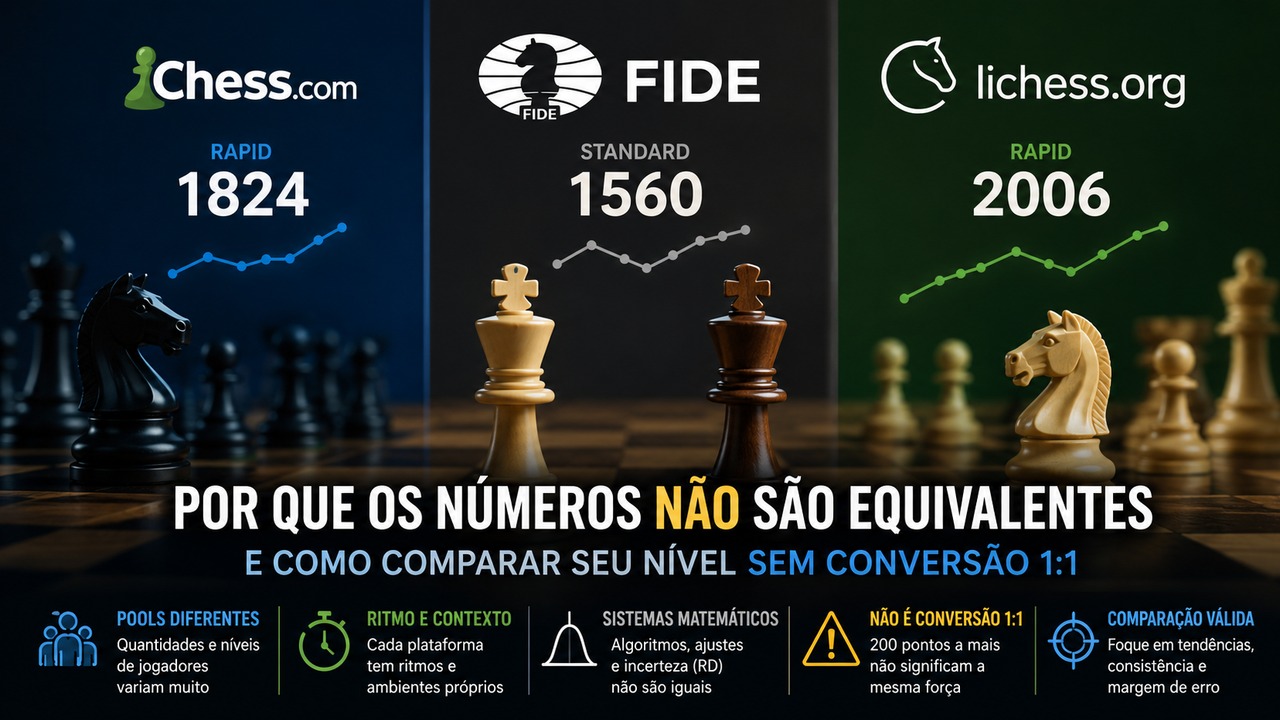
On Chess.com, the help center informs that Live games are automatically declared a draw on the third repetition and also when the limit of 50 moves is reached. For Daily matches, the 50 move rule must be manually claimed via the draw button; Once the condition is met, the opponent does not need to accept the offer for the draw to be recognized.
In Lichess, the FAQ states that triple reps typically need to be claimed by the player when the button appears, although it is possible to configure the platform to automatically claim reps. The same page informs that repeating for five occurrences always ends the game immediately.
These examples show why a phrase like "the third repetition is automatic" can be true on a platform and false as a description of the FIDE in-person rule. Before applying the procedure of a physical tournament to an internet match, it is necessary to know which regulations and implementation are in effect.
In an in-person tournament, the timing of the action matters
If you suspect triple repetition or 50 moves, the first question is whether the condition has already occurred or whether it will be completed by your next move. In both cases, the claim belongs to the player who has the turn. When it depends on the next move, it must be indicated before it is executed, following the FIDE procedure.
After the claim, the clock is paused by the player or referee and the claim is verified. If correct, the match ends in a draw. If it is wrong, the time is adjusted in favor of the opponent and the game continues.
In the fifth repetition or after 75 moves on each side without pawn or capture, the logic is different: the draw does not depend on a timely request from the player. These are automatic termination rules.
The easiest way not to confuse 3, 5, 50 and 75
Think of two steps for each mechanism. Repetition: three gives the right to claim; five closes automatically. Absence of pawn capture and movement: 50 moves on each side gives the right to claim; 75 moves on each side automatically ends, except
Checkmate on the last move of the 75 sequence.
And, before counting any repetitions, confirm what really defines the position: same side to play, same pieces on the same squares and the same legal possibilities, including castling rights and eventual capture en passant. It is this combination that turns a repeated appearance into a rules-legal repetition.