Calculating well in chess does not mean seeing as many moves as possible. The most common problem is something else: the player starts one variant, abandons it in the middle, jumps to a second one, returns to the first and ends without knowing which position he was comparing. The solution is to transform the calculation into a process with a beginning, middle and end.
The idea of organizing thought by candidate moves was associated with the great master Alexander Kotov and continues to be present in modern training. FIDE, for example, has already presented training for coaches focusing on candidates, elimination, comparison, priorities and typical errors. The useful starting point is not to imitate a perfect mechanical tree, but to reduce confusion: first identify what deserves calculation, then examine the strongest answers, and finally evaluate where each line ends.
The purpose of calculation is not to predict the entire future
A chess position can offer dozens of legal moves. If each of them generates multiple responses, the tree grows too fast to be examined by brute force. Therefore, human players depend on selection. Knowledge, pattern recognition and position understanding help you choose which movements really deserve attention.
That changes the question. Instead of “how many moves ahead can I see?”, ask “which moves do I need to consider, what is the opponent's best response, and how far does this sequence need to be resolved?” A short but correct and well-judged line can be more useful than a long line built on a weak response from the opponent.
The calculation is also not necessary with the same intensity in all moves. There are times when the position calls for a concrete decision: an exchange that changes the structure, an exposed king, a sequence of captures, a pawn break, an immediate threat or a transition to the end. These are the moments when it is worth investing more time and discipline.
Step 1: Recognize if the position is critical
Before opening variants, check whether the bid really requires in-depth calculation. A position tends to be critical when a decision can significantly alter the evaluation or character of the match. This often happens in the face of tactics, decisive exchanges, changes in pawn structure, attacks on the king, sacrifices, transitions to endings or opportunities that may disappear on the next move.
In quiet positions, trying to calculate many unforced sequences often produces noise. You imagine a plan, your opponent chooses another, and the entire tree loses value. In these cases, positional understanding and plane choice carry more weight. In forced positions, the opposite occurs: as there are fewer plausible answers, the concrete calculation gains value.
A simple routine is to ask: what changed with the last move? Is there an immediate threat? Were any parts loose? Did a column, diagonal or critical square open? Has an important trade become available? If the response indicates urgency, treat the position as a candidate for more careful calculation.
Step 2: Understand the threat and position before choosing your move
One of the shortcuts that causes the most mistakes is to start with your own plan without looking at what the opponent has just done. Before generating candidates, read the position from their point of view. What does he threaten in the next move? Which piece improved? Which house weakened? Did the last move remove a defender or create a tactic?
This diagnosis avoids calculating variants that are already irrelevant. If the opponent threatens to kill, win your queen, or execute a decisive break, your pool of candidates needs to respond to that problem, either by defending or by creating an even stronger threat.
This is also where you separate calculation from evaluation. The evaluation tells what matters in the position: material, security of the kings, activity of the pieces, pawn structure, space, initiative and possible targets. The calculation tests whether a concrete movement works given these factors. Without evaluation, you calculate without direction. Without calculation, you can choose a correct plan that fails tactically.
Step 3: Generate few candidate bids
Once you understand the position, form a short list of serious moves. There is no fixed number that fits every board, but two to four candidates is usually a practical range for many moments in a game. In an almost forced sequence, there may only be one or two options. In a complex strategic position, you may need to consider more.
In tactical positions, start looking for moves that restrict your opponent's responses: checks, captures and concrete threats. This does not mean that every check is good or that a capture must be calculated to the end. It just means that forcing movements deserve screening because they can change position immediately.
Then, include the movements required by the position. A necessary defense may be a candidate. A prophylactic move that prevents the rival plan as well. In calmer positions, a move that activates the worst piece, contests an open file, improves the king, or prepares a break may be more important than any aimless check.
The error that the list combats is tunnel vision. When you find an attractive pitch and start to delve deeper into it before looking for alternatives, all the thinking becomes trying to justify the first idea. The list of candidates forces a real comparison.
Step 4: Calculate the opponent's best response first
Choose a candidate and ask the most uncomfortable question possible: what answer is most disruptive to my plan? Don't look for the natural response you would like to face. Look for the counterattack, precise defense, intermediate exchange, check, capture, or tactical device that makes your idea less convincing.
This discipline changes the quality of the variant. A sacrifice is not good because it works against an obvious recapture; he's good if he keeps working against the strongest defense you can find. Likewise, a strategic maneuver only deserves confidence after verifying whether the opponent has a breakthrough or tactic that changes everything.
When you reach a new position within the variant, repeat the thumbnail process. Check forcing moves and critical resources on both sides. If your opponent's response immediately eliminates your candidate, end that line and return to the starting position. There is none
award for deepening an already refuted variant.
How not to get lost when the variant branches
Imagine the starting position as the root. Candidate A opens a branch. You follow this branch until you find the best rival answer and continue as long as there are concrete consequences. When the sequence is sufficiently resolved, evaluate the result and mentally return to the root. Only then move on to candidate B.
Kotov's classical method became famous for defending a very disciplined analysis of each branch. In practice, it is not necessary to treat human thinking as a rigid algorithm. Sometimes an idea discovered in variant B reveals a feature that you need to check again in variant A. The problem isn't going back; the problem is going back for no reason and recalculating the same sequence because you lost your mental position.
To avoid this, end each branch with a short conclusion. For example: “A loses a pawn without compensation”, “B leads to equal final”, “C maintains attack with safe king”. This mental tag creates a return point. If you revisit the line, you know what you're trying to confirm.
Step 5: stop in a sufficiently stable position and compare
Knowing when to stop is part of the calculation. You don't need to continue until the end of the game. The time to stop a variant is when the forcing sequence has been resolved and the resulting position can be assessed with sufficient confidence for comparison.
A stable position does not have to be completely calm. It needs to be clear enough to answer the relevant questions. Who got the most material? Are the kings safe? Is there an immediate attack? Which side has more active pieces? Has the pawn structure improved or worsened? Is there a passed pawn, a permanent weakness, or an initiative that pays off materially?
If there is still a forced check, a decisive capture or a threat that changes the assessment, you have not yet reached the stopping point. If, on the contrary, the next moves are mostly strategic choices and the comparison between the results is already clear, going deeper can only be time consuming.
The clock is also part of the decision. In a real game, the optimal calculation is limited by the time available. A position may merit ten minutes in a non-clock analysis and just one minute in a quick game. The method serves precisely to spend more time in critical moments and less in moves where the position does not require an extensive tree.
The decision tree in a sentence
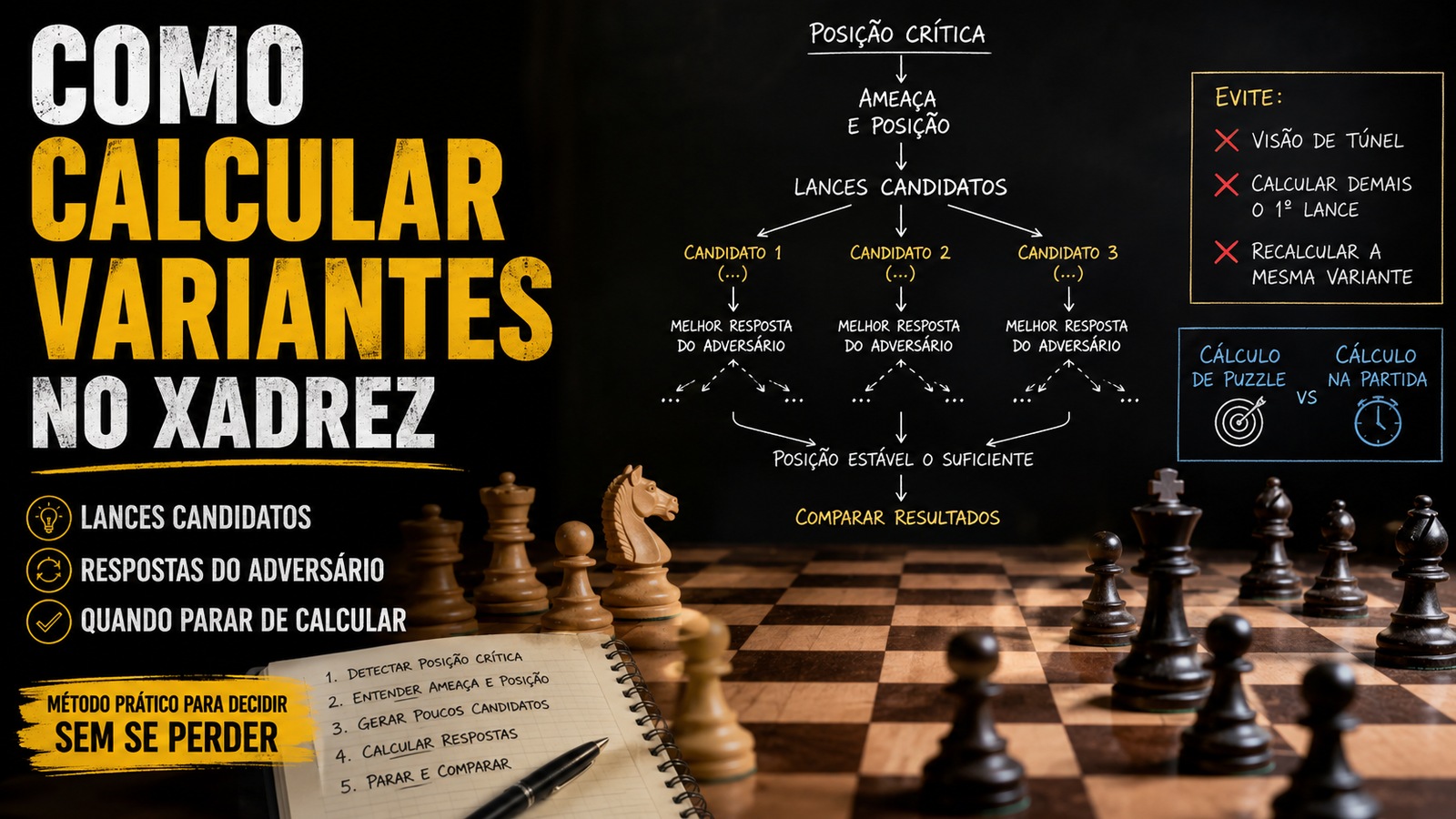
The flow can be summarized as follows: critical position -> threat and characteristics of the position -> few candidates -> best opponent response -> concrete sequence -> stable position -> comparison between results -> final check before playing.
This order avoids two extremes. The first is to play on impulse, without calculating. The second is trying to calculate everything, which is not viable and increases the chance of mixing positions.
Position-type 1: there is an immediate threat
Suppose your opponent has just created a tactical threat against your king. You also notice that you have a check and a capture available. The disorganized player starts with the capture because it seems to gain material. The organized player starts with the diagnosis: “if I do nothing, what happens?”.
From there, candidates can be a direct defense, a countercheck and the capture. For each, the first answer to calculate is the opponent's best resource. If the capture does not stop the threat and leads to the mate, that branch ends immediately. If the countercheck forces an exchange of queens and neutralizes the attack, you have quickly reached an assessable position. The depth required was small; the correct selection of candidates solved the problem.
Type 2 position: an exchange transforms the match
Now imagine a position without immediate tactics in which the opponent offers to exchange queens. Accepting can relieve pressure, but it can also lead to a lesser ending. Refusing preserves attack possibilities, but leaves your own king exposed.
Here, calculating only checks and captures is insufficient. The decision depends on the transformation of the position. Your candidates could be accepting the exchange, refusing by moving the queen to an active square, or creating an intermediate threat. You don't need to calculate twenty moves from each ending. You need to advance to the point where you can compare the type of position that results: material, structure, activity, and security of the king.
This example shows why calculation and evaluation are inseparable. The variant ends when you understand the practical result of the transformation, not when you have already imagined all the possible moves at the end.
Position type 3: you find a move that appears to win
Bids that appear to win deserve extra attention precisely because they provoke enthusiasm and tunnel vision. When you find an attractive match, don't automatically make her your only candidate. Register the idea and look for at least the opponent's strongest defenses.
Ask if there is an intermediate check, different recapture, escape from the king, exchange of queens, overloaded piece or counter threat. If the idea holds up, compare it to less spectacular alternatives. Sometimes the simple move preserves a greater advantage than the pretty combination.
Error 1: Deeply calculating the first move found
Depth does not correct a poor initial choice. If you invest five minutes in a variant of an inferior candidate and don't even consider the best alternative, you calculated a lot and made a bad decision. The antidote is to form the list before delving deeper.
Error 2: choosing answers that are convenient for the opponent
This error turns calculation into fantasy. You imagine a sequence in which the opponent responds naturally, but ignores the annoying defense. The correct question is not “what is he likely to play?” but rather “what strong response might make my play bad?”
Error 3: recalculating the same variant
Repeating a line can be a legitimate check, but it is often just a loss of reference. You come back because you forgot where the piece ended or because you didn't summarize the review. End each branch with a mental conclusion and only revisit when there is a concrete reason, such as a new tactical feature discovered in another thread.
Error 4: continuing to calculate after the decision has already become clear
If a candidate loses material without compensation and there is no forcing recourse, stop. If another leads to a clearly better position and the critical line has been checked, it may not be necessary to explore very distant quiet moves. The goal is to decide, not produce an engine analysis inside your head.
Error 5: forgetting the final check
After choosing the move, do one last short sweep. Imagine the piece on the destination square and look for the opponent's checks, captures and most direct threats. Also check if the moved piece was defending something important. This step does not replace the calculation; it protects against the error of a move that appears after you have already “closed” the decision.
Puzzle calculation and match calculation are not the same thing
A puzzle already warns you that there is a problem to solve. There is usually a relevant tactical idea, the position was selected because of it and you know it is worth looking for a concrete sequence. This information reduces uncertainty even before the first calculation.
In the real match, no one warns you that the tactical moment has arrived. There may be no combination. The best move can be silent, prophylactic or positional. Additionally, you need to manage clock, fatigue, and risk. The first skill of the game, therefore, is recognizing when the position deserves in-depth calculation.
So solving lots of puzzles helps, but it doesn't train the entire decision process alone. To bring training closer to the match, don’t start immediately looking for “the hit”. First describe the position, identify the rival threat, choose candidates and only then calculate. When finished, record what final position you expected to obtain and what your assessment was.
How to train the method without depending on the engine
A good calculation session can be done with specific starting positions, studies or exercises. Look at the position without moving the pieces. Choose the candidates, calculate each branch and formulate a final assessment. Only then move the pieces or consult the solution.
In your own games, do the first review without an engine. Try to reconstruct what you thought, which candidates you failed to consider, where you calculated a weak response from your opponent and at what point you lost your mental position. Then use the engine as a verification tool, not as a process substitute.
It's also worth training with a time limit. If you play fast, resolving all positions in twenty minutes creates a difficult skill to transfer. Use exercises where you need to reach a decision within a similar range to what you will have in the match. The goal is not just to get it right, but to organize reasoning under constraint.
A short protocol to use during the match
When you feel that the position requires attention, mentally ask yourself five questions. First: what has changed and what does the opponent threaten? Second: who are my few serious candidates? Third: what is his strongest response against each candidate? Fourth: at what stable position does each branch end and how do I evaluate it? Fifth: Before playing, are there any checks, captures or simple threats that I missed?
With practice, this protocol stops looking like a conscious list and becomes a habit. The gain does not come from calculating twenty moves. It comes from choosing better where to calculate, keeping the branches separate and knowing when the information is enough to make the decision.
Calculating better is organizing better
The main difference between confusing calculation and useful calculation is not the number of variants. It's the organization. Recognize the critical moment, understand the position, generate candidates, test the opponent's best resistance, stop when the sequence is sufficiently resolved and compare the results.
This method does not eliminate errors or transform human thought into engine. It reduces avoidable mistakes: tunnel vision, lines built on weak answers, aimless repetition, and excessive time wasting. In a real game, this is already an important advantage: you start using calculation to decide, instead of getting lost in it.