
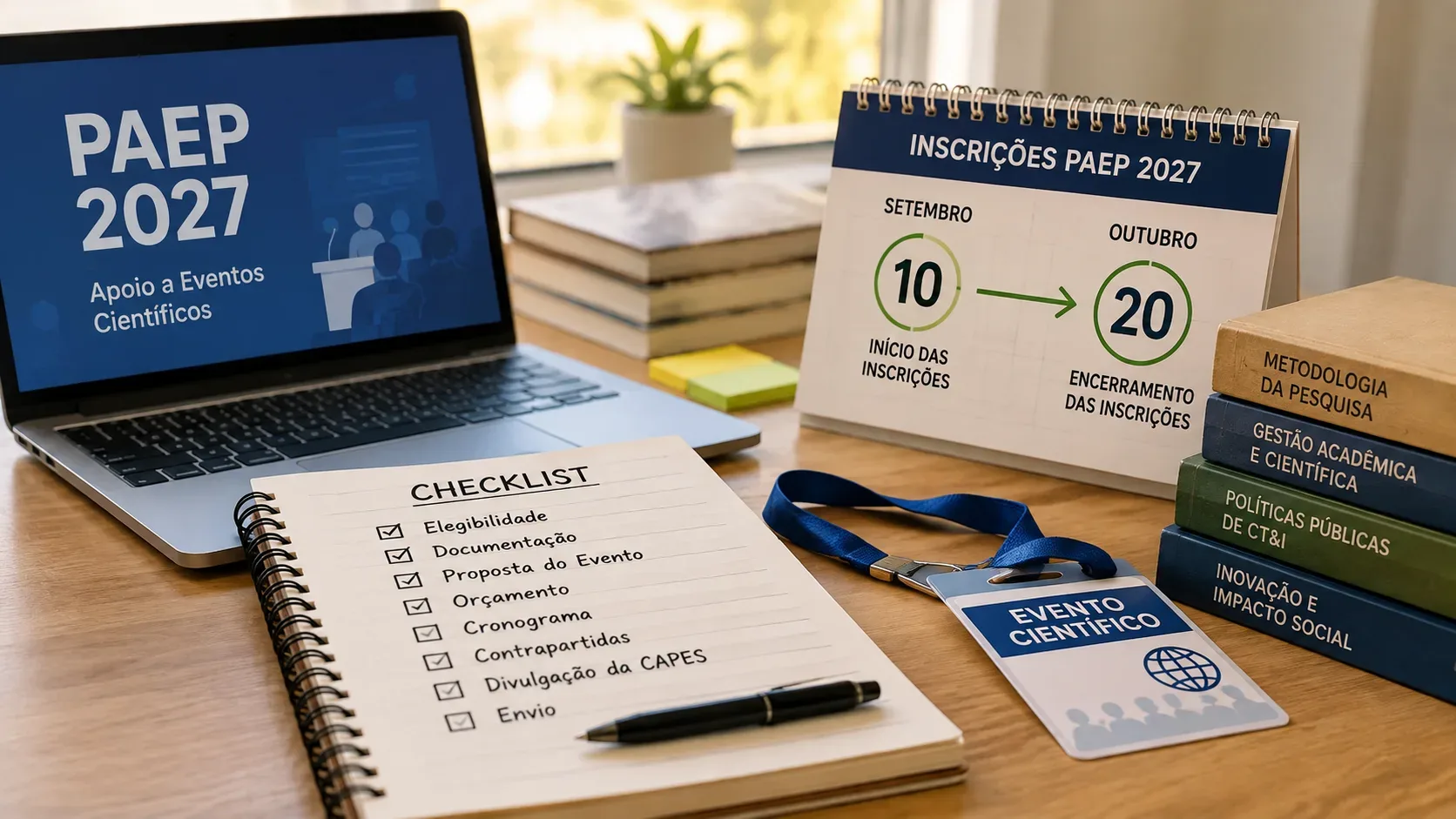
PAEP 2027, governed by CAPES Call No. 25/2026, accepts proposals from September 10 to October 20, 2026. The hard deadline is October 20 at 5:00 p.m., Brasília time. Before opening the form, separate two questions: is the institution eligible to be the proposing organization, and does the individual submitting the application meet the personal requirements? Eligibility depends on both answers.
Quick checklist: can your event apply to PAEP 2027?
- Is the institution or organization public or private and nonprofit?
- Is it directly linked to Brazil's National Graduate Education System (SNPG) and responsible for an active academic graduate program accredited by CAPES and currently operating?
- Is the applicant an individual formally linked to the proposing institution and to an academic stricto sensu graduate program recommended by CAPES?
- Does the applicant fit one of the roles listed in the call, such as chair of the organizing or scientific committee, head of a higher education institution, leader of a research organization, member of a rectors/pro-rectors forum, representative of a scientific or technological association/society, or signatory to a cooperation agreement promoting the event?
- Does the event involve at least three graduate programs recommended by CAPES?
- Will it take place in Brazil, in person or in a hybrid format, between February 1 and December 31, 2027?
- Can it demonstrate national or international reach rather than merely local reach?
If any answer is “no” or remains uncertain, treat it as an eligibility issue before investing time in the application form. CAPES's September 1 announcement summarizes these requirements, but the final submission decision should be checked against the current call and any amendments.
Who can submit the proposal
The call distinguishes the proposing institution or organization from the individual applicant. The institution must be public or private nonprofit and fall within an eligible category: higher education institution; scientific or technological research organization; forum of rectors and/or pro-rectors; scientific or technological association or society; or signatory to a scientific or technological cooperation agreement. It must also be directly linked to the SNPG and be responsible for an active academic graduate program accredited by CAPES.
The person filing the request must be linked to the institution or organization and to an academic stricto sensu graduate program recommended by CAPES. The call also requires an up-to-date Lattes CV. Eligible roles include chair of the organizing or scientific committee, head of a higher education institution, leader of a research organization, member of a rectors/pro-rectors forum, representative of a scientific or technological association/society, and signatory to a cooperation agreement promoting the event.
The event has its own eligibility requirements
In addition to institutional and individual eligibility, the event must involve at least three graduate programs recommended by CAPES, take place in Brazil between February 1 and December 31, 2027, and be in person or hybrid. The call also sets minimum reach criteria:
- International: in-person target audience from at least two countries and speakers or conference presenters from at least two countries.
- National: in-person target audience from at least three regions of Brazil and speakers or conference presenters from at least three regions of the country.
Events deemed local during merit review are eliminated. Therefore, simply labeling an event “national” or “international” is not enough: the expected audience and speaker composition must support that classification.
Event size and maximum funding
At submission, the applicant reports the expected in-person target audience. Events are classified as small (50–200 people), medium (201–600), or large (601 or more). Maximum funding depends on size and reach:
| Reach | Small | Medium | Large |
|---|---|---|---|
| National | up to R$70,000 | up to R$100,000 | up to R$140,000 |
| International | up to R$90,000 | up to R$120,000 | up to R$160,000 |
The call's estimated overall budget is up to R$30 million, distributed among evaluation areas. Being ranked does not automatically guarantee funding: awards depend on ranking position and the budget available to each area.
What must be ready before submission
Applications are submitted exclusively through the CAPES Application System. Each applicant, identified by CPF, may submit only one proposal per event. The CAPES evaluation area selected during registration determines the review chamber and cannot be changed after the proposal is sent for review.
The program must be detailed enough for evaluation. The call requires information such as venue, dates and times for all scheduled activities, names of speakers or conference presenters, the nature and title of each activity, and, when there were previous editions, a short history including the number of editions, audience reached, and main results. For hybrid events, the proposal must clearly distinguish in-person from remote activities.
The following documents are also mandatory:
- Statement of Consent from the highest authority of the proposing institution or organization, or from a formally delegated authority, with the delegation document when applicable;
- Statements of Consent from the coordinators of the participating graduate programs.
Templates should be downloaded from the official PAEP page. Because files and instructions can be updated, confirm that the available templates correspond to the 2027 edition before collecting signatures.
The form also becomes part of the Work Plan
Do not treat fields such as objectives, schedule, budget, targets, indicators, and resource-application plan as mere administrative registration. The call states that this information recorded in the electronic form will become part of the project and constitute its Work Plan. Internal consistency therefore matters: activities, audience, budget, targets, and indicators should tell the same story.
How the proposal will be scored
Merit review is both eliminatory and classificatory. The total score ranges from 0 to 100, and proposals scoring below 70 are eliminated. The nine criteria and maximum scores are:
- Relevance to the field of knowledge — 15 points;
- Event reach — 10 points;
- Qualification and fit with the SNPG — 10 points;
- Event program — 15 points;
- Speaker qualifications and fit with the proposal — 10 points;
- Scientific committee qualifications — 10 points;
- Organizing committee qualifications — 10 points;
- Encouragement of graduate student participation — 10 points;
- Budget adequacy to the proposed event — 10 points.
An effective checklist therefore goes beyond “documents attached.” It should test whether the proposal narrative addresses the criteria that will actually receive scores.
Reverse timeline to avoid relying on the final day
The official process dates are: applications open on September 10; deadline to request registration of an institution not yet in the system is October 9; submissions close October 20 at 5:00 p.m.; preliminary results are due November 27; appeals run November 30 through December 4; and final results are due January 8, 2027. The internal milestones below are editorial planning suggestions, not CAPES deadlines.
| When | What to finalize | Why |
|---|---|---|
| Before Sep 10 | Eligibility of institution, applicant, and graduate programs; event format, date, and venue | Avoids building a proposal that fails basic requirements. |
| Sep 10–25 | Program, speakers, reach, expected audience, and evaluation area | These elements affect classification and merit review. |
| By early October | Objectives, targets, indicators, budget, and resource-application plan | These fields become part of the Work Plan. |
| By Oct 8 | Confirm whether the institution is already registered in the system | The official deadline to request registration is Oct 9. |
| By Oct 13 | Collect consent statements and verify signatures/delegations | Mandatory documents should not be left to the last minute. |
| Oct 14–18 | Cross-review by someone who did not fill out the form | Helps find inconsistencies between program, budget, and scoring criteria. |
| By Oct 19 | Finalize submission and save the application receipt | Reduces risk from congestion or technical failures at closing time. |
| Oct 20, 5 p.m. | Official hard deadline | No revisions, corrections, or changes are accepted afterward. |
Final source-validation checklist
- Check whether Call No. 25/2026 remains the current version and whether an amendment has been issued.
- Confirm the status of the applicant's academic graduate program and the at least three participating programs.
- Confirm that the institution is registered; if not, observe the official October 9 deadline to request registration.
- Review the evaluation area before submitting because it cannot be changed after the proposal is sent for review.
- Test whether the audience and speaker mix truly meets the declared national or international reach.
- Download the consent templates again from the PAEP page before final signatures.
- Check eligible-expense rules and prohibitions before locking the budget.
- Read objectives, program, budget, targets, indicators, and resource-application plan one last time as a single Work Plan.
After submission
Once registration is completed, the applicant receives the proposal number by email; this serves as proof of submission. If a finalized proposal needs changes before the deadline, the call requires canceling the application and starting a new process. After the deadline, revisions or supplementary information are not accepted. Saving the receipt and checking the data shown on it are part of the procedure.
For updates, documents, and results, rely on the official PAEP page, Call No. 25/2026, and communications published on the CAPES portal.