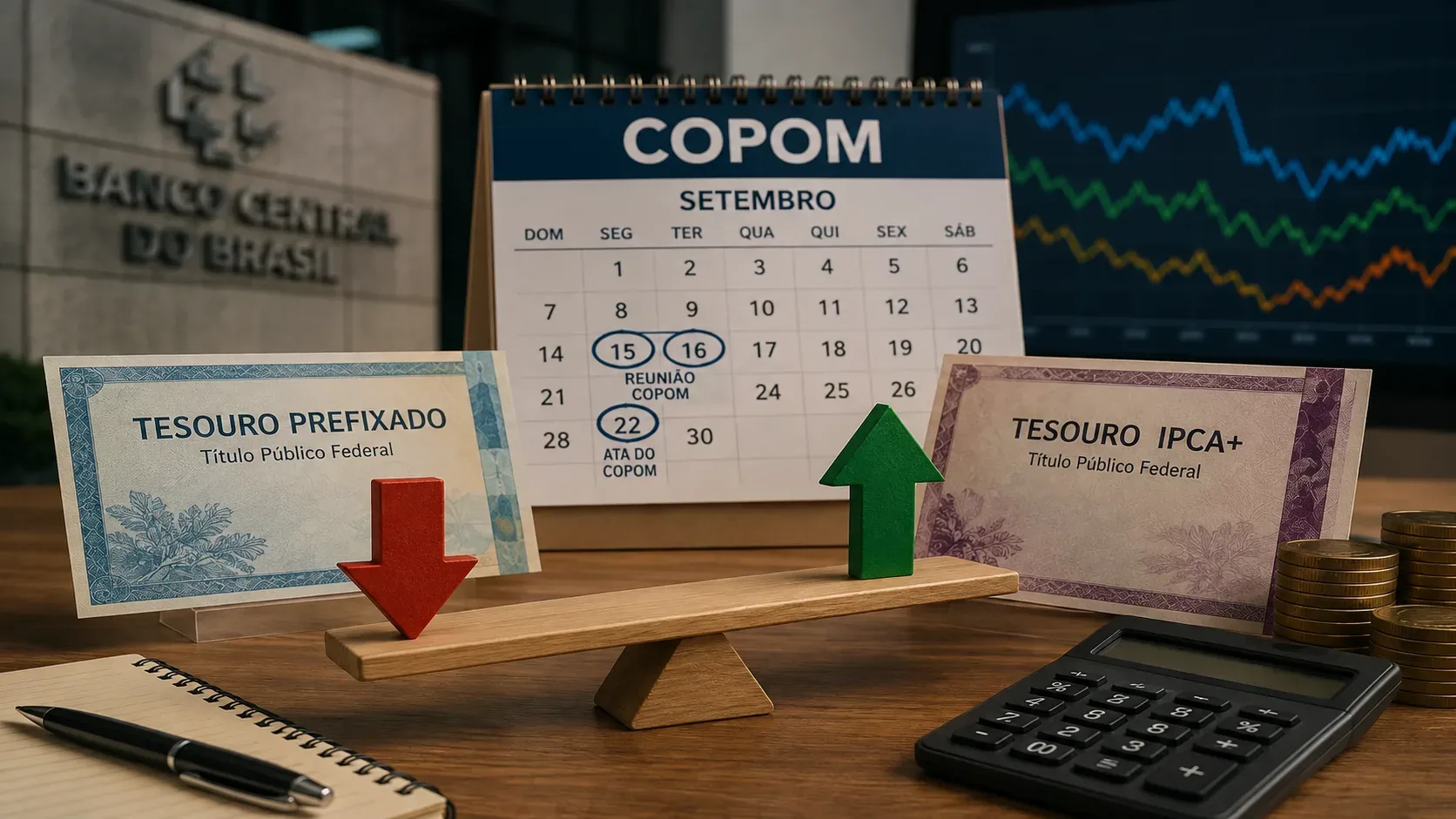

Copom meets on September 15 and 16, 2026, but the two documents most closely watched by markets are not released at the same time. On September 16, after the second session, the Central Bank of Brazil releases the statement with the monetary policy decision and its immediate message. On September 22, it publishes the minutes of the same meeting, with more room to explain the diagnosis, balance of risks, and discussion about the conduct of monetary policy. They are complementary documents, not redundant versions of the same text.
Timeline: what happens between September 15 and 22
| Date | Stage | What the reader gets |
|---|---|---|
| Sep. 15 | First day of the meeting | Technical presentations and an assessment of economic conditions that support the decision. This is not when the new Selic target is announced. |
| Sep. 16 | Second day and statement | Selic decision, votes, and the immediate public message on the outlook, inflation, risks, and strategy. |
| Sep. 22 | Minutes publication | More detail on the reasoning from the same meeting: how the Committee assessed the data, which risks mattered, and how it discussed the conduct of monetary policy. |
The official Copom calendar confirms the September 15–16 meeting and the publication of the minutes on September 22. The Central Bank itself explains that the decision is disclosed on the same day as the second session and that the minutes follow later as part of the monetary policy transparency process.
What the September 16 statement answers first
The statement resolves the most urgent question: what did Copom decide? It reports the new Selic target — or its maintenance — and records the members' votes. But it is not limited to a one-line rate announcement.
In recent meetings, the statement has also presented a condensed view of the global and domestic environment, inflation expectations and projections, the balance of risks, and language about the strategy ahead. At the previous meeting, on August 4–5, for example, the 280th meeting statement reported a reduction in the Selic rate to 14.00% per year and, in the same document, described upside and downside inflation risks, reference-scenario projections, and the Committee's cautious stance.
When reading the September statement, it helps to separate four blocks:
- decision: the Selic target and how members voted;
- diagnosis: how the Committee summarizes activity, the labor market, inflation, and the global environment;
- risks and projections: which factors could move inflation away from the expected path and which reference-scenario numbers are presented;
- strategy: which conditions Copom says it will watch when calibrating its next steps.
The last block requires care. Language about caution, firmness, serenity, an appropriate degree of restriction, or dependence on new data is not a mechanical promise about the next meeting. It describes a strategy conditional on how the outlook evolves.
What the September 22 minutes add
The minutes do not retroactively change the September 16 decision. Their value is to make more visible how the Committee reached the decision and how it weighed the elements of the outlook.
The minutes of the 280th meeting, published on August 11, illustrate this difference. In addition to repeating central points from the statement, they were organized into sections on the economic outlook update, scenarios and risk analysis, discussion of monetary policy conduct, and the policy decision. In that additional space, Copom developed its assessment of slower activity, the labor market, fiscal policy, inflation expectations, monetary policy transmission, and supply shocks.
In practice, the minutes can answer questions that the statement leaves only partly open, such as:
- which evidence led the Committee to view activity as stronger or weaker;
- how the labor market entered the assessment of inflationary pressure;
- why a particular risk received more attention;
- how the Committee views the transmission of interest rates to activity and inflation;
- what maintaining restrictive policy or recalibrating its degree of restriction means in the context of that meeting.
Why the statement and minutes do not “say the same thing”
The two documents come from the same meeting, but they serve different functions. The statement must provide immediate clarity on the decision and the Committee's central message. The minutes have more room to record the sequence of reasoning.
This creates three important differences:
- timing: the statement is released with the decision; the minutes are published days later;
- granularity: the statement summarizes; the minutes develop arguments and relationships among variables;
- use for the reader: the statement answers “what was decided and what is the message now”; the minutes help answer “why does that message make sense within the Committee's diagnosis”.
Some passages may be very similar or even reappear, especially in the decision section. That does not make the minutes unnecessary. The informational gain lies in the sections that explain the assessment and discussion surrounding the conclusion.
What to look for in each document
| Signal | In the statement | In the minutes |
|---|---|---|
| Selic and voting | Central and immediate information. | Reaffirmed in the record of the decision. |
| Inflation projections | May appear directly in the reference scenario. | Gain context on assumptions, interpretation, and risks. |
| Balance of risks | Lists the main upside and downside risks. | Shows how those risks were discussed and linked to the outlook. |
| Activity and labor market | Summary of the diagnosis. | More detail on evidence and interpretation. |
| Future strategy | Short message on caution, restriction, pace, or data dependence. | Broader explanation of how the Committee is thinking about policy conduct. |
How to read the language without turning conditions into forecasts
A useful reading starts with the hierarchy of statements. The decision is a fact: the Selic target and the votes are objective data. Statements about next steps, however, are usually conditional. When Copom says it will adjust policy in light of new information, that does not amount to pre-announcing a cut, hold, or hike at the next meeting.
It is also important to compare the language with the previous meeting. A single word rarely settles the interpretation. What matters is whether the Committee changed its description of the outlook, increased or reduced concern about a risk, changed the relevant horizon, revised projections, or began to describe monetary restriction differently.
In September, therefore, the benefit comes less from searching for a “secret word” and more from comparing equivalent blocks in the September 16 statement with the August document; then, on September 22, checking whether the minutes clarify the weight assigned to those same elements.
What this means for fixed-income investors and readers
For fixed income, the Selic decision matters, but it is not the only information capable of moving market rates. The yield curve embeds expectations for multiple future periods. The statement can therefore trigger an immediate reaction not only because of the chosen rate level, but also because of the combination of projections, risks, and policy guidance.
The minutes can prompt further repricing even though they contain no new rate decision. That can happen when the additional detail causes the market to revise its interpretation of how long restriction may last, how strong the disinflation process is, how resilient activity remains, or how sensitive Copom is to specific risks. For nominal fixed-rate and inflation-linked bonds, changes in market yields at each maturity affect market prices; the effect does not depend only on whether the Selic rate rose, fell, or stayed unchanged.
A disciplined reading therefore avoids confusing the current decision with the expected path. The first comes from the statement. The expected path is a market inference built from the full information set — and it can change when the minutes add context.
A practical checklist for September 16 and 22
- On September 16, record the decision and voting first, without interpreting before separating the facts.
- Compare the outlook, projections, balance of risks, and strategy with the August statement.
- Check whether the language changed substantively, rather than merely through editing.
- On September 22, use the minutes to look for the reasoning behind changes noticed in the statement.
- Separate what the Central Bank actually wrote from analysts' reactions and market prices.
This method helps explain why both documents matter at different moments. The statement delivers the decision and the immediate public message; the minutes show the architecture of the reasoning behind that message. For anyone following interest rates and fixed income, reading them in sequence is more informative than treating the minutes as a mere repetition of the statement.
This content is for informational and educational purposes. It is not investment advice and does not forecast Copom's decision.