
Choosing between Tesouro Selic and a daily-liquidity CDB requires looking beyond the percentage of CDI. Both can be used for short-term cash and emergency reserves, but they do not provide exactly the same combination of access to funds, credit risk, costs, and returns.
Short answer: there is no universal winner
Tesouro Selic tends to make more sense when the priority is reducing exposure to a specific bank and you are comfortable with Tesouro Direto's settlement rules. A daily-liquidity CDB can be more attractive when it offers a better net return, its redemption rules match your needs, and the invested amount remains within the relevant FGC coverage limits.
The key is to compare net return, the actual time needed to receive the money, issuer risk, and costs. “100% of CDI” is only one part of the decision.
| Criterion | Tesouro Selic | Daily-liquidity CDB |
|---|---|---|
| Return reference | Tracks the Selic rate, with the bond priced at market value | Often pays a percentage of the DI/CDI rate, as defined in the contract |
| Who owes you the money | Brazilian National Treasury | Issuing bank |
| FGC | Not covered by the FGC | Eligible when the product and institution meet FGC rules |
| Liquidity | Daily repurchase by the National Treasury, subject to its settlement windows | Depends on the CDB terms and on the bank or platform's operating hours |
| Income tax and IOF | Regressive fixed-income income tax schedule; IOF during the first 30 days | Regressive fixed-income income tax schedule; IOF during the first 30 days |
| Costs | B3 custody fee of 0.20% per year; Tesouro Selic is exempt up to BRL 10,000 per CPF, with the fee charged only on the excess | There is no standardized equivalent B3 custody fee for every CDB; any offering or platform costs must be checked |
1. Start with the most important difference: the issuer
Tesouro Selic
Tesouro Selic is a Brazilian federal government bond. In practice, its credit risk is the risk that the National Treasury fails to honor its debt. It is not covered by the Credit Guarantee Fund (FGC), because it is not a bank deposit.
Daily-liquidity CDB
A CDB is debt issued by a financial institution. B3 itself notes that the risk of a CDB is directly linked to the strength of the issuing bank. CDBs are among the products eligible for ordinary FGC coverage, subject to the fund's rules.
The FGC currently states that coverage is up to BRL 250,000 per CPF or CNPJ, per financial institution or financial conglomerate, with a maximum of BRL 1 million in guarantee payments within a four-year period. This matters when an investor holds several covered products within the same conglomerate.
It is also important to separate protection against default from immediate liquidity. In an intervention or liquidation, FGC payments follow their own procedure; therefore, having coverage does not mean the money will be instantly available when an emergency happens.
2. “Daily liquidity” does not mean the same thing for both products
Tesouro Selic has daily repurchase, but settlement follows specific times
The National Treasury provides daily liquidity for Tesouro Direto securities. Under the current rules, redemptions requested on business days between 9:30 a.m. and 1:00 p.m. become available at the financial institution from 1:00 p.m. on the same day. Requests between 1:00 p.m. and 6:00 p.m. become available from 1:00 p.m. on the next business day. Orders scheduled at night, on weekends, or on holidays follow the next business day's opening. The moment the money reaches the client's final account also depends on the financial institution's transfer process.
For an emergency reserve, this means that “daily liquidity” should not be interpreted as 24/7 access to already-settled cash.
For a CDB, liquidity is contractual
A CDB may be offered with daily liquidity, but maturity, return formula, and redemption conditions are set when the investment is contracted. Therefore, two CDBs marketed as “daily liquidity” may have different operating hours, account-credit timing, maturities, and rules.
Before investing, check four questions: is there a lock-up period? can redemption be requested on any business day? is the cash credited on the same day or later? is access available outside banking hours, on weekends, or on holidays?
3. Tesouro Selic also has a market price
Tesouro Selic is often treated as if its balance simply rises every day. It does experience less market-price fluctuation than long-dated fixed-rate or inflation-linked government bonds, but an early sale is still executed at the market price available at that time.
This does not make Tesouro Selic unsuitable for short-term use; it simply avoids the mistaken idea that its redemption value behaves exactly like a bank account with a fixed daily credit. Tesouro Selic's sensitivity to rate changes is usually low compared with other Treasury bonds, but it is not literally zero.
4. Taxation is almost the same — which makes the comparison easier
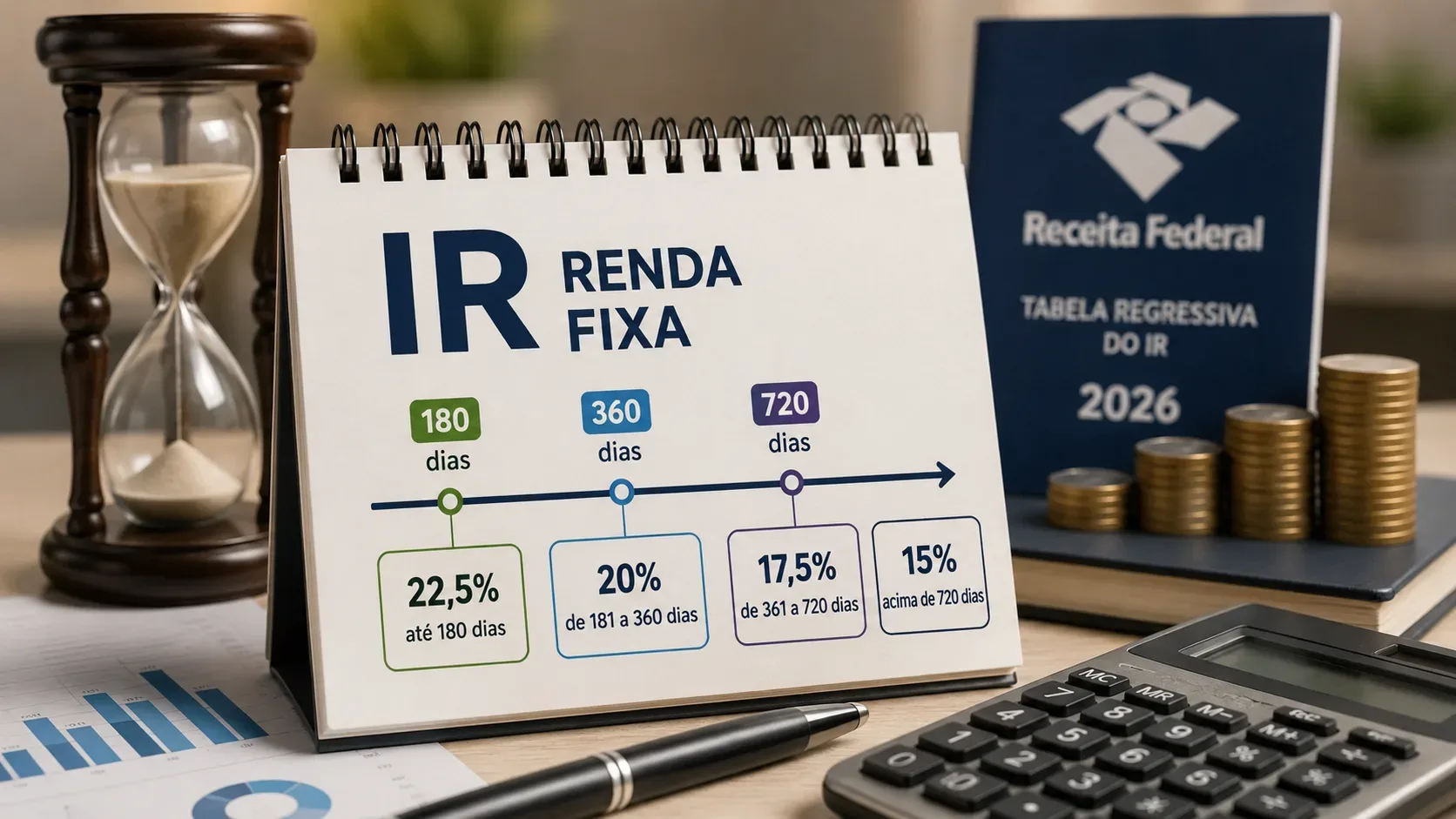
For individual investors, both Tesouro Direto and CDBs follow Brazil's fixed-income taxation rules. Income tax is charged on earnings according to a regressive schedule:
- 22.5% for investments held up to 180 days;
- 20% from 181 to 360 days;
- 17.5% from 361 to 720 days;
- 15% after 720 days.
If a redemption occurs before 30 days, IOF may also apply to the earnings according to the tax's declining schedule.
This similarity has a practical consequence: if the holding period is exactly the same, the decision should not be based on the income-tax table, but on effective gross return, costs, risk, and operating liquidity. Contributions made on different dates have their own holding periods for tax purposes.
5. Fees and costs can overturn a small return advantage
B3 charges a 0.20% annual custody fee on Tesouro Direto securities. For Tesouro Selic, holdings up to BRL 10,000 per CPF are exempt, and the fee is charged only on the amount above that threshold. The custody institution may also charge a service fee, although commercial policies differ across platforms.
There is no standardized equivalent B3 custody fee charged to all CDB investors. Even so, the offering should be reviewed for any platform costs, issuer conditions, or other rules that affect net return or access to funds.
When two investments offer very similar returns, even a small cost difference can change the net result. That is why comparing only “100% of CDI” with “Tesouro Selic” without including fees and the actual holding period can lead to the wrong conclusion.
6. 100% of CDI is not the same as 100% of Selic
The DI rate is calculated by B3 from one-business-day interbank deposit transactions between financial institutions. Selic, in turn, is Brazil's benchmark interest rate and also reflects an effective one-day rate in transactions backed by federal government securities. They are related short-term market references, but they are not the same indicator.
Therefore, a CDB paying 100% of CDI should not be compared with Tesouro Selic as if both had exactly the same gross rate. Beyond the difference between the reference rates, Tesouro Selic is marked to market and may incur a custody fee; a CDB depends on the contracted percentage of CDI and on the issuer's terms.
7. How to compare without forecasting interest rates
A useful comparison can be built with scenarios, without trying to predict future Selic rates:
- Use the same initial amount and the same horizon for both products.
- Use the rate or return estimate shown by the platform for Tesouro Selic and the contracted CDI percentage for the CDB.
- Calculate gross earnings over the period.
- Subtract income tax, any IOF, and applicable costs.
- Repeat the exercise for an early redemption, because the option that looks best over 12 months may not be best for a need arising after 10 or 90 days.
The goal is not to produce a perfect forecast, but to test whether the CDB's rate advantage remains meaningful after taxes, costs, and liquidity constraints.
8. When each option may become more attractive
Tesouro Selic tends to gain points when
- you want to reduce credit concentration in a specific bank;
- the amount you would hold in CDBs would exceed the FGC exposure limits you consider appropriate;
- you value the National Treasury's daily repurchase and accept its settlement windows;
- the CDB's net-return advantage is small after costs;
- you prefer a federal government bond for part of your short-term cash.
A daily-liquidity CDB tends to gain points when
- the offered rate is sufficiently better after taxes and costs;
- the bank provides a redemption routine that is more convenient for your use;
- the amount stays within issuer exposure and FGC limits that you consider acceptable;
- you want to keep all cash movements inside the same bank account;
- the maturity and renewal conditions fit the intended holding period.
9. Checklist before choosing
- Return: what effective rate is offered and how is it calculated?
- Liquidity: when can redemption be requested and when does the money become usable?
- Maturity: is there a lock-up, a short maturity, or a need to reinvest later?
- Risk: who is the issuer and how much of your portfolio is already exposed to it?
- FGC: is the CDB eligible and is your total exposure to the conglomerate within the relevant limits?
- Costs: is there a custody, institution, or other fee?
- Taxes: what income-tax rate will apply at the likely redemption date, and will IOF apply?
- Real use: do you need access during banking hours, on the same day, or also on weekends?
For an emergency reserve, the best product is not necessarily the one displaying the highest rate. It is the one that keeps a coherent balance of credit safety, access to money, cost, and net return for the type of emergency you are preparing for.