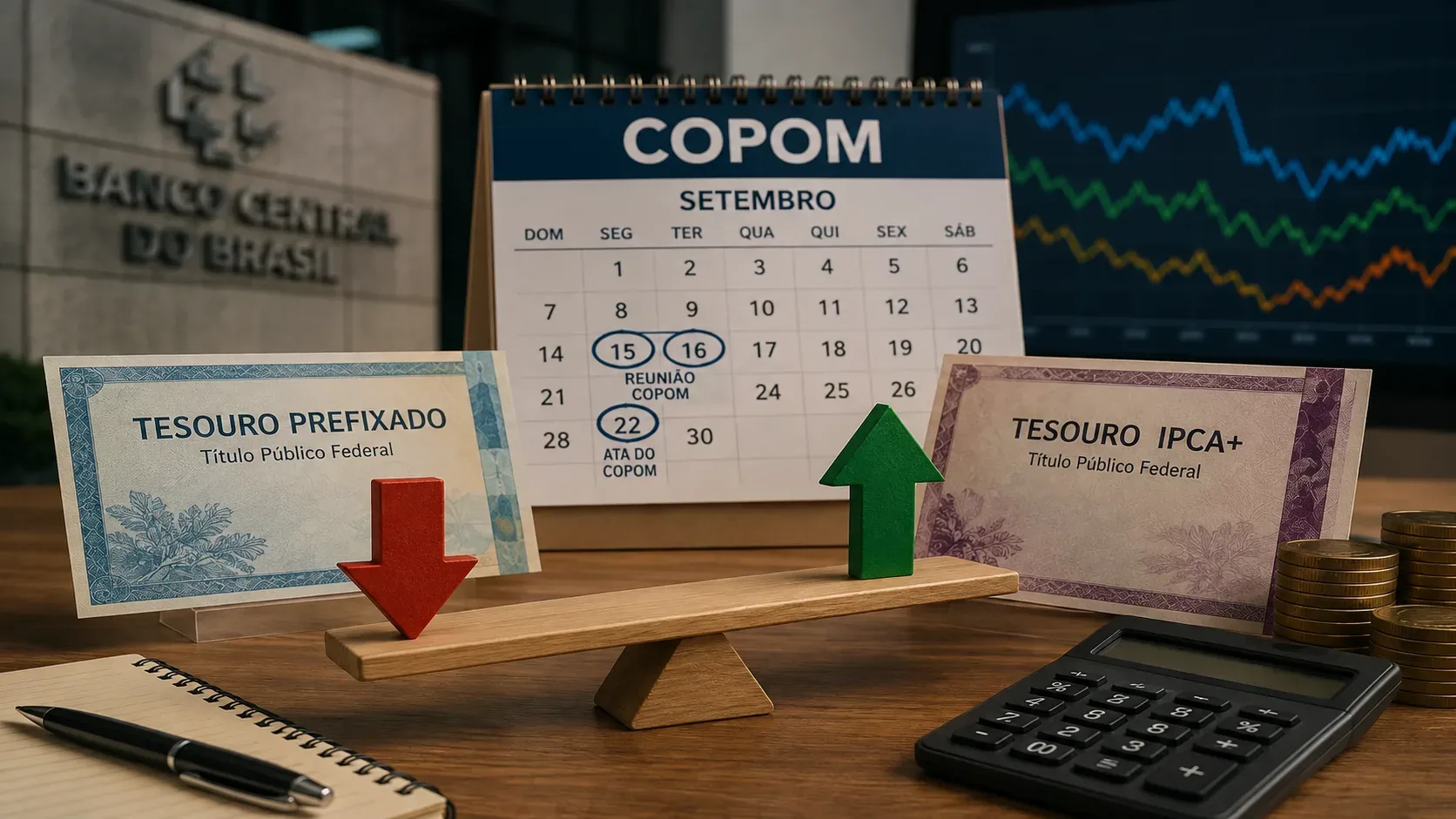
The September 2026 Copom meeting is scheduled for September 15–16, with the minutes due on September 22. For investors holding Tesouro Prefixado or Tesouro IPCA+, the key is not to guess the Selic decision, but to understand how the decision and the Central Bank’s communication can change the yields required by the market. Those yield changes are what translate into price movements before maturity.
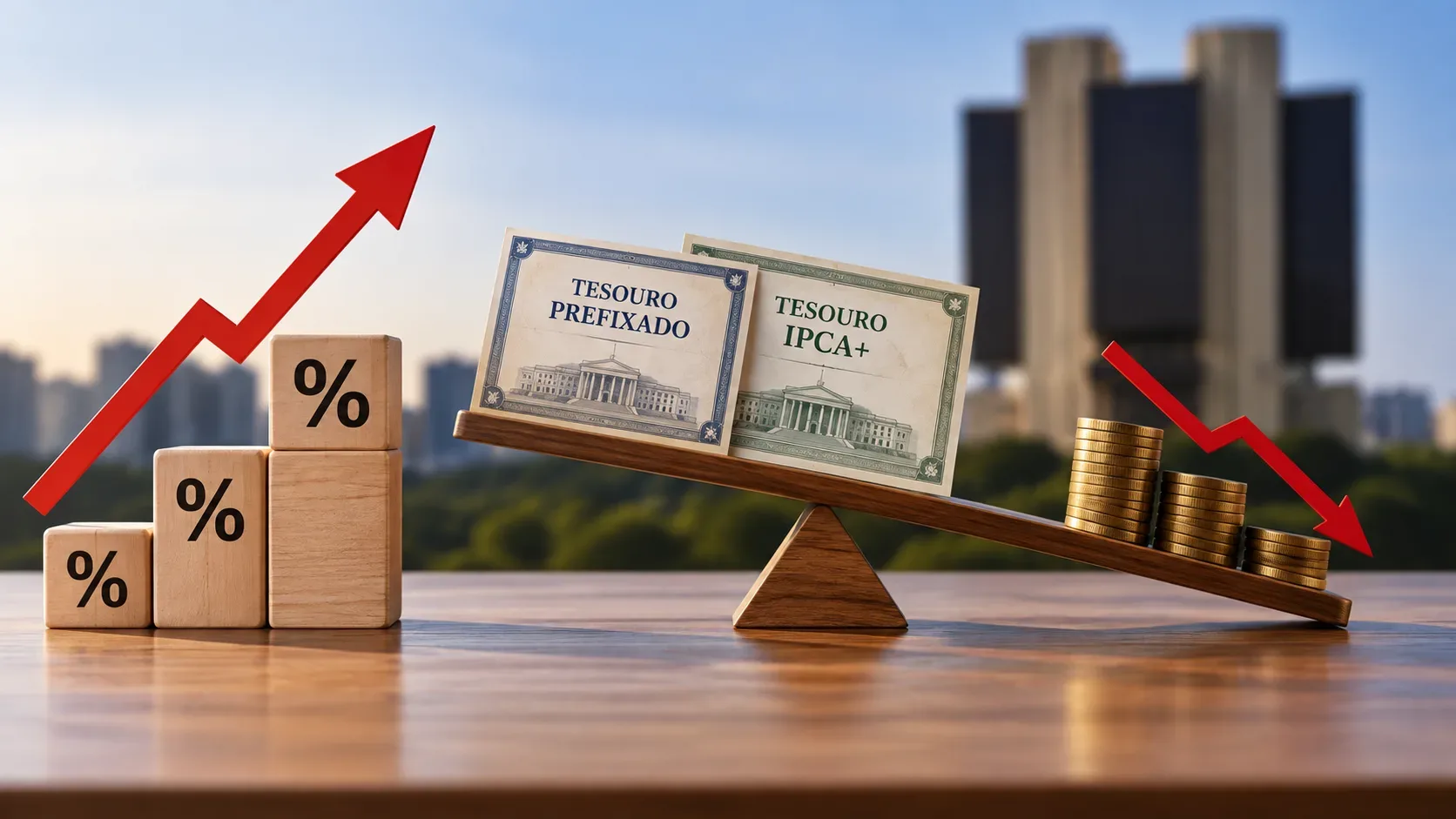
The practical rule is straightforward: when a bond’s market yield rises, its price tends to fall; when the yield falls, its price tends to rise. Tesouro Direto itself explains this inverse relationship and states that investor balances reflect market prices. The size of the move, however, depends on maturity, bond type, and which part of the yield curve changes.
What happens on the September Copom calendar
According to the Central Bank’s official calendar, Copom meets on September 15 and 16, 2026, and the meeting minutes are scheduled for September 22. The decision made in the second session can trigger immediate changes in expectations for the Selic path, but the market also reacts to the statement, the reasoning behind it, and the signal about future steps.
That is why two bonds can move differently on the same day. A short maturity is more sensitive to the outlook for interest rates over the next few months; a long maturity embeds expectations for inflation, growth, fiscal policy, risk premia, and interest rates over many years. Copom is an important part of that picture, not a switch that single-handedly determines every price.
The core rule of mark-to-market pricing
Tesouro Direto states that bonds redeemed before maturity are repurchased at market prices. The balance shown in the investor statement also follows those prices. Between purchase and maturity, therefore, a Tesouro Prefixado or IPCA+ bond can be worth more or less than the amount paid, even though the contractual terms for an investor who holds to maturity have not been changed.
This is mark-to-market pricing. It does not retroactively change the yield agreed at purchase; it changes the current value of a future cash flow. If comparable new bonds start offering a higher yield, an older lower-yield bond must become cheaper to compete. If new yields fall, the older bond with a higher locked-in yield becomes relatively more valuable and its price rises.
Post-decision scenarios: market yields and the expected price direction
| Market-yield scenario | Tesouro Prefixado | Tesouro IPCA+ | How to read it |
|---|---|---|---|
| Required yields rise | Price tends to fall | Price tends to fall if required real yields rise | Future cash flows are discounted at a higher rate |
| Required yields fall | Price tends to rise | Price tends to rise if required real yields fall | Locked-in cash flows become more valuable relative to new yields |
| Yields change little | Price may move only slightly or for other reasons | Price may move only slightly or react to changes in the real-yield curve and projected IPCA | The decision may already be priced in |
The table shows direction, not magnitude. A Selic increase decided by Copom, for example, does not guarantee that all Prefixado and IPCA+ yields will rise by the same amount. If the decision was already expected, the reaction may be small. If the communication changes expectations for future meetings, some maturities may react more than others — and can even move in a different direction from the policy rate on the day.
Why Tesouro Prefixado often shows the effect so clearly
For a coupon-free Tesouro Prefixado, the final cash flow is known in nominal terms. Official Tesouro material shows the inverse relationship between price and yield: for the same maturity value, a higher market yield implies a lower present price, and vice versa. The document also notes that longer-dated bonds tend to show greater price volatility.
Around an event such as Copom, that means investors should focus less on the sentence “Selic rose or fell” and more on the market yield of the specific maturity they hold. A long Prefixado can move significantly even if Selic is unchanged, if the market revises its interest-rate path for the following years.
For more detail on the relationship between yield, price, and convergence toward maturity, see the official Tesouro Prefixado material.
For Tesouro IPCA+, the real yield is also marked to market
Tesouro IPCA+ combines IPCA inflation with a contracted real yield. That does not mean its pre-maturity price only rises with inflation. In the bond’s pricing, the inflation-adjusted principal is combined with a quotation that depends on the real yield required by the market. The official Tesouro IPCA+ pricing methodology makes this structure explicit.
In practice, if the market real yield on an IPCA+ bond rises, the price can fall — even during a period of positive inflation. If the real yield falls, the price can rise. IPCA remains an essential component of the bond’s return, but it does not eliminate mark-to-market price volatility before maturity.
This helps avoid a common misunderstanding: Copom directly changes Selic, while IPCA+ is traded at a real yield. The connection works through expectations and the yield curve, but it is not a one-for-one relationship.
Mark-to-market is not the same as carrying the bond to maturity
For investors who plan to sell before maturity, mark-to-market pricing is decisive because it determines the repurchase price at that moment. For investors who plan to hold to maturity, interim changes in the account balance serve a different purpose: they show what the position is worth today, but they do not replace the bond’s contractual maturity rules.
For Prefixado, holding to maturity preserves the contracted nominal yield, subject to the bond’s rules, taxes, and applicable costs. For IPCA+, the contractual objective is to receive IPCA inflation plus the real yield agreed at purchase, also subject to the bond’s rules, taxes, and costs. The need to sell early is precisely what turns the market-price movement into a redemption result.
That does not make the price movement “irrelevant.” It measures the position’s current economic value and matters for anyone who may need liquidity, rebalance a portfolio, or compare alternatives before maturity.
An example without forecasting Copom
Imagine a Prefixado bond that has already been purchased. If, after Copom, the market starts requiring a higher yield for that same maturity, the existing bond’s price tends to fall. If the required yield falls, the price tends to rise. The mechanism is similar for IPCA+, but the focus is the real yield traded for that maturity, in addition to the inflation-linked adjustment.
You do not need to assume whether Copom will raise, cut, or hold Selic to understand the effect. For mark-to-market pricing, what matters is comparing the yields the market required before the event with the yields it requires afterward.
How to read your statement after Copom
- Check the exact bond maturity. Different maturities can react differently.
- Compare the current market yield with your purchase yield. Price tends to move in the opposite direction.
- For IPCA+, watch the real yield. Do not use current inflation alone to explain the balance movement.
- Separate market value from maturity return. The statement shows what the position is worth today; holding follows the bond’s terms if it is kept to maturity.
- Do not attribute every move to Selic. Expectations, risk premia, and other factors also move the yield curve.
The most important point for September
The September 15–16 meeting can be a catalyst for market yields, but the correct reading always comes from the yield curve and the bond’s maturity. For Prefixado, higher nominal yields tend to mean lower prices. For IPCA+, higher real yields tend to pressure prices even though the bond is inflation-linked. If yields fall, the logic reverses.
This relationship explains why a government bond can show a gain or loss in the account before maturity even though Tesouro has not changed the original contract. Mark-to-market pricing turns new expectations into a present price — a dynamic that is especially visible around Copom decisions but applies on every trading day.
Educational content. This is not a recommendation to buy, sell, or adopt any investment strategy.