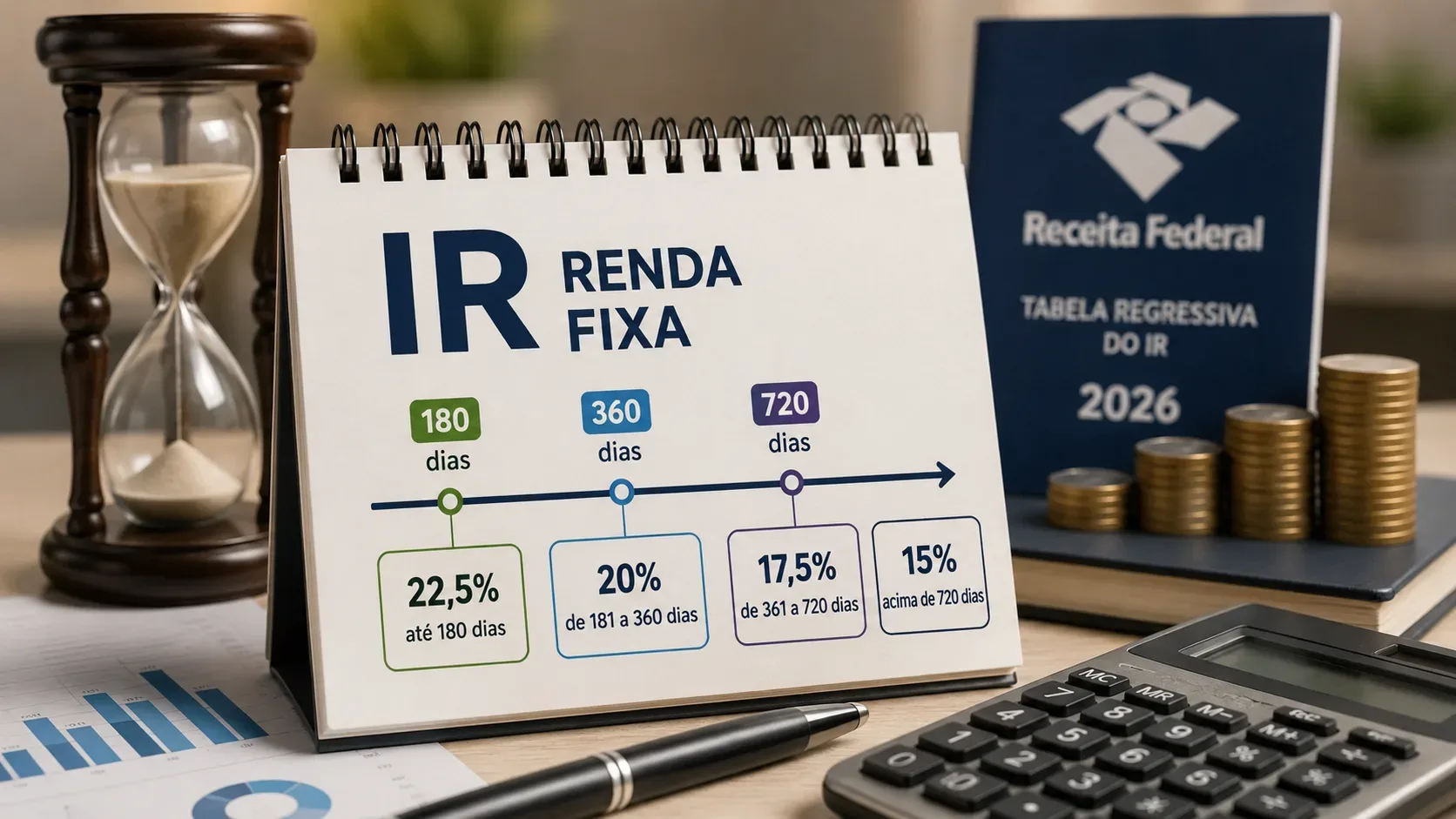

Since January 2026, profit and dividend distributions in Brazil have been subject to new income tax withholding (IRRF) rules. For a resident individual investor, the monthly rule is straightforward: when the same legal entity pays, credits, applies, or delivers more than BRL 50,000 in profits and dividends to the same individual in the same month, it must withhold 10% on the full amount reached that month. The trigger is “more than BRL 50,000”: exactly BRL 50,000 does not activate this monthly withholding.
The change was introduced by Law No. 15,270/2025 and detailed by Brazil’s Federal Revenue Service in guidance published on August 6, 2026. The rules require care because monthly withholding, the annual minimum tax on high incomes, and payments abroad operate differently. This guide separates those rules and explains what investors should check on their annual income statement before filing a tax return or disputing a payment.
When the 10% withholding applies to a Brazilian resident
For a resident individual, monthly withholding depends on three elements: the same payer, the same beneficiary, and a monthly total above BRL 50,000. The law does not require dividends from different companies to be combined when testing this monthly threshold.
- BRL 50,000 or less in a month from the same company: the 10% monthly withholding under Article 6-A does not apply.
- More than BRL 50,000 in a month from the same company: the rate is 10% on the full amount paid, credited, applied, or delivered during the month, with no deductions.
- Several payments by the same company in the same month: the payer must recalculate withholding based on the accumulated monthly total.
- Payments from different companies: the monthly threshold is tested separately for each paying legal entity.
So receiving BRL 30,000 from one company and BRL 30,000 from another in the same month is not treated as BRL 60,000 from a single source for this monthly withholding. Two payments from the same company that together exceed BRL 50,000, however, are included in the monthly recalculation.
Who calculates, reports, and pays the tax
The operational responsibility lies with the paying legal entity. According to the Federal Revenue Service guidance of August 6, 2026, the payer is responsible for recording, reporting, and remitting the withholding tax. For payments to individual beneficiaries, the Service instructs payers to use EFD-Reinf event R-4010.
In the reporting records, the gross amount includes everything paid, credited, or delivered, including exempt or non-taxable portions. When a resident’s monthly dividend payment exceeds BRL 50,000, the taxable amount reported is the full distribution and withholding is calculated at 10%. The amounts flow to DCTFWeb; the Service identified revenue codes 1841-01 for residents and 1841-02 for non-residents.
For investors, the practical consequence is important: they do not issue the DARF payment slip for this monthly withholding. Their task is to verify whether the gross amount, tax withheld, and net amount received reconcile and to keep the documents supporting the transaction.
When the withholding tax must be remitted
Deadlines differ according to the beneficiary’s residence:
| Situation | Withholding rule | Remittance deadline stated by the Federal Revenue Service |
|---|---|---|
| Individual resident in Brazil | 10% when the same company distributes more than BRL 50,000 to the same individual in the month, on the full monthly amount | Last business day of the second ten-day period of the month following the taxable event |
| Non-resident beneficiary | 10% on profits and dividends paid, credited, delivered, applied, or remitted abroad, subject to statutory exceptions | On the day the taxable event occurs |
For non-residents, the Federal Revenue Service instructs the payer to issue the DARF with a taxable-event date matching the date reported in EFD-Reinf and DCTFWeb.
Non-residents: the BRL 50,000 threshold is not the rule
Payments abroad are governed by a different framework. Law No. 15,270/2025 subjects profits and dividends paid, credited, delivered, applied, or remitted abroad to 10% withholding tax. The rule covers beneficiaries abroad and does not use the BRL 50,000 monthly threshold reserved for resident individuals.
The law itself provides exceptions, including certain payments to foreign governments on a reciprocal basis, sovereign wealth funds, and qualifying foreign entities whose main activity is administering pension and retirement benefits. Tax treaties, the beneficiary’s status, and other specific provisions may also require separate analysis, so cross-border payments should not be treated as a simple extension of the domestic rule.
Profits earned through 2025 may fall outside the new withholding
The law preserved a transition for profits and dividends related to results earned through calendar year 2025. To remain outside the new withholding, the distribution must have been approved by the competent corporate body by December 31, 2025, and the payment, credit, application, or delivery must follow the terms originally established in the approval act.
This point deserves documentary review. When a company treats a 2026 payment as covered by the transition rule, the investor should keep the income statement and, when available, the corporate documentation supporting the date and terms of approval. Merely stating that the profit is “old” does not replace the statutory requirements.
Monthly withholding is not the same as the annual minimum tax
Law No. 15,270/2025 also created an annual minimum tax regime for high-income individuals, applying to calendar year 2026 in the 2027 tax return. That regime has its own calculation: the rate rises for income considered by the law above BRL 600,000 and reaches 10% from BRL 1.2 million.
Monthly dividend withholding operates as an advance payment that is taken into account in the annual calculation, and the law provides for its deduction in that computation. Therefore, seeing 10% withheld from a dividend does not by itself mean the investor’s final tax burden on that income will necessarily be 10%. The final position depends on total income, exclusions, taxes already paid, and the other rules of the annual regime.
What to check on the income statement or tax certificate
The Federal Revenue Service states that the payer must provide an annual income statement, and the information may also appear in the Service’s systems when correctly reported by the payer. From calendar year 2025, DIRF was replaced by eSocial and EFD-Reinf events, and the Service provides tools to consult payments and withholding reported through those systems.
Before using the statement in a tax return or challenging a payment, check:
- Payer identification: legal name and CNPJ matching the company that distributed the income.
- Type of income: whether the amount is identified as profits and dividends rather than interest on equity or another type of income.
- Gross amount: the total allocated to the beneficiary before withholding.
- IRRF: the amount actually withheld and whether it is consistent with the month’s payments.
- Dates: payment, credit, application, or delivery, because the taxable event and the month of aggregation matter.
- Payer-by-payer test: do not combine different companies to test the BRL 50,000 monthly threshold.
- Split payments: if the same company made more than one payment in the month, verify the accumulated amount and the withholding recalculation.
- Transition rule: if no tax was withheld on a significant 2026 payment attributed to 2025-or-earlier profits, verify the documentary basis for approval by December 31, 2025 and the payment terms.
- Reconciliation with account records: compare the payer’s statement with credit notices and brokerage or custody statements, without assuming those account records replace the tax certificate.
If there is a discrepancy, first request the payment breakdown and a corrected certificate from the payer. The Federal Revenue Service states that the annual income statement must be provided by the payer and also offers access to reported income information. For withholding reported through EFD-Reinf, the DIRF replacement support page explains how the information is consolidated.
A quick review process for a dividend received in 2026
- Identify the paying company and whether the beneficiary is resident or non-resident.
- Add only profits and dividends paid by the same company to the same beneficiary in the same month.
- For a resident individual, check whether the total exceeded BRL 50,000.
- If it did, verify that 10% was calculated on the full monthly amount, not only on the excess.
- If the payment went abroad, do not automatically apply the BRL 50,000 threshold; review the 10% cross-border rule and any exceptions.
- Check whether a transition claim is being made for profits earned through 2025 and whether the supporting documents fit the legal requirements.
- Reconcile gross amount, IRRF, and net amount with the annual certificate and account statements.
- Keep the documentation for the 2027 return, when 2026 income will be considered under the applicable annual rules.
What the new rule does not mean
The change did not make every dividend received by a resident investor automatically subject to 10% withholding. It also did not create a single monthly threshold combining all companies. And the withholding should not be confused with the annual minimum tax, which has its own base and calculation.
For corporate reorganizations, cross-border payments, treaties, usufruct arrangements, estates, investment structures, or questions about a beneficiary’s classification, professional advice based on the specific documents may be appropriate. This article is informational and does not replace individual tax advice.