
Redeeming a taxable Brazilian fixed-income investment before 30 days can make two taxes apply to the same gain, but they are not simply added on the same tax base. IOF, Brazil's Tax on Financial Operations, comes first and can absorb a large part of the return in the first days. Income tax is then calculated on the return left after IOF.
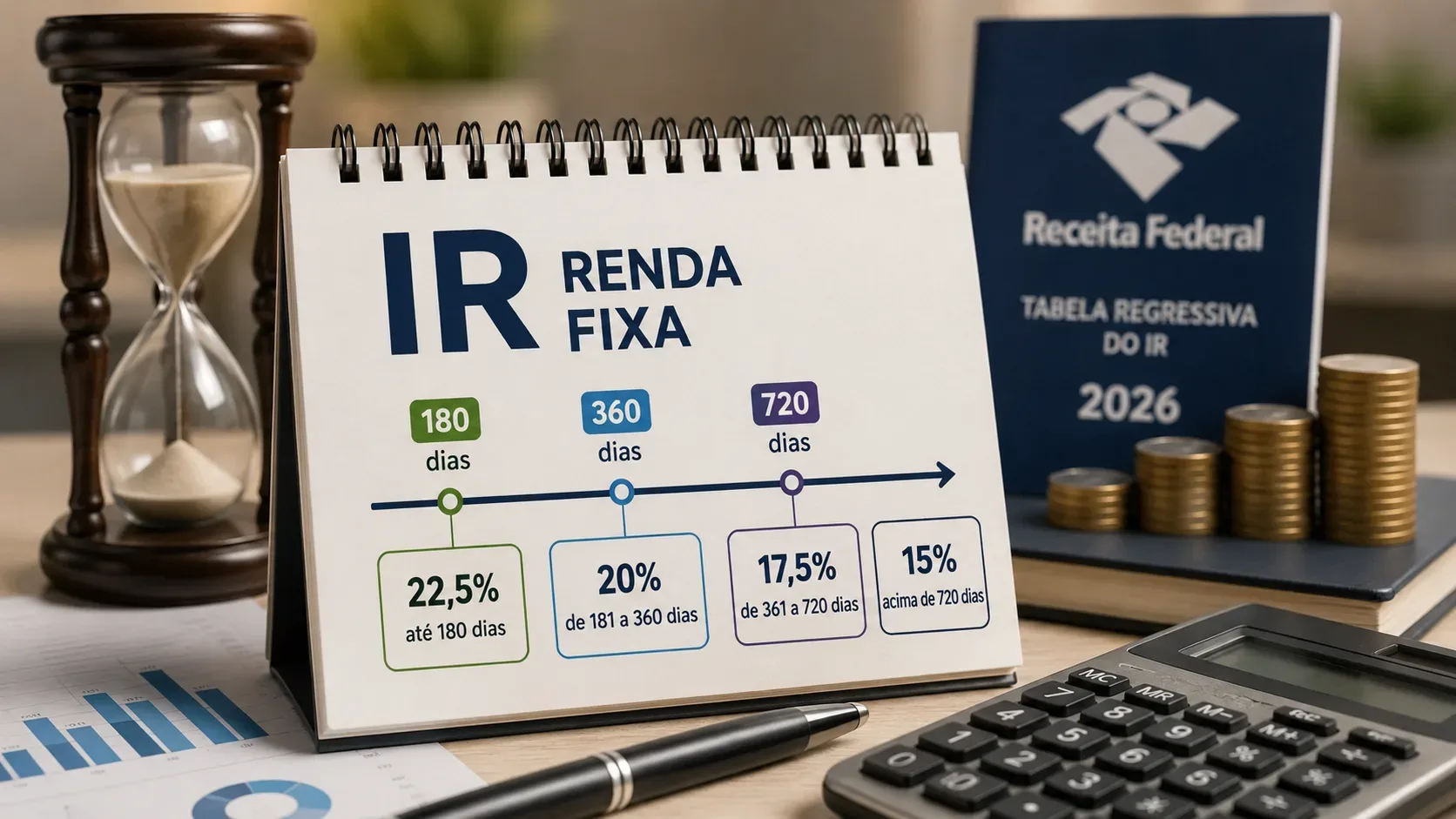
Under the general fixed-income schedule, the income-tax rate for investments held up to 180 days is 22.5%. IOF, however, falls day by day: its cap can equal 96% of the return on day 1, 3% on day 29, and zero from day 30 onward. CAIXA and Tesouro Direto describe this combination for short holding periods.
The key point: income tax is calculated after IOF
The order materially changes the result. According to educational material from Brazil's Investor Portal/CVM, the income-tax base is the return net of IOF. Brazilian tax regulations also define, for covered fixed-income investments, the income-tax base as the positive difference between the disposal or redemption value, net of IOF when applicable, and the amount invested.
In practical terms, for a taxable redemption within 30 days:
- calculate the investment return;
- calculate IOF according to the holding period;
- subtract IOF from the return;
- apply income tax to the remaining return.
That is why saying “50% IOF + 22.5% income tax = 72.5%” is incorrect. On day 15, for example, the 22.5% income tax applies to the 50% of the return left after IOF, not again to 100% of the gross return.
Which income-tax rate applies before 30 days?
For investments covered by Brazil's general regressive fixed-income schedule, a holding period shorter than 30 days falls within the first income-tax bracket: 22.5% for investments held up to 180 days. Law No. 11,033/2004 sets the 22.5%, 20%, 17.5% and 15% brackets according to the holding period.
| Holding period | Income-tax rate |
|---|---|
| Up to 180 days | 22.5% |
| 181 to 360 days | 20% |
| 361 to 720 days | 17.5% |
| Over 720 days | 15% |
So, from day 1 through day 29, the variable that changes every day is IOF; the general income-tax rate remains 22.5% throughout that window.
Daily IOF table for the first 30 days
IOF on securities is charged at 1% per day on the transaction amount, subject to a cap based on a share of the return that decreases with the holding period. Under normal short-term investment conditions, this regressive cap is what determines how much of the gain can be absorbed. The table below reproduces the cap percentages published by CAIXA and official Investor Portal educational material.
| Holding period in calendar days | Maximum share of return subject to IOF |
|---|---|
| 1 | 96% |
| 2 | 93% |
| 3 | 90% |
| 4 | 86% |
| 5 | 83% |
| 6 | 80% |
| 7 | 76% |
| 8 | 73% |
| 9 | 70% |
| 10 | 66% |
| 11 | 63% |
| 12 | 60% |
| 13 | 56% |
| 14 | 53% |
| 15 | 50% |
| 16 | 46% |
| 17 | 43% |
| 18 | 40% |
| 19 | 36% |
| 20 | 33% |
| 21 | 30% |
| 22 | 26% |
| 23 | 23% |
| 24 | 20% |
| 25 | 16% |
| 26 | 13% |
| 27 | 10% |
| 28 | 6% |
| 29 | 3% |
| 30 | 0% |
The key boundary is straightforward: IOF still applies through day 29; on day 30 the table percentage is zero.
Example: R$100 of gross return
To see the combined effect, assume a hypothetical gross return of R$100, with no additional fees and an investment subject to the general rule. The amounts are only meant to illustrate the tax mechanics; they are not a promise of returns.
| Redemption | IOF table rate | IOF on R$100 | Income-tax base after IOF | Income tax at 22.5% | Net return |
|---|---|---|---|---|---|
| Day 1 | 96% | R$96.00 | R$4.00 | R$0.90 | R$3.10 |
| Day 15 | 50% | R$50.00 | R$50.00 | R$11.25 | R$38.75 |
| Day 29 | 3% | R$3.00 | R$97.00 | R$21.83 | R$75.18 |
| Day 30 | 0% | R$0.00 | R$100.00 | R$22.50 | R$77.50 |
On day 1, R$96 of the return would be absorbed by IOF in this example. R$4 would remain as the income-tax base; 22.5% of R$4 is R$0.90. The net gain would be R$3.10. On day 15, IOF would fall to R$50, income tax would be R$11.25, and R$38.75 would remain.
By day 29 the difference is much smaller: IOF would be R$3 and income tax would apply to R$97, producing roughly R$21.83 in income tax and R$75.18 net. On day 30, IOF drops to zero; on a R$100 return, 22.5% income tax would leave R$77.50 net.
A simple formula to check the logic
For a straightforward investment with a positive gain and subject to both taxes, the sequence can be checked as follows:
- Gross return: gain before taxes.
- IOF: amount determined by the holding period and the regressive cap table.
- Income-tax base: gross return minus IOF.
- Income tax: income-tax base × the rate for the holding period; before 30 days, 22.5% under the general rule.
- Net return: gross return − IOF − income tax.
The institution responsible for withholding performs the actual calculation, which may involve rounding, settlement dates and product-specific details. This formula explains the order of taxation; it does not replace the official transaction statement.
How to count the 30 days without missing the boundary
The IOF schedule applies to periods shorter than 30 days counted from the investment date, and official materials present the scale in calendar days. That means day 29 still carries a 3% IOF cap, while day 30 carries a zero IOF percentage.
In practice, do not confuse “30 days on the calendar” with the moment your product treats a redemption or settlement as completed. Tesouro Direto, for example, has its own settlement rules and states that, for income-tax purposes, the holding period is counted from the settlement date. If your decision depends on the exact boundary date, check the app, statement or product rules for the starting date and the event that ends the count.
Not every fixed-income product follows exactly this combination
“Fixed income” covers a broad range of products. Some securities and structures have exemptions, zero rates for a tax, fund-specific rules, semiannual taxation, lock-up periods or other tax treatments. The logic in this article therefore applies to taxable investments that are subject to short-term IOF and the regressive income-tax schedule.
Taxation should also be separated from investment performance. A security sold before maturity can have a market price different from its purchase price; fees, spreads or mark-to-market effects may change the result before taxes are even applied. IOF and income tax do not turn a market loss into a gain or guarantee preservation of principal.
Checklist before redeeming within 30 days
- Confirm that the product is actually subject to IOF and income tax for that transaction.
- Check how many calendar days have elapsed from the date recognized as the investment date.
- Find the IOF percentage corresponding to the redemption day.
- Remember that the general income-tax rate in this window is 22.5%.
- Calculate income tax on the return after IOF, not again on the same gross return.
- Consider fees, market price, lock-up rules and settlement time.
- Review the net amount shown by the institution before confirming the redemption.
In short: a redemption before 30 days can be subject to both IOF and income tax, but income tax applies to the return after IOF has already been deducted. IOF falls daily until it reaches zero on day 30; under the general schedule, income tax remains 22.5% through day 180. This difference in tax base is why the two percentages should not simply be added.
Educational content, not investment advice. Tax rules and product characteristics may change or have exceptions; confirm the terms of the investment and, when appropriate, have the material reviewed by a financial or tax professional.