
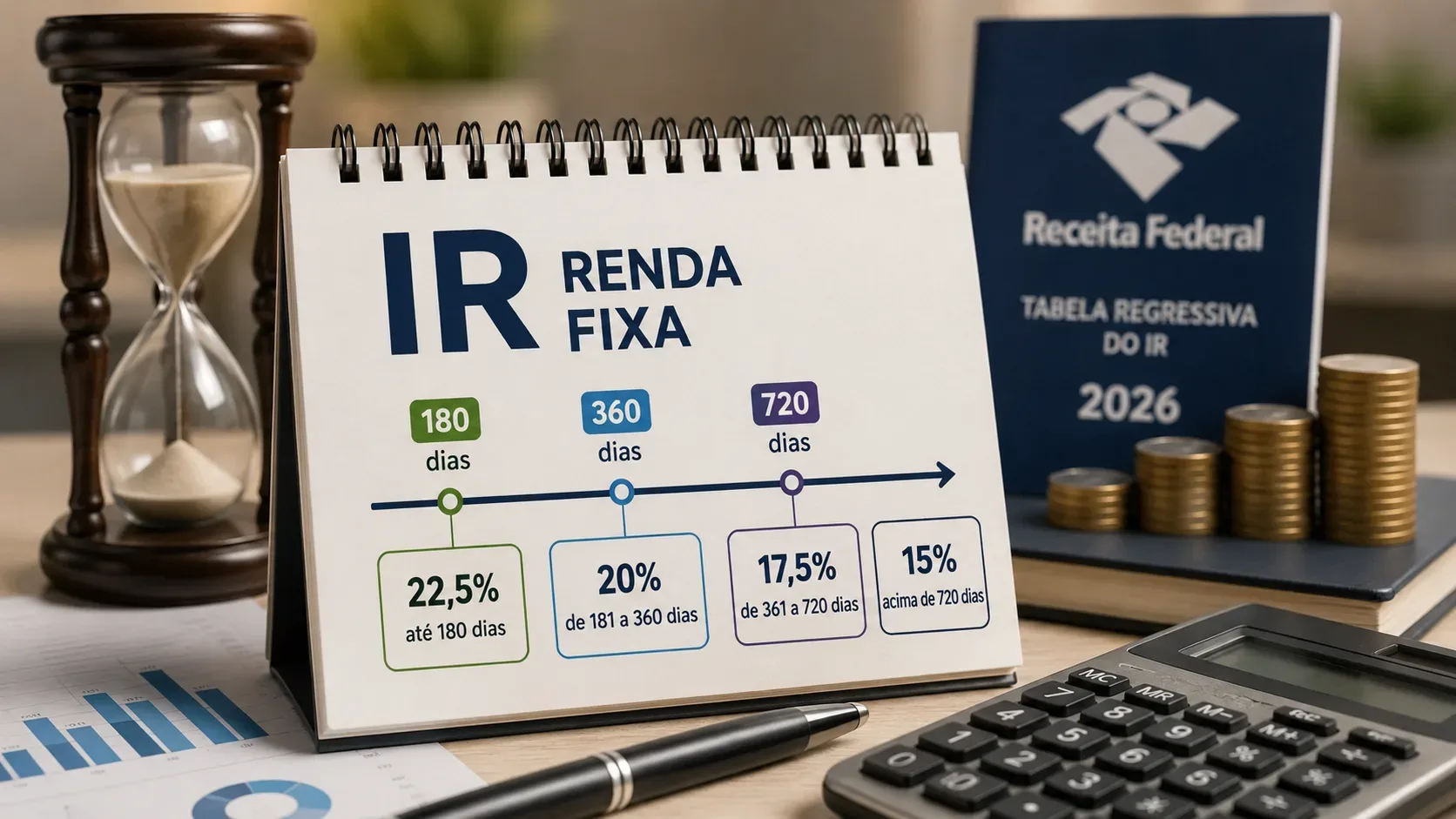
For investments taxed under Brazil’s regressive income-tax schedule, the boundary works like this: the 180th day is still taxed at 22.5%; the 181st day moves to 20%. Day 360 remains at 20%; day 361 moves to 17.5%. Day 720 is still at 17.5%; only above 720 days — in practice, starting on day 721 — does the rate fall to 15%. The tax is levied on the investment return, not on the principal invested.
Brazil’s fixed-income regressive income-tax schedule in 2026
Brazil’s Federal Revenue Service keeps the four rates in 2026 for long-term funds and fixed-income investments in general. The statutory wording that removes doubt about the boundaries appears in article 1 of Law No. 11,033/2004.
| Investment holding period | Income-tax rate on returns |
|---|---|
| Up to 180 days | 22.5% |
| 181 to 360 days | 20% |
| 361 to 720 days | 17.5% |
| Above 720 days | 15% |
There is an important editorial detail: the Federal Revenue Service’s 2026 page shows “22.5% — up to 180 days” and, on the next line, “20.0% — from 180 to 360 days,” creating an overlap at 180. That does not change the legal rule. Law No. 11,033/2004 expressly states 181 to 360 days for the 20% rate, and the current CAIXA post-fixed CDB page uses the same division. So, to resolve the boundary, use 180/181 rather than an interpretation that places day 180 in both bands.
What happens exactly on days 180, 181, 360, 361, 720 and 721
| Holding day | Applicable band | Rate |
|---|---|---|
| 180th | Up to 180 days | 22.5% |
| 181st | 181 to 360 days | 20% |
| 360th | 181 to 360 days | 20% |
| 361st | 361 to 720 days | 17.5% |
| 720th | 361 to 720 days | 17.5% |
| 721st | Above 720 days | 15% |
These changes are discrete: there is no intermediate rate within the transition day. If the investment’s tax holding period has reached 181 days, the band is 20%; if it remained at 180, the band is 22.5%. The same logic applies to 360/361 and 720/721.
How to count the holding period correctly
The safest approach is to count the investment holding period, not market business days. Tax material from B3 explains that the period used to determine the rate starts with the acquisition and ends with the redemption, maturity, assignment or sale; for this count, the settlement date is considered both on entry and on exit.
In practice, this avoids two common mistakes. The first is using the date on which you clicked “invest” or “redeem” when settlement occurred on another day. The second is adding only business days. What matters is the holding interval between the operational/tax settlement dates. Weekends and holidays may affect when an order settles, but they do not turn the rule into a count of 180 trading sessions.
If purchases were made on different dates, treat each acquisition as having its own clock for the tax band. And for investments that make periodic income payments, B3 notes that the rate on each payment depends on the time elapsed between the investment of the funds and that income payment. Therefore, before planning a redemption exactly at a threshold, check the statement or calculator provided by the institution to confirm which settlement date will be used.
Example: how much one day can change the tax
To isolate the rate effect, assume a hypothetical taxable return of BRL 1,000 in each case. In real life, the gross return at 180 days and 181 days will not be exactly the same; the example keeps the gain constant only to show the tax difference.
| Redemption | Rate | Tax on BRL 1,000 of return | Return after tax |
|---|---|---|---|
| Day 180 | 22.5% | BRL 225 | BRL 775 |
| Day 181 | 20% | BRL 200 | BRL 800 |
| Day 360 | 20% | BRL 200 | BRL 800 |
| Day 361 | 17.5% | BRL 175 | BRL 825 |
| Day 720 | 17.5% | BRL 175 | BRL 825 |
| Day 721 | 15% | BRL 150 | BRL 850 |
Each band change reduces the rate by 2.5 percentage points. With BRL 1,000 of taxable return, that is a BRL 25 difference in tax. With BRL 10,000 of return, it would be BRL 250, assuming all other conditions remain equal.
Is it worth waiting one more day to redeem?
Sometimes yes; sometimes no. The tax saving should be compared with what changes when redemption is delayed: liquidity needs, price fluctuations in securities sold before maturity, issuer risk, repurchase conditions, additional interest and the alternative use of the money. With a daily-liquidity CDB, the decision may be straightforward. With a security exposed to mark-to-market pricing, a price move can be larger than the 2.5-percentage-point saving in the tax rate applied to the return.
That is why the schedule is a planning variable, not an automatic instruction to “hold until tomorrow.” The tax benefit must be calculated on the taxable return, not on the entire investment balance.
The schedule does not apply in the same way to every fixed-income product
“Fixed income” covers products with different tax treatments. Taxable CDBs follow the regressive schedule; CAIXA, for example, states that CDB income tax is charged at maturity or redemption and only on the returns. Brazilian Treasury Direct securities also use the regressive schedule on redemption, early sale or maturity.
By contrast, an LCI held by an individual, for example, is presented by CAIXA as a fixed-income investment whose returns are exempt from income tax. Investment funds may also have their own mechanics for semiannual tax prepayments and a complementary rate at redemption. Before using the 180/360/720 thresholds, therefore, confirm that your product is actually subject to the regressive schedule discussed here.
Checklist before scheduling a redemption near a threshold
- Confirm that the investment is taxable under the fixed-income regressive schedule.
- Check the settlement date of the investment, not only the order date.
- Check the expected settlement date for the redemption, maturity or sale.
- Determine whether the tax holding period will be 180 or 181, 360 or 361, 720 or 721 days.
- Calculate the income-tax saving on the taxable return and compare it with the other costs and risks of waiting.
Sources for checking the rule
- Brazilian Federal Revenue Service — 2026 taxation: current capital-income table.
- Law No. 11,033/2004, article 1: statutory wording for the 180/181, 360/361 and 720/721 boundaries.
- CAIXA — post-fixed CDB: practical use of the regressive schedule for a CDB.
- B3 — market taxation material: reference for the start/end of the period and use of settlement dates.
Updated in September 2026. This is informational content; individual situations, funds and specific tax regimes may require additional confirmation with the financial institution or a qualified professional.