
Comparing a CDB with an LCI or LCA only by the percentage of CDI often leads to the wrong conclusion. CDB earnings are generally subject to income tax, while LCI and LCA earnings remain exempt from income tax for individual investors as of this update on September 6, 2026. At the same time, maturity, lock-up periods, liquidity and exposure to the issuing bank can completely change the outcome. A useful comparison therefore looks at net return, the actual time the money will be tied up, and FGC coverage, rather than two isolated gross rates.
What changes between CDB, LCI and LCA
All three are Brazilian bank-issued fixed-income instruments: by investing, the investor provides funds to a financial institution in exchange for remuneration under the terms of the security. The practical differences appear in taxation, the purpose of the funding, and the maturity and liquidity rules of each issue.
| Criterion | CDB | LCI | LCA |
|---|---|---|---|
| Taxation for individuals | Regressive income tax from 22.5% to 15% on earnings; IOF may apply if redeemed before 30 days | Earnings are income-tax exempt | Earnings are income-tax exempt |
| Liquidity | Varies: some CDBs offer daily liquidity, while others do not allow early redemption | Depends on the issue; a lock-up period or redemption only at maturity is common | Depends on the issue; a lock-up period or redemption only at maturity is common |
| Regulatory minimum maturity | Depends on the product and issue | For LCI without inflation-index adjustment, the minimum maturity is 6 months | For LCA without inflation-index adjustment, the minimum maturity is 6 months |
| FGC | Covered if eligible and issued by a member institution | Covered if eligible and issued by a member institution | Covered if eligible and issued by a member institution |
Brazil's Investor Portal summarizes CDB, LCI and LCA as bank securities and highlights their differences in taxation and liquidity. For LCI and LCA without inflation-index adjustment, the National Monetary Council reduced the minimum maturity to six months in 2025. Other structures may follow different rules, so the maturity stated in the specific offering should always be checked.
First step: turn the CDB gross rate into a net rate
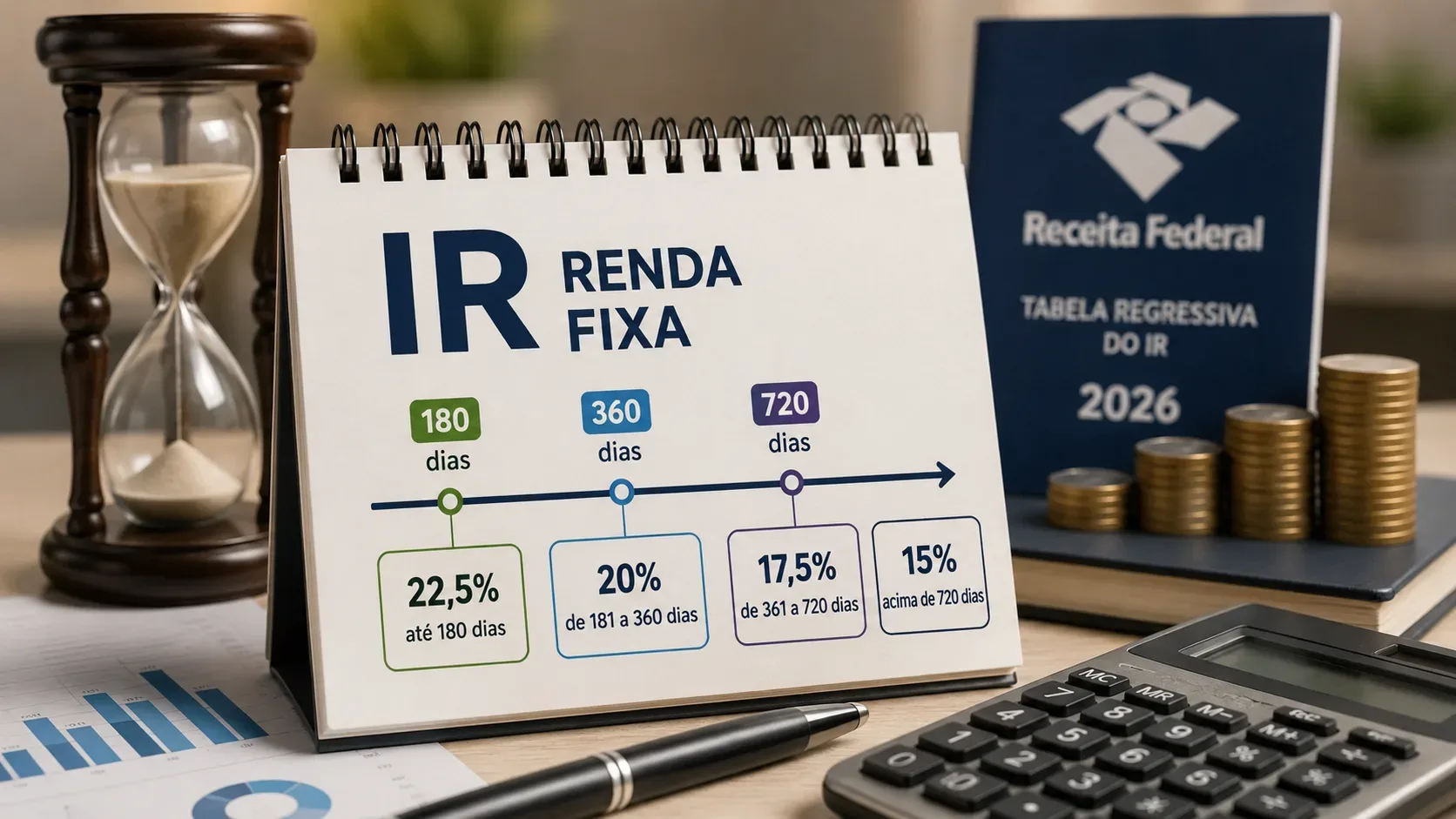
For a CDB, the income-tax rate falls as the investment is held longer. The general fixed-income schedule set by the Brazilian tax authority is:
- up to 180 days: 22.5%;
- 181 to 360 days: 20%;
- 361 to 720 days: 17.5%;
- more than 720 days: 15%.
The tax base is the investment gain, not the total amount invested. Brazilian Federal Revenue Instruction No. 1,585/2015 sets out these rates for fixed-income investments. CDB redemptions before 30 days may also be subject to the regressive IOF tax on earnings.
For a simple comparison between CDI-linked instruments held for the same period, a useful approximation is to multiply the CDB rate by the percentage remaining after income tax. A CDB paying 110% of CDI and held for 365 days falls in the 17.5% tax bracket and is therefore equivalent to roughly 90.75% of CDI in net earnings: 110% × 82.5% = 90.75%.
Hypothetical example: 110% CDI CDB vs 90% CDI LCI
Consider two securities with the same 365-day term and, for teaching purposes only, ignore differences in day count, compounding methodology and the specific terms of each issue.
- CDB: 110% of CDI gross. After 17.5% income tax on earnings, the approximate equivalent is 90.75% of CDI net.
- LCI: 90% of CDI, exempt from income tax for individuals. The equivalent remains 90% of CDI net.
In this hypothetical scenario, the CDB would have a small net advantage. If the CDB paid 105% of CDI, however, its after-tax equivalent would be about 86.63% of CDI, and the 90% LCI would come out ahead. The purpose is not to forecast returns, but to show that the CDI percentage cannot be compared without adjusting for taxation.
What CDB rate is equivalent to a tax-exempt LCI or LCA?
A reference formula is: equivalent CDB rate = LCI/LCA rate ÷ (1 - income-tax rate). For an LCI or LCA paying 90% of CDI:
- in the 17.5% tax bracket, a CDB would need to pay about 109.09% of CDI to match the net earnings;
- in the 15% tax bracket, a CDB would need to pay about 105.88% of CDI.
This is a comparison tool, not a guarantee of results. It assumes the same benchmark, the same investment period, and no material differences in costs, redemption terms or reinvestment.
Maturity and liquidity can matter more than a few CDI percentage points
An LCI or LCA with an attractive net rate may be unsuitable for money that might be needed before maturity. Likewise, a daily-liquidity CDB may allow redemption at any time but pay less than a CDB locked in for a longer period.
Before comparing yields, check four dates: investment date, the date from which redemption is allowed, maturity, and the date on which the cash actually becomes available after redemption. “Daily liquidity” and “two-year maturity” can coexist in the same CDB: the first describes the exit option, while the second is the security's final term.
For LCI and LCA, the regulatory minimum maturity does not mean every issue will allow redemption as soon as that minimum is reached. The issuer may offer a longer maturity with no early liquidity. The relevant information is the term of the specific security purchased.
How to read FGC coverage without assuming “R$250,000 per product”
CDB, LCI and LCA are among the instruments covered by the ordinary guarantee of the Fundo Garantidor de Créditos (FGC) when they are eligible and issued by member institutions. The limit, however, is not separate for each security. The FGC states that coverage is up to R$250,000 per individual or company, per financial institution or conglomerate, subject also to a cap of R$1 million in guarantees paid over a four-year period.
This means different positions in the same conglomerate are added together. If an individual has, for example, a balance of R$180,000 in CDB and R$100,000 in LCI from the same conglomerate, the R$280,000 total does not receive two independent R$250,000 limits. Ordinary coverage is calculated over the set of eligible claims against that conglomerate, subject to the applicable limit.
FGC guidance also explains that the balance considered includes principal plus accrued earnings. For taxable instruments such as CDB, tax due may be withheld from the guarantee payment. Therefore, investing exactly R$250,000 of principal does not necessarily keep the entire economic position within the limit once interest accumulates.
FGC is not the same as immediate liquidity
The guarantee protects against an intervention or liquidation event involving a financial institution, subject to the fund's rules. It does not turn an illiquid security into an investment redeemable at any time. If the guarantee is triggered, there is a creditor-consolidation and payment-request process. FGC should therefore be treated as credit protection, not as a substitute for emergency-fund liquidity.
A comparison checklist that avoids a universal ranking
- Define when the money may be needed. If the date is uncertain, liquidity may matter more than yield.
- Compare securities with genuinely compatible terms. Do not compare a daily-liquidity CDB with an LCI locked for two years as if they offered the same flexibility.
- Convert the CDB to a net return. Use the income-tax rate that matches the expected holding period.
- Check redemption conditions. Lock-up period, maturity and early liquidity must be clear in the offering.
- Add exposure by conglomerate for FGC purposes. CDB, LCI, LCA and other covered claims from the same group share the same ordinary limit.
- Consider reinvestment risk. A shorter security may require a new investment after maturity, potentially at different rates.
- Do not treat a promotional rate as a product rule. Attractiveness depends on the specific issue, not merely on the CDB, LCI or LCA label.
When each structure may be more suitable
A daily-liquidity CDB tends to become more relevant when redemption flexibility is a priority, provided the net rate and issuer risk fit the objective. A fixed-term CDB may compete more strongly on yield, but requires accepting reduced access to the money or specific exit conditions.
LCI and LCA can become more competitive when the income-tax exemption offsets a lower gross rate and the investor can respect the lock-up period or maturity. The tax advantage, however, does not solve a liquidity mismatch.
There is no universal winner among CDB, LCI and LCA. The correct comparison ends with one question: which security offers the best combination of net return, usable term, liquidity and issuer exposure for the purpose of that money? Once those four elements are compared side by side, the CDI percentage stops being a misleading shortcut and becomes just one part of the decision.
Reference sources: Investor Portal — bank securities; Brazilian Federal Revenue — IN RFB No. 1,585/2015; Central Bank of Brazil — minimum maturity adjustment for LCI and LCA; FGC — covered products and guarantee limits.