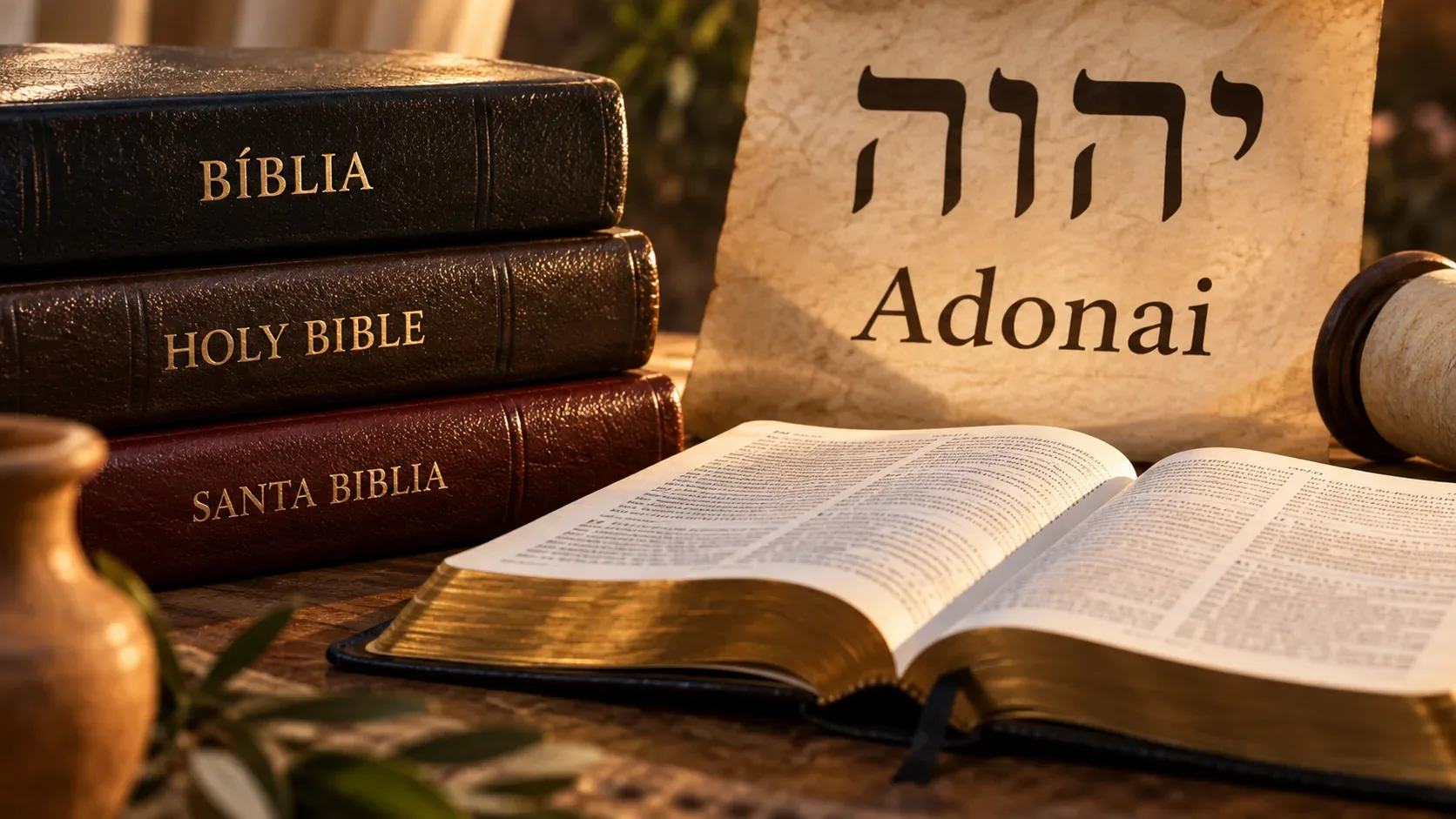
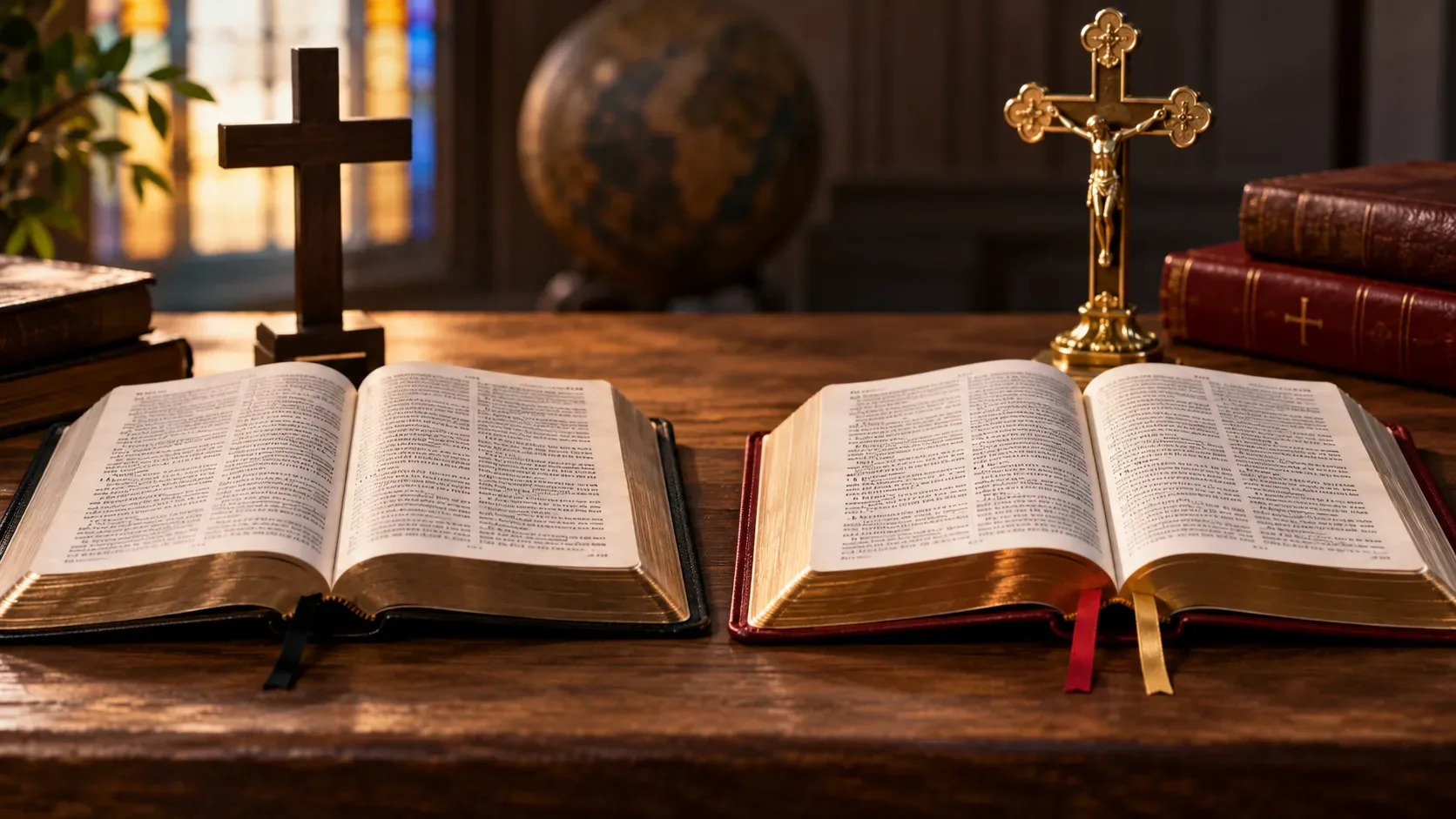
The difference between a 66-book Bible and a 73-book Bible is not in the New Testament. Catholics and the major Protestant traditions recognize the same 27 New Testament books. The difference is in the Old Testament: many Protestant Bibles count 39 books, while the Catholic Bible counts 46. The seven books that account for the numerical difference are Tobit, Judith, Wisdom, Sirach (Ecclesiasticus), Baruch, 1 Maccabees, and 2 Maccabees; in addition, the Catholic tradition also receives portions of Esther and Daniel that are not part of the Protestant canon.
The short answer: 39 + 27 and 46 + 27
| Tradition | Old Testament | New Testament | Total | What explains the difference |
|---|---|---|---|---|
| Protestant, in many denominations | 39 books | 27 books | 66 | Uses as its Old Testament canon the collection corresponding to the Hebrew canon, although divided and ordered in a Christian form. |
| Catholic | 46 books | 27 books | 73 | Includes seven deuterocanonical books and also passages of Esther and Daniel received as canonical. |
The United States Conference of Catholic Bishops summarizes the difference in those terms, and the Catechism of the Catholic Church lists 46 Old Testament books and 27 New Testament books.
This comparison covers the most common Catholic-Protestant contrast. Orthodox churches and other Christian traditions may use different lists, so there is no single book count that applies to all Christianity.
Which books are in the Catholic Bible but not in the Protestant canon?
| Book or collection | In the Catholic Bible | In many Protestant Bibles |
|---|---|---|
| Tobit | Canonical | Outside the canon; may appear in an Apocrypha section in some editions |
| Judith | Canonical | Outside the canon |
| Wisdom | Canonical | Outside the canon |
| Sirach (Ecclesiasticus) | Canonical | Outside the canon |
| Baruch | Canonical | Outside the canon |
| 1 Maccabees | Canonical | Outside the canon |
| 2 Maccabees | Canonical | Outside the canon |
| Additions to Esther | Integrated into the book | Not part of the canonical Protestant text of Esther |
| Additions to Daniel, including the Prayer of Azariah and Song of the Three Young Men, Susanna, and Bel and the Dragon | Integrated into the book | Not part of the canonical Protestant text of Daniel |
That is why the numerical difference is seven books rather than nine: Esther and Daniel already exist in both Bibles; what changes is the presence of additional sections within those same books. An official USCCB page about Catholic editions identifies both the seven books and the additions to Esther and Daniel.
What does “deuterocanonical” mean?
In Catholic terminology, the seven books and the additional portions of Esther and Daniel are called deuterocanonical. The term historically distinguishes books whose reception was more debated, but in current Catholic teaching they belong to the canon of Scripture and do not form a category of “second-class Bible.” The Catechism includes them in the same list of sacred Old Testament books.
In Protestant settings, the word Apocrypha is commonly used for writings outside the canon. The terms, however, are not perfectly interchangeable. “Apocrypha” can refer to a broader collection than the Catholic deuterocanonical books, depending on the tradition and Bible edition.
There has also never been only one historical Protestant attitude toward reading these texts. The Westminster Confession of Faith, influential in the Reformed tradition, says that the books commonly called Apocrypha are not part of the canon. By contrast, Article VI of the Church of England's Thirty-Nine Articles says that certain books may be read for example of life and instruction while not being used to establish doctrine. This is why an older Protestant Bible can contain a separate Apocrypha section without assigning those books the same canonical status as the others.
How did history produce two different counts?
The canon did not begin as a ready-made printed table of contents. “Canon” is the name for the list of writings a community recognizes as Scripture. These collections took shape over time in different Jewish and Christian settings.
1. Jewish Scriptures and Greek versions
The books that make up the Hebrew Bible were transmitted mainly in Hebrew, with some sections in Aramaic. Greek-speaking Jewish communities also used Greek translations associated with what we call the Septuagint. Ancient Greek manuscripts and collections should not be treated as though they all contained one fixed “official table of contents” identical to a modern Catholic Bible; textual and canonical history is more complicated than that. Even so, writings later called deuterocanonical circulated in Greek and were used by early Christians.
An academic work made available by the Society of Biblical Literature describes the Greek-speaking Christian tradition as broader than the Hebrew collection later preferred by Protestant traditions. A document from the Pontifical Biblical Commission likewise emphasizes the importance of the Greek Bible in early Christianity and the existence of a Western biblical tradition that preserved the deuterocanonical books.
2. The early Church did not debate every book in the same way
Across the first centuries, Christian authors and communities produced lists and judgments that did not always agree on every book. This applied to some Old Testament writings and, at earlier stages, to certain New Testament books as well. Therefore, statements such as “the entire Church always had exactly the same table of contents” or “the seven books first appeared in the sixteenth century” compress a much longer and more complex history.
3. The Reformation brought the Protestant Old Testament closer to the Hebrew canon
During the sixteenth-century Reformation, traditions that became Protestant generally treated as canonical in the Old Testament the books corresponding to the Hebrew Bible collection. Other writings could be gathered separately as Apocrypha or omitted from some editions. Later Protestant confessions formalized this distinction; the Westminster Confession's list, for example, corresponds to the 39 Old Testament books found in modern Protestant Bibles.
4. The Council of Trent formally defined the Catholic canon in the context of controversy
In 1546, during the Council of Trent, the Catholic Church reaffirmed as sacred and canonical the books that make up its Old Testament, including the deuterocanonical books. For that reason, saying simply that “Trent added seven books to the Bible” is inaccurate: those writings already had a long history of Christian use and reception, even though their status had been debated by authors at different times. Trent made the list a formal Catholic definition at a moment when the Reformation made the divergence especially explicit. The official USCCB introduction to Judith, for example, notes the book's inclusion in the canon by the Council of Trent in 1546.
If the Hebrew Bible has 24 books, why does the Protestant Old Testament have 39?
This is a second counting difference that can cause confusion. The 24 books of the Jewish Tanakh correspond, in their basic textual contents, to the 39 books of the Protestant Old Testament. The difference comes from how books are grouped and divided.
- Samuel is counted as one book in the Jewish system but as 1 and 2 Samuel in Christian Bibles.
- Kings and Chronicles are likewise divided into two volumes in Christian Bibles.
- Ezra and Nehemiah are traditionally counted as one unit in the Jewish reckoning.
- The twelve Minor Prophets form one book, “The Twelve,” in the Jewish count but twelve separate books in the Christian Old Testament.
The Jewish Virtual Library explains how these divisions lead from the traditional total of 24 to the 39-book count used in Protestant Bibles. So 24 and 39 do not represent two completely different sets of texts.
So which Bible is “right”?
The more useful historical question is not to treat one tradition as though the other made a simple counting mistake, but to identify which canon a community recognizes and why. For Catholics, the deuterocanonical books are Scripture and belong to the Old Testament. For many Protestant denominations, those writings do not belong to the inspired canon, even though some traditions have read or printed them separately.
This difference also explains why a quotation from Tobit, Wisdom, Sirach, or Maccabees can appear normally in a Catholic Bible yet be absent from a 66-book Protestant Bible. It is not a printing error: the editions are built from different canons.
How to identify your edition quickly
- Check the Old Testament table of contents.
- Look for Tobit, Judith, Wisdom, Sirach/Ecclesiasticus, Baruch, 1 Maccabees, and 2 Maccabees.
- If all seven appear as part of the Old Testament, the edition follows the Catholic canon or another tradition that also receives them.
- If they do not appear, the edition probably follows the 66-book Protestant canon.
- If they appear in a separate section called “Apocrypha,” read the editorial note: physical inclusion does not necessarily mean the denomination regards them as canonical.
In short, 66 = 39 Old Testament books + 27 New Testament books, while 73 = 46 Old Testament books + 27 New Testament books. The difference centers on the seven deuterocanonical books and the additional portions of Esther and Daniel. Understanding that history keeps a real canonical disagreement from being reduced to the simplistic claim that one tradition merely “removed” or “added” books without context.