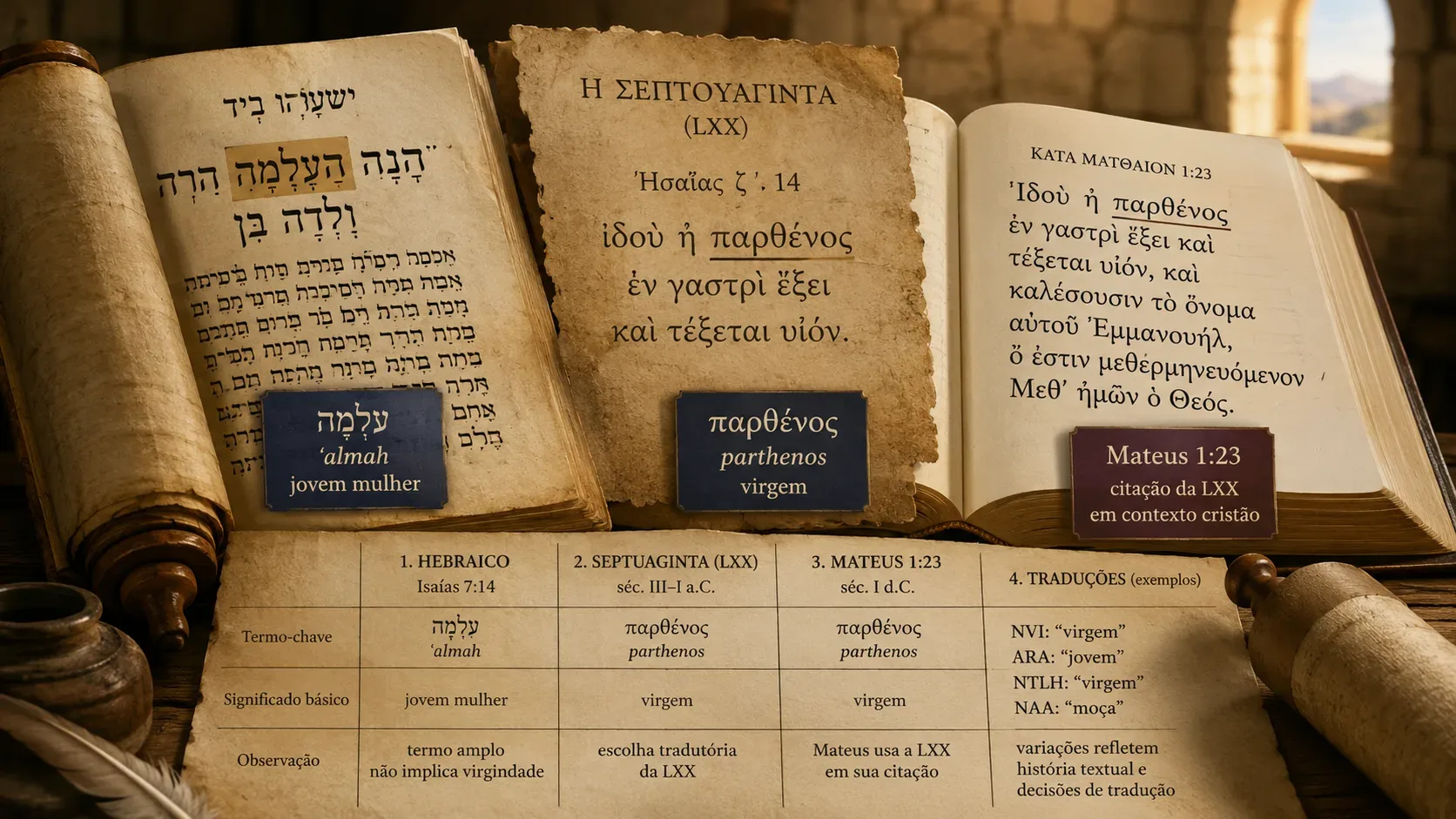
The answer depends on which textual layer is being translated. In the Hebrew of Isaiah 7:14, the phrase is הָעַלְמָה (ha-ʿalmah), referring to “the young woman” or a “young woman of marriageable age” and not, by itself, asserting virginity. In the ancient Greek translation known as the Septuagint, however, the term was rendered as ἡ παρθένος (hē parthenos), a word often translated “the virgin.” Matthew 1:23 closely follows this Greek form and applies it to the birth of Jesus.
So “virgin” and “young woman” are not merely rival answers to an identical question. They reflect different stages in the text’s history and different translation choices. The philological question—what the Hebrew of Isaiah says—also needs to be distinguished from the theological question—how Matthew reads Isaiah within a Christian narrative.
Short answer: Hebrew, Greek, and Matthew are different textual layers
| Layer | Key form | What it signals | Main translation issue |
|---|---|---|---|
| Hebrew Isaiah 7:14 | הָעַלְמָה (ha-ʿalmah) | A young woman; the word primarily concerns age/social status rather than sexual experience | “Young woman” directly represents the lexical value; “virgin” adds a specification not encoded by the noun alone |
| Greek Septuagint Isaiah 7:14 | ἡ παρθένος (hē parthenos) | A Greek term commonly associated with “virgin,” though its range can be broader in some contexts | The Greek translation makes a virginal reading much more available |
| Matthew 1:23 | ἡ παρθένος (hē parthenos) | Matthew reuses Septuagint language inside a narrative that has already described Mary’s conception as extraordinary | In Matthew, “virgin” is supported not only by the Greek noun but by the context of 1:18–25 |
| Modern translations of Isaiah | “young woman” / “virgin” | Different editorial choices | Some prioritize the Hebrew in Isaiah’s immediate context; others preserve Christian tradition or the canonical link to Matthew, sometimes through footnotes |
What ʿalmah means in the Hebrew of Isaiah 7:14
The safest point is that ʿalmah is not a word that technically means “virgin” by itself. The translation note in the NET Bible on Isaiah 7 explains that the term concerns age and can describe a young woman who is a virgin, but virginity is not inherent in the noun. The University of Iowa similarly summarizes it as “young woman” or a young woman of marriageable age.
This does not mean an ʿalmah could not be a virgin. It means that virginity is contextual information rather than a mandatory dictionary definition. Biblical Hebrew also has betulah, a more usual term when virginity is foregrounded, although even that vocabulary can depend on context. Reducing the question to “ʿalmah can never mean a virgin” versus “ʿalmah always means virgin” therefore oversimplifies the evidence.
Isaiah’s context: a sign addressed to the crisis of King Ahaz
Isaiah 7 did not originally arise as a debate over sexual terminology. The chapter places the prophet before King Ahaz during the Syro-Ephraimite crisis, when Judah faced pressure from Aram-Damascus and the northern kingdom. The sign of the child called Immanuel is presented within that political and temporal horizon: before the child reaches a certain maturity, the threat posed by the two kings will have collapsed.
This frame helps explain why many translators and scholars prefer “young woman” in Isaiah 7:14: the choice seeks first to represent the Hebrew and the function of the sign in its immediate literary setting. The exact identity of the woman and child remains debated, so one need not choose a specific identification to recognize the chapter’s near-term horizon.
There is also a less familiar second translation difference. The Hebrew around harah can be rendered in a way that suggests the young woman is pregnant or is in an imminent conception situation, whereas translations influenced by the Greek tradition often use the future “will conceive.” In English, for example, the NRSVUE has wording equivalent to “the young woman is with child,” while the NIV has “the virgin will conceive,” showing that the divergence is not limited to a single noun.
Why the Septuagint uses parthenos
Before Christianity became established, Hebrew biblical texts were translated into Greek. In Isaiah 7:14 the Septuagint renders ʿalmah as parthenos. That is a translation decision; it does not mean the Hebrew manuscript was changed to a different word. The Hebrew tradition continues to have ʿalmah, while the Greek tradition offers parthenos.
Parthenos very often means “virgin,” but it is not an absolutely rigid technical label in every Greek occurrence. The comparison assembled by Intertextual Bible, drawing on academic literature, notes that the Septuagint itself can use the word with a wider range. That prevents a mechanical equation in which “parthenos always = virgin” in every passage.
Even so, the choice of parthenos in Isaiah 7:14 is crucial to the verse’s later history because it makes a virginal reading far more salient. The University of Iowa analysis also notes that other occurrences of ʿalmah were rendered with different Greek terms for a young woman, making the choice in Isaiah 7:14 particularly significant.
How Matthew 1:23 enters the chain
Matthew is not directly translating Isaiah from Hebrew at the point of quotation. Matthew 1:23 closely follows the Greek Septuagint tradition and retains parthenos. There are small wording differences between Greek Isaiah and Matthew’s citation—for example, in the wording about who will name the child Immanuel—but the key noun is the same.
More importantly, in Matthew “virgin” does not depend on the dictionary alone. The immediate context of Matthew 1:18–25 presents Mary as pregnant before marital relations with Joseph and attributes the conception to the Holy Spirit. Thus, within Matthew’s narrative logic, parthenos is unmistakably read in a virginal sense. The Isaiah citation operates inside a framework the story has already established.
The essential textual path is therefore: Hebrew Isaiah: ʿalmah → Greek Septuagint: parthenos → Matthew: parthenos within the birth narrative of Jesus.
Does that mean “young woman” is a correction and “virgin” is an error?
That formulation is also too simple. If the task is to translate the Hebrew of Isaiah 7:14 in its immediate context, “young woman” is a direct philological choice because it does not add an assertion of virginity that ʿalmah does not require. This is why major modern translations use that solution or record it in a footnote.
On the other hand, Christian translation and interpretive traditions may choose “virgin” in Isaiah to preserve the reading received through the Septuagint and Matthew. One confessional defense of that possibility is Alfred von Rohr Sauer’s study, “The Almah Translation in Isaiah 7:14”, which explicitly begins from Matthew’s reading as prophetic fulfillment and argues that a rendering suggesting maidenhood/virginity is admissible. Its value for the debate is precisely that it shows how the decision can involve not only lexicon but assumptions about prophecy and the relationship between the Testaments.
Two Bibles can therefore translate Isaiah differently without using different Hebrew base texts. They may be making different editorial choices about which interpretive layer to foreground in the main text.
Textual history and doctrinal reading should be kept distinct
The philological observation that ʿalmah does not require “virgin” does not by itself settle the Christian doctrine of the virgin birth. In Matthew, virginal conception is stated by the narrative regardless of how a modern translator renders Isaiah 7:14. Conversely, accepting the Christian doctrine does not require a translator to render ʿalmah as “virgin” when the task is to represent the Hebrew of Isaiah.
It is therefore useful to keep two questions distinct:
- Philology and textual history: What word does the Hebrew text use, how did the Septuagint translate it, and what form does Matthew quote?
- Theological interpretation: How do Jewish and Christian communities understand the Immanuel sign and the relationship between Isaiah and Jesus?
Blending those questions produces false alternatives. Separating them makes it possible to see why a translation can say “young woman” in Isaiah and “virgin” in Matthew without technical contradiction: it is translating two texts in different languages and contexts.
How to read Isaiah 7:14 in a Bible with notes
- If Isaiah 7:14 says “young woman”, check whether the note mentions the Septuagint or the alternative “virgin.” That usually signals a decision to translate the Hebrew more directly.
- If it says “virgin”, look for a note mentioning Hebrew ʿalmah or the alternative “young woman.” That makes the lexical issue visible.
- Compare Isaiah 7:14 with Matthew 1:23. A difference between the two passages may be intentional because Matthew is Greek and uses parthenos.
- Do not use one translated word as the entire proof of a doctrinal position. The issue requires context, source language, and reception history.
In one sentence: why translations differ
Translations differ because Hebrew Isaiah 7:14 has ha-ʿalmah, the young woman; the Septuagint rendered it as hē parthenos; and Matthew 1:23 inherited the Greek wording and read it within a virginal-conception narrative. “Young woman” foregrounds the Hebrew of Isaiah; “virgin” foregrounds the Greek tradition and its received Christian reading. Following the path between the three texts is more precise than asking which isolated word “won.”