
The Enem 2026 reference matrix does not inform you in advance which subjects or questions will appear in the test. Its usefulness is different: to show the competencies, skills, objects of knowledge and cognitive processes that guide the construction of the exam.
In practice, it can replace review based on an endless list of subjects with a more manageable cycle: choose a skill, resolve related issues, identify the process that caused the error, and review only what the evidence shows is necessary.
Inep published the official Enem Reference Matrices page on July 17, 2026. The body presents the document as the conceptual structure used in the preparation and evaluation of tests, organized into cognitive axes, competencies, skills and objects of knowledge. Applications for 2026 are scheduled for November 8th and 15th.
What the Enem matrix really organizes
The matrix presents five cognitive axes common to the areas assessed:
- command of languages;
- understanding of phenomena;
- resolution of problem situations;
- construction of argument;
- preparation of proposals.
Based on these, the document details skills and abilities for Languages, Mathematics, Natural Sciences, Human Sciences and Writing, in addition to the objects of knowledge associated with each area.
This means that the document brings together two different dimensions:
What the student needs to mobilize: knowledge, concepts, languages, procedures and information.
What the student needs to do with it: interpret, relate, select, compare, explain, resolve, argue or propose.
This second dimension is the one that usually disappears when the review is organized only by subject names. Two questions about the same content can require very different cognitive operations. In one, it is enough to recognize a relationship; in another, it is necessary to interpret data, discard irrelevant information and justify a conclusion.
Why the matrix should not become another infinite list
The matrix does not function as a test prediction or incidence calendar. Nor should it be treated as equivalent to the entire school curriculum.
When explaining the role of reference matrices in large-scale assessments, Inep himself highlights, in the Saeb documentation, that they are sections used to guide the construction of items and do not encompass the complete curriculum. Although this explanation is in the Saeb area, the distinction helps to correctly interpret the function of an assessment matrix: it defines benchmarks for measuring skills, not a complete teaching sequence.
Therefore, it is not productive to transform each row of the matrix into a new matter to “zero”. The objective should be to use it as a sampling and diagnostic system.
The question is no longer:
“How many chapters are left to review?”
And becomes:
“In what skills am I still unable to perform the required reasoning consistently?”
Transform cognitive axes into diagnostic questions
The table below does not reproduce official definitions. It translates the five axes presented by Inep into practical questions to analyze issues and errors.
| Cognitive axis | Question to analyze the issue | Difficulty sign |
|---|---|---|
| Language mastery | What text, graph, formula, map, image or representation do I need to understand? | The student knows the content, but incorrectly interprets the language used. |
| Understanding phenomena | What concept or relationship explains the situation presented? | The concept has been memorized, but is not recognized in the context of the question. |
| Resolution of problem situations | What data is relevant and what strategy allows you to arrive at the answer? | There is difficulty in selecting information or putting together a resolution path. |
| Construction of argument | What conclusion is supported by the evidence presented? | The alternative is chosen by opinion, keyword or superficial association. |
| Preparation of proposals | What response, decision or intervention is consistent with the problem and its constraints? | The solution ignores presented conditions, consequences or limits. |
The same error can involve more than one axis. To make follow-up possible, record a main process, the one that most directly prevented resolution.
The skill → question → error → review method
The method can be applied in four steps.
1. Choose a few skills for the week
Start with four skills, preferably one from each objective area. Don't just choose the ones that seem important; use evidence of your performance.
Prioritize skills that meet at least one of these criteria:
- appeared in the wrong questions in recent weeks;
- provoked hits with low confidence;
- required excessive time;
- were confused with similar abilities;
- they depend on content that you have already studied, but are not yet able to apply.
Copy the code and full skill text from the array. The code alone does not explain what needs to be done.
2. Create a small sample of questions
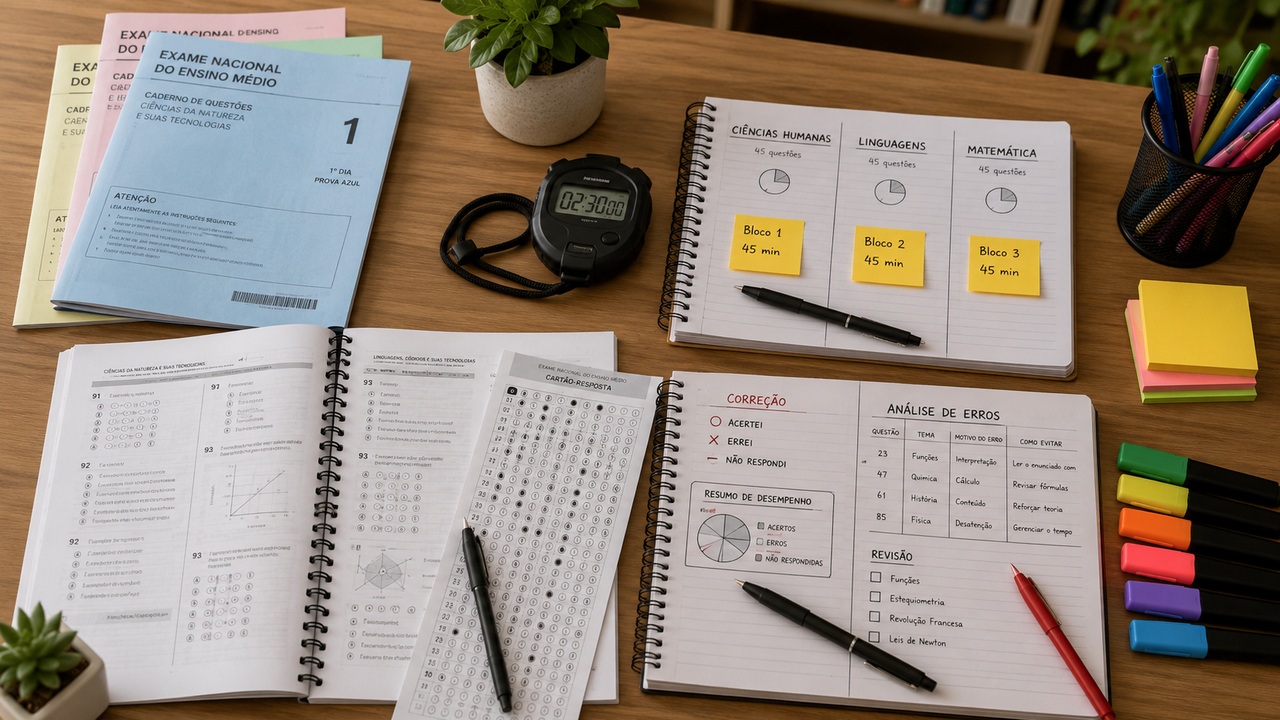
For each skill, initially select four to six questions from previous tests. Inep has maintained an official page with Enem tests and answer sheets since 1998; Since 2009, the exam has four objective tests with 45 questions each and an essay.
Give preference to official questions from different years. This reduces the risk of confusing an ability with the appearance of a specific test.
Ability classification will be a study hypothesis, not an official label. To do it more carefully:
- identify the central verb of the skill;
- observe the object on which the action is performed;
- resolve the issue before definitively classifying it;
- check which evidence makes the alternative correct;
- choose the skill that best describes the path needed to reach the answer.
A question can mobilize several knowledge and processes. For tracking purposes, record a primary skill and, when necessary, a secondary skill.
3. Solve before consulting the explanation
Make a real attempt, without looking at the resolution and without consulting the summary of the matter. In addition to the marked alternative, record your level of confidence:
- 0 — kick or almost no control of reasoning;
- 1 — doubt between alternatives or incomplete strategy;
- 2 — response supported by clear evidence.
The hit with zero or one confidence must be included in the review. The correct answer sheet alone does not prove mastery of the skill.
Studies on retrieval practice indicate that trying to retrieve a response and receiving corrective feedback can promote learning and error correction compared to simply re-presenting information. This does not mean that resolving issues guarantees automatic improvement: the benefit depends on analyzing and incorporating feedback.
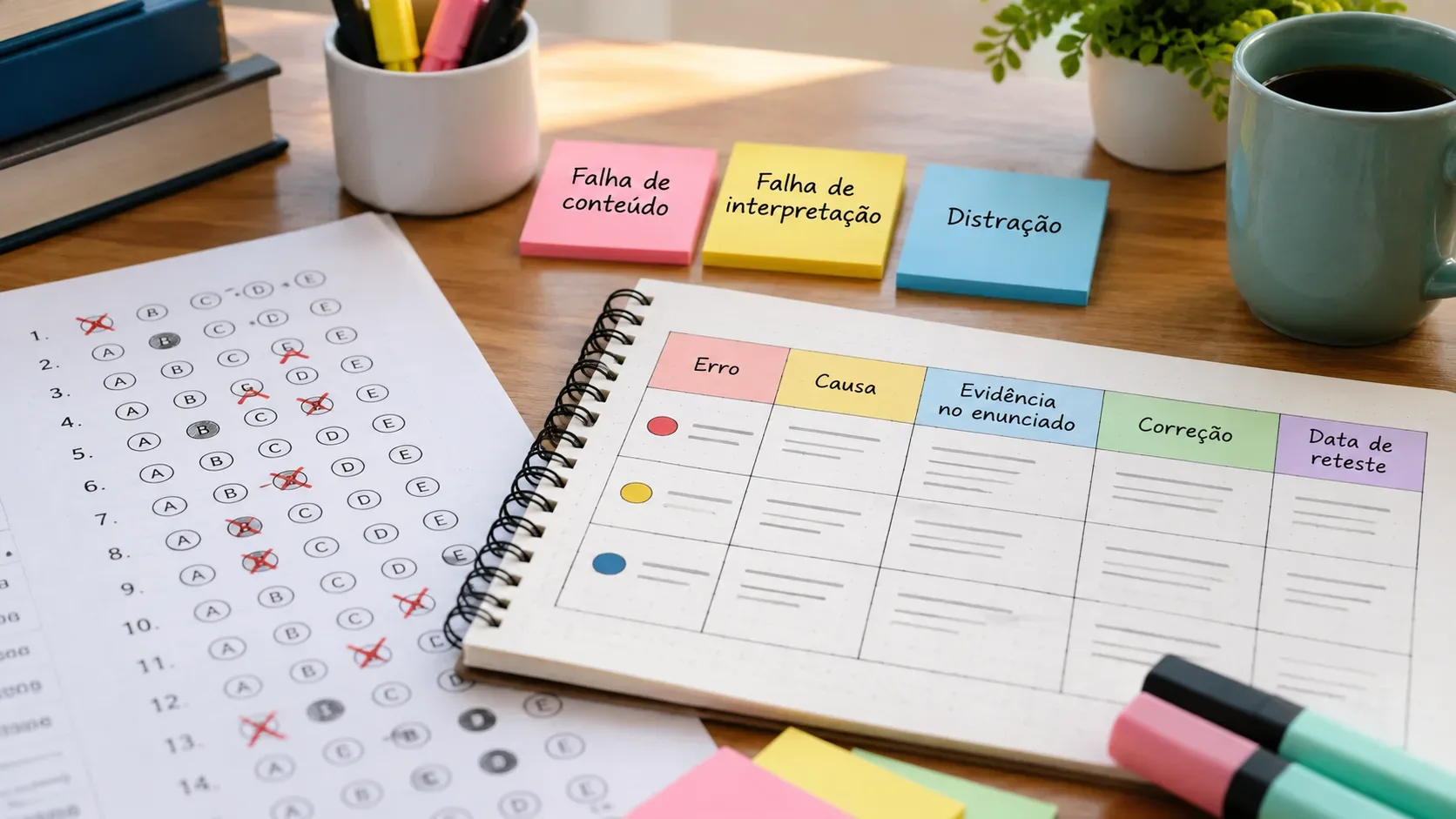
4. Record the cause of the error, not just the subject
“I got the electrodynamics wrong” or “I got the interpretation wrong” are too broad diagnoses. The record must indicate where the resolution process broke down.
Use simple sorting:
| Code | Type of error | Diagnostic question | Review action |
| C | Content or concept | What necessary knowledge did I not possess or mobilize incorrectly? | Review a short explanation and test the concept in a new situation. |
| L | Reading or command | What word, condition, negation or relationship in the statement did I misinterpret? | Rewrite the command with your own words and highlight restrictions. |
| D | Data or representation | Which table, graph, map, formula or unit did I read incorrectly? | Reread the data before any calculation or conclusion. |
| E | Strategy | I knew the content, but didn't know how to start or organize the resolution? | Record the first step and compare possible strategies. |
| A | Argumentation or inference | Was my alternative actually supported by the text or was it chosen by association? | Find the evidence that confirms the correct one and overturns the rest. |
| X | Execution, attention or time | Houve cálculo, transcrição, marcação ou gestão de tempo inadequada? | Criar uma regra de conferência e repetir sob condição semelhante. |
O objetivo não é encontrar uma justificativa confortável. É produzir um registro que permita mudar a próxima tentativa.
Template of a week of questions by matrix
O ciclo abaixo trabalha quatro habilidades e pode ser reduzido ou ampliado conforme o tempo disponível.
| Day | Activity | Expected result |
| Monday | Choose four skills and separate five questions for each one. | Sample of 20 questions organized by skill. |
| Tuesday | Resolver as questões de Linguagens e Ciências Humanas. | Ten attempts with response and confidence recorded. |
| Wednesday | Solve questions in Mathematics and Natural Sciences. | Ten attempts with response and confidence recorded. |
| Thursday | Correct the 20 questions and classify errors and weak successes. | Diagnosis by process, not just by matter. |
| Friday | Do a short review of the identified causes and resolve two new questions by skill. | Eight targeted retries. |
| Saturday | Solve a mixed block of 12 to 16 questions, without consulting the matrix during execution. | Test of transfer between areas and skills. |
| Sunday | Redo four to eight mistakes and choose skills for the following week. | Evidence of correction, permanence or repetition of the error. |
This cycle produces approximately 40 questions, but volume is not its main metric. A week with 24 well-analyzed questions can be more useful than a list of 100 questions corrected only by the answer sheet.
Review sheet by skill
Copy the form below to a spreadsheet, notes app or notebook.
Identification
Date:
Area:
Area competence:
Skill — code and full text:
Question source — year, notebook and number:
Related content or object of knowledge:
Try
Marked alternative:
Answer:
Confidence before correction — 0, 1 or 2:
Approximate time:
Process required by the question:
Diagnosis
Result: sure hit / weak hit / error
Main type of error: C / L / D / E / A /
Next action
What I need to review:
New question chosen to test correction:
Reattempt date:
Reattempt result:
Same error reappeared: yes / no
Decision: close / keep under review / return to base content
The most important part of the form is the correction sentence. It must describe a transferable action, for example:
- “Before calculating, I need to compare the units presented.”
- “The correct alternative must be supported by the text, not by what I already think about the topic.”
- “When the command asks for percentage variation, I must first identify the reference value.”
- “I need to separate cause, consequence and example before choosing the alternative.”
Avoid phrases like “pay more attention” or “study more”. They do not indicate what should change.
How to decide if a skill needs to continue in the cycle
At the end of the week, don't just use the percentage of hits. Note four pieces of evidence:
Consistency: Did you get different skill-related questions correct?
Rationale: Can you explain why the correct alternative is supported by the evidence?
Transfer: can you apply the same process when the content or format changes?
Efficiency: did the time and number of attempts decrease without loss of accuracy?
A skill can exit the cycle when there are consistent hits, clear justifications and absence of the same error in new questions. It doesn't need to disappear forever: it can return in mixed and simulated blocks.
If the error persists, do not repeat almost identical questions over and over again. Return to the previous point of the diagnosis. Perhaps a basic concept is missing; maybe the problem is reading graphics; perhaps you are classifying the question by apparent matter rather than by the skill actually required.
What the matrix does not replace
The matrix organizes the evaluation target, but does not replace:
- conceptual study;
- classes or reference materials;
- calculation training and procedures;
- frequent reading;
- production and correction of essays;
- mixed blocks;
- complete simulations;
- time analysis and test strategy.
There is also no guarantee that all abilities will be represented in the same way or with the same frequency in an edition. Therefore, the method should be used to diagnose and diversify training, not to try to guess the test.
Enem has 180 objective questions distributed across the four areas of knowledge, in addition to the essay. Working on a few skills per week is a sampling strategy: it brings study closer to the logic of assessment without pretending that a short cycle covers the entire exam.
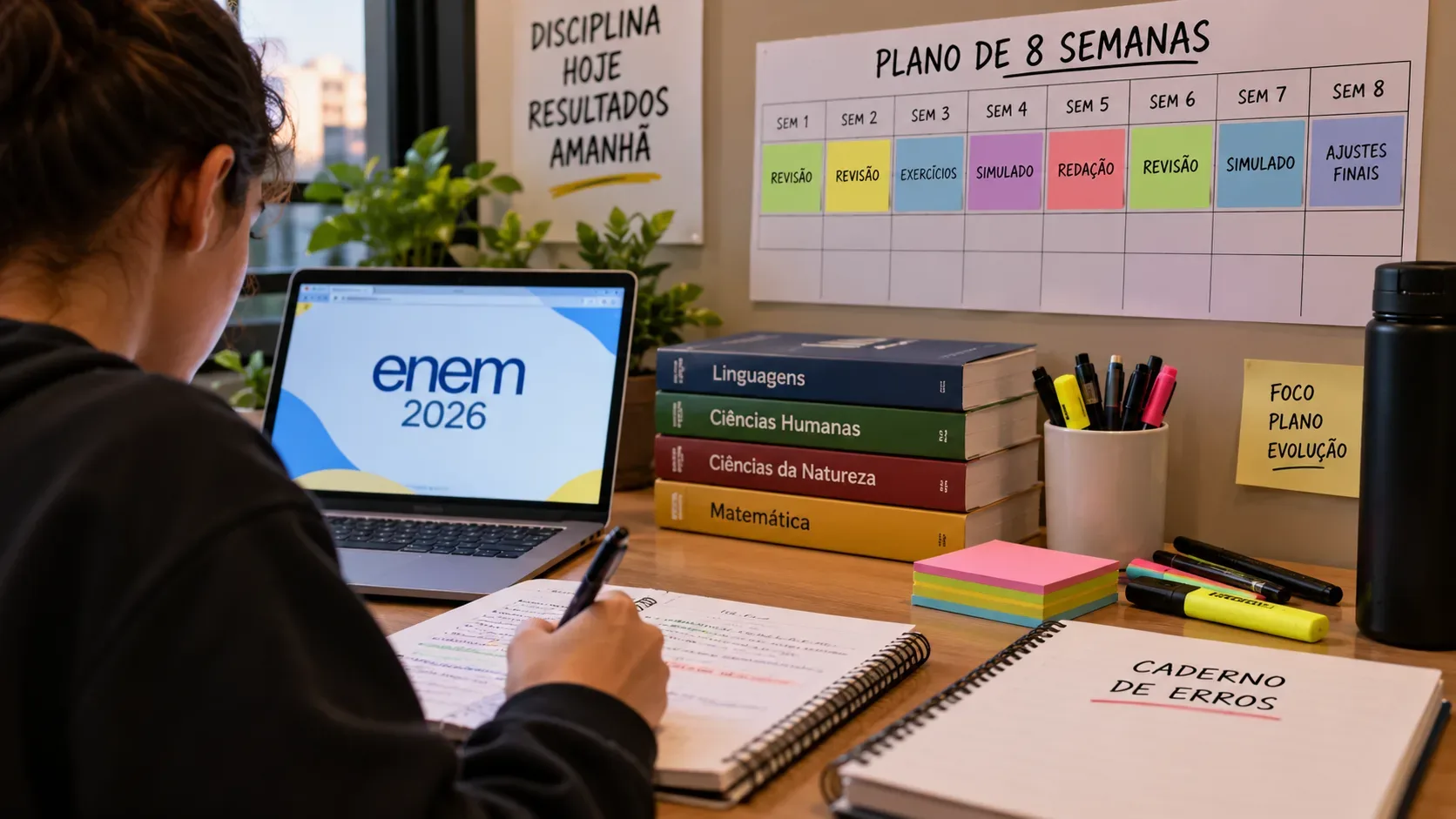
How to integrate this method into the 96-day plan
The 96-day plan answers when to study and how to distribute the load until the test. The matrix answers how to choose and analyze the issues within this load.
To combine the two:
- maintain the blocks and time limits defined in the plan;
- select skills based on previous week's mistakes;
- use official tests as the main source of questions;
- register weak successes along with errors;
- reserve a weekly block for mixed questions;
- progressively increase the presence of complete simulations;
- review the form before choosing the next week.
This way, the calendar is no longer filled with chapters chosen out of anxiety. Each week involves answering an objective question: what skill was tested, what process failed, and what evidence showed improvement?
Copy the review sheet for this article, choose four skills and set up your first cycle. Then, save this guide and use the 96-day plan to fit in the next few weeks leading up to the exams on November 8th and 15th, 2026.