Downloading an old Enem test is easy. The difficult part is deciding what to do with it. Solving everything at once can be useful for measuring resistance and time management, but it can waste a session when the real problem is concentrated in a skill, a type of reading or content that is still fragile. The best format depends on what you want to discover, your current level and the time available.
Inep maintains notebooks and templates from editions from 1998 to 2025. This collection allows you to work with both simulations and directed blocks. The choice, however, does not need to follow the logic of “the more questions, the better”. An old test works best when each session has a clear question: do I want to diagnose, repair a gap, test strategy or simulate test day?
The ancient test is a tool, not a ritual
Taking previous tests helps because it puts you in front of real items, with the type of text, command, alternative and problem situation used by the exam. Retrieval practice also has consistent support in the learning literature: attempting to respond, rather than just rereading, can strengthen long-term retention, especially when the attempt is followed by feedback and retaking the error.
This does not mean that every session needs to be a complete simulation. An entire test measures several things at the same time: knowledge, reading, decision making, pace, fatigue and strategy. If you still don't know which of these dimensions is bringing down your performance, a smaller block may give a cleaner answer and allow for same-day correction.
The first decision, therefore, is not “which year am I going to do it?”, but “what do I want to measure today?”.
When to use the entire test
The entire proof makes more sense when the objective is to test the whole, not an isolated gap. This usually happens when the base is already reasonably consolidated, when you need to practice rhythm and endurance or when you want to check whether a strategy that worked in blocks continues to work under greater load.
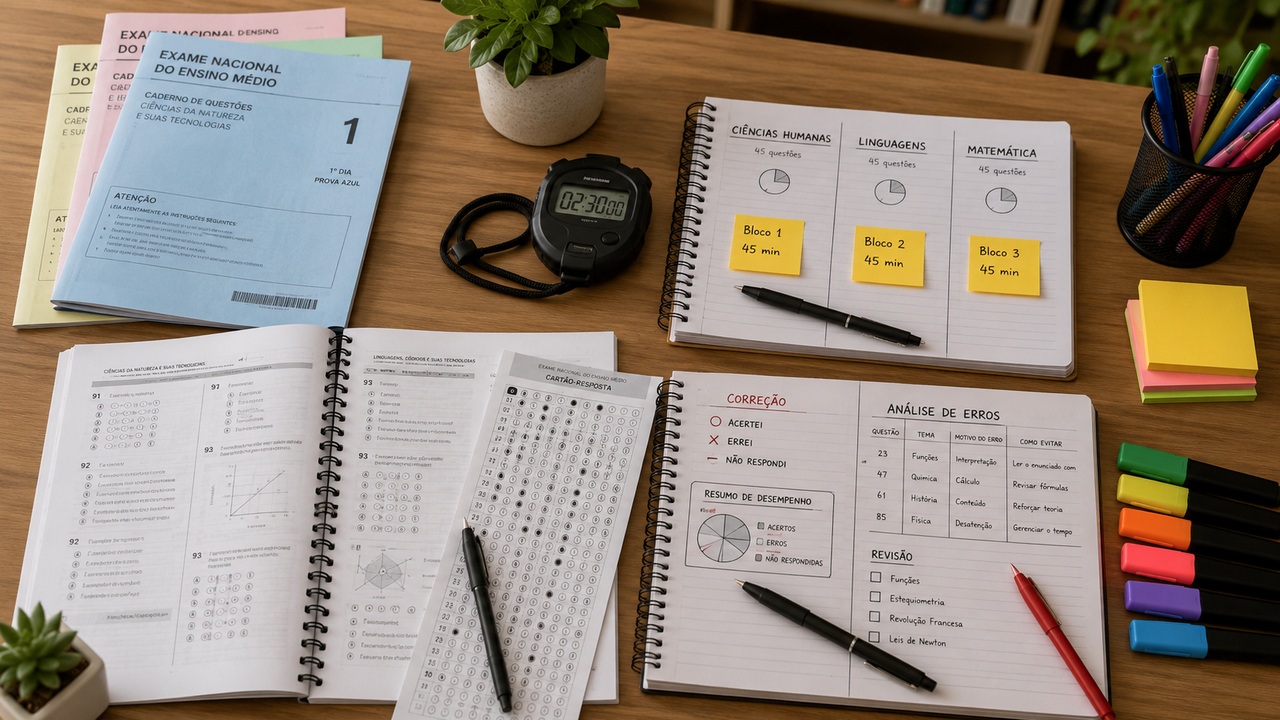
In this article, “entire test” means reproducing a complete notebook from one day of application. As the Enem is carried out over two days, the most faithful simulation must respect the organization and timing of the edition that you will actually do, consulting the current notice, instead of automatically copying the conditions from an old year.
Use an entire race to measure pace and endurance
If you get it right when you solve ten or fifteen questions, but lose quality after a long test, the problem does not appear in a short block. In this case, the long session is necessary because what is being trained is maintaining performance: when to read more calmly, when to abandon a question, how to distribute energy and how to prevent a difficult sequence from consuming the rest of the notebook.
The full proof is also useful after you have already tested block strategies. For example, if you learned to identify time-consuming questions and leave them for a second pass, the simulation serves to check whether this choice really improves the set, without creating a new problem at the end of the test.
Don't use the entire test just to accumulate hours
If most of the questions still seem indecipherable, finishing a complete notebook can produce a large number of errors, but little new information. You already know that the base is insufficient; insisting for hours only confirms the diagnosis. In this scenario, it is more efficient to reduce the training size, find error patterns, and repair a group of skills before repeating a long simulation.
A good rule of thumb is this: the entire test is worth it when its result can change a strategic decision. If you already know, before starting, that you will make mistakes due to a lack of basic content in almost every area, targeted training tends to be more productive.
When to train in blocks
The block is the most flexible format for transforming an old test into study material. It can be organized by area, skill, topic, perceived difficulty or type of problem. The important thing is that the cropping has a reason.
Use blocks for initial diagnosis
If you don't already know where the bottlenecks are, start with a mixed block short enough to fit together with the correction in the same session. The goal here is not to estimate a final grade, but to observe patterns. Do you make mistakes because you don't know the content? Do you understand the material, but read the command in a hurry? Do you know how to solve it, but choose a path that is too long? Leave simple questions until the end and run out of time?
A small, well-corrected diagnosis is usually more informative than an entire test followed only by counting correct answers.
Use directed blocks when the base is fragile
When the diagnosis points to a clear gap, the block must become more specific. If the problem is with percentages, interpreting graphs, functions, stoichiometry, reading argumentative text or another recurring process, gather questions that require that knowledge or skill and use the sequence to test whether the review actually changed performance.
The logic is simple: revise the minimum necessary to solve it again, try new questions without consulting the theory during the attempt and observe if the error reappears. If it reappears for the same reason, the review was not enough or the problem was not just content.
Use blocks to test strategy without waiting for a simulation
It is also possible to train test behavior on a smaller scale. A timed block can show if you take too long on a type of question, if you reread texts unnecessarily, if you insist on long calculations or if you change correct answers due to insecurity. This type of training reduces the cost of trying a strategy: you don't have to spend an entire notebook to discover that an approach doesn't work.
How to choose based on available time
The size of the training must leave room for correction. If you have a short session, don't choose a block that takes up every minute just solving it. Learning doesn't end when you select the last alternative; it depends on what you can identify and repair later.
In a short session, choose a few questions with a defined objective and set aside part of the time to review errors. In an average session, you can expand the block, mix content, and include some time control. In a long session, a complete area or a day's notebook makes sense, as long as the correction is scheduled for immediately afterwards or for the following session.
The most useful rule is to allow enough time to answer two questions after the answer key: why did I make a mistake and what will I do to reduce the chance of repeating that mistake? If the session ends without these responses, the block was probably too big for the time available.
Correcting is not just checking the answer sheet
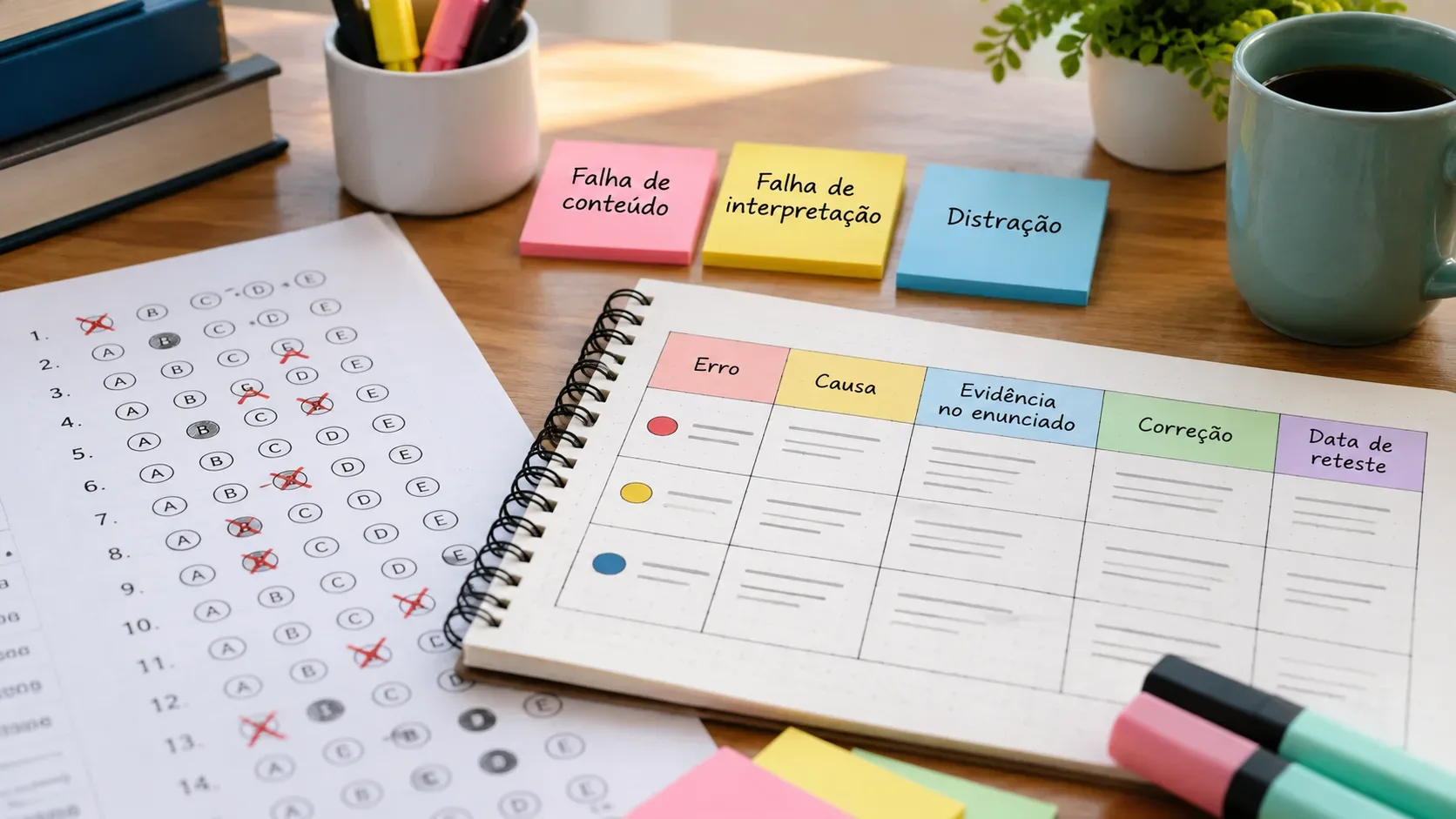
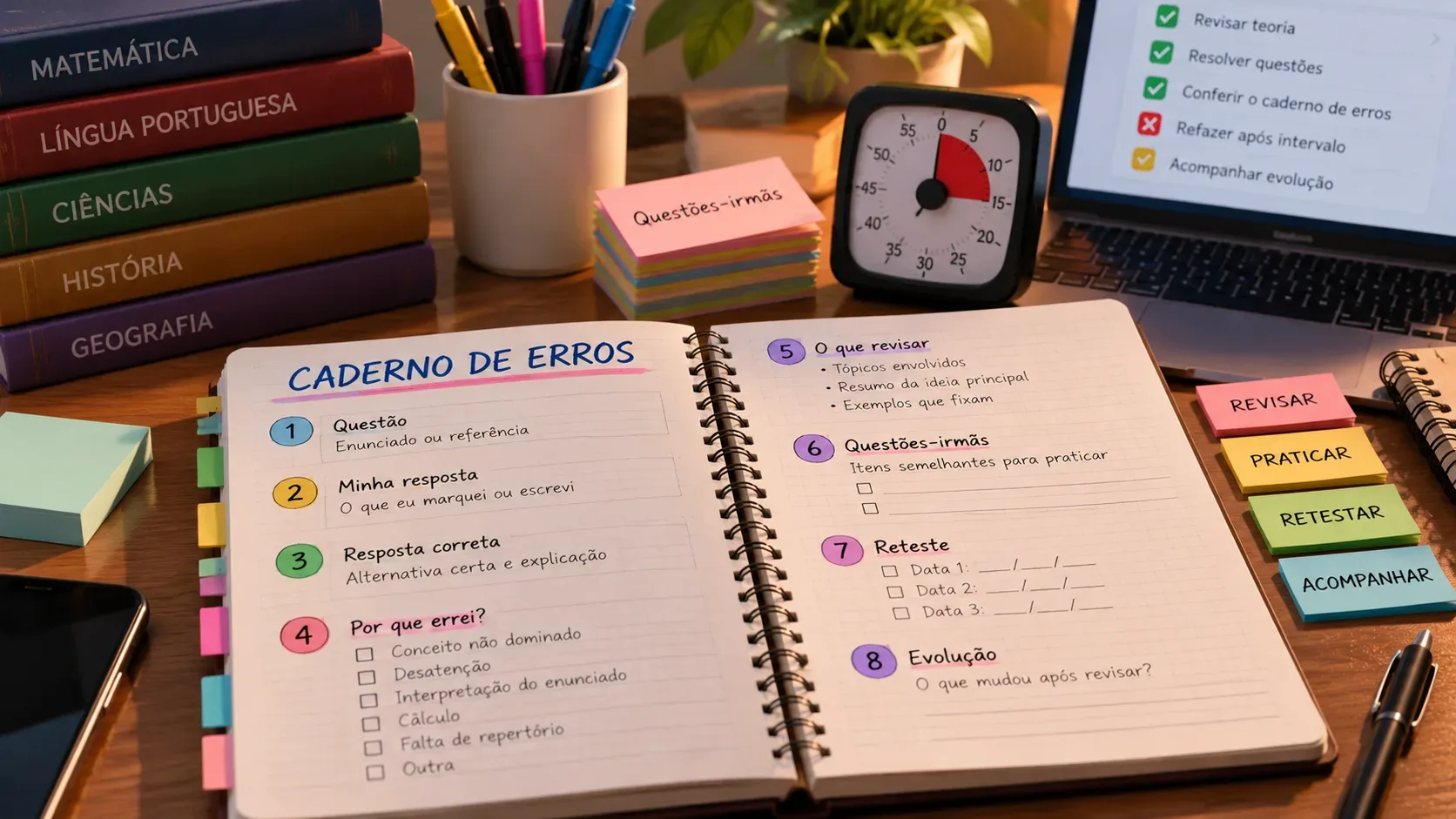
The difference between “asking questions” and “studying with questions” appears in the correction. Marking right or wrong tells the result, but does not explain the cause. To transform an old test into a study plan, classify the error according to the process that failed.
Content error
This is the case in which an idea, formula, relationship, concept, vocabulary or procedure necessary to begin or conclude the question was missing. The next session should contain a short, focused review, followed by new questions that require the same knowledge in different contexts.
The important point is not to turn a one-off error into a reflexive revision of an entire chapter. First identify exactly what was missing. Then study enough to test the skill again.
Reading or interpretation error
Here the content was available, but the reading diverted the path. There may be an ignored command, a forgotten unit, a misinterpreted keyword, graphic data not related to the statement or an alternative chosen before finishing the analysis.
In this case, rereading theory does not solve it alone. The correction must reconstruct the path: what information in the statement should have controlled the decision? Then ask new questions with deliberate attention to the command and relevant data.
Strategy error
The student knew the content and understood the question, but chose a bad method. Maybe you started an extensive calculation when there was an estimate, tried to solve everything algebraically when the graph already answered, or stayed too long on a low-return question.
The next session should train path choice. Before calculating, take a few seconds to decide the method. Then compare the solution used with a shorter alternative and record the signal that could have indicated that route.
Timing error
The timing error appears when the question would be resolved correctly under normal conditions, but the pressure of the clock leads to abandonment, kicking or loss of attention. It should not be confused with lack of content.
If timing errors are concentrated towards the end of the block, gradually increase the duration of timed workouts. If they appear in specific question types, work on those types in smaller chunks to reduce the average time before returning to the full exam.
Insecure hit also deserves review
Not every hit confirms dominance. An alternative chosen by guess, incomplete elimination or vague memory can turn into an error in the next question. Mark these hits as “unsafe” and treat them as a secondary review priority. The answer key should confirm the answer, not end the analysis.
A correction protocol that generates the next session
First, try to explain the error before opening the theory
After checking the answer key, go back to the wrong questions and those answered incorrectly. Try to locate the point where the reasoning was lost. This attempt is important because it forces you to find your way back, rather than just recognizing a ready-made explanation.
If you still can't, consult a review source. Read as much as necessary to understand the specific point and return to the question. The objective is not to memorize the resolution of that item, but to be able to explain why the correct alternative is defensible and why your choice failed.
Then classify the dominant cause
At the end of the block, look for the pattern, not just the quantity. Five errors can require five different chapters, but they can also have a single cause: rushed reading. Likewise, a small number of errors can hide a serious problem if everyone is focused on a skill that is too frequent for you.
The dominant category must decide the next training session. If content predominates, do minimal revision and targeted block. If reading predominates, train interpretation and command. If strategy predominates, compare methods and practice path decisions. If time predominates, increase exposure to timed blocks and, when there is stability, return to the entire race.
Finally, test if the fix worked
A correction is only complete when learning survives a new question. After reviewing, resolve different items that require the same process. If you only get the question you just read the solution right, there is still no evidence of transfer.
This retest does not need to occur immediately. Spacing out the retry can be helpful because it reduces the deceptive feeling of familiarity produced by the recent correction. The goal is to find out if you can recall the procedure when the answer is no longer fresh in your memory.
Use the Enem matrix to get rid of the label “I made mistakes in Mathematics”
Inep publishes the Enem Reference Matrix, which organizes competencies, skills and objects of knowledge and explains cognitive axes common to the areas, such as mastering languages, understanding phenomena, facing problem situations, building arguments and preparing proposals.
In practice, this helps to make the diagnosis less generic. Instead of just recording “I got Mathematics wrong” or “I got Human Sciences wrong”, ask which operation the question required. Was it acting a performance? Relate information? Select a model? Evaluate an argument? Apply a concept in a new situation?
This level of analysis brings training closer to the way the exam organizes skills. It also avoids excessive revision: two errors from different content can share the same difficulty in reading data or making decisions.
Which old tests to prioritize
The official Inep archive goes from 1998 to 2025, but not all editions have the same value for the same objective. Inep itself reports that, between 1998 and 2008, the objective part had 63 interdisciplinary items in a single notebook. Since 2009, Enem has included four objective tests of 45 questions, in addition to the essay, distributed over two application days.
Therefore, if the goal is to simulate the format closest to the current Enem, prioritize editions from 2009 onwards and adjust the session to the rules of the current notice. The tests from 1998 to 2008 can still be useful as a question bank, especially for reasoning and reading training, but they should not be treated as a replica of the current exam design.
It's also worth alternating years. Quickly repeating a test that you just corrected can inflate performance due to memory of the answers. When you want to measure progress, choose previously unseen issues or return to an issue after a sufficient interval for specific recall to have diminished.
Do not turn the number of correct answers into an official score
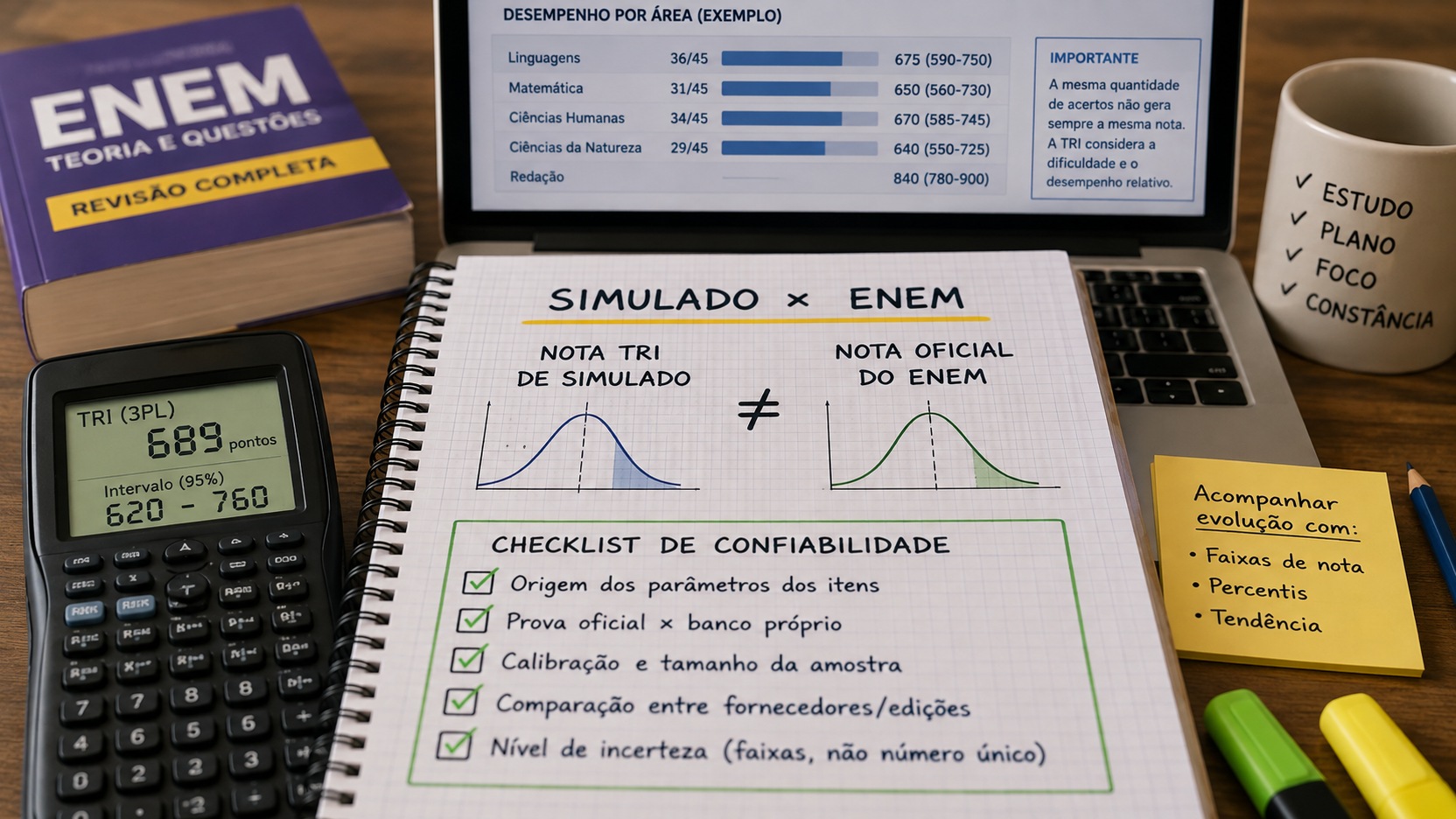
The number of correct answers is useful for monitoring progress within your own training, but it is not automatically equivalent to the official Enem score. The calculation of objective tests uses Item Response Theory, and Inep explains that participants with the same number of correct answers can obtain different proficiencies depending on the set of items answered correctly and the pattern of answers.
Therefore, use hits to compare similar blocks, detect stability and observe trends. Avoid concluding that a certain number of correct answers is “worth” an exact grade. For studying, it is more productive to track which types of errors have decreased and whether you maintain performance as the time and length of the notebook increase.
The rule for deciding the next session
After each workout, don’t choose the next activity because you want to “finish another race”. Choose the dominant error and the unanswered objective.
If the base is fragile, reduce the block and repair contents. If the base is good, but the reading brings down questions, practice command and interpretation. If knowledge appears in blocks, but disappears under pressure, increase the time and length until you reach the complete notebook. If the problem is already located, search for new issues from the same process to confirm the correction.
The progression can be summarized as follows: use the test to diagnose, transform the diagnosis into targeted training, test the correction on new questions and only then increase the scale. The old test stops being a file to “solve one day” and starts to function as a decision system on what to study next.