Correcting your own Enem essay does not replace the official correction nor does it accurately reveal the grade you would get. Still, self-correction is one of the most useful ways to study, because it forces you to read the text carefully, spot concrete flaws, and decide what to rewrite. The point is not to play Inep broker. The point is to figure out what's weakening your writing now and what needs to change in the next version.
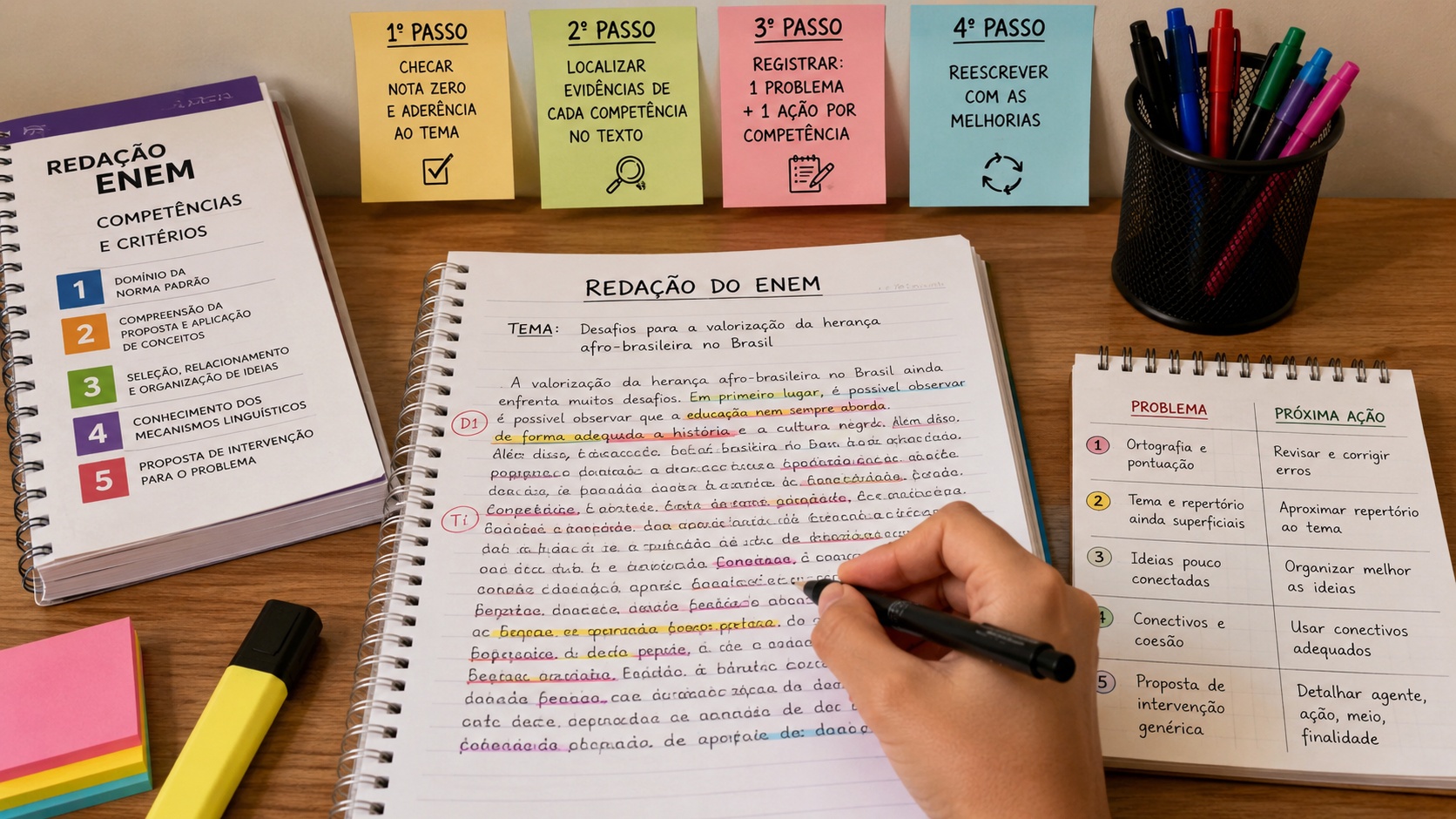
For this to work, it’s worth leaving the question “how much would I take?” and ask the question “what does this text show in each competency?”. Using the Inep booklet and manuals, you can set up a simple routine: first eliminate serious problems with adherence to the proposal; then look for evidence of each competency; then register a problem and a next action by competence; finally rewrite the text. This process is much more reliable for studying than transforming a general impression into an approximate grade.
Before looking at the 5 skills Before adding anything, see if the writing continues within the game. Enem evaluates a dissertation-argumentative text, in formal written form in the Portuguese language, produced based on the proposed theme and accompanied by a proposal for intervention that respects human rights.
In self-correction, ask if the text responds to the topic, if it presents a recognizable thesis, if it maintains the essay-argumentative structure from beginning to end and if it has its own development and minimum length required by the exam. If there is a departure from the topic, disobedience to the textual type or other serious problem foreseen in the correction documents, discussing commas and connectives before that loses meaning. The first filter is always adherence.
How to read your essay using the 5 skills
Instead of trying to give a grade immediately, read in layers. Within each competency, spot signs of what works and what fails. The ideal is to record, at the end of each reading, a main problem and a next action. This keeps the diagnosis objective and avoids vague comments such as “the text is more or less good”.
Competence 1: mastery of the standard norm This includes spelling, accentuation, agreement, regency, punctuation, choice of verb tenses and sentence construction. The isolated error does not explain everything; What matters most is the frequency of the deviations and how much they hinder the reading.
In autocorrection, mark only what is repeated. If you try to hunt down every detail at once, the review becomes chaotic. Look for patterns: commas in the wrong places, long uncontrolled periods, broken agreement, forgotten accents, repetitions of structure. The problem to be recorded must be specific, such as “scores over long periods” or “many deviations from agreement”. The next action also needs to be specific, such as “breaking up long sentences and reviewing the relationship between subject and verb in each paragraph.”
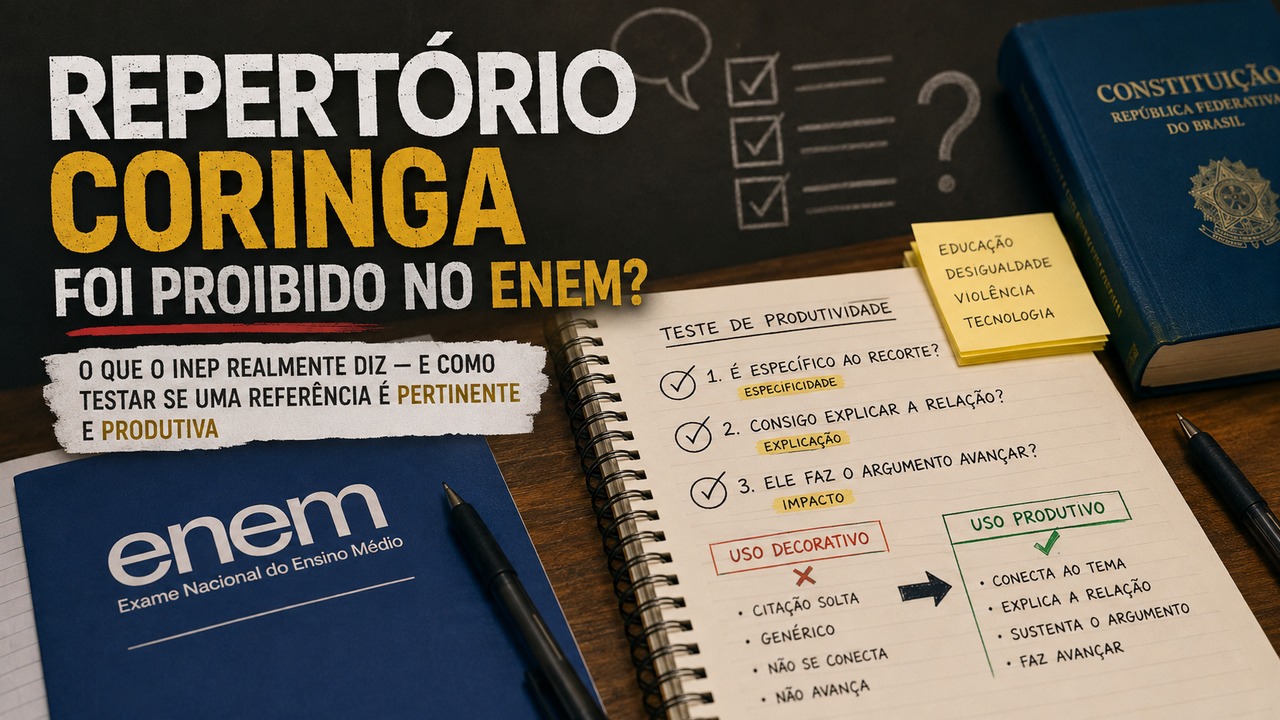
Competence 2: understanding the proposal and developing the topic It is not enough to touch on the subject. The corrector checks whether you understood the topic, whether you defended a clear point of view and whether you mobilized concepts or repertoires in a pertinent way to develop this discussion within the dissertation-argumentative format.
In practice, re-read the topic and ask if each paragraph speaks to it. See if the text just repeats generic ideas or if it develops a real thesis. Also observe whether repertoires, such as data, historical references, works or concepts, appear linked to the argument. A common problem is citing something “beautiful” but loose. Record something like “repertoire with no connection to the thesis” or “discussion too broad, not very consistent with the scope”. The next action might be “explain why this example proves my point” or “rewrite the thesis to answer the topic exactly.”
Skill 3: selection and organization of arguments Here the question is simple: does your text convince because it organizes reasoning or just piles up sentences? Competency 3 assesses the ability to select, relate, organize and interpret information, facts and arguments in defense of one's point of view.
In self-correction, identify the thesis in the introduction, the role of each development paragraph and the progression to the conclusion. If a development repeats the previous one, changes the subject without function or uses an example without explaining its meaning, there is a problem with the argumentative design. Record a central point, such as “repeated arguments without elaboration” or “lack of clear connection between cause and consequence”. The next action might be to “give a distinct function to each development” or “explain the effect of each example rather than just citing it.”
Competence 4: textual cohesion Cohesion is not about embellishing the text with rare connectives. It’s about making the writing move forward without reading gaps. Cohesive mechanisms link sentences, resume ideas and make clear relationships such as cause, opposition, explanation, consequence and conclusion.
When reviewing, pay attention to two things. The first is the passage from one idea to another: does the reader understand why the next period came after the previous one? The second is the variety and suitability of connectors. Repeat “furthermore” throughout the paragraph or
using “however” without real opposition weakens cohesion. Record something like “repetitive connectives” or “abrupt transitions between periods”. The next action may be “replace repetitions with connectors appropriate to the logical relationship” or “rewrite the opening of the second development to return to the previous idea”.
Competence 5: intervention proposal In conclusion, Enem does not ask for a generic closure. Request an intervention proposal for the problem discussed, detailed and compatible with the arguments presented, with respect for human rights.
In self-correction, see if your proposal clearly answers practical questions: who does it, what does it do, how does it do it and for what purpose. When there is space, it is also worth indicating the means or instrument of the action. The more concrete and connected to the text, the better. A recurring problem is the vague proposal, such as “the government must raise awareness among the population”. This still leaves a lot open. Register something like “generic intervention” or “lack of details of the environment”. The next action may be to “define specific agent and execution instrument” or “tie the proposal to the cause discussed in the previous paragraphs”.
How to record self-correction without turning it into a grade after reading for competence, resist the temptation to immediately turn everything into punctuation. The greatest utility is in the written diagnosis. On a separate sheet, leave each competency with three records: what worked, the main problem and the next action. This chart says much more about your current level than an improvised number.
If you want to use tracks, use them only as a broad reference. You can mark whether that competency is strong, average or weak according to the official criteria. This helps you prioritize studying without pretending to be accurate. Official correction follows standardized criteria and goes through more than one evaluator, so self-correction is not used to accurately predict the final grade. It serves to improve the text.
From correction to rewriting Self-correcting and saving the paper doesn't do much good. The gain appears in the rewrite. First choose the problems that most affect the overall quality, such as a poorly formulated thesis, repetitive development, broken cohesion or a generic intervention proposal. Only then go to fine-tuning the phrase.
A good practice is to rewrite in layers. First, change the structure: thesis, order of arguments, function of each paragraph and conclusion. In the second, adjust repertoires, explanations and connectives. In the third, clean your language, with spelling, agreement and punctuation. When you try to solve everything at the same time, you tend to improve one section and disorganize another.
It is also worth comparing the first and second versions. Ask if the thesis has become more explicit, if the paragraphs now have different functions and if the conclusion really solves the problem discussed. This comparison teaches you more than just reading ready-made comments.
What AutoCorrect does and doesn't do AutoCorrect can show patterns. If almost all of your writing has a loose repertoire, for example, this is not an occasional error; It's a skill that needs training.
If the recurring problem is in Competency 1, the study may need to include a systematic review of grammar applied to the text. If the weakness appears in Competency 5, the path is to train more detailed conclusions.
What autocorrection cannot do on its own, with good precision, is simulate the official look in all shades or establish the grade that would be obtained in the exam. Therefore, when possible, combine self-correction with reading booklets, analyzing commented essays and external correction from time to time. Autocorrection is great for routine. External validation is excellent for calibration.
A simple routine to repeat in every essay If you want to turn all of this into a method, do this every time you write: re-read the proposal, go through the adhesion and textual type screening, read the essay once in its entirety, then once per competency, record a problem and a next action for each one and rewrite the text. In the next essay, start the review with the two points that were most repeated in the previous one.
Studying writing alone becomes much more productive when the focus moves away from guessing grades and onto evidence in the text. The right question is not “how much is this worth?” The right question is “what does this text already demonstrate and what still needs to appear to be better?”. It's this shift in reading that turns self-correction into real learning.