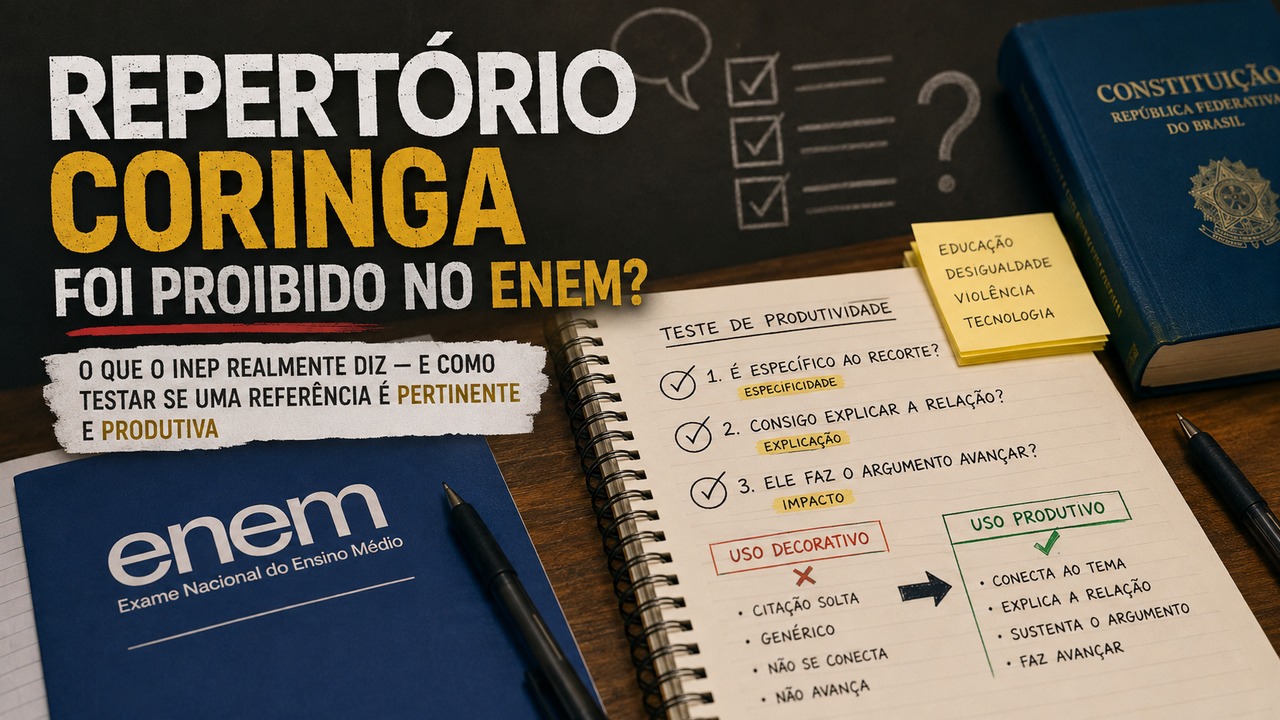
The short answer is no: Inep did not publish a rule that prohibits, by name, the Constitution, a well-known author, a famous book or any other repertoire called "joker". The official warning is against the use of the so-called "pocket repertoire": ready-made, memorized, generic and little-depth references, inserted without genuine connection with the theme and the argument developed.
The difference matters because "prohibited" and "not productive" are not the same thing. A reference can be known by thousands of candidates and still work well if it is correctly related to the selection, contextualized and used to support reasoning. On the other hand, even a rare reference can be weak if it appears only to decorate the text.
On the Enem documents page updated by Inep on July 17, 2026, the 2025 Participant Handbook still appears as the most recent writing booklet listed. It is here that the Institute explicitly highlights the care taken with the "pocket repertoire" and explains that a memorized, automatic or forced insertion can be assessed as non-productive in Competency II.
What Inep actually said about pocket repertoire
The 2025 Participant Handbook describes the pocket repertoire as a reference previously memorized and used in a generic way, without depth and without a genuine relationship with the proposed theme. The document links the problem directly to Competency II, which requires understanding the proposal and mobilizing knowledge from different areas in a way that is relevant to the development of writing.
The guidance does not transform a list of authors or works into vetoed material. In an interview before Enem 2025, the then president of Inep, Manuel Palacios, responded precisely to a question about the Constitution. He explained, in short, that there is no obstacle to using a quote if it fits well into the development of the argument. The quote does not support the text alone; it needs to reinforce an idea that the participant is actually constructing.
This also helps clear up another confusion: pocket repertoire is not an automatic cause of a zero score. Inep treats the problem as a matter of evaluating repertoire and argumentation. A poorly used reference can harm Competency II and, if accompanied by broader problems in approaching the topic, contribute to worse performance. But there is no general rule that mentioning the Constitution, Bauman, Thomas More, or any well-known name makes the writing null and void.
Forbidden and non-productive are different things
"Forbidden" would suggest an objective prohibition: used a certain reference, lost the possibility of scoring or committed a previously defined infraction. That's not what the official material says.
"Not productive" describes another situation. The reference is in the text, but it does not perform a sufficient argumentative function. It does not clarify the cause discussed, does not provide a comparison criterion, does not help to interpret a fact, does not support a consequence or create a specific link with the proposal's outline.
It is possible to think on three levels. First, the reference must be relevant: it must have a real relationship with the subject and, preferably, with the exact outline of the theme. Second, it needs to be contextualized: the reader must understand which idea of the work, norm, concept or episode is relevant. Third, it needs to be productive: after being presented, it must move the argument forward.
This sequence avoids a common mistake when preparing for the Enem: memorizing sentences and then looking for a place to fit them. The safest way is the opposite. First comes the thesis of the paragraph; then, the reference that really helps to explain or support this thesis.
Constitution, book or author are not good or bad in themselves
The Constitution is a good example because it appears in many drafting models and, at the same time, contains very specific provisions. Just saying that "the Constitution guarantees rights" is almost always too broad. Already pointing out which right, which principle or which duty relates to the clipping can transform the same source into a useful repertoire.
The same reasoning applies to literary works, films, sociological concepts and philosophers. The author's name does not guarantee depth. What counts is the operation carried out with the reference. A concept can serve to define a phenomenon, establish a comparison, offer a counterpoint, explain a cause and effect relationship or provide a criterion for judging the situation discussed.
For this reason, exchanging a well-known repertoire for a more "different" one does not solve the problem if the way of use remains automatic. Authorship, in this context, appears in the way the candidate selects, explains and articulates knowledge to the text project itself.
A test in 3 questions before using any repertoire
Question 1: Is it specific to the theme?
Do a substitution test. If the excerpt could be reused on five different topics by changing just two or three words, there is a sign of excessive generality. The more the reference matches the exact outline of the proposal, the lower the risk of looking like a ready-made piece.
This does not mean that the same work can never appear in different themes. It means that, in each text, you need to mobilize a different aspect when the cut requires another relationship. The knowledge may be the same; the argumentative function does not need to be.
Question 2: Can I explain the relationship without depending on the famous name?
After quoting, mentally complete the sentence: "this matters to my argument because...". If you can't respond in one or two clear sentences, the connection is probably weak.
This test separates knowledge from ostentatious knowledge. Writing "according to a certain philosopher" is not worth much if the paragraph does not explain the concept mobilized and why it helps to understand the problem. The corrector needs to see the bridge between the reference and the thesis, not just recognize the surname mentioned.
Question 3: Does the reference move the argument forward?
Delete the quote for a few seconds and re-read the paragraph. If nothing important changes and the reasoning remains exactly the same, perhaps the reference is just serving as decoration.
A productive reference usually adds something identifiable: a criterion, a cause, an example, a contrast, a definition or a consequence. It doesn't need to take up many lines, but it should leave a mark on your reasoning. The paragraph would lose some strength or some precision if it were removed.
Before and after: the same Constitution used in a decorative and productive way
Example 1: staying at school - decorative use
"The Federal Constitution states that education is everyone's right. However, many students still leave school, which shows that this right is not respected in Brazil."
The problem here is not the Constitution. It's the generality. The reference simply repeats that there is a right and then immediately states that the reality is different. The excerpt still does not show why the constitutional provision helps to specifically analyze school retention.
Example 1: staying in school - productive use
"In a debate about student retention at school, article 206, item I, of the Constitution is more specific than a generic mention of the right to education: the constitutional text establishes equal conditions for access and retention. Thus, when the argument analyzes barriers that prevent students from continuing to attend school, the reference offers a precise criterion to show that the problem does not end with enrollment; it also involves the continuity of the school bond."
The difference is in the function. The Constitution does not appear as a seal of authority. The device delimits the relevant aspect of the problem and helps to formulate the analysis.
Example 2: appreciation of African heritage - decorative use
"The Constitution determines that the State must protect Brazilian culture. Even so, African heritage still faces challenges of appreciation in the country."
The phrase is related to the subject, but remains broad. "Brazilian culture" could be used on many topics, and the text does not show which part of the Constitution speaks directly to the section.
Example 2: appreciation of African heritage - productive use
"In the Enem 2024 theme on the appreciation of African heritage in Brazil, article 215, paragraph 1, creates a direct relationship with the cut by determining the protection of manifestations of popular, indigenous and Afro-Brazilian cultures. The reference becomes productive when the text uses this specific duty as a criterion to discuss, in the following argument, why certain practices of recognition, preservation or dissemination are still insufficient."
Here, the repertoire points to a constitutional duty directly linked to the theme and prepares the ground for the development of the paragraph. He starts to fulfill a task in
argumentation.
How to review a repertoire that seems wild
When you notice that a reference is generic, it is not mandatory to discard it immediately. First try to make it more accurate. Identify which part of the concept, work, standard or fact really speaks to the theme. Then explain the bridge with the thesis of the paragraph. Finally, make sure the reference helps explain something you actually intend to demonstrate.
If the only possible connection is "reality is different from the ideal", "society has problems" or "the State must act", specificity is probably lacking. These formulas fit into too many subjects and tend to produce exactly the effect that Inep's warning seeks to avoid.
It is also worth reviewing memorized repertoires along with the introduction models themselves. Sometimes the problem is not in an isolated quote, but in an entire structure set up to receive any theme: a famous phrase, a generic opposition between ideal and reality, two previously chosen causes and a conclusion that simply repeats this template. The more the text appears before the proposal, the greater the risk of the real proposal taking a backseat.
What to do when preparing for Enem
Instead of assembling a collection of universal quotes, organize your repertoire by ideas you really understand. For each reference studied, know how to explain the concept in your own words, remember in which context it makes sense and imagine what types of arguments it can support.
It is also useful to train the same repertoire in two situations: one in which it is clearly relevant and one in which it is not. This contrast develops the most important skill for the test: selecting, not just remembering.
In the final review of the essay, return to the three questions. Is the reference specific to the clipping? Can you explain the relationship? Does it advance the argument? If all three answers are positive, the fact that the reference is known does not automatically transform it into a pocket repertoire.
The rule of thumb
The best summary of Inep's position is this: don't look for a list of "prohibited" references. Look for signs of automatic use. The Constitution, a literary classic or a frequently cited author may work; What needs to disappear is the quote placed just because it was memorized and seemed to fit everything.
Until Inep publishes a new specific booklet for writing Enem 2026, the most recent official guidance listed by the Institute continues to be that of the 2025 booklet. If there is an update, it is worth checking the new document before the test. The central logic, however, is already clear in the available material: repertoire is not a prop. He needs to participate in the argument.