
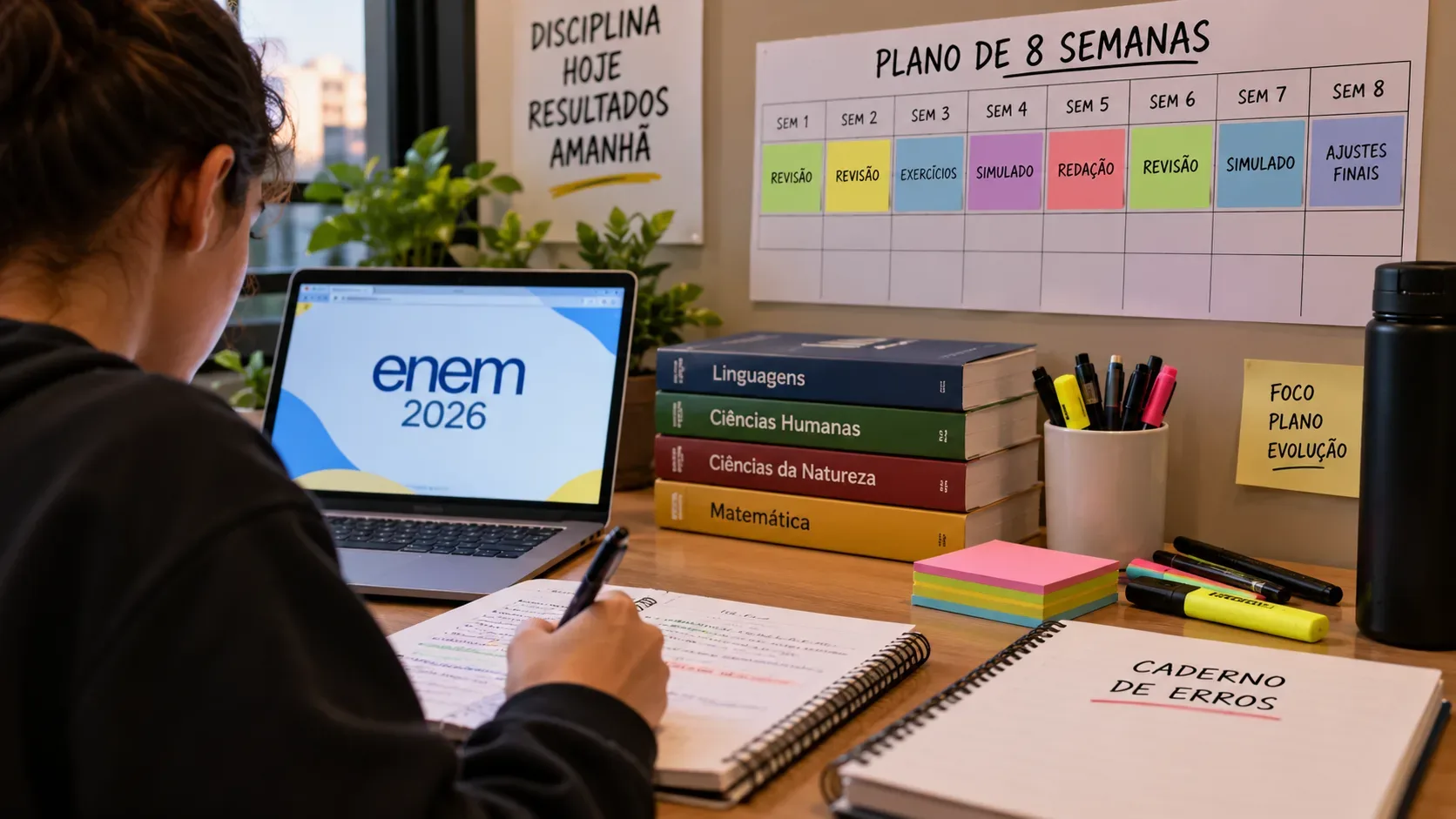
On September 9, 2026, Inep announced that 60 days remained until the first Sunday of ENEM. The regular exam dates are November 8 and 15, 2026. That makes it possible to turn the final stretch into eight weeks of structured work with a simple logic: diagnose, revise by priority, practice questions, write essays, take mock exams every two weeks, and revisit mistakes until they stop recurring.
The plan below uses a cycle from September 14 to November 7. If you start a few days earlier or later, keep the same sequence and shift the dates. The key is not to try to “review everything”: revision should be guided by what matters within the exam competencies and, above all, by what is still lowering your performance.
Before building the schedule: what ENEM 2026 requires
According to Inep, ENEM covers four knowledge areas, totaling 180 multiple-choice questions, plus the essay. The first Sunday includes Languages, the Essay and Human Sciences; the second includes Natural Sciences and Mathematics. The official schedule page confirms the November 8 and 15 dates, and Inep also keeps past exams and answer keys, which should be the main material for your mock exams.
To decide what to revise, use the ENEM Reference Matrix published by Inep in 2026. It organizes cognitive axes, competencies, skills and knowledge objects. Instead of turning the final stretch into an endless list of chapters, use the matrix as a map and your mistakes as a filter.
Three weekly workload options
Choose a workload you can sustain until the exam. The longest version is not automatically the best: if it damages sleep, school, work or consistency, it will usually produce less. On mock-exam weekends, the test replaces part of the normal study blocks; it should not simply be added on top.
| Option | Weekly workload | Suggested structure | Best for |
|---|---|---|---|
| Essential | 8 to 10 hours | 5 short sessions + 1 longer weekend block | Students balancing school, courses or work who need strong prioritization |
| Balanced | 14 to 16 hours | 6 days, with 2 to 3 hours on most days | Students with an established routine who want more practice |
| Intensive | 22 to 24 hours | 6 days, with longer blocks and one recovery day | Students with more available time without sacrificing rest |
As a starting point, allocate about 35% of your time to targeted revision, 35% to questions, 15% to essay work and 15% to error analysis and mock-exam review. In mock-exam weeks, some revision and question time becomes testing and correction time.
Use cycles, not a rigid day-by-day grid
A fixed timetable breaks when you miss a Tuesday and then try to “make everything up.” A cycle is more resilient: you keep a queue of blocks and resume where you stopped.
- Mathematics: key concept, 10 to 20 questions and correction.
- Natural Sciences: rotate Physics, Chemistry and Biology according to your mistakes.
- Human Sciences: History, Geography, Philosophy and Sociology with emphasis on interpretation and connections between topics.
- Languages: reading, interpretation, genres, arts and the foreign language selected in your registration.
- Essay: repertoire, planning, drafting and rewriting.
- Error log: redo questions and recover concepts that remain weak.
In the essential version, do one block at a time and move through the cycle more slowly. In the balanced version, repeat Mathematics and Natural Sciences more often if they are your bottlenecks. In the intensive version, increase the number of blocks, not the number of different topics inside each block.
8-week revision plan
| Week | Dates | Main objective | Deliverables |
|---|---|---|---|
| 1 | Sep 14-20 | Diagnosis and organization | Mini mock by area, list of 10 to 15 weaknesses, 1 diagnostic essay and creation of the error log |
| 2 | Sep 21-27 | High-impact fundamentals | Review the 4 or 5 weakest topics, question sets and Mock Exam 1 at the end of the week |
| 3 | Sep 28-Oct 4 | Fix what Mock Exam 1 exposed | Redo mistakes, review conceptual gaps and write 1 full essay |
| 4 | Oct 5-11 | Second consolidation round | More official questions, time management practice and Mock Exam 2 |
| 5 | Oct 12-18 | Gain speed without losing accuracy | Timed blocks, review of recurring errors and 1 essay with detailed correction |
| 6 | Oct 19-25 | Test exam endurance | Mock Exam 3 under near-real conditions and full correction the next day |
| 7 | Oct 26-Nov 1 | Close gaps, do not open new fronts | Review group A and B topics from the error log, selected questions and 1 final full essay |
| 8 | Nov 2-7 | Reduce workload and recover | Short review blocks, reread key errors, essay repertoire, regular sleep and exam logistics |
The mock-exam cadence is every two weeks until the polishing phase: weeks 2, 4 and 6. In week 8, avoid a full mock if it usually causes fatigue or anxiety. Prefer short blocks with preselected questions and immediate correction.
How to use mock exams so they actually teach you
A mock exam is not just a score. It should reveal three things: knowledge, strategy and endurance. Use past official exams whenever possible and respect the order and timing of the day you are simulating. Inep states that the first day includes Languages, the Essay and Human Sciences and lasts 5 hours and 30 minutes; the second includes Natural Sciences and Mathematics and lasts 5 hours.
Alternate the focus of the three mocks: in the first, prioritize the exam day where you feel less secure; in the second, simulate the other Sunday; in the third, repeat the day that still concentrates more mistakes. Then classify every mistake before studying again. Correction deserves its own study block and can be more valuable than simply solving another full test.
An objective rule for feeding your error log
Do not record every wrong answer. Add a question to the log when at least one of these situations occurs:
- you did not know the concept or procedure;
- you knew it, but misread the instruction, graph, text or unit;
- you chose an inefficient method and spent too much time;
- you got it right through guessing or uncertain elimination and could not reproduce the reasoning.
For each entry, note the area and topic, question source, error type, correct explanation in two or three lines, the “clue” you should have noticed and the date for another attempt. A practical rule is to redo the question or an equivalent one after 48 hours, 7 days and 21 days. If the error returns, it goes back to the revision queue; if it disappears in two consecutive attempts, it can leave the priority list.
Essay: one full piece per week, with correction that creates a task
Write at least one complete essay per week. Students on the balanced or intensive workload can add a second essay in weeks 5, 6 and 7, as long as the correction is high quality. Writing two texts without understanding the problems is usually less useful than writing one, receiving a diagnosis and rewriting weak sections.
At the publication date of this plan, the ENEM Other Documents page still lists the 2025 essay booklet as the most recent available edition. Use the newest version Inep offers when you study. After every correction, turn the feedback into a concrete task for the following week: improve the thesis, organize paragraphs, expand useful repertoire, strengthen cohesion or review standard-language issues.
How to choose what to revise in each area
Create three groups: A for topics you miss often and that appear frequently in past exams; B for medium-strength topics where you have a base but lack consistency; and C for topics where your performance is already stable. Most of the final stretch should go to A and B. Group C stays in maintenance through spaced questions.
Use past questions to confirm priority. If a topic feels “weak” because you dislike it, but you get almost everything right when practicing, it does not need the same time as a topic that repeatedly produces errors. The plan should follow evidence from your performance, not feeling.
What to do in the week between November 8 and 15
The eight-week plan ends before the first Sunday, but ENEM continues. After the November 8 exam, preserve energy for Natural Sciences and Mathematics:
- Monday: rest and organize; avoid spending hours debating answer keys;
- Tuesday to Thursday: priority errors in Mathematics, Physics, Chemistry and Biology, using short question sets;
- Friday: light review of formulas, relationships, graphs and strategies;
- Saturday: minimal workload, sleep and logistics for the second Sunday.
Final checklist for the eight-week stretch
- Choose a sustainable weekly workload and keep one recovery day or period.
- Do official questions every week and mock exams in weeks 2, 4 and 6.
- Write at least one essay per week and turn corrections into specific tasks.
- Use the error log only for mistakes that need to return to your study queue.
- Revisit errors after 48 hours, 7 days and 21 days.
- In week 7, stop opening major new fronts; in week 8, reduce the workload.
- Check the Confirmation Card when it becomes available in the Participant Page and plan your route in advance.
When Inep announced the 60-day countdown, it also emphasized that candidates should follow the Confirmation Card and exam-day instructions. Final preparation works best when studying and logistics move together: less improvisation in the last days leaves more energy to execute what you have trained.