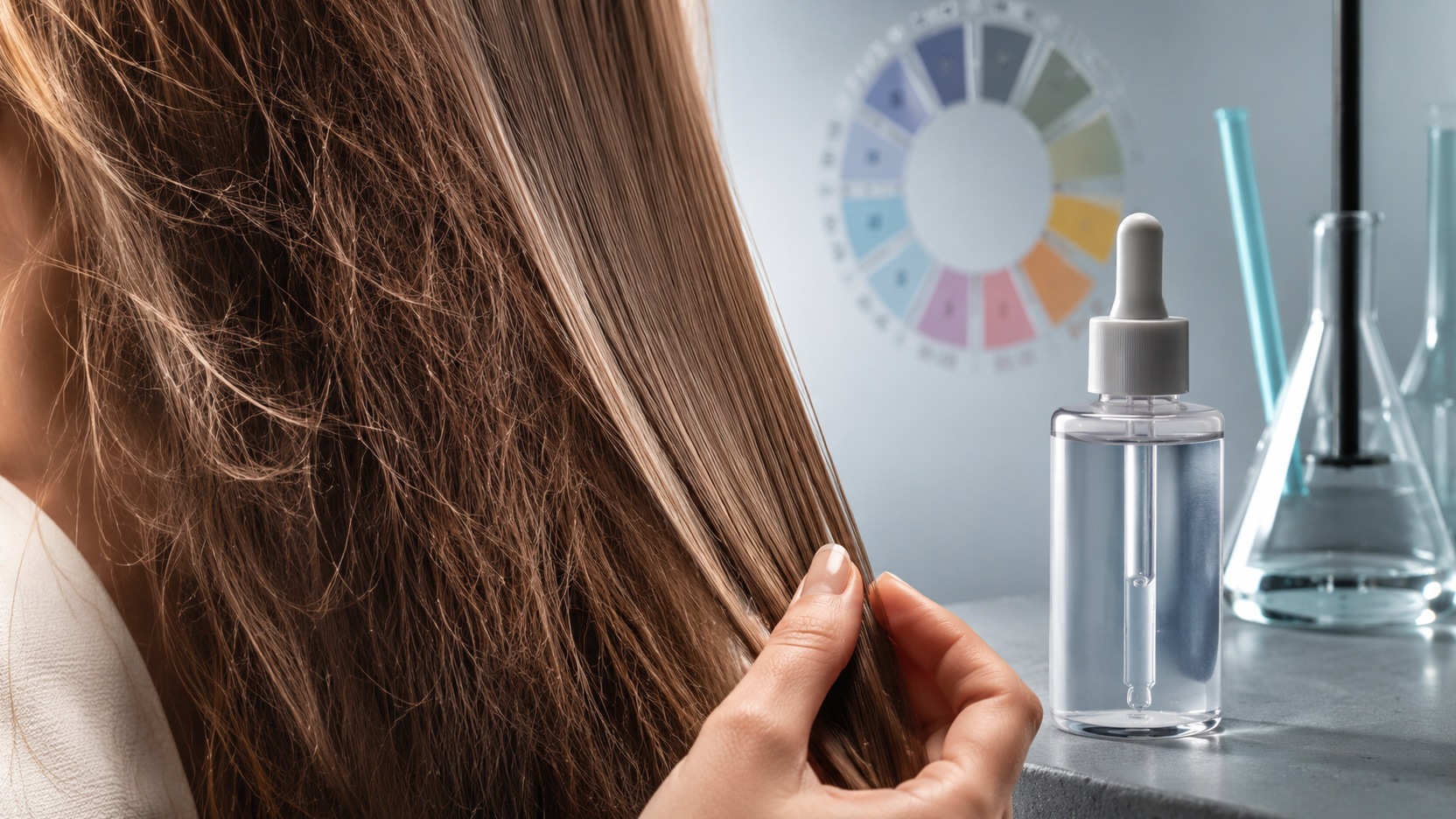
Hair acidifier works, but the correct question is: what does it work for? In a well-made formula, a lower pH product can temporarily alter the behavior of the fiber, reducing some of the swelling associated with alkaline media, changing the surface charge and helping to reduce friction and roughness. This can be perceived as more aligned hair, less tangled and with a smoother feel. The leap that is not supported by the evidence is to transform this cosmetic effect into a universal promise of “repair” of the hair.
The decision to buy an acidifier becomes clearer when you separate three things that are usually mixed: the effect of pH on the fiber, the conditioning effect of the entire formula and the structural damage already caused by bleaching, coloring, straightening, heat or mechanical wear. pH participates in the first part. Conditioning ingredients play a large part in the second. None of these points alone prove that a damaged internal structure was rebuilt.
What pH really changes in hair
The hair strand is a keratin fiber covered by the cuticle, formed by overlapping cells. When fiber is exposed to more alkaline conditions, it tends to absorb more water and swell; the surface may also become more negatively charged. This set increases friction between strands, tangling and wear during combing, especially when the hair has already been sensitized.
This is where the idea that an acidic environment “closes the cuticle” comes from. The expression is useful as a shortcut, but it is oversimplified. The cuticle does not function as a door that opens and closes in a binary manner. Changes in pH alter hydration, charge, interaction between proteins and fiber geometry; in parallel, conditioners can be deposited on the surface, reducing friction and making the cuticular scales visually more settled.
A review published in 2014 on the pH of shampoos concluded, from the available literature, that more alkaline formulas can increase the negative charge of the surface and friction, favoring frizz, tangling and mechanical damage. This reasoning helps to understand why a more acidic step can improve the feel of the thread. It does not mean that the lower the pH, the better.
The study that complicates the promise of “reparation”
A study published in 2020 in the journal Biopolymers evaluated bleached human hair balanced at different pHs. At pH 5, the authors found the best indicators of structural integrity among the conditions studied. At pH 10, there was more water in the fiber and an increase in diameter, consistent with greater swelling. At pH 3, the hair behaved differently, with less water absorption and smaller diameter.
The most important data for the consumer is another: in the pH range 3 to 10, the study found no change in the mechanical resistance to breakage of bleached hair, neither dry nor wet. This overturns a common interpretation. Changing pH can change relevant physical properties and even improve appearance or handling, but it is not correct to use this effect as automatic proof of strengthening or structural reconstruction.
There is also an essential limitation: this was a laboratory pH balance experiment, not a test of a commercial acidifier used for a few minutes in the bath. Evidence shows that the chemical environment matters for fiber; it does not allow declaring that any product called “acidifier” will produce the same result.
When an acidifier is more likely to add something
The step makes more sense when there is a context compatible with the function expected of it. The most obvious case is hair that has become rougher, swollen, difficult to untangle or has greater friction after chemical procedures, especially those involving alkaline or oxidative steps, such as bleaching and many permanent colors.
These processes do not just cause a momentary change in pH. Discoloration, for example, can damage cuticle and cortex, alter surface lipids, and reduce mechanical properties when damage accumulates. Therefore, an acidifier can improve the surface behavior of a sensitized thread without undoing the damage that has already occurred. This distinction is at the heart of the decision.
Another plausible scenario is a routine in which the hair remains excessively rough or tangled even with adequate cleaning and a conditioner that, alone, does not provide good glide. In this situation, testing an acidifying step may be reasonable, as long as the product has clear instructions and the result can be evaluated on the hair itself, without turning the step into a permanent obligation.
When it's probably one step too many
If your hair is soft, detangles well, has not undergone significant chemicals and responds well to the conditioner or mask you already use, there is no strong reason to add an acidifier just because the category has become popular. The absence of product does not, in itself, create a “pH imbalance” that needs to be corrected every time you wash.
There may also be redundancy when the conditioner or mask already provides low friction, good alignment and softness. Physical-chemical reviews of hair care show that conditioners act precisely by depositing cationic and film-forming agents on a surface that tends to be negative, which reduces static electricity, friction and the force required for combing. Many conditioning formulas still operate in the slightly acidic range.
In this case, adding an acidifier may change little. The name “acidifying” on the packaging does not alone inform the final pH, buffering capacity, conditioning agents present, effective concentration or performance after rinsing. Two products with the same category label can behave very differently.
Acidifier, acid mask and conditioner are not synonymous
PH is just one variable in the formula. A conditioner can be slightly acidic and, at the same time, have cationic surfactants, fatty alcohols, silicones, polymers or other agents that modify touch and friction. A mask can combine the same type of conditioning with a greater load of emollients. An acidifier may be simpler and focus on exposure to a lower pH, or it may be a complex formula with similar conditions.
Therefore, comparing just the word on the front of the label is uninformative. To decide whether the new stage makes sense, it is worth observing what the current routine is not solving. If the problem is detangling, a good conditioner may be more important than chasing the lowest pH. If the thread has been sensitized by chemicals, the acidifier can be a surface management tool, but the rest of the routine needs to reduce new sources of mechanical, thermal and chemical damage.
“Acidic” does not automatically mean gentle or repairing
There is another frequent confusion: placing an acidifying rinse and straightening procedures called “acids” in the same group. They are not equivalent. Straightening treatments with very low pH, whether or not combined with intense heat, involve another chemical and can alter the fiber significantly. Just because a process is acidic does not make it benign.
The useful rule is to think about dose, formulation, contact time and purpose. A short cosmetic exposure formulated for conditioning cannot be evaluated with the same logic as a chemical process intended to permanently or semi-permanently modify the shape of the hair.
The order and frequency depend on the product
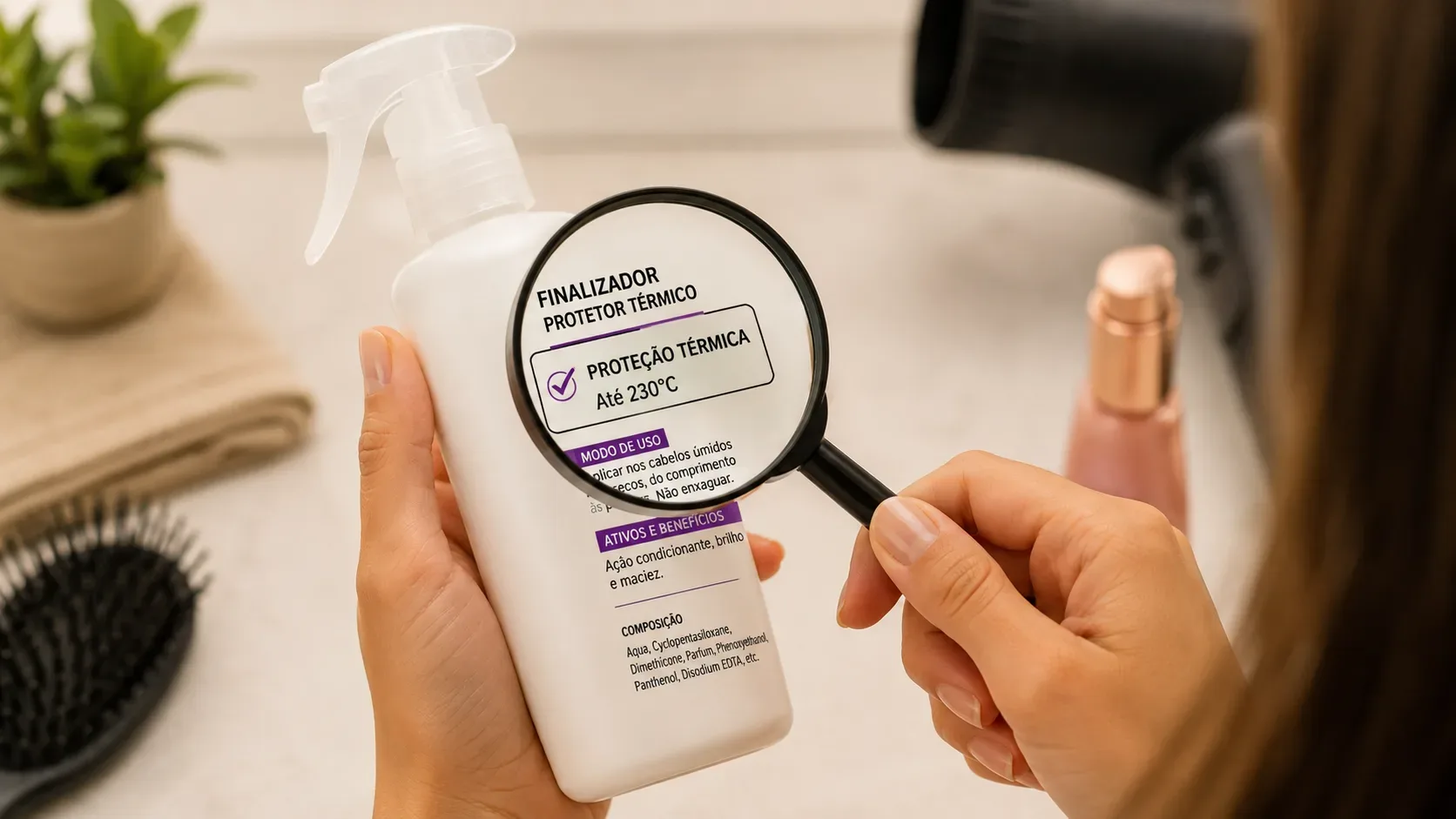
There is no universal sequence that works for every acidifier. Some are recommended for use after shampoo and before mask or conditioner; others already combine a conditioning function and ask for another fit into the routine. The safest recommendation is to follow the specific formula usage mode, rather than copying a social media order for any product.
The same caution applies to frequency. If the benefit appears only after chemistry or in periods of greater hardship, there is no clear advantage in transforming use into a strict schedule. Repeating more times does not guarantee greater results. The hair's sensory response and the manufacturer's instructions are more useful references than the idea of “acidifying” out of obligation.
In professional procedures that require chemical neutralization, the routine cosmetic acidifier should not replace the neutralizer provided by the technical system. Neutralizing a chemical reaction and using a care product with an acidic pH are different tasks.
Signs that it is better to stop and reevaluate
Burning, persistent itching, redness or other irritation of the scalp are reasons to stop contact with the product and rinse. Hair cosmetics can cause irritation or allergies due to different components of the formula; it is not possible to attribute a reaction to pH alone without evaluation.
In terms of length, the ruler is practical. If after a few applications the hair becomes more difficult to untangle, with a progressively worse touch or with a noticeable increase in breakage during manipulation, the step is not fulfilling its objective. In this case, discontinuing the product and simplifying the routine usually produces better information than adding another treatment on top.
What an acidifier doesn't prove to repair
Brightness, softness and less friction are legitimate cosmetic results. The problem arises when they are used as a synonym for rebuilding the cortex, recovering chemical bonds or reversing oxidative damage. Research on damaged hair measures different properties precisely because appearance, friction, tensile strength, protein loss, cuticle structure and thermal behavior are not the same thing.
A thread may appear smoother because the surface has been better conditioned and yet still remain structurally damaged. This does not make the product useless; it just puts the promise in the right place. In hair, reducing friction can be valuable, because combing and brushing a rough fiber increases the accumulated mechanical wear.
A simple matrix to decide
Freshly bleached hair, rough and tangling more
There is a reasonable justification for testing an acidifier because the prior chemistry and increased friction make the mechanism relevant. The realistic objective is to improve surface, sliding and handling. Don't expect this step to reverse the internal damage of discoloration on its own.
Hair with color or chemicals, but already soft with the current routine
Chemical history increases the possibility of benefit, but does not create an obligation. If conditioner, mask and heat reduction already control roughness and breakage, adding an acidifier may be redundant.
Hair without chemicals and no complaints of roughness
The step is less likely to solve an important problem. Buying the product just to “correct the pH” tends to be a decision based more on category than observable need.
Acidifying product worsens touch or irritates
Don’t insist on “your hair getting used to it”. Stop, check the method of use and review the formula or the need for the step. If there is a persistent reaction on the scalp, seek dermatological evaluation.
The best question before buying
Instead of asking if acidifier “works”, ask what specific problem you want to solve and whether it is still present after a simple cleaning and conditioning routine. pH influences fiber, especially when there is damage and previous alkaline exposure. But the effect of a product depends on the entire formula, the contact time, the condition of the hair and what is already in your routine.
If the hair is sensitized and rough after chemical treatment, an acidifier can be a useful step to improve surface behavior. If your hair is already soft and manageable with conditioner or mask, it may not add anything noticeable. The most solid criterion is not the promise of “sealing”, but rather the combination of a plausible mechanism, a real problem and an observable result without worsening the hair or scalp.