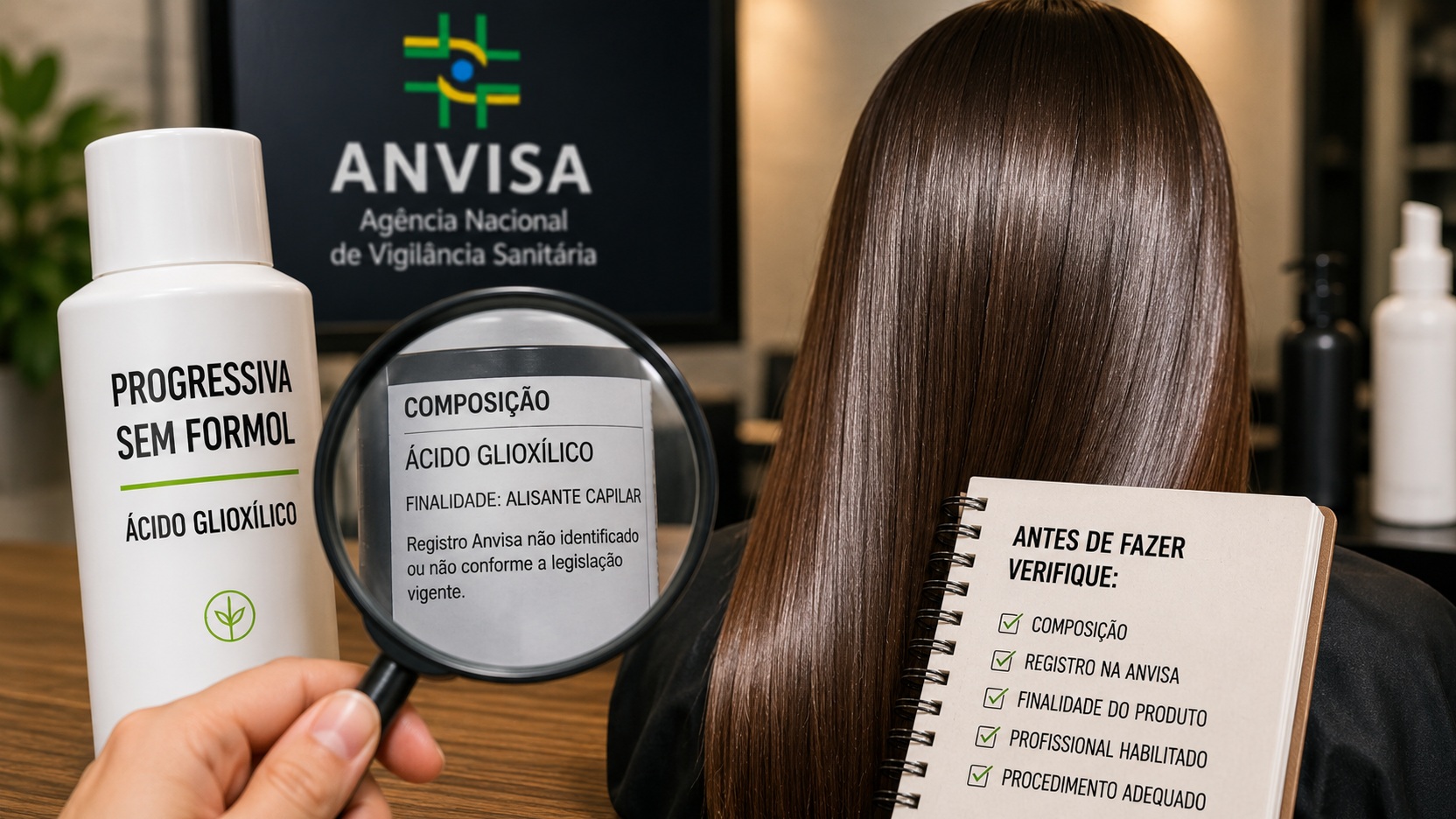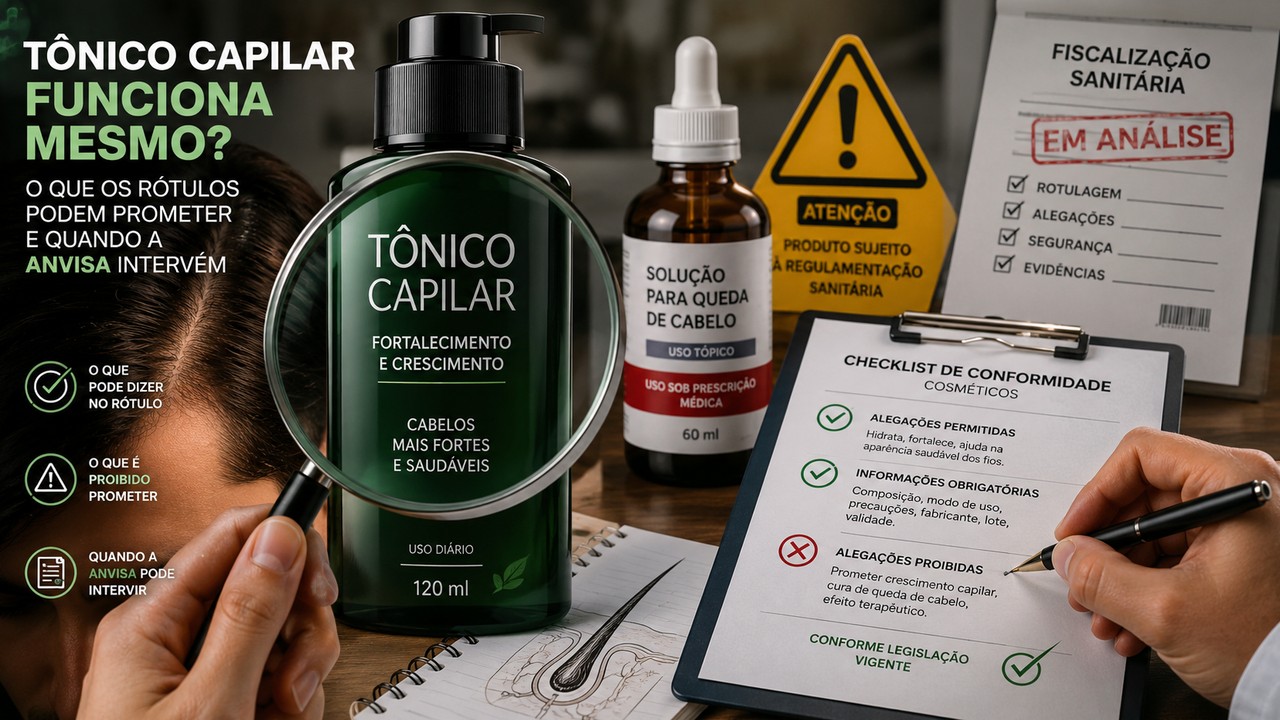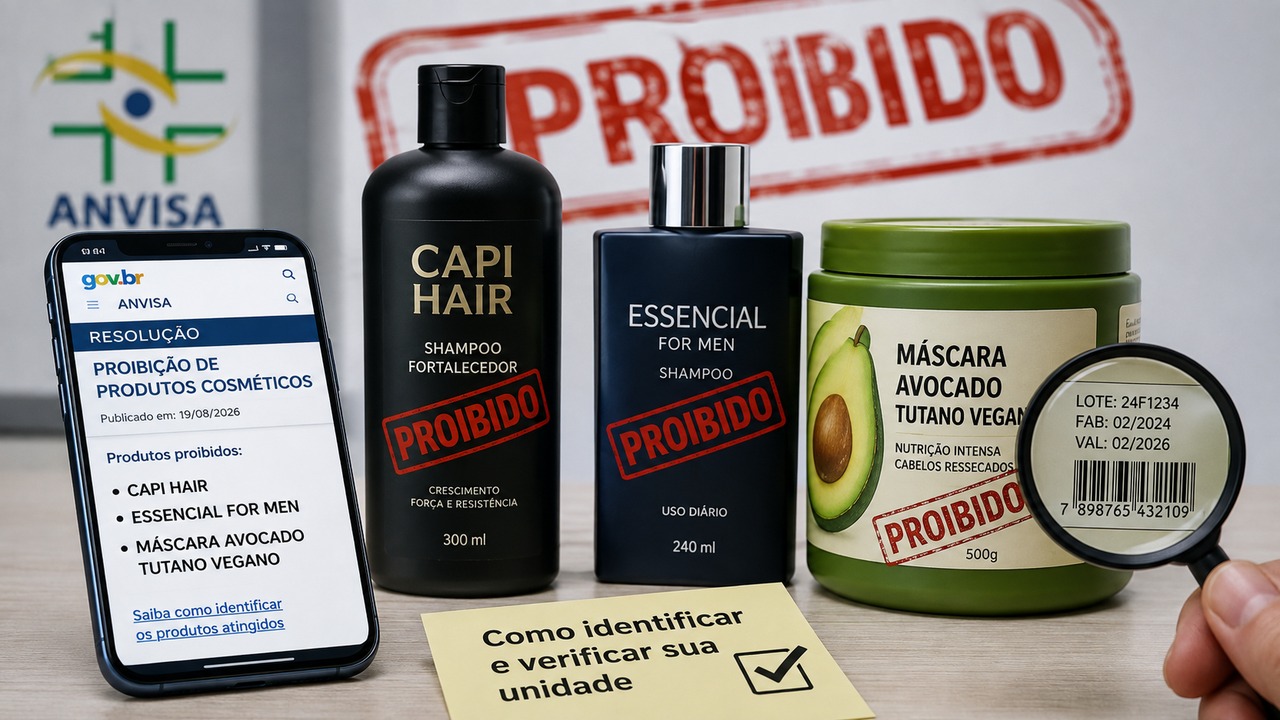
A hair cosmetic does not necessarily need to display a registration number to be regularized. Shampoos and conditioners, for example, are normally exempt from registration and undergo prior communication, also called notification. Products for straightening or curling hair require registration.
Hair ointment intended to fix or style hair without rinsing requires a third level of attention: while the temporary rule of RDC 814/2023 is in force, the reference indicated by Anvisa is the specific list of authorized ointments, and not just the common cosmetic consultation.
Therefore, a missing result in the search for “registered products” is not enough, alone, to classify a shampoo or conditioner as irregular. Before searching, you need to identify the category and enter the corresponding query.
First, choose the right query
RDC 907/2024 determines that straighteners, products for straightening and dyeing and products for curling hair are subject to registration. Groups that do not appear in this list are, as a rule, exempt from registration and subject to prior communication to Anvisa.
| Hair product | Form of regularization or consultation | Where to look |
|---|---|---|
| Shampoo | Exempt from registration, with prior communication | Registration-exempt cosmetics consultation |
| Conditioner | Exempt from registration, with prior communication | Registration-exempt cosmetics consultation |
| Smoothing or waving | Registration required | Consultation of registered cosmetics or official list of straightening and curling products |
| Leave-in pomade for setting or styling | Specific rule while RDC 814/2023 is in force | List of authorized ointments |
The exception of pomades covers leave-in products intended to fix or style hair whose declared physical form is “pomade” or that present this term, including in another language, in the name or labeling. Anvisa informs that, while RDC 814/2023 is in force, only the products on the specific list are authorized and the ordinary consultation should not be used as the only reference.
Suggested capture 1: “Cosmetics consultation” page, showing the two official options: registered and exempt from registration.
What data to remove from the packaging
Before opening the consultation, photograph the packaging and separate it:
- full name and brand of the product;
- regularization process number;
- CNPJ of the title company;
- corporate name of the company;
- batch and expiration date.
The process number usually starts with 25351 and is the preferred data for the search because it reduces the chance of confusing products with similar names. Current regulations require that the process number, CNPJ and company name of the holder appear on the secondary packaging or, when it does not exist, on the primary packaging.
The registration number, on the other hand, is not mandatory on the labeling of all cosmetics. The absence of this expression on the bottle, therefore, does not prove irregularity.
Step by step to consult by process, name or CNPJ
1. Enter through the official Anvisa page
Start on the “Cosmetics consultation” page of the Aesthetics with Safety campaign. It works as a gateway for inquiries about registered products and products exempt from registration.
Avoid relying on links sent by sellers or images of old results. The official guidance pages were updated on April 27, 2026, and the general Inquiry System page was updated on May 17, 2026.
2. Identify the actual function of the product
Don't just be guided by promotional words like “botox”, “sealing”, “volume reducer”, “realignment” or “treatment”.
Read the instructions for use and the purpose stated on the label. If the product promises to modify the chemical structure of the hair, straighten, relax or curl with an effect that remains after rinsing, it must be treated as a straightener or curler and must be registered. Anvisa warns that a straightener that has only been notified remains irregular, even if it has a process number printed on the packaging.
3. Open the corresponding modality
For shampoo and conditioner, select the registration-exempt cosmetics inquiry.
For straightening or curling, use the registered cosmetics consultation or the official list indicated in the specific straightening and curling product campaign.
For leave-in ointment intended for setting or styling, open the list of authorized ointments. Don't consider it enough to find an old notification in the common query.
Suggested capture 2: initial screen of the chosen modality, before filling in the fields.
4. Search first by case number
Enter the process exactly as it appears on the package. A common format is:
25351.XXXXXX/20XX-XX
Searching by process tends to be more precise than searching by name. If the system does not accept the punctuation, try just the numbers, without adding spaces or words.
Fictional example: 25351.XXXXXX/2026-XX. This number is only used to demonstrate the format and does not correspond to an actual product.
5. Repeat the name search
If the process returns no result, search for the full name and then for a distinctive part of the name.
Consider possible differences in accentuation, abbreviation, word order or brand update. A product may be registered by regulatory name, which does not always coincide exactly with the most prominent part of the packaging.
Don't stop at the first similar name. Open the result and compare the process, the CNPJ and the title company.
6. Do a third search for CNPJ
Search for the CNPJ of the company responsible for the product and check the items linked to it.
This step helps detect situations where the name is spelled differently or appears on multiple lines. It also allows you to check whether the CNPJ of the result is the same as that printed on the packaging.
Finding the company is not enough: the specific product also needs to appear in the correct modality.
7. Open result details
Anvisa's guidance is to click on the result to access the details. Compare, at a minimum:
- product name;
- process number;
- CNPJ and company name;
- category or group;
- product status.
Joint comparison is safer than checking just the tag. Different products may use similar names, and suspicious packaging may copy data from a company or other regulated item.
Suggested capture 3: details page, with the name, process, CNPJ and situation visible. Hide personal data that may appear outside the public record.
8. Register verification
Take a screenshot of the details page and save:
- date of consultation;
- searched name and process;
- situation displayed;
- official page address;
- invoice or proof of purchase;
- photo of packaging and batch.
Situation may change after purchase. Keeping these records makes it easier to file a complaint with the seller, the manufacturer, health surveillance or Anvisa itself.
How to interpret “active”, “inactive” and “no result”
Active product
In Anvisa's guidance, “active” means that the product is regularized and that its manufacture, import and commercialization are permitted. Still, check that the result data corresponds to the item in your hands.
The active status confirms the regulatory status of the registration at the time of the query. It does not alone guarantee that a physical drive is authentic, has been stored correctly, or has not been tampered with.
It also does not allow us to conclude that the cosmetic will have the expected effect on everyone. The consultation teaches about regularization, it does not evaluate individual performance, suitability for hair type or risk of personal reaction.
Inactive product
“Inactive” means that the product is no longer regularized. According to Anvisa, this may occur due to cancellation requested by the company, expiry or identified irregularity. Manufacturing and import are no longer permitted.
Inactive status does not automatically mean counterfeiting or fraud. You need to open the details and look at the available reason. When making a purchase or use decision, follow the official recommendation to only use products that are regular and active.
No results found
The lack of results needs to be investigated before making any conclusions. The most common causes are:
- choosing the wrong modality;
- typing error;
- difference between the commercial name and the registered name;
- incomplete process;
- CNPJ from a different manufacturer than the holder;
- product subject to a specific list, such as certain hair ointments;
- product effectively not regulated.
Redo the search by process, name and CNPJ. Also confirm whether the item is a straightener, notified cosmetic or ointment submitted to the special list.
If there is no match after these checks, do not buy or use the product until you obtain clarification from the company or Anvisa. Also consult the database of irregular and counterfeit products, as it brings together inspection measures and items identified due to problems such as lack of regularization, counterfeiting or quality deviation.
Three fictitious examples of query choice
Clara Brisa Shampoo
The label presents a process number starting with 25351, CNPJ and the purpose of cleaning the hair. The correct query is cosmetics that are exempt from registration.
Not finding this shampoo in the search for registered products does not demonstrate irregularity, as common shampoos follow the prior communication route.
Smooth Line Straightener
The method of use informs a change in the hair structure and a long-lasting smooth effect after rinsing. The query must be made among the registered products or in the official list of straighteners and curlers.
If the item appears only as a notified product, the regularization is incompatible with its purpose. Anvisa expressly states that notified straighteners are irregular.
Firm Trace Ointment
The product remains in the hair and is intended for fixing or styling. The main check must be carried out on the list of authorized ointments, crossing name, process and CNPJ.
A similar tag in the list is not enough. The three data points must correspond to the packaging analyzed.
All names and numbers in these examples are fictitious and do not represent reviews of real products.
What Anvisa’s consultation proves — and what it doesn’t prove
The query allows you to check:
- if there is a corresponding public registry;
- whether the product is active or inactive;
- which company and CNPJ appear as holders;
- which process number is associated with the item;
- if the category found is compatible with the expected type of regularization.
The result does not prove, in isolation:
- authenticity of the unit purchased;
- integrity of the seal or batch;
- equality between the real formula and the registration;
- adequate storage by the seller;
- effectiveness for specific hair;
- absence of allergy, irritation or other adverse event.
The Consultation Portal itself informs that public data is made available by Anvisa, but some documents, such as labels and instructions for use, originate from files sent by companies. The product remains subject to audit, inspection and monitoring after regularization.
Before completing your purchase
Compare the official result with the packaging and do not proceed when there is a discrepancy in name, process, CNPJ or category. In straighteners and fixing or modeling ointments, pay extra attention because an incompatible notification can be used to create the appearance of regularity.
Make the inquiry as close as possible to purchase or use. Save the result capture, product photos and invoice. If falsification, irregularity or adverse reaction is suspected, discontinue use and use the official health surveillance service or notification channels.