
“Anti-residue,” “clarifying” and “chelating” are not three closed categories that, by themselves, guarantee three standardized effects. In Brazil, Anvisa lists “shampoo” and some variants with specific benefits within the regulatory classification of cosmetics, but it does not create separate product types called anti-residue, clarifying or chelating. The commercial name should therefore be read together with the benefit claim, the ingredient list and the directions for use.
In practice, anti-residue and clarifying often overlap: they generally indicate more intensive cleansing to remove oil, styling-product buildup and other deposits that can be washed away by surfactants. Chelating is a more specific chemical description: the formula contains an agent capable of binding metal ions, as occurs with EDTA and its salts. Even so, spotting a chelator in the ingredient list does not, by itself, tell you how much mineral deposit the product will remove from hair.
Quick comparison: what each label usually means
| Label term | Most common function | What to look for to confirm it | Limit of the term |
|---|---|---|---|
| Anti-residue | More intensive cleansing of oil and product buildup | Claims about removing residue, buildup, oil or deep cleansing, plus directions for use | Does not tell you by itself which residues are removed or how strong the cleansing system is |
| Clarifying | Cleansing buildup and a coated or weighed-down feel | The same signals as anti-residue: stated benefit, cleansing system and instructions | May be virtually a commercial synonym for anti-residue in one brand and a different formula in another |
| Chelating | Interaction with metal ions and mineral deposits | A claim related to hard water, minerals or metals and the presence of chelating agents such as EDTA or its salts | The presence of the ingredient does not reveal concentration, contact time or final formula performance |
What really differentiates the formula
1. Surfactants do most of the ordinary cleansing
Shampoo cleans mainly through surfactants, molecules that help detach oil, dirt and deposited materials so they can be rinsed away. Dermatology reviews show that surfactant systems vary widely in cleansing power and in their potential to leave hair feeling dry. For that reason, a single label phrase such as “sulfate-free” should not automatically be treated as a synonym for either mild or strong cleansing.
A product sold as anti-residue or clarifying may use a more efficient cleansing system to remove product buildup, but the result depends on the whole formula. Conditioning ingredients, surfactant concentration, pH and directions for use also change how the hair responds.
2. Chelators have a different chemical function
Chelating agents bind certain metal ions. PubChem, a database maintained by the National Center for Biotechnology Information, lists Disodium EDTA as a cosmetic ingredient with a chelating function. This helps explain why EDTA and related salts appear in formulas that refer to minerals or hard water.
This mechanism is different from simply increasing detergent strength. A shampoo can be very effective against oil and styling-product residue and still have no strong mineral-removal positioning. The reverse is also possible: one formula can combine surfactants and chelators, addressing ordinary buildup and mineral deposits in the same wash.
It is also important not to turn “contains EDTA” into proof that a product is a powerful chelating treatment for hair. Chelating ingredients can also help stabilize the formula itself, and the ingredient list does not tell consumers the concentration or the performance of the complete system. The manufacturer’s specific claim and instructions complete the picture.
Label checklist: how to tell what the product actually claims
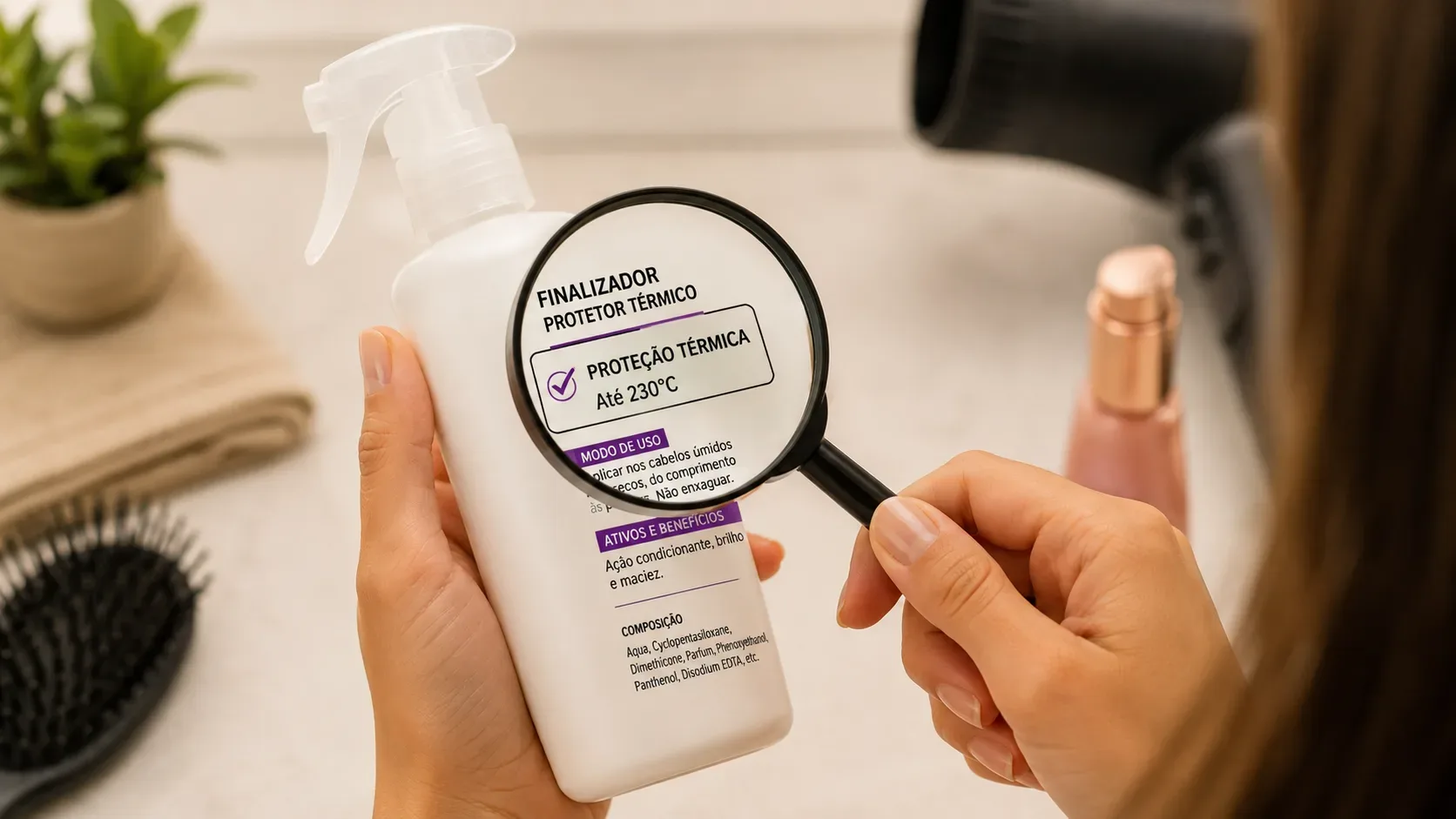
- Start with the benefit claim. Look for concrete statements such as “removes product buildup,” “deep cleansing,” “removes hard-water minerals” or “helps remove metals.” Broad terms such as “detox,” “reset” and “purifying” say less when they do not identify the target.
- Read the ingredient list. For a chelating proposition, EDTA and its salts are relevant clues. For clarifying or anti-residue cleansing, the surfactant system matters more than hunting for one ingredient.
- Read the directions for use. If the brand recommends occasional use, a contact time, a repeated application or specific aftercare, those instructions are part of the product’s intended use.
- Check warnings and the intended user. Bleached, very porous, dry hair or a sensitive scalp may respond poorly to aggressive washing. Follow the label, and remember that more cleansing does not necessarily mean a better result.
- Check regulatory status when in doubt. Anvisa provides a public cosmetics search and requires labeling information, including ingredients, directions for use when applicable and claims related to product benefits.
When the label name misleads
The issue is not the existence of these commercial terms, but treating them as universal technical specifications. “Clarifying” may name an intensive cleanser with no mineral focus. Another product with the same label may include a chelator. “Anti-residue” may describe a strong occasional-use formula or simply a more efficient cleanser within a brand’s range.
Brazilian regulation itself helps put the name in perspective. RDC 752/2022 treats shampoo as a product type and requires labeling not to mislead or cause confusion about properties, composition, intended use or safety. Anvisa’s labeling guidance also treats benefit claims and composition as relevant product information. In other words, the useful question is “what does this specific product claim and contain?”, not “which large word is printed on the front?”.
Which one makes sense in each situation?
- Styling-product buildup, oils and a weighed-down feel: look for a clear claim about residue removal or deep cleansing. Anti-residue and clarifying products may address the same need, depending on the formula.
- Suspected hard-water deposits: prioritize a product that specifically claims action on minerals or metals and has a coherent chelating system. A small experimental study found more magnesium deposition on hair exposed to hard water for three weeks, but no statistically significant difference in surface damage under scanning electron microscopy. That is a useful reminder that “hard water” should not automatically be blamed for every case of dryness, breakage or dullness.
- Routine washing without obvious buildup: there is no universal benefit to always choosing the strongest cleanser. The American Academy of Dermatology recommends washing according to how oily or dirty the hair becomes and applying shampoo mainly to the scalp to reduce unnecessary drying of the lengths.
- Very dry, bleached or fragile hair: pay extra attention to the directions. Stronger cleansing systems may increase the feeling of dryness, especially when used more often than necessary.
There is no universal “detox” schedule
A fixed rule such as “clarify every week” or “chelate once a month” ignores differences in formula, the amount of styling products used, wash frequency, hair characteristics and water composition. A safer starting point is to use the product for an identifiable problem and follow the manufacturer’s directions rather than creating an intensive routine because of the bottle name.
If a stronger cleanser consistently leaves hair rough, tangled or brittle, increasing the frequency is usually a poor response. Reducing use, reviewing the rest of the routine and choosing a cleansing system compatible with the hair may make more sense.
When a persistent problem calls for a routine review or professional evaluation
Persistent itching, burning, sores, marked flaking, hair loss or breakage that continues despite simple routine changes should not be managed only by switching among “detox,” anti-residue and chelating products. The American Academy of Dermatology advises working with a dermatologist for hair and scalp conditions. In these situations, repeatedly escalating cleansing strength can delay identification of the cause and increase irritation or dryness.
Practical summary: anti-residue and clarifying usually describe a deeper-cleansing proposition; chelating describes a chemical function aimed at metal ions. But the label becomes useful only when you combine four pieces of information: the specific claim, ingredient list, directions for use and the problem you are trying to solve.
Sources and references
- Anvisa: Concepts and definitions for personal care products, cosmetics and perfumes
- Anvisa: Cosmetics labeling
- American Academy of Dermatology: Tips for healthy hair
- PubChem: Disodium EDTA
- International Journal of Trichology: Pro and Contra of Cleansing Conditioners
- International Journal of Trichology: Scanning electron microscopy study of hair shaft changes related to hardness of water