Hard water can contribute to a persistent change in how hair feels, handles and behaves because calcium and magnesium in the water can associate with the hair fiber. That does not, however, turn every case of dryness, frizz or heavy-feeling hair into a “diagnosis” of mineral buildup. The best decision starts by separating three things: the hardness of the water, the type of residue that may be on the hair, and what your cleansing product was actually formulated to remove.
The literature does not support a simple statement such as “hard water always damages hair.” Studies confirm mineral uptake and deposition, especially under certain hair conditions, but disagree on how much this changes structure and strength. In practice, it makes more sense to treat hard water as a testable hypothesis than as an automatic explanation for every hair change.
What hard water is - and why it matters for hair
Hardness is a measure linked mainly to dissolved calcium and magnesium ions in water. A classification widely used by the U.S. Geological Survey considers water with up to 60 mg/L of hardness, expressed as CaCO3, soft; 61 to 120 mg/L, moderately hard; 121 to 180 mg/L, hard; and above 180 mg/L, very hard.
Those numbers describe the water, not the condition of your hair. They help establish whether plausible exposure exists. Hard water also tends to leave clues outside the hair itself: whitish scale on faucets and showerheads, deposits on surfaces and greater difficulty producing lather are signs compatible with high hardness. A 2025 study on cosmetic foams found a substantial loss of shampoo-foam stability in hard water, reinforcing that water can change the washing experience without, by itself, proving damage to the hair fiber.
If you live somewhere with a public water supply, the first step is to look for a water-company report that gives total hardness in mg/L as CaCO3. If that figure is not available, titration kits or test strips can estimate hardness at home. Some tests use “grains per gallon”; as a reference, 1 grain per U.S. gallon corresponds to approximately 17.1 mg/L as CaCO3.
Hair symptoms do not confirm mineral buildup
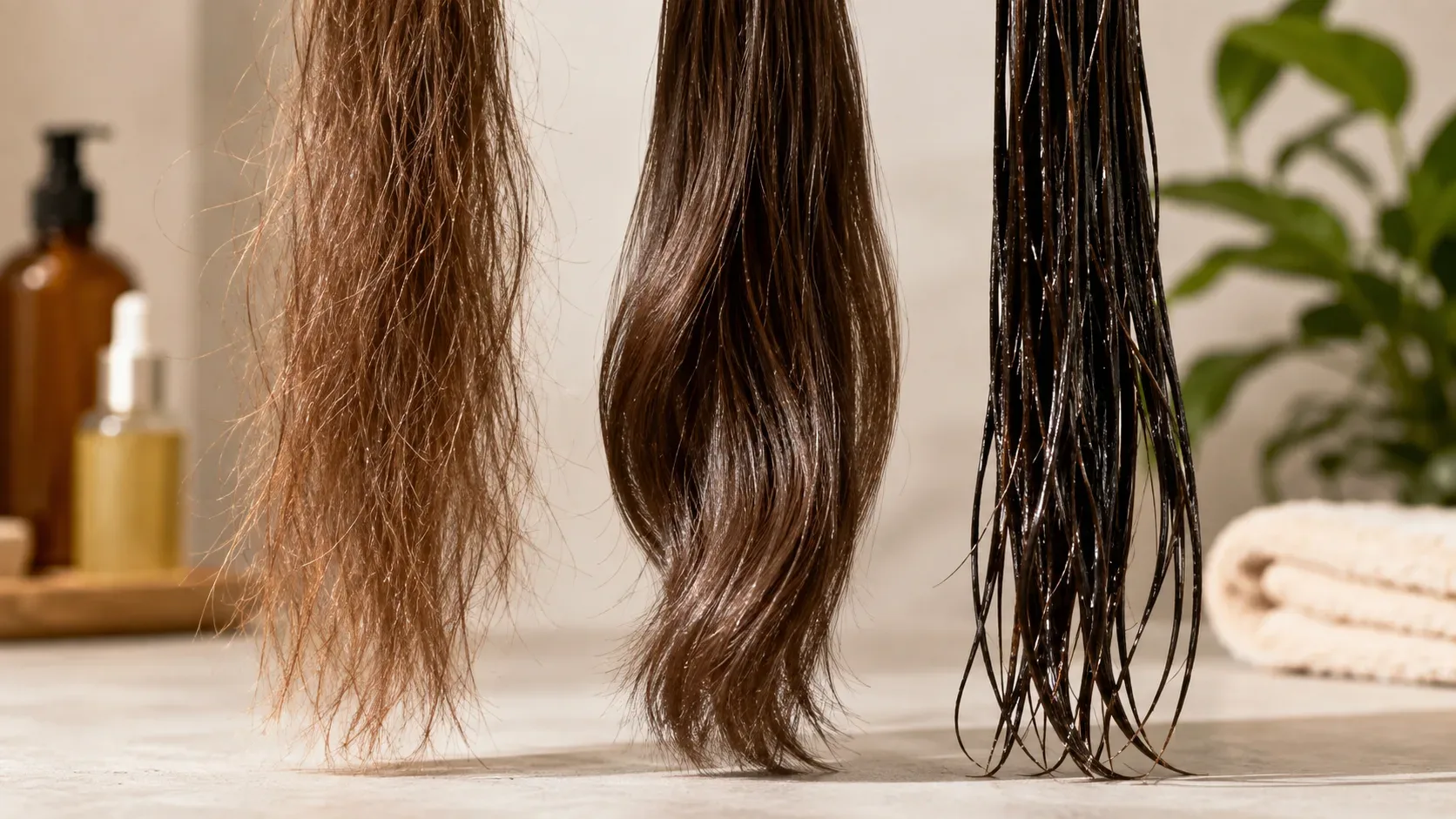
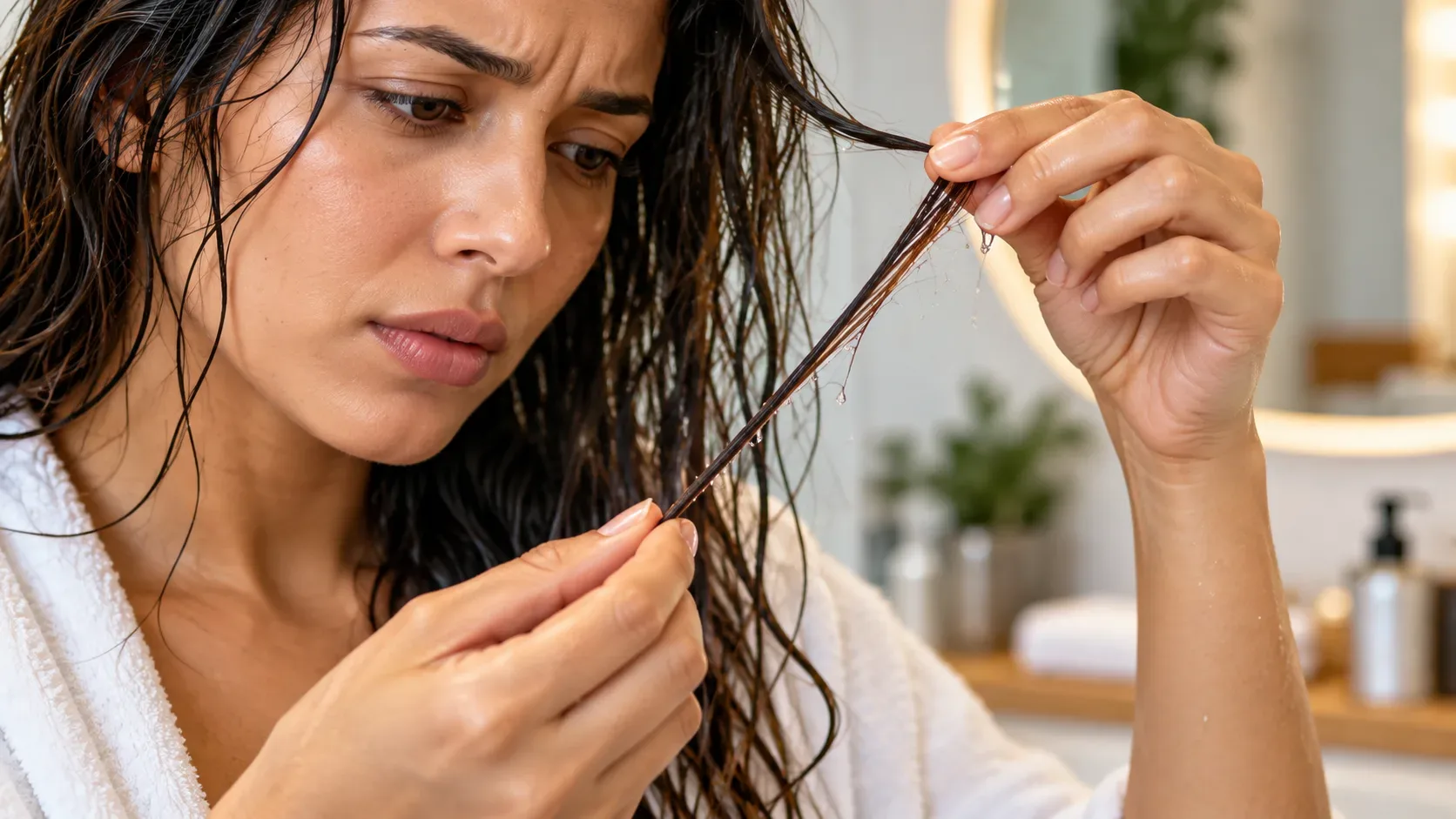
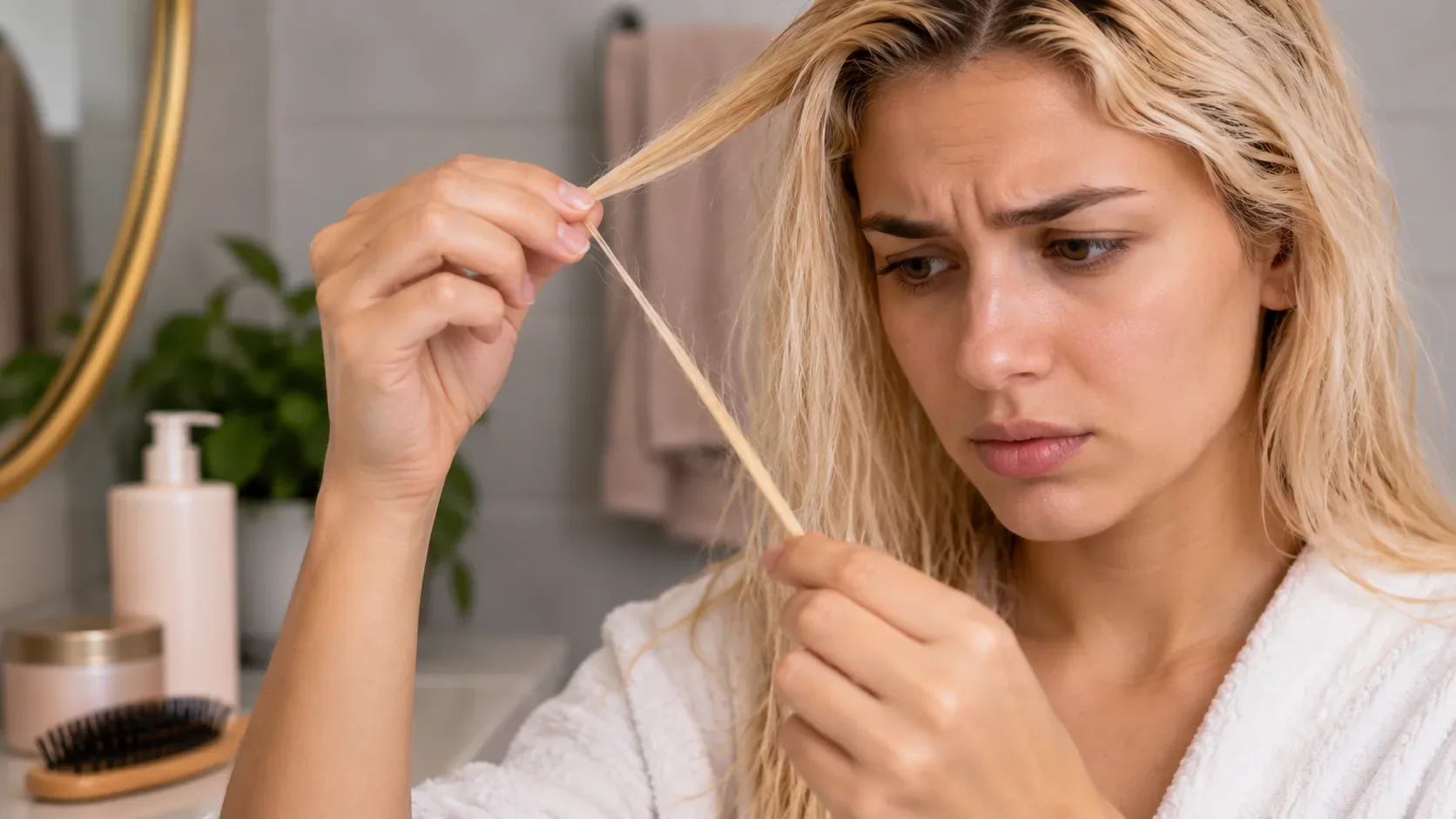
Hair that feels rougher, duller, stiffer, more prone to tangling, heavier, or that responds differently to conditioners can be compatible with mineral deposits. The problem is that the same signs can appear with excess styling polymers, silicones, oils, conditioner residue, insufficient cleansing, heat damage, bleaching and other changes to the fiber.
That is why the best clue is not a single symptom but a coherent set of clues. The hard-water hypothesis becomes stronger when the change began after moving to another city, building, well or water source; when visible mineral scale appears in the bathroom; when a test shows high hardness; and when the altered feel persists despite a washing routine that used to work.
It is also important to separate buildup on the lengths from scalp signs. True hair loss from the root, bald patches, progressive thinning, pain, burning, intense itching, significant flaking or inflammation should not automatically be attributed to the water. The American Academy of Dermatology emphasizes that hair loss and breakage have many causes and that scalp symptoms can indicate conditions that need dermatologic evaluation.
What the studies show - and why they seem to contradict one another
In 1999, researchers showed that human hair can take up calcium and magnesium from waters in different regions and that this uptake varies with hardness and pH. In 2011, another study showed that hair condition is an even more important factor: chemically damaged hair had a greater capacity to take up metals associated with hardness, even in relatively soft water. The same group found increased fiber stiffness with higher calcium and magnesium content, showing that “mineral in the hair” does not necessarily translate into a single form of damage.
Tests of strength do not all point in the same direction either. A 2013 study found no statistically significant difference in tensile strength or elasticity between hair exposed to hard water and distilled water for 30 days. In 2015, an electron-microscopy analysis found more calcium and magnesium deposits and a more irregular surface appearance in hair treated with hard water. In 2017, a similar study found greater magnesium deposition but no significant difference in the degree of structural alteration observed under the microscope. A 2018 study, however, found a significant reduction in tensile strength in hair treated with hard water.
The safest synthesis is this: mineral deposition is plausible and measurable; the hair's previous condition influences how much it takes up; and the mechanical consequences vary with the method, the water, exposure time and the state of the fiber. That is very different from saying that all hard water “destroys” hair.
Regular, clarifying or chelating shampoo: what problem each one is trying to solve
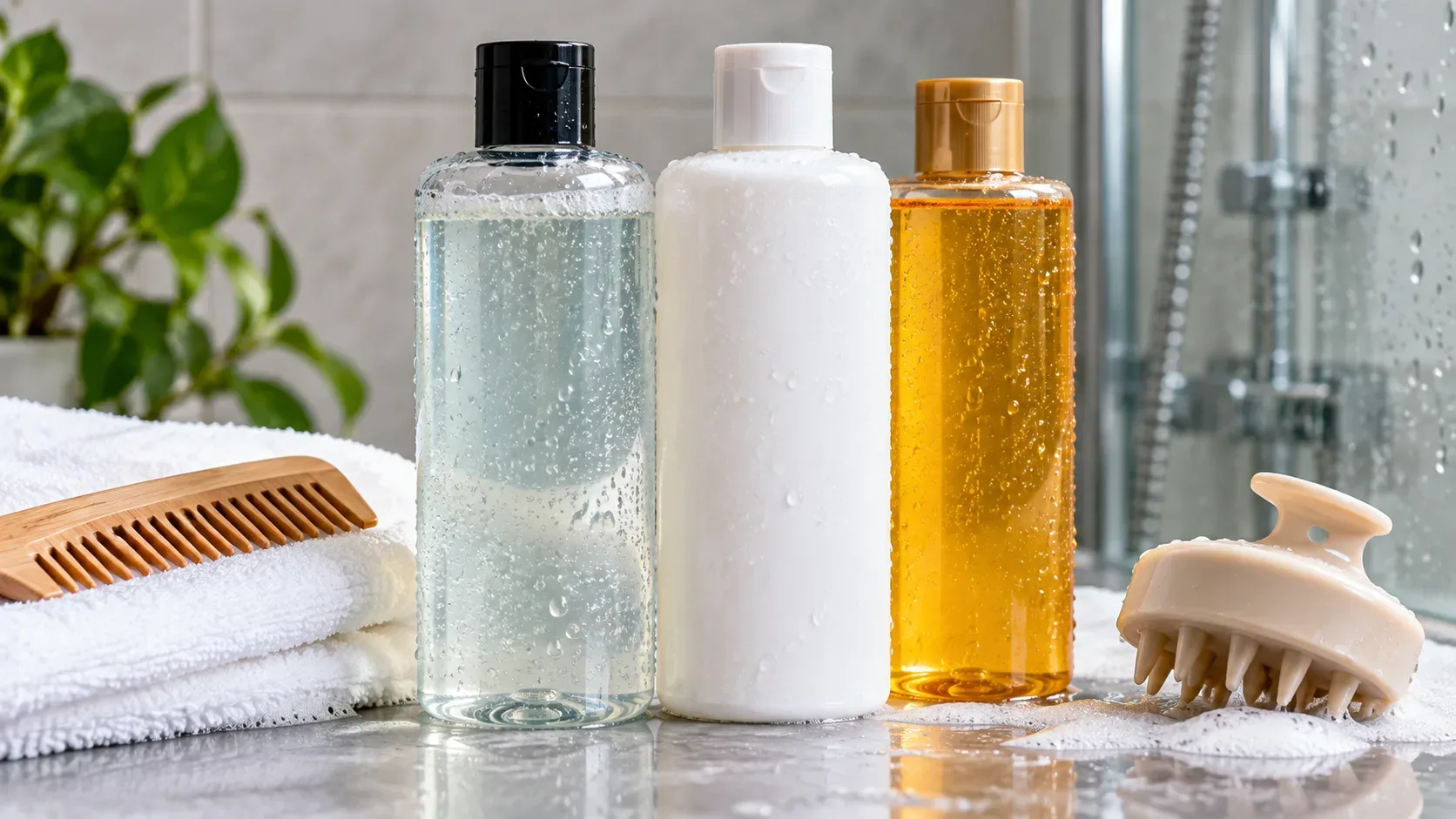
A regular shampoo relies mainly on cleansing agents to remove oil, dirt and residues that can be released with surfactants and rinsing. If the hair has simply become oilier, heavy from products or insufficiently cleansed, a thorough wash with a regular shampoo may solve the problem without anything more aggressive.
A clarifying shampoo, also called deep-cleansing or “detox” by some brands, usually aims for stronger cleansing to remove cosmetic buildup. The word “detox” does not, by itself, indicate whether a product has a specific ability to bind metals. To know that, you need to look at the formula and the product's technical purpose.
A chelating shampoo contains ingredients capable of forming complexes with metal ions. In cosmetic nomenclature, examples of ingredients used for chelating functions include Disodium EDTA, Tetrasodium EDTA, Sodium Phytate, Sodium Gluconate and Tetrasodium Glutamate Diacetate. The presence of one of these names in the ingredient list is a formulation clue, but it does not allow you to compare the strength of two shampoos just by reading the label: concentration, pH, ingredient combinations and contact time also matter.
The practical difference is that a shampoo can be excellent at removing oil and polymers without being particularly targeted at calcium, magnesium or other metals. And a chelating product can combine cleansing with complexing agents specifically for that type of residue. For that reason, “clarifying” and “chelating” overlap in some products, but they are not synonyms.
When a chelating shampoo makes more sense
Its use becomes more justifiable when there is a chain of evidence: water measured as hard or very hard, a persistent change in the hair's behavior after that exposure, and little response to the kind of washing that normally removes cosmetic residue. Bleached or chemically processed hair deserves extra attention because studies indicate a greater capacity to bind minerals when the fiber is more damaged.
In that situation, a product clearly formulated with chelating agents can be a more rational trial than repeatedly using clarifying shampoos without knowing what you are trying to remove. The goal is not to “detoxify” the hair in a generic way, but to reduce a specific type of deposit that the water may have left on the fiber.
There is no universal frequency of use that fits every chelating shampoo. Formulas vary widely. The safest guidance is to follow the label, observe how the lengths and scalp respond, and maintain appropriate conditioning after cleansing when the product recommends it. If the hair is very sensitized, bleached or brittle, repeatedly using intense cleansing products without a clear need can add roughness instead of solving the problem.
A home test that is more useful than looking for “signs” in the mirror
Instead of trying to identify minerals by how the hair looks, start with the water. Measure its hardness or check the water-supply report. If the value falls in the hard or very hard range and the timeline makes sense, the hypothesis becomes stronger.
Next, review what else may already be accumulating on the hair. Frequent use of leave-ins, oils, silicones, pomades, sprays or dry shampoo can produce a heavy feeling unrelated to the water. If a deeper-cleansing wash completely resolves the problem and the effect takes time to return, cosmetic buildup is probably relevant.
If the hardness is high, the hair continues to feel altered, and an appropriate chelating product clearly improves feel and manageability after one or a few uses according to the label, that is practical evidence in favor of the mineral-deposit hypothesis. Even so, response to a product is not a laboratory test. Direct confirmation of metals in hair requires instrumental methods such as those used in studies with spectrometry or microscopy with elemental analysis, which does not make sense as a household routine.
Does a shower filter solve hard water?
Here it is important not to mix up different problems. Many shower filters are designed to reduce particles, odors or certain forms of chlorine, but they do not necessarily remove enough dissolved calcium and magnesium to “soften” the water. For hardness, the classic process is ion-exchange softening, which replaces the ions responsible for hardness. Therefore, buying a filter simply because it promises to “improve the water” does not guarantee a reduction in hardness.
If the goal is to address the source of exposure, check whether the equipment specifies hardness reduction and what technology it uses. Otherwise, it may affect another characteristic of the water without changing the number of mg/L as CaCO3.
The simplest decision: confirm the water before blaming the hair
If your water is soft and the source has not changed, a chelating shampoo becomes a lower priority, and it makes more sense to investigate cosmetic residue, washing routine, heat, chemical processing and other causes first. If the water is hard or very hard, there is scale in the bathroom and the hair changed after that exposure, the mineral hypothesis is reasonable. In that case, a product with declared chelating action makes more sense than choosing only by the word “detox.”
The central point is not to turn a hypothesis of mineral buildup into a visual diagnosis. Science supports that hair can take up calcium and magnesium and that this can change properties of the fiber, but it also shows different results regarding structural damage and strength. Measuring the water, reading the formula and observing the hair's response in a controlled way is a more reliable strategy than assuming every case of dryness comes from the shower.