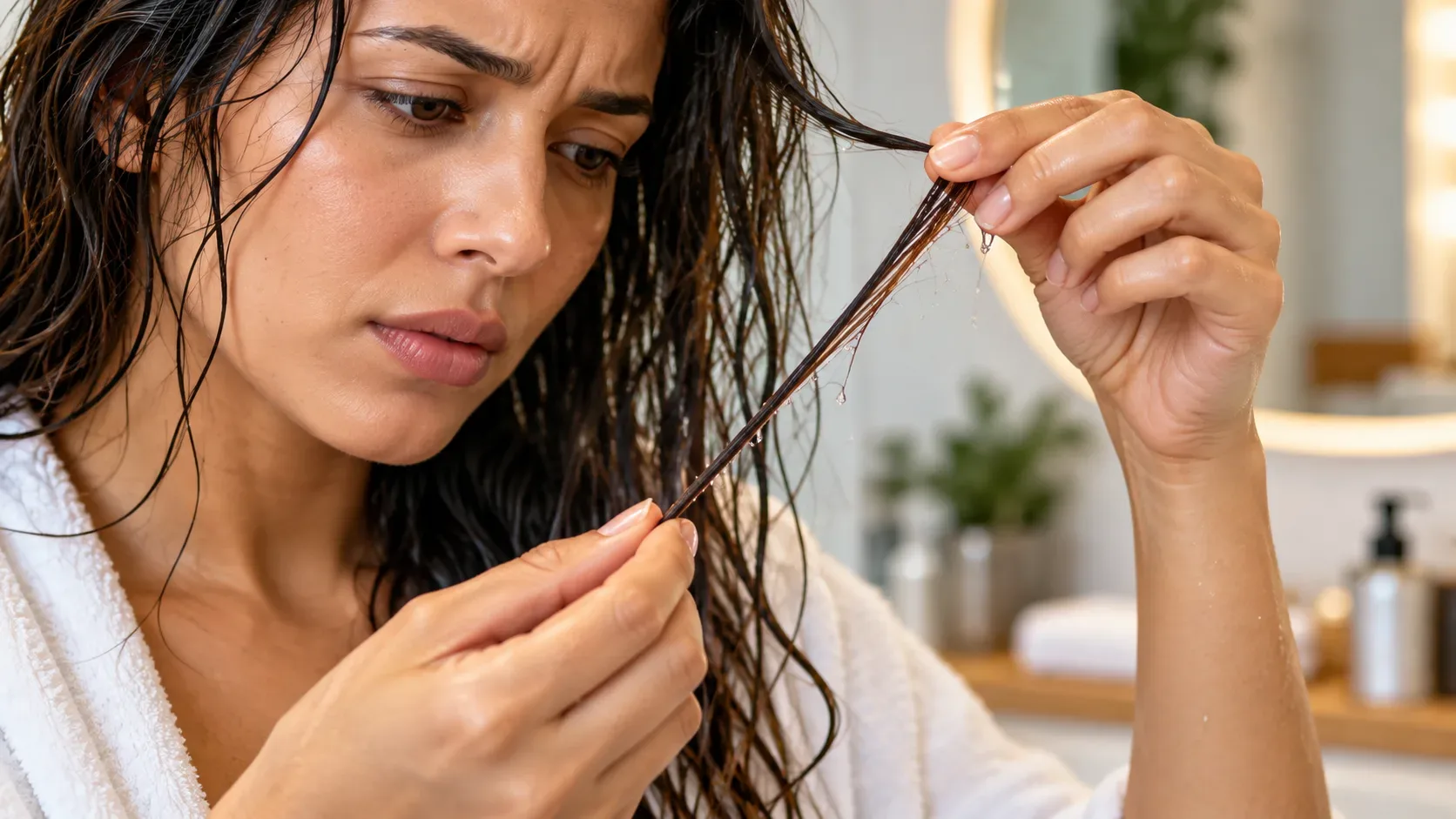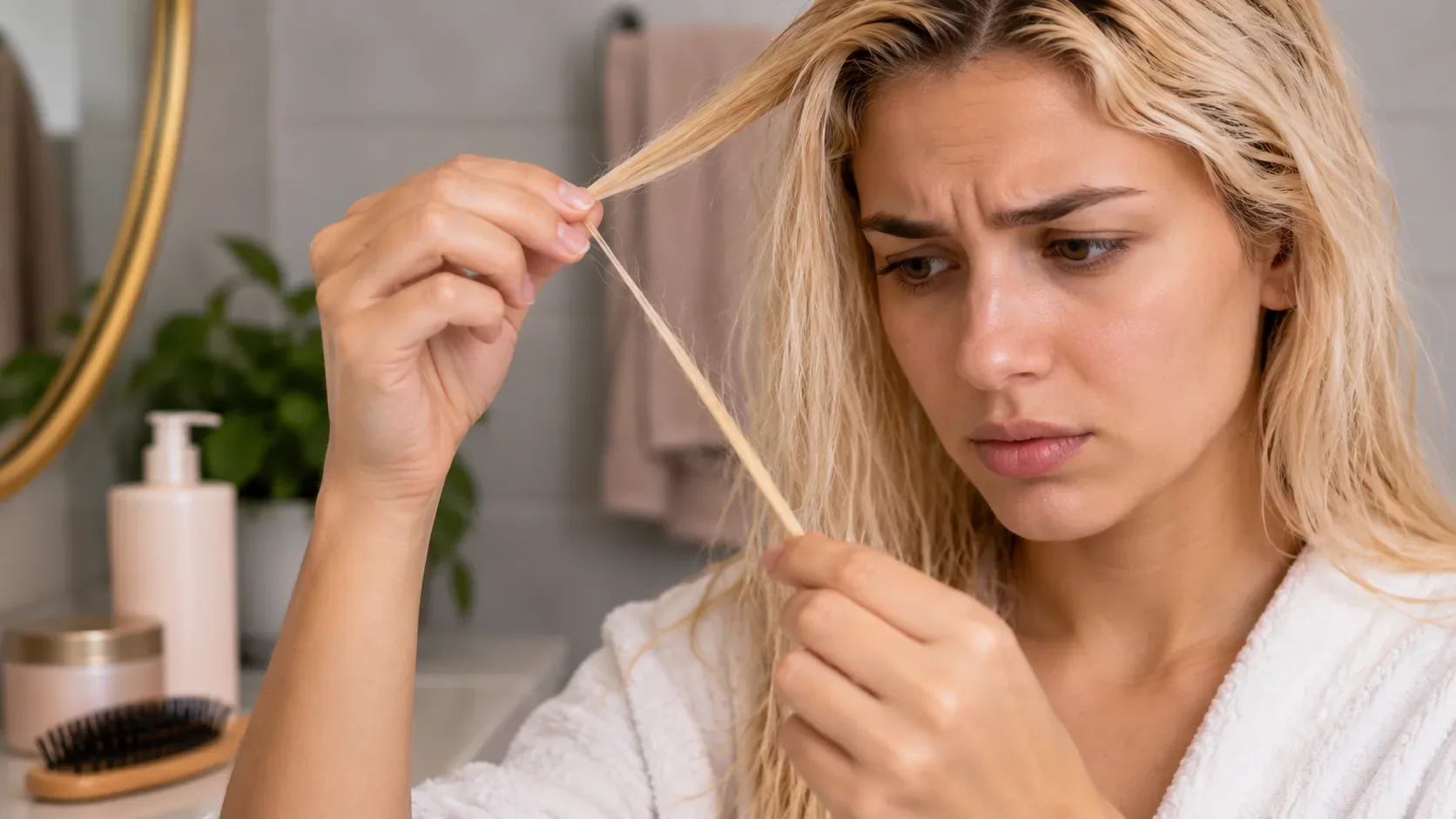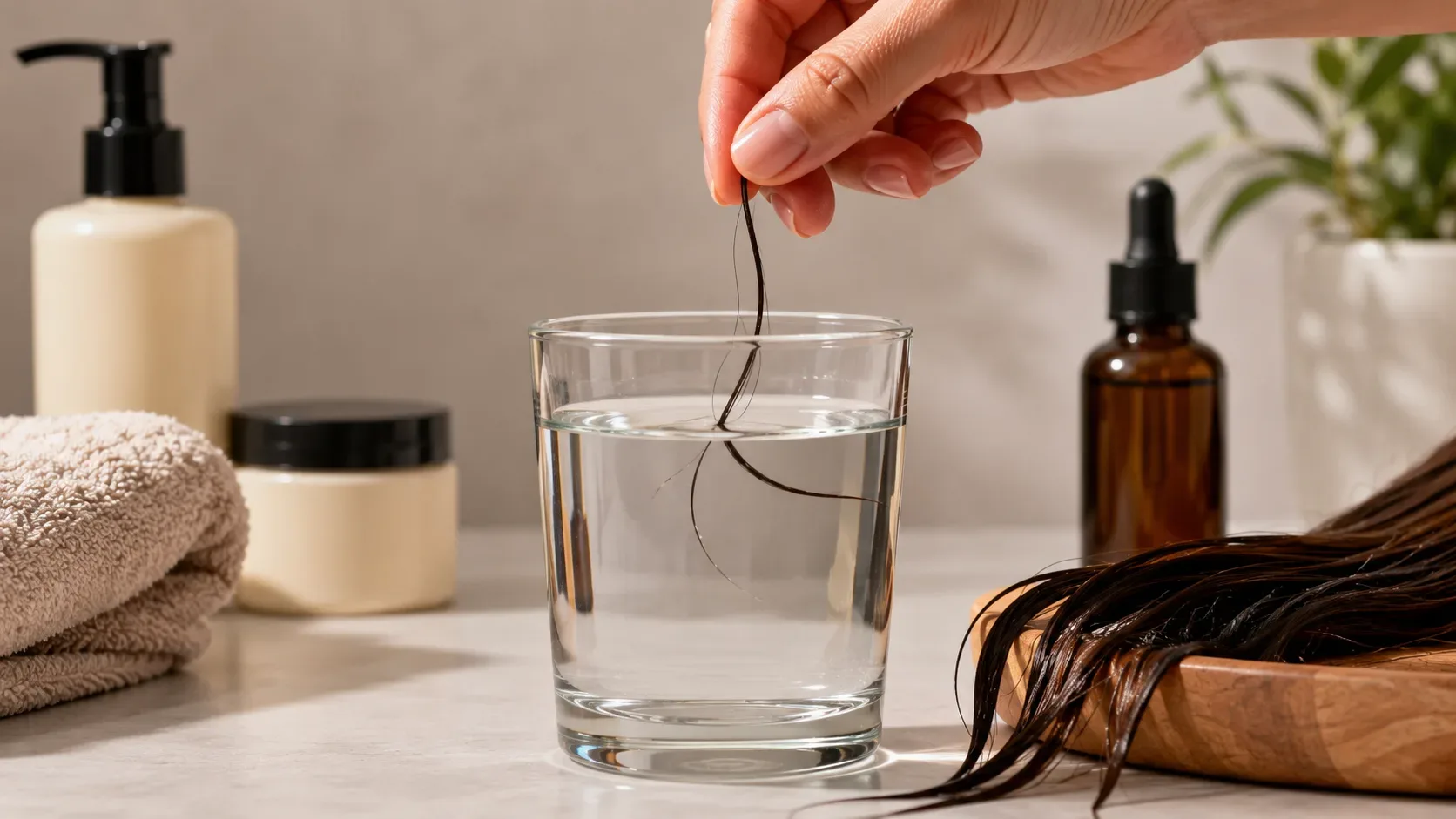
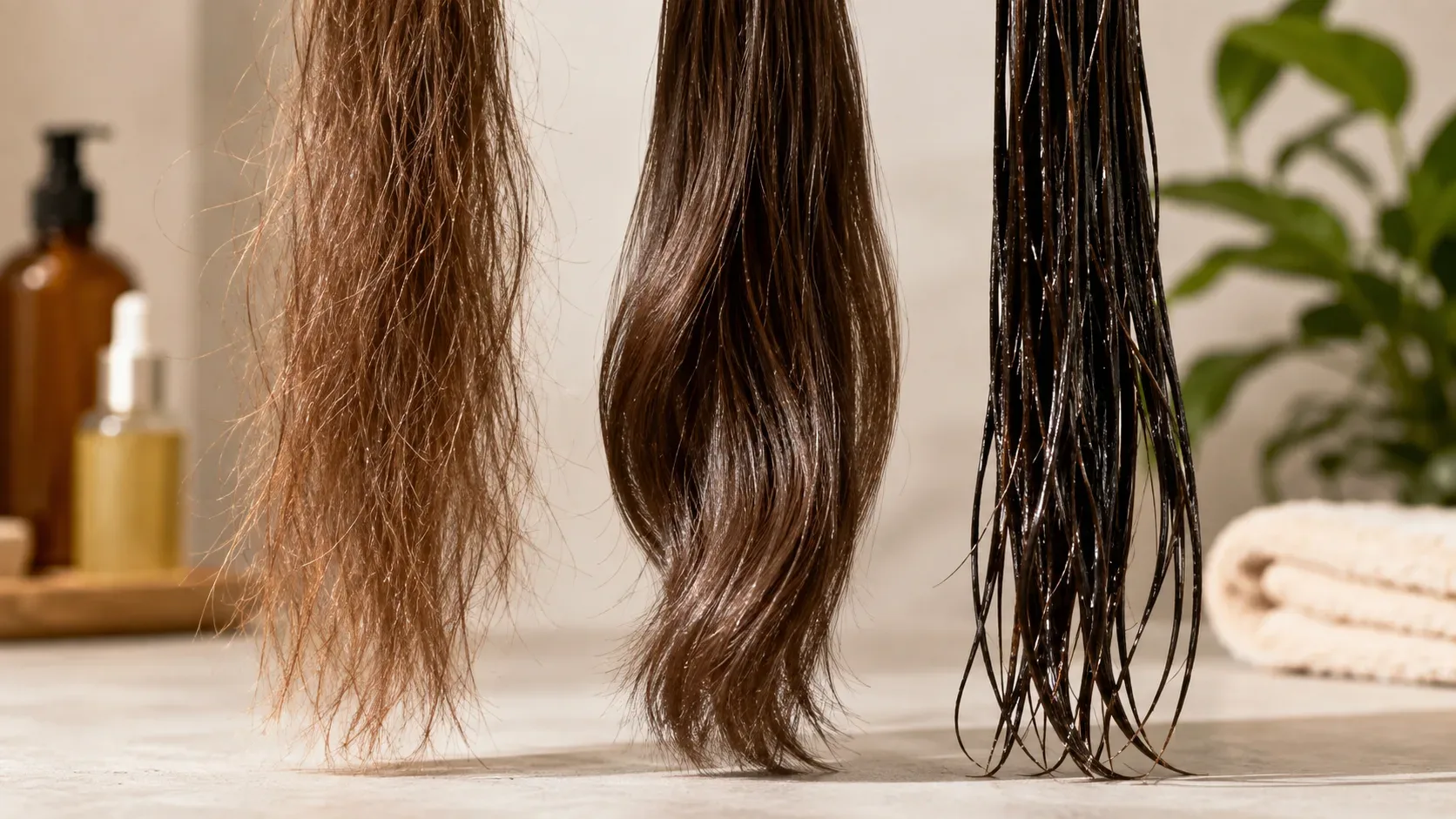
Hair is rough, dull or lacks movement. The first reaction may be to look for a more powerful mask, change the shampoo or conclude that the hair is “damaged”. The problem is that similar signs can appear for different reasons.
Perceived dryness, structural damage to the fiber and product build-up can increase roughness, alter shine and make untangling difficult. Therefore, a single signal is not enough. The most useful way is to check how your hair is behaving, what has happened to it in the last few weeks and how it responds after a proper wash.
This distinction matters because the answers are also different. Hair with little lubrication can benefit from better adjusted conditioning. A structurally damaged thread requires reduced aggression and more delicate handling. A feeling of heaviness caused by waste is unlikely to improve just by adding more layers of product.
What we call “dry” is not always damage
In everyday use, “dry” mainly describes a perception: hair that is rough, lacks softness, has little glide, or has a dull appearance. This alone does not identify a specific structural change.
The surface of the thread greatly interferes with this sensation. Conditioners and other treatment agents deposit substances on the fiber to reduce friction between the strands, facilitate combing and improve characteristics such as softness and shine. The American Academy of Dermatology itself recommends the use of conditioner after washing and remembers that the need for cleaning and conditioning varies depending on the type of hair and scalp.
This helps to understand why hair can appear dry even without a strong history of chemical or thermal aggression. Naturally drier, curlier or frizzy strands, older ends and lengths subjected to washing, friction and the environment may need more conditioning than the region close to the root.
A useful clue is the answer. If the hair becomes clearly more manageable, detangles better and regains some of its shine with a simple washing and conditioning routine, without showing increasing breakage or very fragile areas, the hypothesis of a predominantly conditioning problem gains strength.
It does not mean that it is proven that “it is just dryness”. This means that there is still no reason to classify the thread as structurally compromised just because of its roughness.
When history weighs in favor of fiber damage
Hair damage is a different situation. The fiber can suffer progressive wear of the cuticle, loss of components on its surface and changes that, when they advance, compromise more internal regions of the thread. Chemical processes, excessive heat and mechanical aggression can accelerate this wear. A review of the physical chemistry of hair describes the progression from loss of smoothness and shine to reduced strength and breakage in more advanced stages.
That's why recent history is as important as appearance. Bleaching, straightening, perming, repeated use of very hot tools, intense friction and aggressive manipulation increase the plausibility of damage.
The pattern also tends to be more persistent. Split ends, many strands of different lengths due to breakage, intense tangling in specific areas and worsening concentrated precisely in the parts that have received the most chemicals or heat are more informative signs than simply saying that the hair is “dry”.
Conditioning products can greatly improve the feel and combability of damaged hair, but cosmetic improvement does not necessarily equate to reversing structural damage. In a study published in the April 2026 issue of International Journal of Cosmetic Science, certain conditioning agents reduced the force needed to comb hair, but spectroscopic analysis did not show reversal of the oxidative damage studied.
This difference avoids a common expectation: a product can make hair much better to use without completely “reconstructing” what has already been altered in the fiber.
Build-up can leave hair heavy and rough at the same time
Hoarding doesn’t simply mean “using too many products.” Several ingredients are formulated precisely to remain on the hair for some time and improve its properties. The problem appears when the combination of deposition, amount applied and cleaning capacity leaves the hair with a behavior that no longer corresponds to the expected result.
The classic pattern is the feeling of coated hair: little movement, strands that clump together, loss of volume, appearance dull or oily sooner than usual. In some cases, the thread may feel both heavy and rough.
Ordinary shampoo with water has, among its functions, removing excess oil, product residues and other accumulated particles. Dry shampoo is a good example of the difference between absorbing oil and effectively cleaning: the American Academy of Dermatology advises that it does not replace washing with shampoo and water and warns that its accumulated use can leave residues on the hair and scalp.
Silicones also deserve a less simplistic reading. A review published in 2025 describes benefits such as reduced friction, improved texture and shine, while recognizing that some silicones that are poorly soluble in water can accumulate depending on the formulation and cleaning routine. Therefore, “has silicone” is not a diagnosis of buildup, just as “silicone-free” does not guarantee that a product will be gentle on any hair.
The same sign can point to different paths
Comparison helps when used as a guide, not as a definitive test.
| What do you notice | What deserves to be investigated first | Clue that increases suspicion |
|---|---|---|
| Rough, opaque, with little slip | Insufficient conditioning or damage | If it improves significantly after conditioning, the perceived dryness component may be greater |
| Breakage, brittle ends, persistent tangling | Fiber damage | History of discoloration, straightening, heat or strong friction in the same region |
| Heavy, motionless, “coated” | Product build-up or excess oil | Clear improvement after proper cleaning |
| Heavy and harsh at the same time | Factor overlap | Waste can coexist with a previously damaged fiber |
| Opaque without relevant break | Perceived dryness, residue, or both | The response to washing and conditioning helps separate the hypotheses |
The most important column is the last one. Behavior throughout the routine often provides more information than appearance in a single photograph.
A guide before changing shampoo, mask and finisher all at once
- Return to a wash you already know. Clean mainly the scalp, rinse well and use conditioner suitable for the length. Avoid turning observation into a sequence of aggressive washing.
- Observe the hair after it is clean and dry. See if it has regained movement, if it is still coated, where the roughness is and if the tangling is concentrated at the ends or in a chemically treated area.
- Remember recent attacks. Bleaching, straightening, coloring, hot tools, hairstyles with strong tension and repeated manipulation make structural damage a more relevant hypothesis. The AAD also recommends reducing excessive heat, traction, and aggressive handling to prevent additional damage.
- Review what is being deposited. Leave-ins, oils, sprays, dry shampoos and layering treatments can change weight and texture. The goal is not to automatically exclude a class of ingredients, but to verify that quantity and cleanliness are balanced.
- Change one variable at a time. When shampoo, mask, finisher and washing frequency change together, it's difficult to know which change helped or worsened the problem.
This roadmap does not need to become a rigid schedule. It serves to create a reference before purchasing an entirely new routine.
What about hard water?
Calcium and magnesium present in water also frequently enter the conversation about “mineral accumulation”. There is evidence that minerals can deposit on wires exposed to certain hard water, but studies do not allow this to automatically be diagnosed as damage.
In a 2017 study, there was greater deposition of magnesium in strands treated with hard water, with no statistically significant difference in the structural changes on the surface observed by microscopy. Another previous study found no significant difference in tensile strength or elasticity between hair treated with hard water and distilled water.
There are studies with different results on fiber resistance, which reinforces the need for caution. Therefore, living in an area with hard water may be useful historical information, but does not, in itself, prove that it is the cause of breakage or roughness.
When the problem is no longer just a cosmetic routine
Strand breakage and hair loss from the scalp are not the same thing. Broken hair can appear at varying lengths, while loss of density, widening of the parting, areas without hair or progressive thinning deserve further investigation.
Intense itching, burning, pain, sensitivity, sores, secretion, significant peeling or noticeable shedding should also not be treated simply as “build-up”. The American Academy of Dermatology includes changes in density and various scalp symptoms among signs that may accompany hair loss conditions and recommends dermatological evaluation when there is concern about thinning or hair loss.
Before looking for the strongest product, look for the standard
Roughness does not prove dryness. Opacity does not prove harm. Weight does not prove accumulation. Each of these signs gains meaning when it appears together with a history and a consistent response to the routine.
If cleaning returns lightness, investigate excess deposition before adding more treatment. If simple conditioning improves softness and combability and there is no significant breakage, it may not be necessary to move on to more intense interventions. If the fragility persists precisely in areas subjected to chemicals, heat or strong wear, the damage to the fiber deserves more attention.
The best routine change usually starts not with the quantity of products, but with a more specific question: what does the hair do before and after each step?