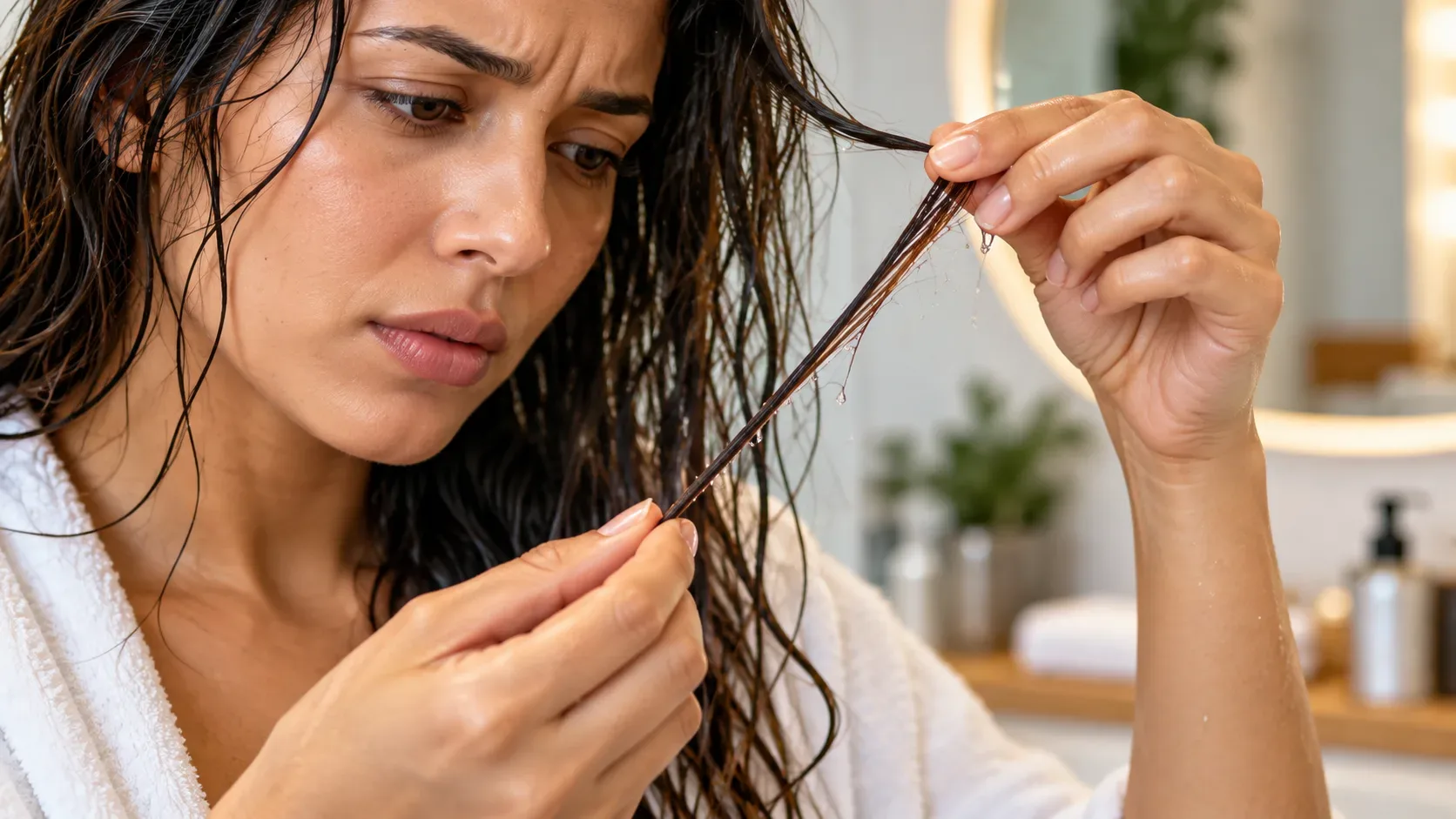
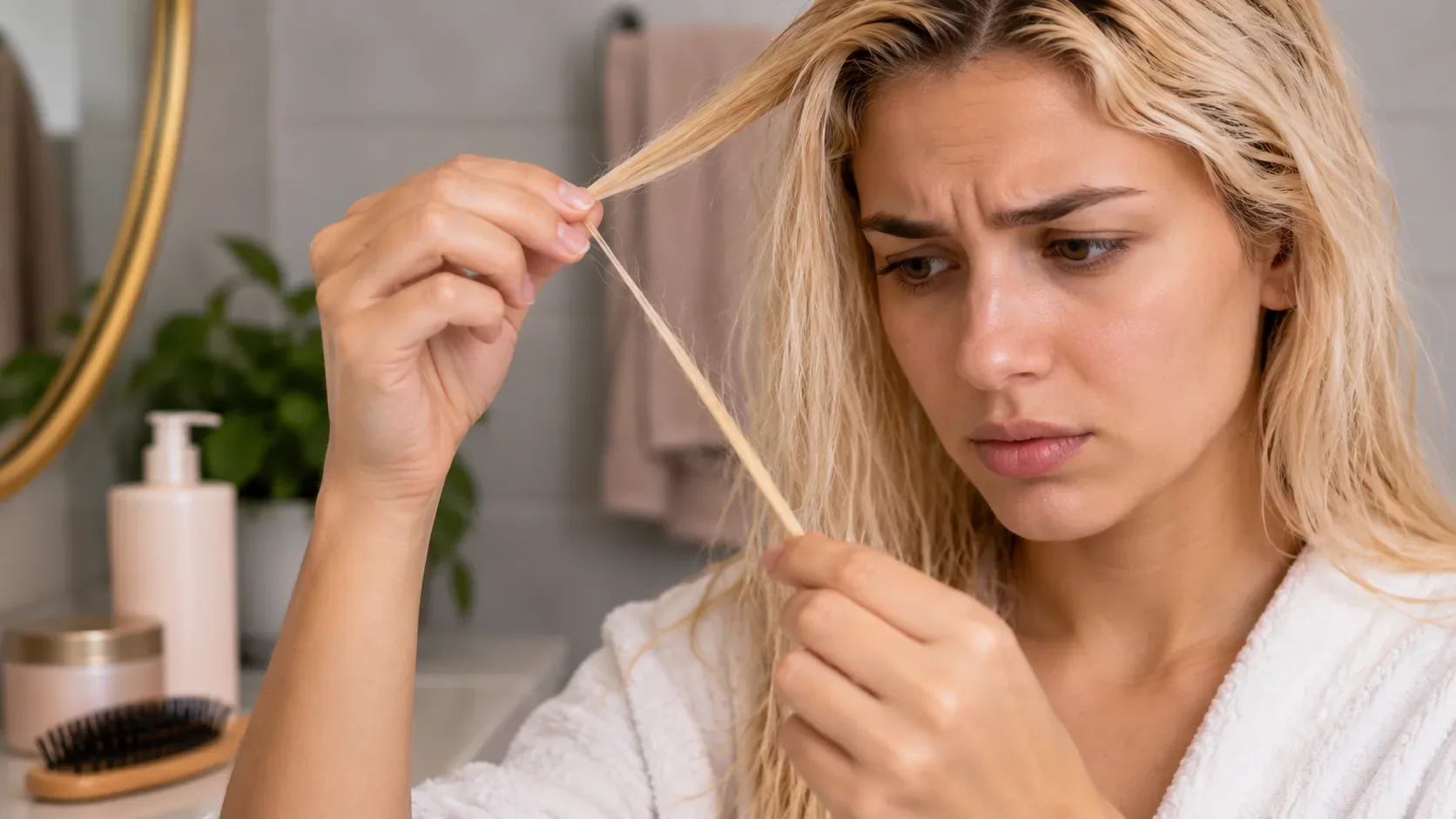
If your hair became “gummy” or unusually stretchy after bleaching — meaning it stretches excessively when wet, does not spring back well, and breaks with little force — treat that pattern as a sign of substantial loss of strength. The first step is not to add another chemical treatment to “seal” or “neutralize” it: it is to stop new sources of damage while you assess how extensive the problem is.
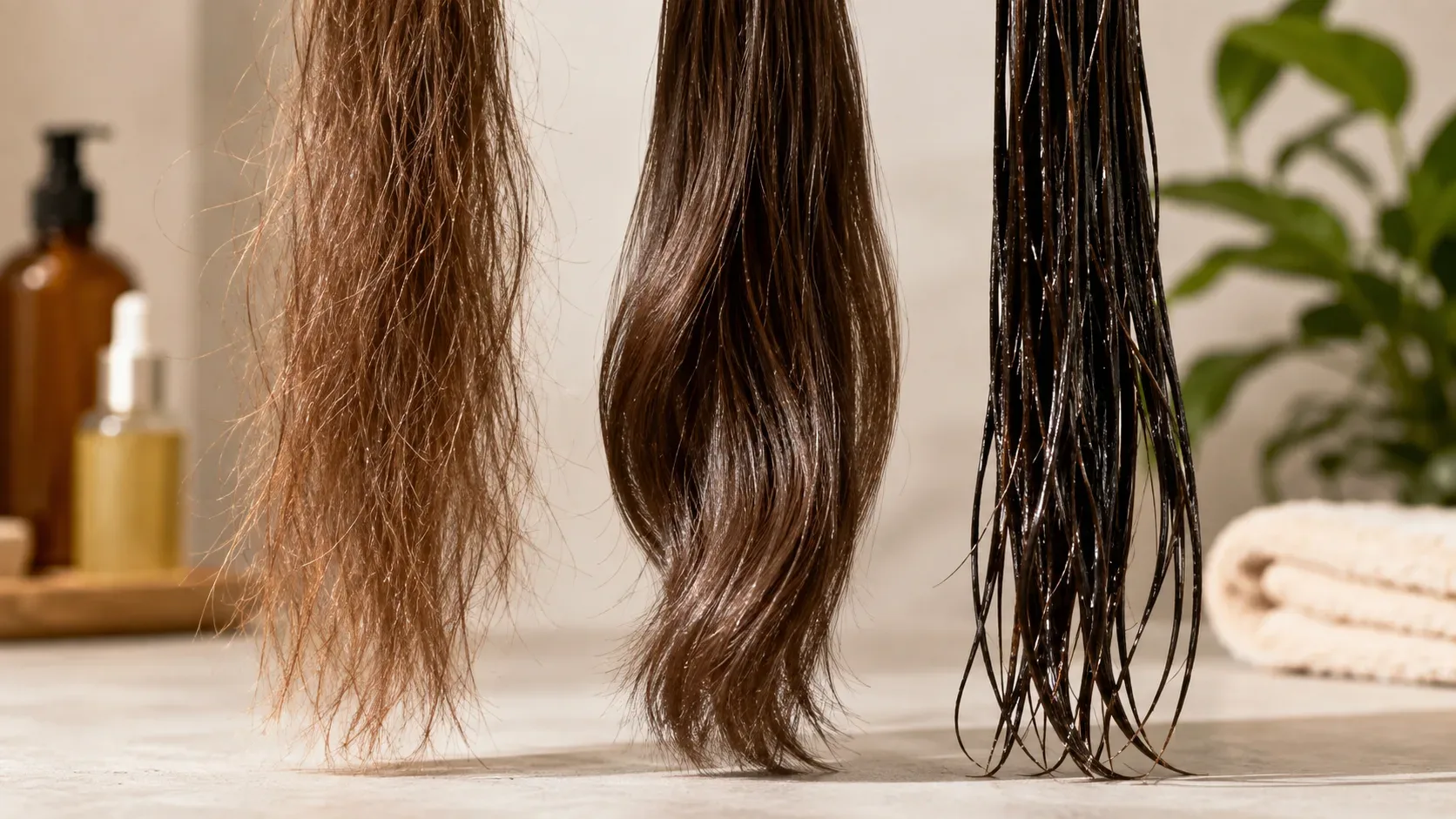
Bleaching oxidizes melanin, but it can also alter structural components of the hair fiber. Microscopy and mechanical studies describe lifted or broken cuticle cells, greater cortex porosity, and reduced elasticity and tensile strength when lightening is excessive. This helps explain why severely compromised hair may feel soft or gummy when wet yet snap very easily. See the study on excessive bleaching damage and a review of hair-fiber structure and degradation.
How to spot loss of strength without repeatedly pulling the hair
“Gummy,” “stretchy,” and “rubbery” are everyday descriptions, not diagnoses. Wet hair is naturally more flexible than dry hair, so one strand that stretches is not enough to prove severe damage. What matters is the combination of signs and a clear change from your hair’s usual behavior, especially soon after chemical processing.
- Excessive stretch when wet: a section seems to elongate much more than it used to.
- Poor recovery: after stretching, it does not return well to its previous shape or length.
- Breakage with minimal handling: strands snap while detangling, towel-pressing, or running fingers through them.
- Very soft, sticky, or gummy feel: especially in areas that received more bleach or overlapping applications.
- Sudden tangling and roughness: a comb no longer glides through areas that were previously manageable.
- Broken pieces of different lengths: many short fragments appear rather than intact strands shedding from the root.
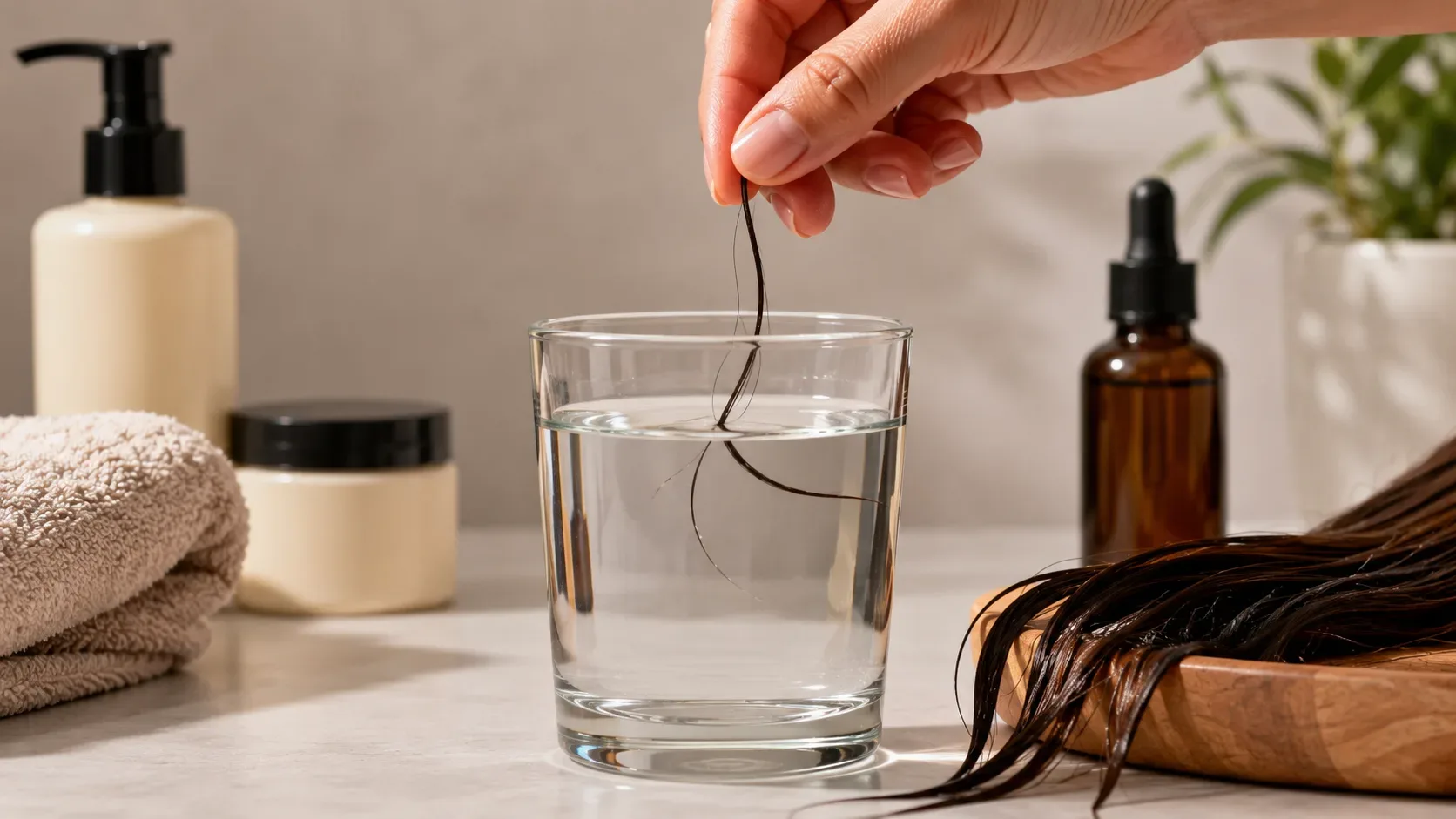
Do not turn an “elasticity test” into a repeated habit. Pulling an already weakened fiber over and over can cause the very breakage you are trying to assess. Gentle observation during washing and detangling is more useful than repeatedly testing the same strand.
What to stop first: stop now vs. what can continue
| Situation | More cautious approach | Why |
|---|---|---|
| More bleach, overlapping retouch, oxidative color, or chemical straightening | Stop now | Another chemical reaction can add damage to a fiber that has already lost strength. |
| Flat iron, curling iron, and very hot or very close blow-drying | Stop or reduce to the minimum | Heat and handling can increase breakage in already vulnerable hair. |
| Repeatedly pulling strands to test elasticity | Stop | Repeated testing adds unnecessary mechanical load. |
| Tight hairstyles, aggressive brushing, forcing through tangles | Stop | Tension and friction can promote fracture of weakened fibers. |
| Gentle scalp cleansing | Can continue | You do not need to stop cleansing; the goal is to avoid rubbing and matting the lengths. |
| Conditioner, mask, or leave-in products you already tolerate | Can continue in moderation | Conditioning products reduce friction and combing force, which can make handling easier. |
| Protein/reconstructive treatment | May be considered according to the label | It may provide temporary cosmetic reinforcement, but it does not biologically “heal” the fiber. |
Conditioners and leave-in products can reduce friction between fibers and make combing easier; dermatology reviews describe this benefit particularly for damaged hair. That is not the same as saying a cosmetic permanently rebuilds the original hair structure. A useful reference is Hair Cosmetics: An Overview.
Low-aggression care for the next washes
1. Clean without piling and rubbing the lengths
Focus shampoo on the scalp and let the lather run through the lengths without rubbing strands against each other. If the scalp is intact and not painful, cleansing can continue according to your normal needs. The aim is to reduce unnecessary friction, not to “stop washing.”
2. Use conditioning to create slip
Apply enough conditioner to let your fingers or comb move with less force. Work in small sections and start with areas that detangle most easily. If a section begins snapping even with light handling, stop rather than forcing through the knot.
3. Dry without twisting or rubbing
Remove excess water by pressing with a soft towel or T-shirt instead of rubbing. If you need a blow-dryer, use lower heat, keep it moving, and maintain some distance. When breakage is intense, pausing high-temperature tools is a conservative choice.
4. Do not stack DIY “corrections”
Avoid vinegar, lemon juice, baking soda, or other mixtures intended to “neutralize” a bleaching process that has already happened. Do not add another chemical service just because a mask temporarily makes the hair feel better. Appearance, softness, and alignment can improve temporarily without restoring the original mechanical strength.
5. Add treatments one at a time
If you use a reconstructive mask, hydrolyzed protein, amino acids, or another treatment for damaged hair, follow the manufacturer’s frequency and watch the response. If the hair becomes more rigid, rough, or harder to detangle, reduce or stop it and reassess. There is no universal keratin schedule that works for every head of hair.
Moisture or reconstruction: what each can and cannot do
For post-bleach hair, it helps to separate improved manageability from structural reversal. Conditioning and moisturizing products can improve feel, perceived flexibility, lubrication, and detangling. Protein- or amino-acid-containing products may provide temporary cosmetic reinforcement in some formulas. None of these turns a severely damaged section back into virgin hair.
The practical question is therefore not “which mask fixes everything?” but “what reduces breakage while I preserve as much length as possible?” In some cases, extremely fractured areas will keep splitting or snapping and may need targeted or gradual trimming.
When a hairstylist can help
See a qualified professional before any new chemical service if breakage is intense, if sections seem to disintegrate during detangling, if bleach was overlapped, or if you do not know exactly what products were used. Bring the history: procedure date, bleach and developer if known, processing time, heat use, and previous chemical services.
A professional assessment can help decide what can be preserved, what may need trimming, and whether there is any room for a future chemical service. The time to bleach or chemically process again should not be decided by a fixed number of days. Reduced breakage, stable handling, and a professional strand test are more informative than a calendar alone.
When it is no longer just a hair-fiber problem and needs medical assessment
If the scalp develops strong or persistent burning, pain, marked redness, swelling, blisters, open sores, drainage, or ulcerated areas, do not treat it as merely “damaged hair.” Lighteners and hair colors can, rarely, cause significant chemical scalp burns; medical reports describe injuries requiring prolonged care. See this review of chemical scalp burn cases.
Stop the suspected product, follow the label’s rinsing instructions, and seek medical care when there is injury or significant symptoms. The American Academy of Dermatology advises stopping the process and seeking evaluation if excessive stinging or burning occurs during chemical treatments; see Coloring and perming tips for healthier-looking hair. If there is shortness of breath, major swelling, severe eye symptoms, or a rapidly progressing acute reaction, seek urgent care.
A dermatologist is also appropriate when there is persistent shedding from the root, bald patches, recurrent scalp inflammation, or uncertainty about whether the issue is shaft breakage or another form of hair loss. Breakage and shedding are not the same: with breakage, the shaft snaps; with shedding, the strand is released from the scalp.
How to tell whether it is improving
Do not expect a “magic deadline.” Track functional signs: fewer broken pieces during washing, less tangling, less gummy feel, less force needed to detangle, and greater stability between washes. An already damaged hair fiber does not regenerate like skin; cosmetics can improve its surface and manageability while new hair grows.
The key is to avoid a cycle in which temporary softness becomes permission for another chemical service too soon. After abnormal stretchiness following bleaching, better-looking hair is not the same as restored strength.
Quick checklist
- Does it stretch too much, recover poorly, and break easily? Treat that as significant fragility.
- Was it recently bleached? Stop new chemical processing on the affected area.
- Is breakage intense? Pause flat irons, curling irons, and high heat.
- Need to detangle? Use conditioner, little force, and small sections.
- Want to try a reconstructive treatment? Follow the label and change one variable at a time.
- Is the scalp burning, painful, blistered, or wounded? Seek medical assessment.
- Thinking about bleaching again? Get a professional evaluation and strand test first.
Sources and references
- Detetive Poo — Cabelo emborrachado ou elástico: o que fazer para recuperar
- Effects of excessive bleaching on hair: comparative analysis of external morphology and internal microstructure
- On Hair Care Physicochemistry: From Structure and Degradation to Novel Biobased Conditioning Agents
- Hair Cosmetics: An Overview
- American Academy of Dermatology — Coloring and perming tips
- Chemical Scalp Burn after Hair Coloring—Case Report with Literature Review