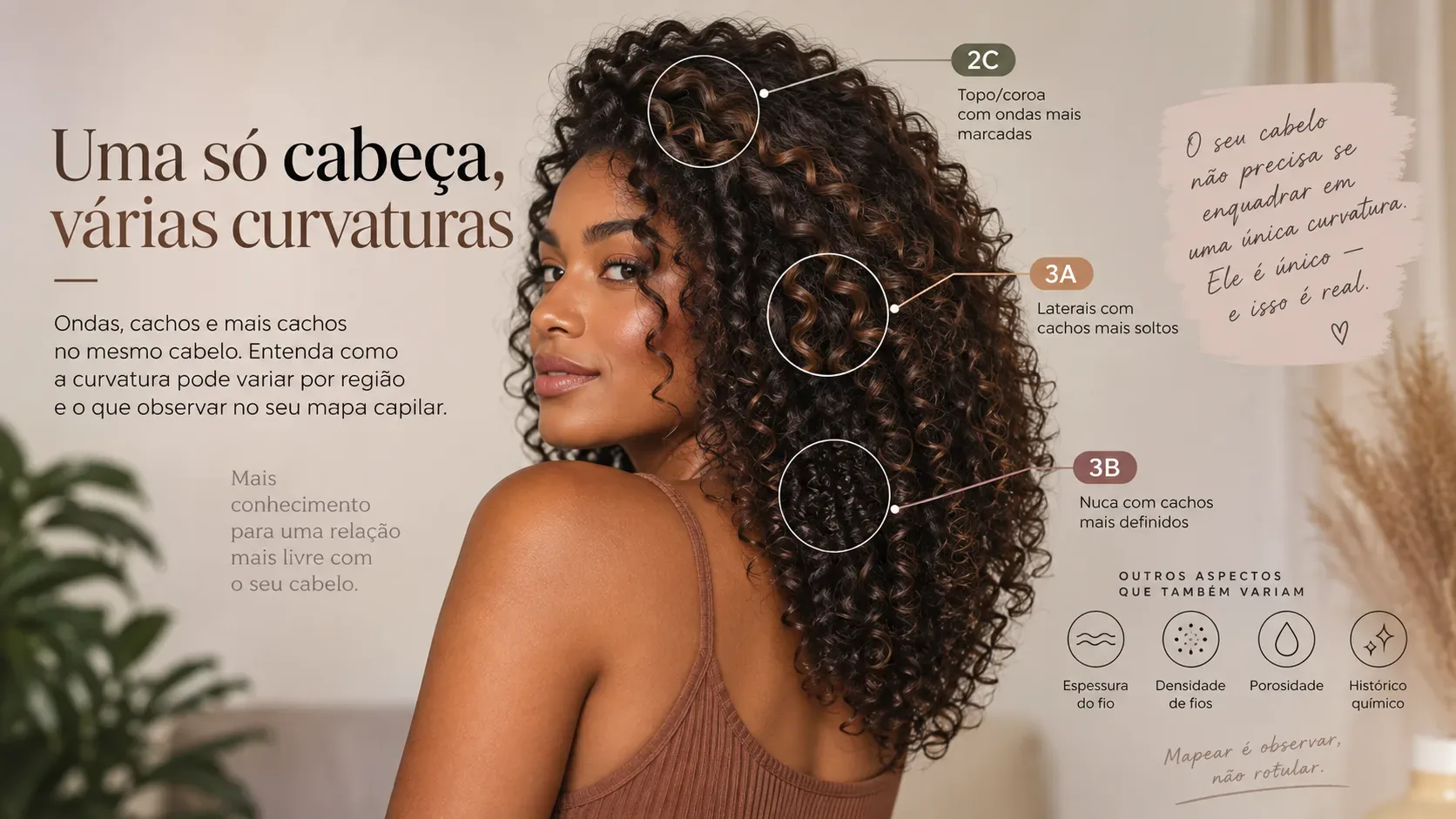
Yes. The same head can show areas that resemble 2C, 3A and 3B at the same time. The popular alphanumeric scale can help describe the visible shape of the hair fiber — waves, curls and tighter or looser spirals — but it is not a diagnosis and does not summarize everything that determines how hair behaves.
A 2026 systematic review in the Journal of Cosmetic Dermatology compared hair-classification systems and noted an important limitation of the André Walker system: it may fail to represent people who have multiple patterns on the same head and, by itself, does not account for characteristics such as density or porosity. The practical takeaway is simple: instead of searching for one number for the entire head, it is more useful to map regions and observe how each one behaves.
What 2C, 3A and 3B describe — and what they do not
In popular use, the scale associates type 2 with wavy hair and type 3 with curly hair; the letters A, B and C indicate gradations within a category. In that language, 2C is commonly used for strongly defined waves, 3A for looser curls and 3B for tighter spirals. Those boundaries are descriptive, however, not universal biological laws.
Scientific literature also shows that hair shape can be classified in other ways. In 2007, researchers proposed a geometric classification based on measurements such as curve diameter, curl index and number of waves, without relying on racial or ethnic categories. The study included 2,449 participants from 22 countries and separated fibers into eight curl groups. This reinforces the idea that hair shape exists on a continuum and can be described by different systems, each with its own purpose and limitations. See the study abstract on PubMed.
Why more than one curl pattern can appear on the same head
Variation among hairs from the same person is not only a mirror impression. In a reliability study of a geometric classification, none of the evaluators placed all ten hairs from the same volunteer into a single group; the authors noted that this could reflect observer error, real heterogeneity in hair morphology, or both, even within a small scalp area. The paper is available from PLOS ONE.
In practice, the nape may form tighter spirals while the sides or crown show looser waves or curls — or the reverse. Differences can also be subtle and become more obvious as hair dries, gains length, is placed under styling tension or accumulates damage.
That is why saying “my hair is 3A” can be a useful shortcut without becoming a fixed identity for every strand. A more faithful description might be: “mostly 3A, with 2C areas at the crown and 3B at the nape.”
How to make a simple region-by-region map
There is no universal at-home protocol for “diagnosing” 2C, 3A or 3B. The map below is an editorial observation tool, not a clinical test. To reduce noise, assess the hair on a day when it is clean and dry in a condition close to its natural state, without styling techniques that strongly stretch or compress its shape.
- Divide the head into zones: hairline/temples, top and crown, sides, back and nape.
- Observe groups of hairs rather than one strand: look for the shape that repeats within each zone.
- Record the dominant shape: for example, “strong S-waves,” “open spirals” or “smaller, tighter spirals.” Add 2C, 3A or 3B only as a reference if useful.
- Write down behavior: shrinkage, loss of definition, ease of creating volume, tendency to become weighed down by product, and areas that feel dry faster.
- Compare roots and lengths: if the hair has chemical or heat damage, processed lengths may not represent the curl pattern of new growth.
Taking photos of each region under similar lighting can make it easier to compare changes over time without relying only on memory.
Curl pattern is not strand thickness, density or porosity
One of the most common mistakes is using the curl number to predict everything else. That does not work. The 2026 review highlights that different classification systems include different characteristics: some account for strand thickness, volume or porosity, while others focus mainly on shape. Two people with 3A areas can therefore have very different fiber diameters, densities and chemical histories.
| Dimension | What it describes | What to observe in practice | Do not infer this from curl pattern alone |
|---|---|---|---|
| Curl pattern | The shape of the fiber: straighter, wavy, curly or coiled. | The repeated shape seen when hair is dry and not under strong tension. | It does not by itself determine product choice, moisture needs or hair “health.” |
| Strand thickness | The diameter of an individual fiber, often described as fine, medium or coarse. | How an individual strand appears and responds to weight, friction and handling. | 3B hair can be fine; 2C hair can be coarse, and vice versa. |
| Density | The number of hairs within a given scalp area. | How visible the scalp is and how much volume results from the total number of fibers. | Tight curls can look very voluminous without necessarily meaning higher density. |
| Porosity | It relates to fiber structure and permeability, especially the condition of the cuticle and cortex. | Response to water and cosmetics, drying time and signs of damage should be considered together. | Porosity cannot be reliably inferred simply from being “2C” or “3B.” |
| Chemical/heat damage | Changes caused by processes such as bleaching, straightening, perming and excessive heat. | Compare new growth with processed lengths; look for roughness, breakage and loss of definition. | A visible pattern change may reflect damage rather than a “new natural curl type.” |
Why chemical history deserves its own column
Bleaching, straightening, perming and intense heat can alter the cuticle and cortex and change the fiber's mechanical properties. A review of hair-care physicochemistry describes how chemical procedures and aggressive heat practices can increase structural damage and fragility. Microscopy studies also show broken and lifted cuticle scales after excessive bleaching. See the review on hair structure and degradation and a microscopy study of excessive bleaching.
This matters because a processed length can look looser, irregular or unable to form the same curl as the roots. When mapping curl patterns, separately note areas with oxidative color, bleach, straightening, perming or frequent heat exposure. The map becomes more useful when it distinguishes “the shape that grows” from “the shape the length shows today.”
How to use the map without buying three different routines
The goal is not to build a shelf for every number. Start with observable needs. If the 3B nape holds definition but tangles more, it may benefit from gentler application and less friction. If the 2C crown gets weighed down easily, it may respond better to less product. If the 3A sides lose definition, application technique or hold may matter more than replacing the entire formula.
- Adjust amounts by region: use less where hair gets weighed down and more where lubrication or control is lacking, without assuming that the curl number dictates the amount.
- Change technique before changing everything: product distribution, water, scrunching, sectioning, brush styling, diffusing and manipulation while drying can alter the visible result.
- Do not force uniformity: one region does not need to “become” 3A to match another.
- Reassess after a haircut, chemical service or growth: length, weight and damage can change the appearance of the pattern.
When the scale stops being useful
If you spend more time deciding between 2C and 3A than observing what the hair needs, the classification has stopped doing its job. The 2026 literature treats classification systems as communication tools and notes that further validation is still needed in clinical contexts. The scale can organize a conversation, but it should not be used to diagnose porosity, damage, hair loss, scalp disease or the need for treatment.
Seek dermatologic evaluation for persistent shedding, visible thinning, pain, intense itching, significant scaling, sores or sudden unexplained breakage. Those are questions about hair and scalp health, not problems solved by choosing a curl code.
The best label is the one that remains useful after you write it down
Having 2C, 3A and 3B on the same head is compatible with real fiber variation and with the recognized limitations of popular classification systems. The most useful map does not end with a number: it combines region, shape, strand thickness, density, behavior, chemical history and signs of damage.
Instead of asking “what is my one hair type?”, try asking “what happens in each region, and what does it need?”. The scale remains available as a reference language — it simply no longer carries a responsibility it was never designed to bear.