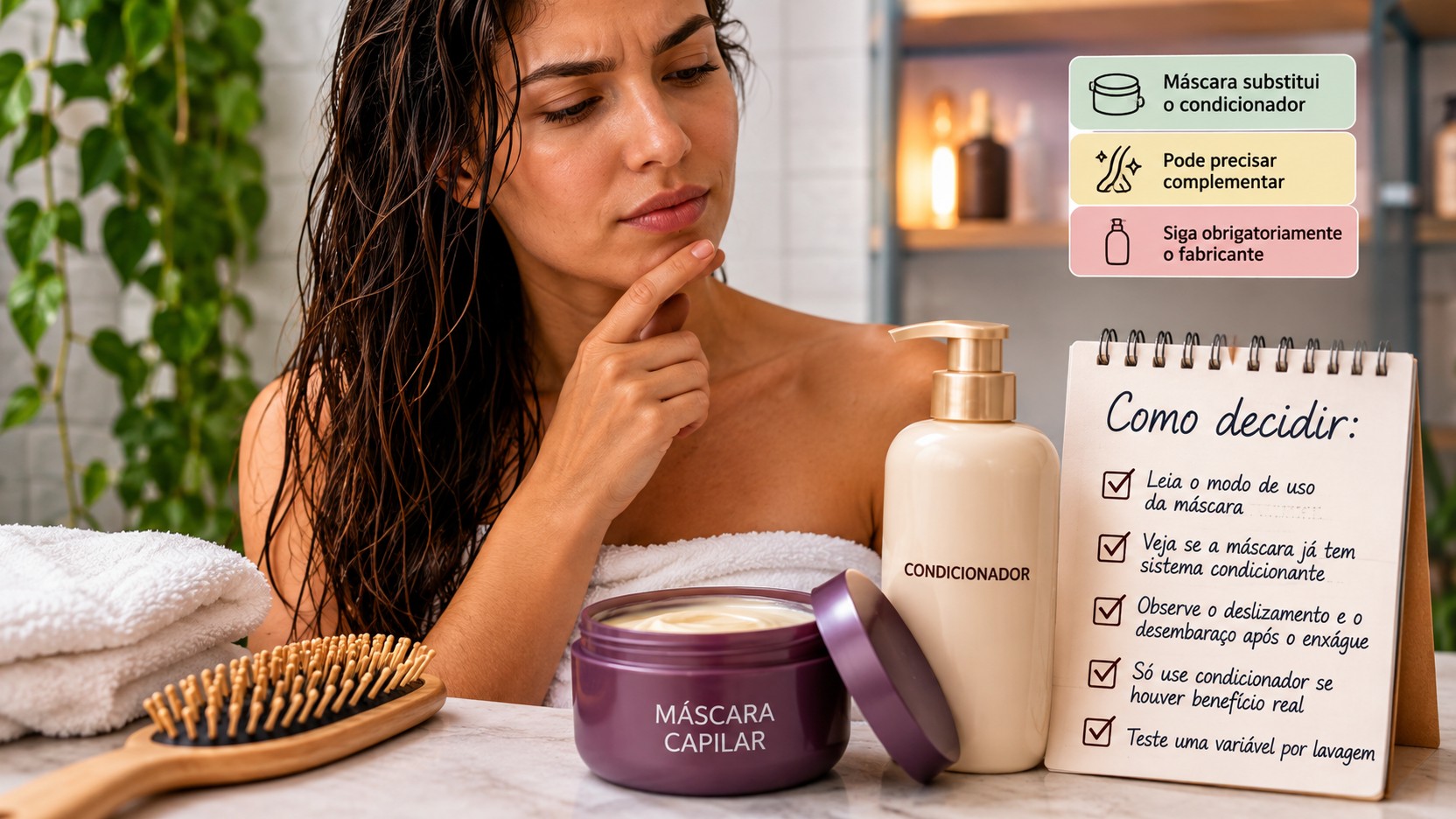
The short answer is: there is no universal obligation to apply conditioner after every hair mask. Some masks are already formulated to deliver sufficient conditioning and can take on this stage alone. Others work more as a specific treatment and can be used in a routine that also includes conditioner. The decisive point is not a fixed rule of “sealing the cuticle”, but how to use the product, the formulation and what happens to the hair after rinsing.
The doubt persists because “mask” describes the shape and positioning of a product more than a single chemical function. There are very conditioning masks, with typical conditioner ingredients; There are pigmented, reconstructive, chelating, protein or other-purpose masks. Therefore, two packages with the word mask may require different sequences.
Why the “seal the cuticle” rule is too simple
The cuticle is the outer layer of the hair fiber, formed by overlapping cells. Shampoo, water, friction, chemical processes and heat can alter the surface of the yarn and increase friction between fibers. Conditioning products help mainly by reducing this friction, improving glide, reducing static electricity and making combing easier.
It is common to summarize this effect by saying that the conditioner “closes” or “seals” the cuticle. The image is intuitive, but it can lead to the wrong conclusion: that every mask necessarily “opens” the cuticle and that a conditioner would be mandatory afterwards to close it. This is not how the sequence should be decided.
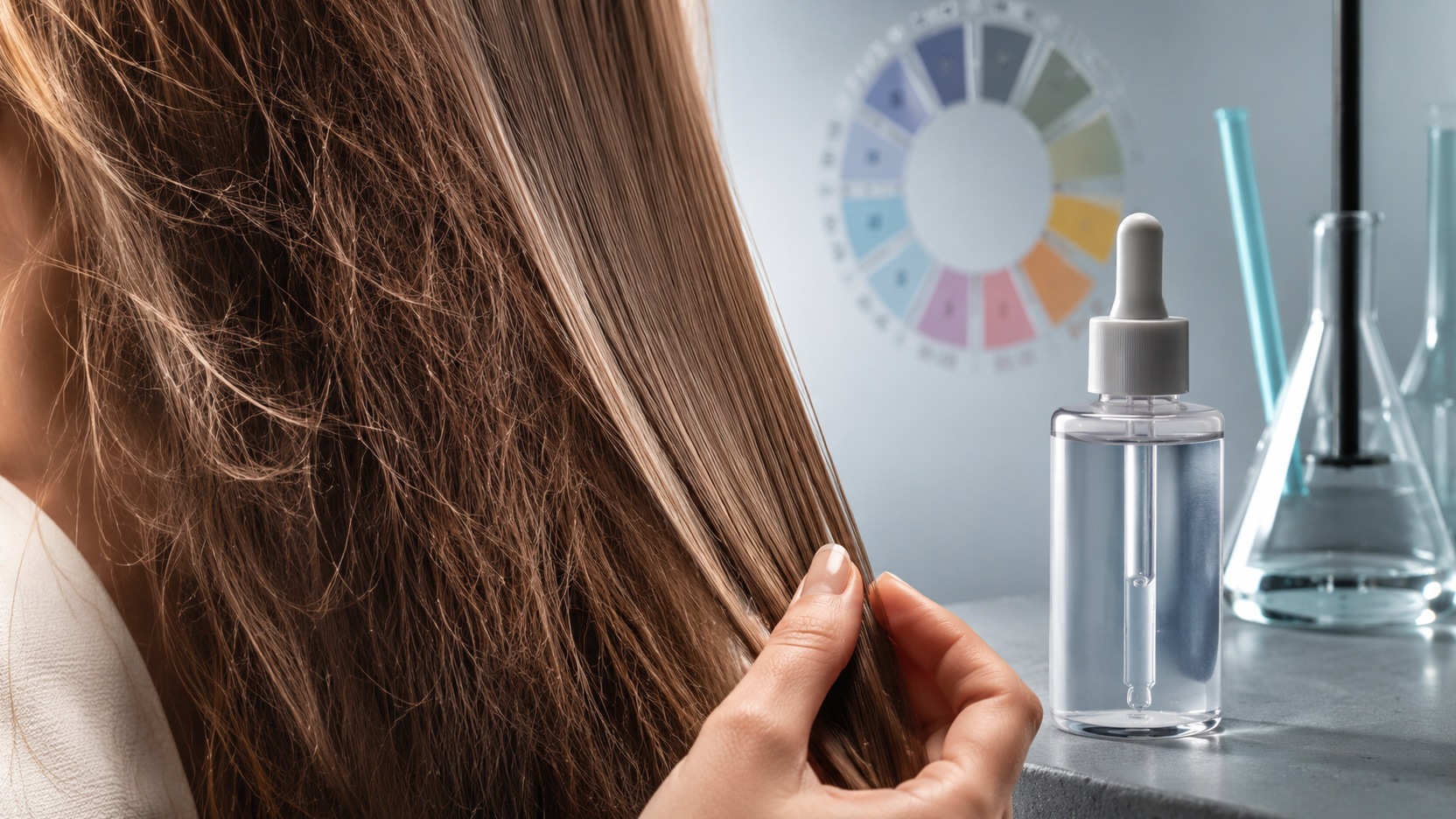
The pH influences the electrical charge and the behavior of the hair surface, and cationic conditioners can deposit on the fiber and favor the settling of the cuticle scales. Still, the result of a product depends on the entire formulation. There is no universal, separate and mandatory step called “sealing” that
only a traditional conditioner can do the job.
What makes a mask conditioning
Conditioning is a formulation effect. In rinse-off products, it usually comes from a combination of agents that deposit or form a film on the fiber and reduce friction. Names that may appear on the ingredient list include behentrimonium chloride, cetrimonium chloride, ceteardimonium chloride and other cationic agents. Fatty alcohols, such as cetyl alcohol, stearyl alcohol and cetearyl alcohol, are also common in cream conditioning bases. Silicones, polymers, oils and other components can contribute to softness, shine and detangling.
Finding one of these names on the list, however, does not alone prove that the mask replaces the conditioner. The list of ingredients does not show the consumer the concentration of each component or how the formula was structured. It serves as a clue, not a sentence. How you use it and how it works on your hair is still more useful than trying to classify the product by a single ingredient.
First criterion: read the usage instructions before choosing the sequence
The label or official product page is the first place to look. If the mask recommends applying after shampoo, waiting, rinsing and finishing the routine, there is no reason to add conditioner just out of habit.. If the brand recommends using conditioner before or after, or defines the mask as part of a system with specific steps, follow this sequence at least for the first test.
The manufacturers' own instructions show that there is no single standard. There are masks whose official guidelines say to skip the conditioner, while other lines present mask and conditioner as distinct or complementary steps. This difference is not a contradiction to be resolved with a general rule; This is a sign that the products have been formulated and tested for different uses.
When the manufacturer informs a specific order, changing the order yourself may alter the sensorial, ingredient deposit, pigmentation or expected performance. This is especially important in tinted mascaras, repair treatments, professional products and systems where the steps are designed to work together.
Second criterion: observe the slippage after rinsing the mask
After rinsing the mask, gently run your fingers along the length. Does the hair have good glide? Do the strands separate without clinging? Does the wide-tooth comb go through with similar or less effort than when you use conditioner? These practical signs say more about the need for an extra step than the abstract idea of “sealing.”
If your hair is already soft, untangled and has little friction, adding conditioner on top may not add any noticeable benefit. For fine hair or people who prefer more volume, the extra step can even leave a feeling of weight or greater coverage, depending on the formulas and amount used.
If, on the other hand, your hair remains rough, sticky or difficult to untangle, a small amount of conditioner can be useful, as long as this does not contradict how you use the mask. The goal is to correct an observable need: to reduce friction and improve malleability, not to comply with a ritual rule.
When the mask can replace the conditioner
Replacement makes sense when the packaging itself indicates that the mask is in the conditioning stage or when the mode of use ends with rinsing and the hair comes out with adequate glide and detangling. It is also a reasonable choice when the formula contains an obvious conditioning system and the end result looks good without a second layer of product.
In this scenario, using a mask and conditioner in the same wash is not automatically better. More product does not mean more treatment. If conditioner doesn't improve detangling, feel, or appearance, it's just adding a step, product consumption, and deposit potential without a clear gain.
Mask replaces
Think of this scenario as “the mask has already delivered the function I was looking for”. The method of use does not require conditioner afterwards, the rinsed hair has good glide and the finish is light enough. In this case, shampoo, mask and rinse can be the complete washing routine before the leave-in products you already use.
When can it be worth supplementing with conditioner
Complementary makes more sense when the mask is aimed at a specific treatment, but does not leave the hair supple enough; when the thread is very prone to tangling; or when the manufacturer includes the conditioner as a step in the system. The conditioner does not come in to “close” something that has necessarily been left open, but rather because it can offer a surface effect that is still missing.
Quantity also matters. If the problem after applying the mask is just a little friction at the ends, there is no need to saturate the entire length. A small, concentrated application where slip is lacking is a more informative test than adding a generous layer to every strand.
May need supplements
Think of this scenario as “the mask did the trick, but the hair is still not easy to detangle”. The decision signal is the behavior of the thread. If the conditioner clearly improves a wet style, reduces the harsh feel, and doesn't leave unwanted weight, the combination may work best for you.
When you must follow the manufacturer
Some products should not be fitted into a generic routine. Pigmenting masks may have specific instructions so as not to alter color deposits. Professional or repair treatments may require a defined sequence. Products that require a specific pause time, application before shampoo or combination with another item in the line also deviate from the “shampoo, mask, conditioner” standard.
In these cases, the way you use it is worth more than the tradition of your routine. If the packaging says not to apply conditioner afterwards, don't add it for fear of leaving the cuticle “open”. If it says apply, use it this way for the first time before testing changes.
Follow the manufacturer
This is the scenario in which the mask has a function beyond simply softening and untangling, or belongs to a protocol with explicit order. The best decision is to respect the sequence described and only adapt later if the manufacturer allows it.
How to read the ingredients list without trying to formulate the product at home
The INCI list can help you understand why a mask behaves like a conditioner. Cationic agents are a strong conditioning cue because they interact with the hair surface and can reduce styling strength and static electricity. Bases with behentrimonium chloride associated with cetyl alcohol, stearyl alcohol or cetearyl alcohol are common in creamy conditioning products.
But the reading must stop at the track. Do not use an ingredient's position on the list to calculate “how much conditioning” there will be, or conclude that a silicone-free product is not conditioning. Different formulas can reduce friction in different ways. Hair testing and product instructions are more reliable for home decision-making.
Test one variable per wash
If you are in doubt between using just the mask or mask followed by conditioner, compare the two routines without changing everything else at the same time. In one wash, use shampoo and mask according to the label. In the next comparable wash, keep the same shampoo, the same amount of mask, the same pause time and the same finish, adding only the conditioner.
Note four things: ease of untangling while in the shower, effort to comb afterwards, feeling of heaviness when the hair dries and results the next day. It's not a lab experiment, but it's a much better way to learn about your routine than changing mascara, shampoo, finisher, and drying technique at the same time.
If mask plus conditioner makes hair easier to comb without losing lightness, the extra step has a purpose. If the result is the same or heavier, the mask is probably already doing what you need for that wash.
Hair type changes the answer, but does not create a new rule
Bleached, chemically treated or heavily worn hair tends to have more damaged areas and can adsorb more conditioning agents. This helps explain why some strands notice a big difference between a treatment mask and an additional conditioning routine.
Thin hair, on the other hand, can quickly show when the combination has become too rich for the desired result. This doesn’t mean that fine hair “can’t” use mask and conditioner; it just means that quantity, place of application and richness of the formula most influence the sensation of volume and lightness.
Curly and frizzy hair often places a high value on sliding during detangling, but it also doesn't need to follow a fixed sequence. A mask that already provides good lubricity may be sufficient. Another may work better with a complementary conditioner. The criteria remains the actual performance and orientation of the product.
The best routine is the smallest one that delivers the necessary result
To decide whether you need to apply conditioner after the mask, start with how you use it. Then, check if the mask leaves your hair with enough slip and detanglement. Use the ingredient list only to help you recognize that many masks already contain conditioning agents. And, when in doubt, compare a wash with a mask alone and another with a mask plus conditioner, changing only this variable.
The “seal the cuticle” rule attempts to transform a complex formulation into a universal sequence. It's more useful to ask something specific: after this mask, on this hair, does the conditioner still improve anything? If the answer is no, he may be expendable. If so, he has a clear role. If the manufacturer defines the order, this instruction comes first.