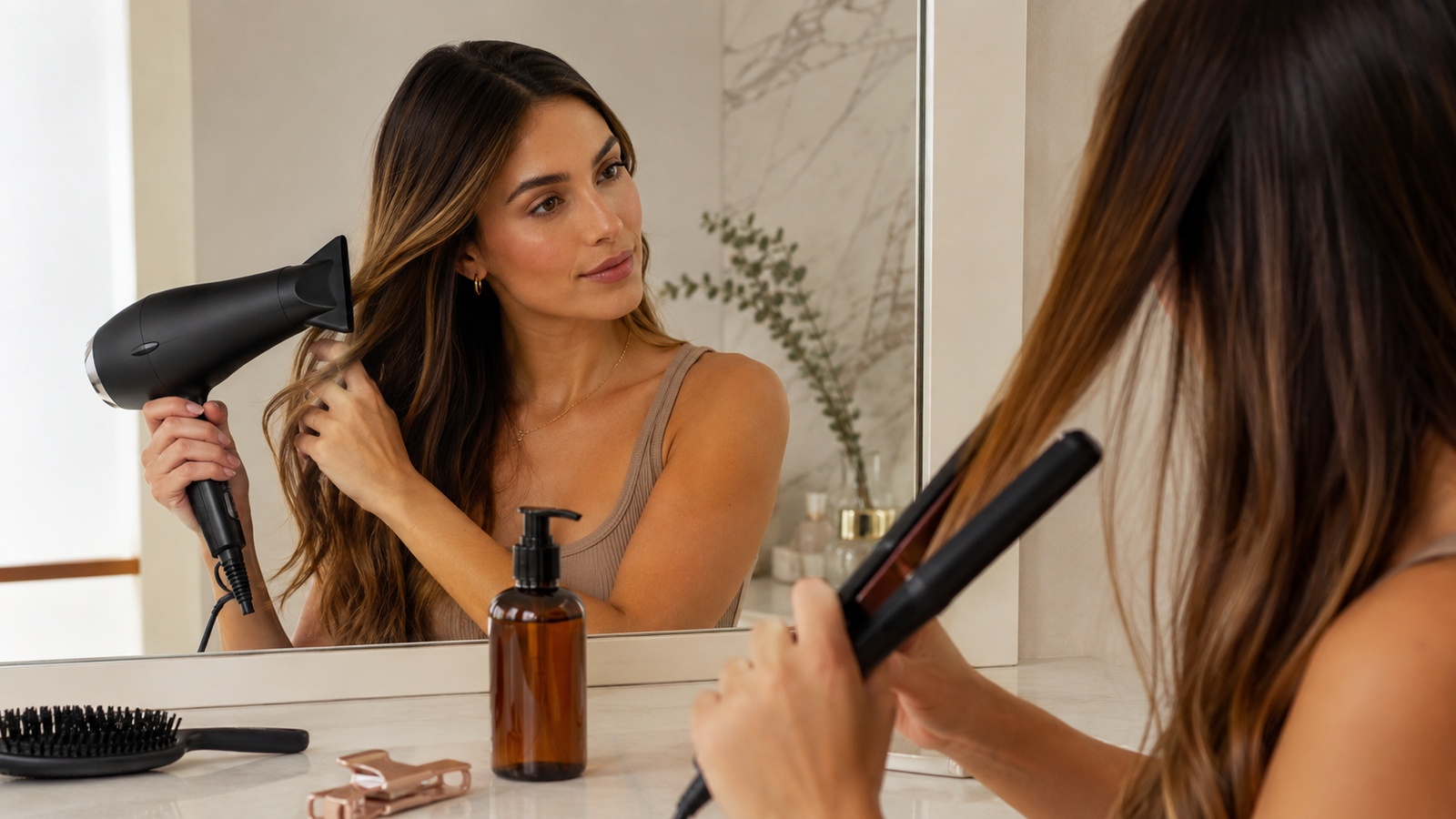
There is no universal rule of “always reapply” or “one application is enough”. When the routine combines a dryer with a straightener or curling iron, the decision depends on two more concrete things: what condition the product was formulated for and what the manufacturer tells you to do before each heat step. The safest way to organize your routine is to treat hairdryer and contact tool as different steps, without turning reapplication into an automatic ritual.
The central point is simple. If the protector was applied to damp hair and the instructions only say to use it before blow-drying, this does not in itself authorize reapplying the same product to dry hair before straightening. If the label allows use on dry hair or advises application before contact heat tools, the second application can be part of the routine. In any case, the straightener or styler should only touch completely dry hair.
The right question is not just “to reapply or not?”
The most useful question is: “Was this product recommended for this second stage, in this state of the thread?”. This changes the reasoning. Instead of deciding based on the feeling that “more product protects more”, you start checking compatibility of use, quantity, distribution and drying.
A heat protectant is a formulation, not an isolated word on the label. Protection depends on the formula set, the method of application and the way the product is distributed over the fiber. Experimental studies with polymeric pretreatments show some reduction in thermal damage and breakdown under controlled conditions, but do not show absolute heat shielding. The product can help reduce damage; it does not make temperature, contact time and repetition irrelevant.
Dryer and straightener do not deliver the same type of heat
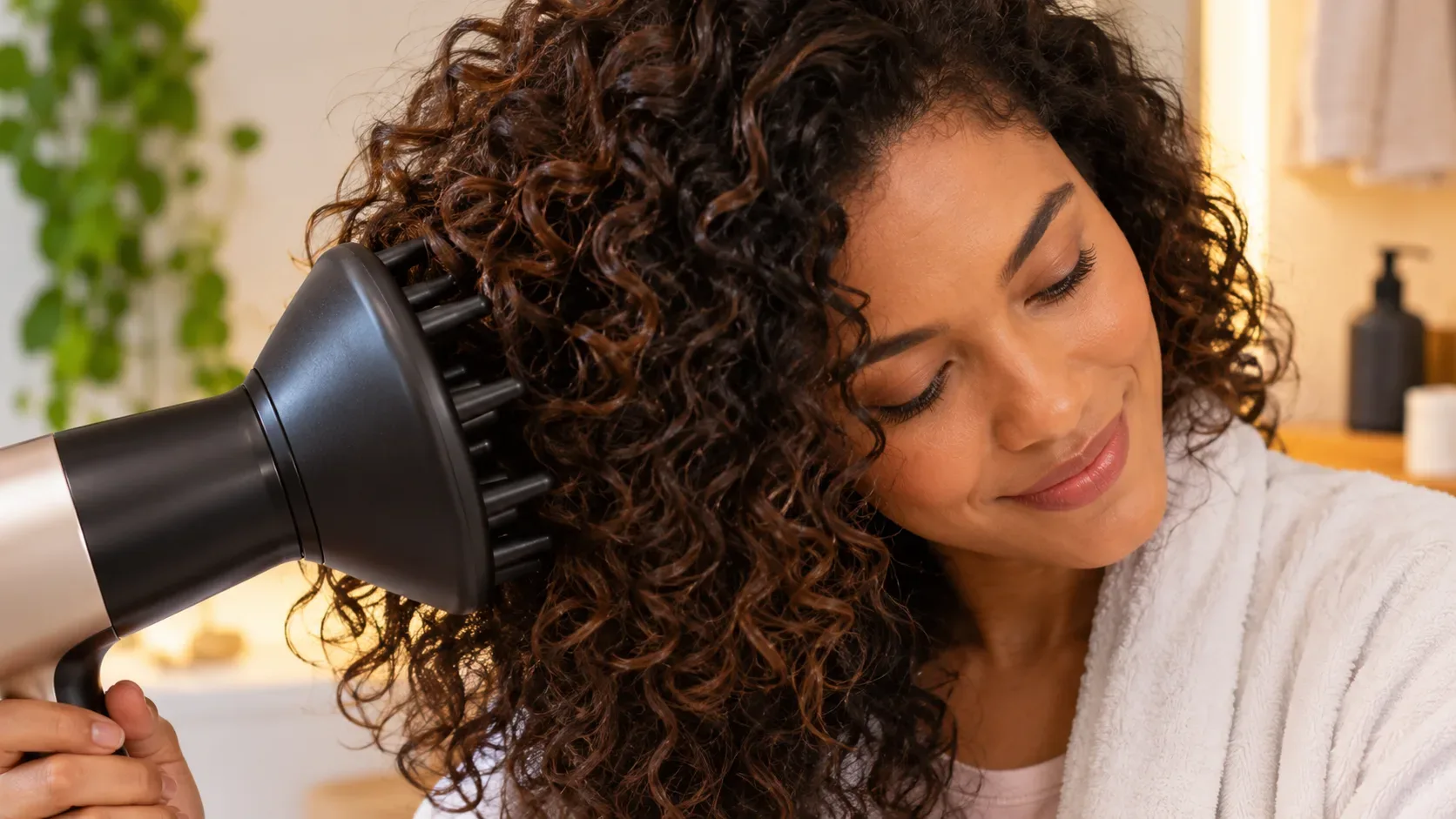
The dryer heats mainly due to the air flow and usually remains in motion. The diffuser continues to be a form of drying using heated air, even though it changes the speed of the flow and the way in which the heat reaches the hair. The straightener and curling iron touch a hot surface directly to the hair. This concentrates the heat in a small area and makes the condition of the wire especially important.
Experiments with dryers show that increasing temperature aggravates changes in the yarn surface. Studies using contact tools have also found cuticle damage, protein changes, and increased brittleness after thermal exposure. Therefore, two heat stages should not be treated as if they were a single continuous stage just because they occur at the same finish.
The practical matrix starts with the state of the wire
Product only suitable for damp hair
If the method of use advises applying to damp or towel-dried hair and then using a hairdryer, this is the stage in which the application is clearly covered. Once your hair has dried, it's not a good idea to automatically conclude that the same product should be sprayed again before straightening.
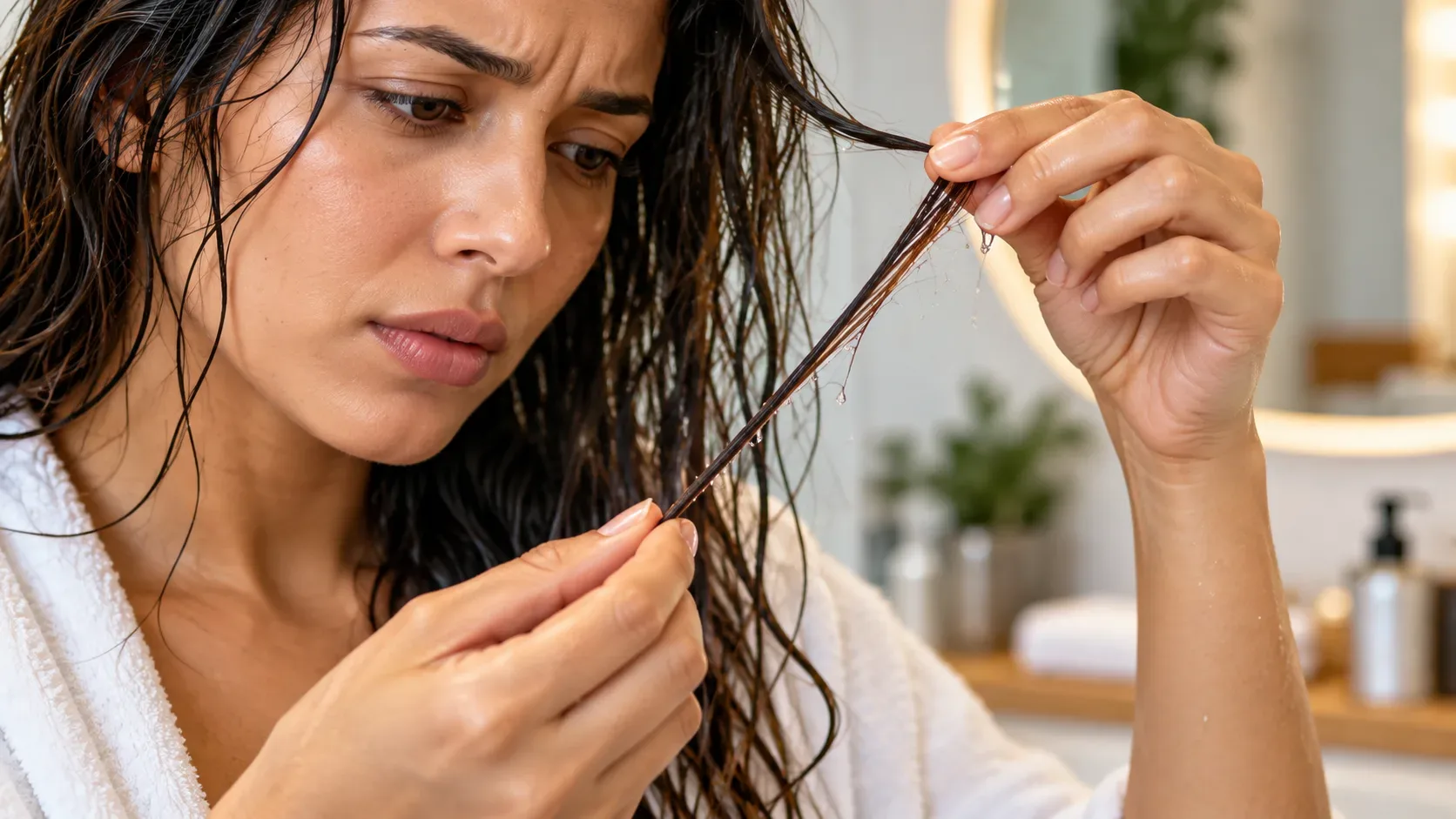
Reapplying a water-based product or product made for wet use can return moisture to the surface of the hair. If a contact tool is used before this moisture has completely evaporated, the hair may suffer additional structural damage. The problem, therefore, is not to “ban water” in cosmetics, but to avoid intense contact heat while the hair is still wet or damp.
If you intend to use a straightener or styler after blow-drying and your product only has instructions for damp hair, there are two coherent options: check with the manufacturer if it is
It can also be used on dry hair or choose, for the second step, a protector explicitly indicated for thermal tools on dry hair.
Product suitable for damp or dry hair
When the manufacturer allows application in both states, the routine gains more flexibility. The product can be used on damp hair before drying and, if the method of use recommends protection before using a new heat tool, it can also be applied in an amount compatible with the label after the hair is dry.
The detail that cannot be skipped is the drying time of this second application. If the product leaves the hair noticeably damp, wait for it to dry completely before using the straightener or styler. Studies that compared hair heated in dry and humid conditions found much more structural damage when water was present during intense heating.
Product that declares protection for the entire finish
Some products are formulated and instructed to cover more than one styling step. If the instructions for use state that the initial application meets the dryer and subsequent tool, or informs that it is not necessary to reapply, there is no technical reason to double the dose just out of habit.
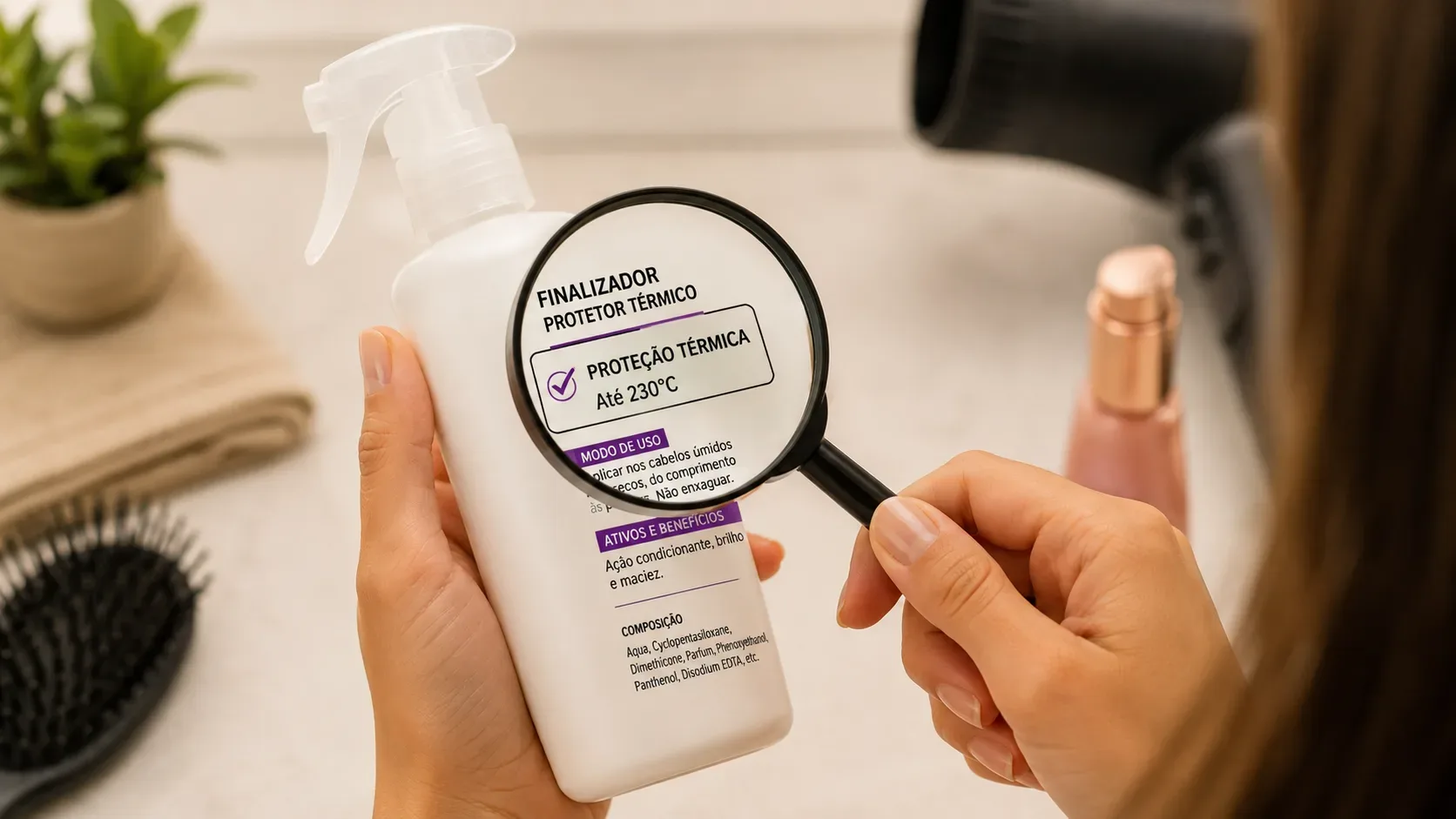
The advantage of following the method of use is to avoid two common extremes: using too little product because it is assumed that any leave-in already protects against heat, or using too much product because it is assumed that each device requires a new mandatory layer. The manufacturer's instructions are the starting point because they relate that specific formula to the expected mode of application.
Vague or incomplete instructions
When the packaging only says “protects from heat”, without making it clear whether it is used on damp hair, dry hair, before blow-drying or before contact tools, there is a real gap. It is not possible to fill this gap by looking at a single ingredient on the list or using a generic internet rule.
In this case, the safest course of action is to seek official guidance from the brand or prefer a product whose method of use describes exactly the step you want to take. The clarity of the label is part of the product's usefulness: if your routine requires a hairdryer and straightener, you need to know whether the formula was designed for one or both situations.
When reapplication makes sense
Reapplication makes sense when the product itself provides for it, when it can be used on dry hair and the guideline is to apply it before using a new heat tool, or when the second stage will be protected by another product clearly indicated for use on dry hair. The reason must come from the intended use, not from the idea that every previous layer “disappeared” as soon as the dryer was turned off.
It is also not necessary to transform the routine into a sum of products. Two different protectors may be compatible, but may also increase weight, stiffness, residue or difficulty in distribution. If the combination is not provided for in the instructions, more layers do not automatically equate to more protection.
Hair needs to be completely dry before straightening
This is one of the most important points in the entire sequence. Research with heat tools shows that heating wet or damp hair can cause more severe structural damage than heating dry hair, in part by the rapid vaporization of water in and around it.
around the fiber.
This applies even when the moisture comes from reapplication. If you sprayed a protectant approved for dry hair and the strand is damp, wait. The application should only be followed by a straightener or styler when the hair is dry to the touch again and there are no damp areas between the strands.
This logic helps to separate two things that are often confused: “product recommended for use on dry hair” does not mean “you can iron it while the product is still wet”. The final state before contact with the hot plate remains dry hair.
Thermal protector reduces damage, but does not cancel heat load
The term “protector” can give the impression of an absolute barrier. The available studies point to something more realistic: certain pre-treatments can reduce fiber changes, better preserve hair structures and reduce breakage compared to unprotected hair under the same conditions. This is different from making damage impossible.
Temperature, contact time, repetition of passes and previous condition of the thread continue to matter. The most coherent strategy is to use the lowest heat intensity that delivers the required result, avoid unnecessary passes and respect the usage range indicated by the tool manufacturer. The protector comes in as part of this control, not as permission to increase heat without limit.
Why “home testing” does not prove the effectiveness of the protector
Tests with paper, bread, skin, a metal plate or the sensation of temperature in the hand seem intuitive, but they do not reproduce the behavior of a hair fiber. In laboratory studies, thermal damage assessment uses methods such as microscopy, protein analysis, spectroscopy, mechanical testing, and water retention measurements. These methods investigate changes that a simple home test cannot see.
Therefore, concluding that a product “works” because a surface heats up less, or that it “does not work” because the wire appears hot, is not a reliable validation. The same goes for comparing two protectors just by the amount of shine, softness or residue after straightening. These characteristics can change without actually measuring the degree of thermal damage to the cuticle and cortex.
How to organize the routine in two steps
Step 1: damp hair and blow dryer or diffuser
Remove excess water without aggressive friction, apply the product in the amount indicated for damp hair and distribute it evenly. Dry using the necessary settings for the result, without keeping the hot jet stopped for a long time at the same point.
If the routine ends in the dryer or diffuser, there is no second protection decision to make. The doubt arises when you intend to add a contact tool later.
Interval: confirm dryness and read the second step instructions
Before picking up the straightener or curling iron, make sure your hair is completely dry. Then, review how to use the protector that is already on the wire. If it covers the second tool without reapplication, continue like this. If you allow or request a new application on dry hair, apply as directed and wait for it to dry again. If it doesn't clarify the use on hair
dry, do not improvise a second layer as a universal rule.
Step 2: straightener or curling iron
Work with strands that allow efficient contact without repeated insistence on the same section. Use the setting compatible with the tool, the desired result and the condition of the hair. Thermal protection must accompany controlled use of the device, and not compensate for greater exposure than necessary.
If your hair sizzles, has persistent steam or is clearly damp, stop contact and let the strand dry before continuing. The objective of the second stage is to shape the dry thread, not to finish evaporating water between hot plates.
A simple criterion to decide without memorizing rules
Before reapplying, mentally answer four questions in sequence: can the product be used on dry hair; the manufacturer orders it to be reapplied or says that the previous application covers the new tool; the second application left the hair completely dry before contact; and the quantity used respects the method of use. If any of these answers are unclear, the solution is not to add more product as a precaution, but to clarify the instructions.
This way of thinking solves most hairdryer and straightener routines without creating a false rule for all protectors. What needs to be constant is the principle: product compatible with the stage, adequate distribution, dry hair before contact heat and control of thermal exposure.
So, do you need to reapply between blow-drying and straightening?
Sometimes yes, sometimes no. If the protector was made only for damp hair and does not recommend subsequent use, automatic reapplication before straightening is not supported by the method of use. If it can be used on dry hair and recommends protection before contact tool, reapplication may be appropriate. If the formula itself declares coverage for both stages without re-application, follow this guidance.
The best routine is not the one that accumulates the most layers, but rather the one that combines clear product instructions with a well-controlled thermal sequence. Blow dry first, completely dry, conscious decision about a possible second application and only then straightener or styler.